By the summer of 1995, the most famous woman on Earth was, in every way that mattered to her, alone. Diana, Princess of Wales, was 34 years old and separated from Prince Charles. The divorce that would end her marriage was still over a year away, and behind the public image of a woman fighting back lay a far lonelier reality. After failed relationships with men from her own gilded, watched world, Diana told her healer Simone Simmons that she wanted something different.
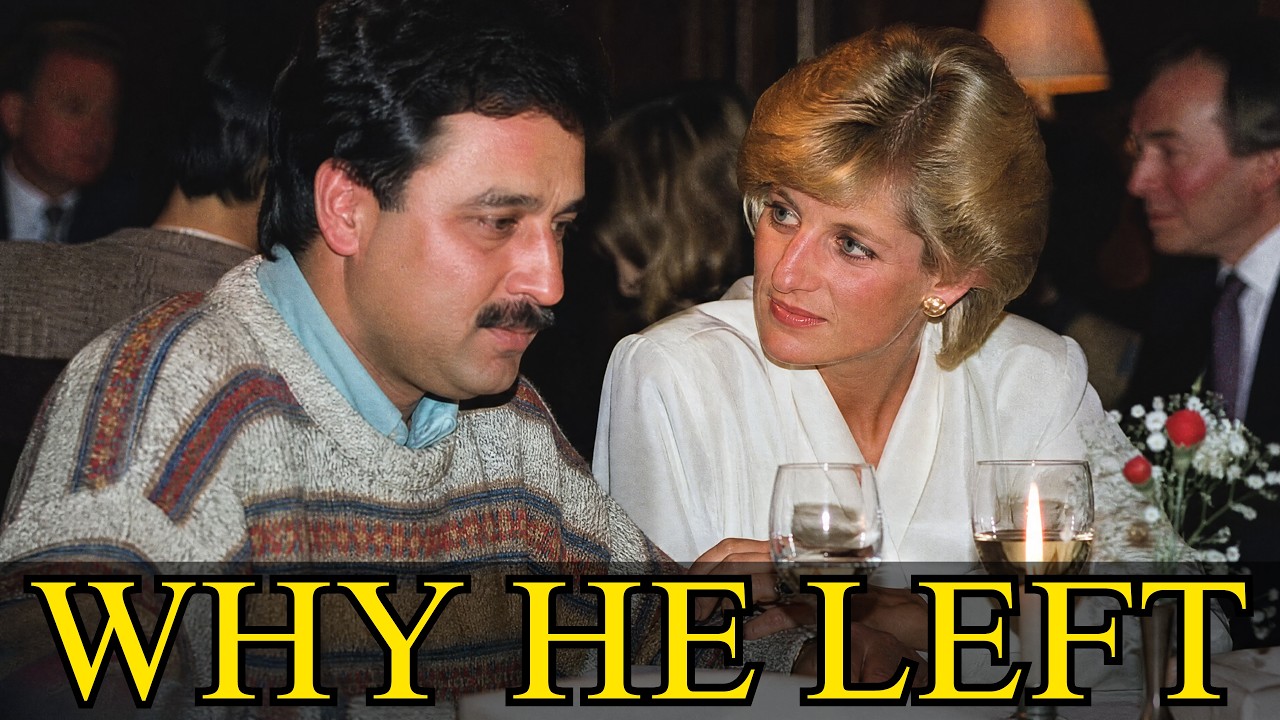
She wanted a man who had not read about her before meeting her, someone to whom her title meant nothing at all. She found him at the Royal Brompton Hospital in Chelsea on a bank holiday Monday at the end of August 1995. She had come to visit a friend’s husband recovering from heart surgery, but she left having noticed a tall, tired, unhurried surgeon in scrubs who seemed entirely indifferent to who she was. His name was Hasnat Khan.
Born in Jhelum in Punjab, Pakistan in 1958, he was a cardiac surgeon working under Sir Magdi Yacoub, one of Britain’s greatest heart and lung transplant pioneers. He was quiet, dry-humored, unimpressed by rank, and completely untouched by celebrity. He lived in a small rented flat, drove nothing anyone would look at twice, and worked punishing 90-hour weeks. Khan was the opposite of every man Diana had loved before, and that was precisely the point.
He met her eyes as though she were simply a woman asking about his work. She would soon tell Simmons that she thought she had met her “Mr. Wonderful. ”
For the next two years, they built a relationship almost entirely in shadow.
A hospital, with its private corridors and service entrances, proved the perfect place to fall in love unobserved. At Kensington Palace, her butler Paul Burrell smuggled Khan in through the gates, sometimes hidden in the boot of a car. At Khan’s small flat in Chelsea, Diana would drive herself late at night, a wig covering her famously recognizable hair. In that flat, she did things no one on Earth would ever have pictured her doing.
She washed his dishes. She folded his laundry. She cooked for him and sat with him while he slept off the exhaustion of the wards. It was, by every account of those close to her, the sheer ordinariness of it that delighted her most.
She was no longer a princess on a plinth, but a woman in a kitchen. Soon Diana stopped imagining a love affair and started planning a marriage. She sent Burrell to sound out a Roman Catholic priest on the possibility of a private wedding. She began to study the Quran and spoke with a London imam about the practicalities of a marriage across two religions.
In 1996, press reports surfaced suggesting she might convert to Islam, which she publicly denied. The most remarkable errand involved winning over the one person whose blessing she believed she needed most: Khan’s mother, Naheed. A traditional Pashtun matriarch in Lahore, Naheed had a settled idea of the wife her eldest son should take. An English divorcee, a Christian, and the former wife of the heir to the British throne was very close to the exact opposite of what she had in mind.
The path to the family ran through an unlikely bridge. In May 1995, the cricketer Imran Khan, a distant cousin of Hasnat, had married Jemima Goldsmith. Jemima became the go-between, and Diana traveled to Pakistan in February 1996 and again in May of that year, publicly raising money for Imran’s cancer hospital and privately taking tea with Naheed Khan at the family home in Lahore. According to Tina Brown’s account, Diana had not warned Hasnat that she was going to approach his family behind his back, and he was outraged when he learned of it.
Jemima Goldsmith later wrote plainly of the obstacle: “For a son to marry an English girl was every conservative Pashtun mother’s worst nightmare. ” Naheed’s position did not move. The crucial turning point, according to biographers Kate Snell and Simone Simmons, came when Diana made her own way around the wall. Desperate to reduce the press pressure on Khan, she went to his employer, Sir Magdi Yacoub, and tried to arrange a transplant post for him abroad, most often named as Australia, where they might live together with less scrutiny.
On its face, it was an act of love. But for Khan, a self-made man who had climbed to the top of one of the most demanding professions on earth by his own effort, it was a betrayal. His career was the spine of his life. The woman he was seeing had gone behind his back to his own boss to arrange his professional future, as though his life were a piece on a board she was free to move.
When he found out, he was furious. The specific quarrel lay on top of a fault line that had been there from the first day in the hospital corridor. Khan had a settled private conviction that a public life beside Diana would be unbearable. His main concern about marrying her, he would later say under oath, was that his life would be “hell” because of who she was.
He thought the idea of the marriage was, in his own word, “ridiculous. ” He never doubted her loyalty, but he had looked clearly at what the world would do to a man who married the most hunted woman alive. On the 26th of January 1996, the Sunday Mirror put the secret on its front page under a headline about “Di, her driver, and a dishy doc. ” It reported on evenings the couple had spent together, including a four-and-a-half-hour dinner at a Greek restaurant near Stratford-upon-Avon.
For Khan, it was proof of precisely the future he feared. A cardiac surgeon needs a mind wholly free of distraction, and he understood that a man who could not walk from his car to the hospital doors without a scrum of photographers could not do that work properly. Washington Post style correction: Simone/Simmons—Khan’s own account, given under oath and taken by police in 2004 and at the inquest in 2008, describes the end. By his account, Diana ended the relationship in two meetings in the early summer of 1997, just after she had spent time with the Al-Fayed family.
She told him it was all over. She denied there was anyone else. He said he was surprised, because he sensed a change in her he could not place, and did not yet know about Dodi Al-Fayed. He learned of that relationship only when he heard it on the radio.
Those close to them agree on the deeper truth: the decision that the relationship could not become a marriage was, in its heart, his. He had made the closing inevitable over the preceding months. Looking back from the inquest, Khan offered an explanation that was strikingly fair to her. He came to believe Diana had realized that Dodi Al-Fayed could give her all the things he, Khan, could not: openness, ease, a willingness to live a public life beside her.
Within weeks of leaving the surgeon, Diana was photographed on a yacht with Dodi Fayed. The relationship with Khan had been built entirely in shadow; this one unfolded almost entirely in light, with paparazzi and long-lens photographs sold around the world. In late August, a photograph of them together, the image called “the kiss,” was reportedly sold to a newspaper for close to $2 million. Diana’s closest friend of that last year, Rosa Monckton, would later testify that Diana was never engaged to Dodi, and that her heart, in some measure, remained tied to the man she had just left.
On the 31st of August 1997, Diana and Dodi were being driven through Paris in a Mercedes, pursued by photographers, when the car crashed in the tunnel beneath the Pont de l’Alma. The driver was Henri Paul. Dodi and Paul died at the scene. Diana, gravely injured, died at the Pitié-Salpêtrière Hospital in the early hours of the morning.
She was 36 years old. The most photographed woman in the history of the world had been killed in a tunnel while trying to escape a camera. The inquest in 2008 found that Diana and Dodi had been unlawfully killed through the negligence of their driver and the pursuing photographers, and found no evidence of any plot. On the 6th of September 1997, among the 2,000 mourners inside Westminster Abbey, one man in dark glasses said nothing at all.
Hasnat Khan was there, the man Diana had wanted to marry, sitting silent behind dark lenses among the invited mourners. The funeral drew a television audience of around 32. 1 million people in the UK and an estimated two to two and a half billion worldwide. Inside the Abbey sat the one man who had known her not as a princess, but as a woman who did his washing up at midnight.
For the rest of his life, Khan chose silence. He sold no memories. He wrote no book. He gave no interviews trading on the relationship.
He spoke only twice: to police in 2004, and in a written statement to the inquest in 2008. His testimony, careful and unsensational, helped lay to rest the wilder theories about her death rather than feed them. His own life went on as it always had. He kept operating at the Royal Brompton and later other London hospitals.
In 2007, he resigned from the health service to lead a cardiac unit in Malaysia, then returned to Britain for a consultant’s post in Essex in 2013. In 2006, his family arranged his marriage to a woman of Afghan royal descent, the marriage his mother had always wanted for him. It ended in divorce within about a year and a half. He married again in later years.
Only twice did he break his silence with force. In 2013, when a film about the romance was released, he rejected it publicly, calling it based on hypotheses and gossip, and saying flatly that he had never approved it. In 2021, after the Dyson report exposed how journalist Martin Bashir had manipulated Diana with forged documents, Khan spoke again, saying Bashir had “filled her head with rubbish” and that she had become fearful and suspicious after the journalist got to her. By 2025, in his late 60s, Hasnat Khan had returned to the country of his birth, taking up a senior post at a cardiac institute in Lahore, the city from which his mother had once said no.
He had gone home. The story is almost always told as something that was done to Diana. But this chapter was a choice made by two people who were each too serious to pretend. She chose a man freely, pursued him, planned a future around him, and he, just as freely, chose to keep the life he had rather than be swallowed by hers.
He did not leave because he stopped loving her. He left because he had looked, with a surgeon’s cold honesty, at what a public life beside her would do to his work, his family, his patients, and his sanity, and he had judged it unsurvivable. And she could not do the one thing that might have saved it, which was to become smaller. She could not shed the fame any more than she could shed her own face.
She had tried, in the flat and the wigs and the midnight drives, to build a room where the fame did not enter. For two years, the room had held. But a marriage is not a room. It is a life lived in the world.
Khan said it himself years later with the plainness that ran through everything he ever said about her. There was no hierarchy in their relationship, he insisted. She was not a princess and he was not a doctor. In his words, they were simply friends.
For a little while, in a world that would not allow it, a woman everyone watched and a man nobody knew managed to be to each other nothing more or less than two people. And then the world, which had never once left her alone, took her back.