On March 2, 1956, a 79-year-old patient died in the women’s ward of St Andrew’s mental hospital in Northampton, England. She had spent 29 years in the ward and had been bedridden for the final five. Her name was Violet Gibson, and eleven years earlier she had lived long enough to hear how the man she once tried to kill met his own brutal end. On April 7, 1926, Violet Gibson, then 50, walked out of the Convent of Santa Brigida in Rome carrying a revolver in one hand and a rock in the other.
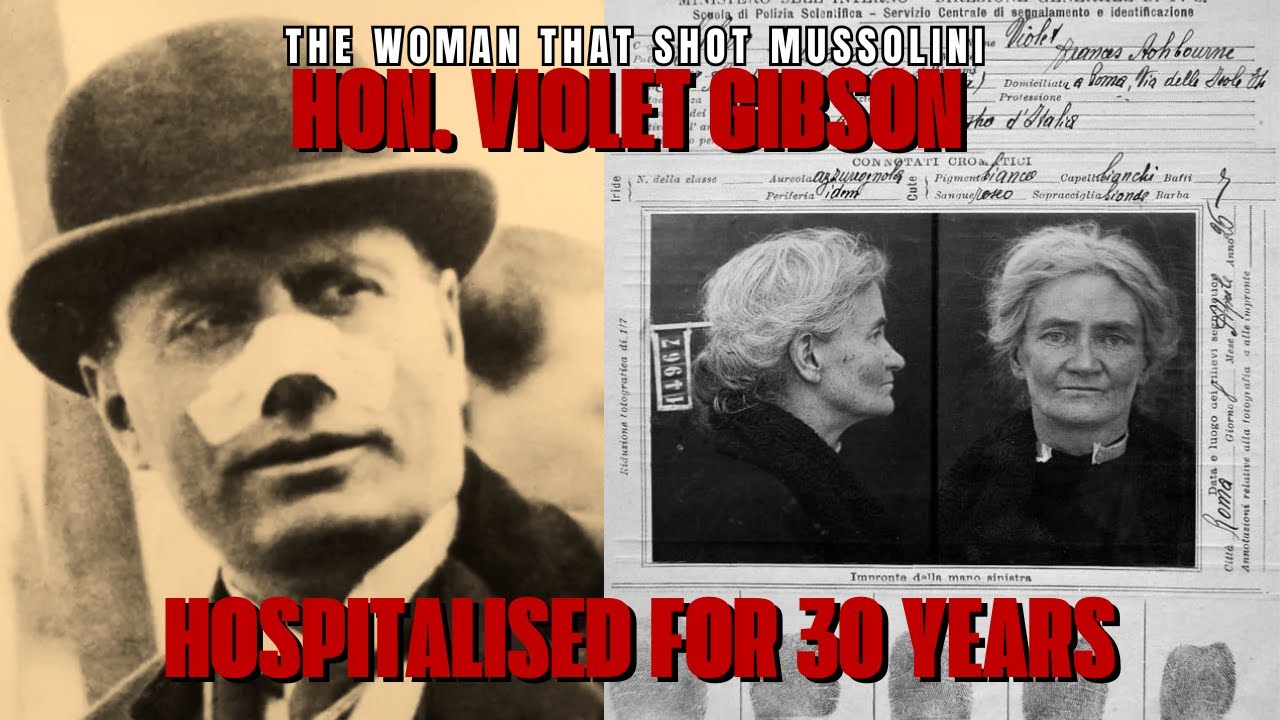
She had been convalescing there after shooting herself in the chest. She made her way to the Piazza del Campidoglio, where Italian Prime Minister Benito Mussolini was addressing a crowd of students. As Mussolini stepped out and waved to his supporters, Violet aimed at his head and fired. At that exact moment, he turned his head, and the bullet only grazed the bridge of his nose.
She tried to fire a second time, but the revolver jammed. An enraged crowd dragged her down, kicked her, and beat her before Italian police intervened and took her into custody. Remarkably, Violet was returned to England without facing charges. Instead of a trial, she was committed to St Andrew’s Hospital for mental diseases in Northampton, where she would spend the rest of her life.
Violet Gibson was born on August 31, 1876, in Dublin, into one of Ireland’s most distinguished legal and political families. Her father, Edward Gibson, was a key figure in Britain’s Conservative Party and served as Ireland’s attorney general. He later became Lord Chancellor of Ireland and was made the first Baron Ashborne, giving his eight children the title “The Honourable. ”
Her mother, Frances, was a devout Christian Scientist, a faith that held the material world and the body to be an illusion.
Violet suffered from serious childhood illnesses, including scarlet fever and rheumatic fever. Historian Totle Bunree has written that her survival was remarkable, given that her mother reportedly viewed her daughter’s ailments as penance for an unspecified sin. Violet was educated at home in music, art, French, and Italian. She was presented as a debutante at Queen Victoria’s court and attended the Season’s balls at Dublin Castle.
Fascinated by religion from an early age, she eventually converted to Roman Catholicism, a decision that so dismayed her father that he stopped speaking to her entirely. After her father’s death in 1913, Violet traveled to Paris at the start of World War I as a pacifist advocate for peace. She continued to face serious health problems, including cancer that required a mastectomy and acute appendicitis that also required surgery. By 1922, she was devastated by the death of her brother Victor, who had returned from the Boer War suffering from severe shell shock and died in an asylum.
Violet’s mental state deteriorated. She began wandering across busy roads at night, and on one occasion, when a housekeeper’s daughter tried to help her, Violet pulled out a knife and cut the child’s hand. She was confined to a sanatorium, where she reportedly attempted to kill another patient before her family managed to have her removed. Living alone in Kensington, Violet developed an intense opposition to the Pope, whom she saw as sympathetic to fascism.
She sailed to Rome in November 1924 with her Irish nurse, Mary McGrath, and requested an audience with the Pope, but the request was denied. Three months after arriving in Rome, Violet shot herself with a bullet that missed her heart but struck her shoulder. After two months in a psychiatric clinic, she was moved to the Convent of Santa Brigida. There, she pinned up newspaper cuttings about Mussolini, acquired a gun, and walked out on the morning of April 7 with one mission.
At the time, Mussolini was 42. He had risen to power in 1922 when his National Fascist Party marched 30,000 Blackshirts into Rome, forcing the resignation of the liberal prime minister. Over the next decade, he dismantled constitutional constraints and built a harsh police state. During her interrogation after the assassination attempt, Violet gave confusing and contradictory answers.
She first denied responsibility, then claimed she had done it to impress a handsome Italian man, then said the act was to “glorify God. ” Asked if she had accomplices, she named all the saints she could think of. Italian propaganda quickly portrayed her as a religious fanatic operating alone. The assassination attempt only consolidated Mussolini’s public support, despite four further attempts on his life over the next 14 months.
Mussolini’s response to Violet was relatively benign: he simply insisted she be removed from Italy. With the consent of her siblings, Violet was taken back to England under the supervision of her sister Constance and placed in St Andrew’s Hospital. During her confinement, she wrote dozens of letters pleading for release, some addressed to Winston Churchill and others to Queen Elizabeth II. All went undelivered.
In 1930, Violet attempted to hang herself. She remained in the hospital until her death in 1956, mostly unknown to the world. She did, however, live to hear of Mussolini’s dramatic fall from grace and his death in 1945, when he was shot by Italian partisans and hanged upside down outside a petrol station in Milan alongside his mistress, Clara Petacci. Petacci had first written to Mussolini as a 14-year-old sending condolences after he was shot by, in her words, “a mad Irish woman.
” As documentary maker Barry D’Alal once asked: “Between her and Benito Mussolini and all the things he did, who was really mad? “