On December 19, 1944, inside a command room in Verdun, Dwight D. Eisenhower studied a map that was changing faster than his staff could update it. Overnight, the German army had torn a massive gap through the American lines in the Ardennes. Entire units had been pushed back, others were cut off, and the town of Bastogne was close to being surrounded.
The reports reaching Eisenhower were fragmented, but the message was unmistakable. The Western Front was in danger of splitting in two.
Around him, senior commanders outlined how long it would take to form a counterattack. Some estimated six days. Others needed more. No one could move fast enough to relieve Bastogne or blunt the German advance. The roads were frozen and clogged, the weather had grounded Allied aircraft, and many divisions were committed elsewhere.
Eisenhower absorbed the implications. If the Germans reached the Meuse River before the Allies could reorganize, the campaign in Western Europe could unravel. The momentum the Allies had spent six months building might vanish in a matter of days.
He turned at last to the only general in the room who had not hesitated, George S. Patton. Asked how soon his army could attack north, Patton did not request more information or time to evaluate. He answered immediately. His forces could strike in two days.
The reaction from the room was disbelief. No army had ever shifted its entire operational direction that quickly. Not in winter, not across hundreds of miles, not under enemy pressure. But Eisenhower held Patton's gaze. Something in the general's certainty convinced him. In that moment, the Supreme Commander decided to stake the future of the Western Front on a single unprecedented maneuver.
By late 1944, the Allies believed the war in Western Europe had entered its final phase. After the breakout from Normandy, they had swept across France, liberated vast territories, and pressed toward the German border with overwhelming force. The line was stretched thin, but steady, cold, battered divisions held quiet sectors while logistics strained to catch up. The worst appeared to be over.
Intelligence assessments reinforced this sense of security. Reports described the German army as depleted beyond recovery, with critical fuel shortages, collapsing manpower, declining morale, and dwindling industrial output. Few imagined Germany capable of anything more than local defensive actions.
The Ardennes sector, a dense forested region of ridges and narrow roads, was considered so unsuitable for large-scale operations that it became a resting ground for inexperienced or exhausted American units. Its quietness lulled commanders into a dangerous assumption. Nothing significant could happen there.
But Hitler had chosen that very terrain for his last great gamble. Under the cover of forests and winter weather, entire armored formations were moved into position. Radio silence was enforced. Marches were conducted at night. What the Allies assumed was stagnation was in fact the careful construction of a spear thrust aimed at splitting the Western Front in two.
On December 16, that spear was unleashed. Before dawn, thousands of German artillery pieces opened fire across a 70-mile front. Communication posts disappeared in the first minutes. Forward positions were wiped out before they could radio a single warning.
Then German armor emerged from the trees. Panzer divisions, assault guns, and mechanized infantry advanced with a ferocity not seen since the early years of the war. Fog and heavy cloud cover grounded Allied aircraft. Roads became rivers of chaos as retreating units struggled to regroup.
New, inexperienced American divisions, stretched thin and lacking cohesive defenses, were hit hardest. Entire companies were swallowed in the opening attacks. Commanders at the front found themselves cut off, relying on fragmented reports, if any reports at all.
At Allied headquarters, the scale of the disaster became clearer with each message that arrived. None of them were consistent, and all of them were alarming. The Germans were driving west fast, punching a widening gap into the American line. At the center of that widening gap was Bastogne.
Bastogne was not a city of strategic industry or political value. Its importance was far simpler and far more decisive. Seven major roads converged there. Whichever side controlled Bastogne controlled movement through the southern Ardennes.
If the Germans seized it, their armored columns could push deeper into Belgium, reach the Meuse River, and threaten Antwerp. That in turn would split the Allied armies, cutting off American forces to the north from those in the south. The implications were catastrophic.
Eisenhower understood immediately. If Bastogne fell, the structure of the entire Western Front could collapse. The defenders inside the town, the 101st Airborne Division and remnants of armored units, were isolated and increasingly overwhelmed. Ammunition, fuel, winter clothing, and medical supplies were already running low by December 18, and reinforcements were nowhere near.
Reinforcements were needed immediately, but every assessment Eisenhower received pointed to the same problem. Most commanders believed it would take nearly a week before enough forces could be repositioned for a meaningful counterattack, far too long for the defenders trapped inside Bastogne.
By December 18, Eisenhower faced a situation no commander ever wants. A fast-moving enemy, paralyzed lines of communication, troops scattered across vast distances, and no immediate ability to counterattack. With each passing hour, the advance of the German spearheads worsened the Allied position.
Every extra mile gained by enemy armor made recovery more difficult, and each new report from Bastogne confirmed that the defenders were being squeezed harder. Every general Eisenhower consulted confronted the same constraint. Reinforcements could not reach the town quickly enough.
The Supreme Commander needed someone who could act immediately, someone capable of moving an entire army faster than the enemy expected, faster than the terrain allowed, faster than any Allied planner had believed possible. That is why Eisenhower called his commanders to Verdun, not to discuss whether a counterattack was needed, but to find out who, if anyone, could deliver one in time.
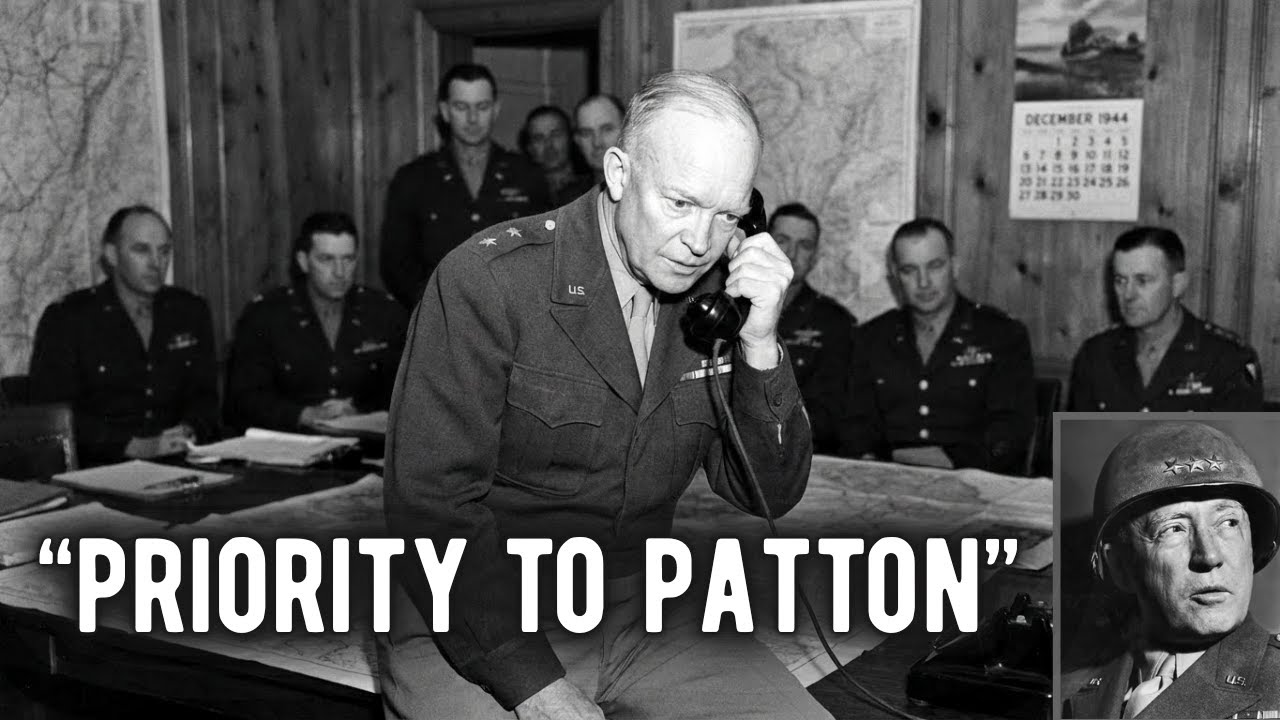
When Eisenhower turned to Patton in that crowded room at Verdun, the question was simple. But the moment was not. The Western Front was under enormous strain. American divisions were scattered, freezing, and blindsided. Senior commanders were struggling to assemble a coherent picture of the German attack. No one knew how far the enemy could push. No one knew how quickly the line might collapse.
Patton, however, saw no need for clarification or extended briefing. His reply came without hesitation because he had already prepared for this moment before anyone else believed it was possible.
Understanding why Eisenhower accepted Patton's claim requires stepping into the mindset of the man himself and into months of subtle tension between Patton's instincts and the assumptions driving Allied planning. George S. Patton was many things, brilliant, abrasive, obsessive, but above all, he was a commander who trusted his sense for danger. In late 1944, something about the Ardennes unsettled him long before the Germans attacked.
Official intelligence saw scattered German movements, depleted units, and shortages that seemed insurmountable. Most analysts believed the Reich no longer possessed the fuel or manpower for an offensive of any meaningful size. The Ardennes, in their view, was a place to rest worn-out divisions.
Patton disagreed. He noticed irregularities in German traffic patterns and reports of units shifting under unusual secrecy. He did not know the scale of what Hitler was preparing, but he believed the quiet in the Ardennes was unnatural, an environment that felt staged, too still, too convenient.
That sense of unease led him to do something no other Allied field commander did. He ordered contingency plans for a rapid pivot to the north weeks before the first German shell fell. Patton instructed his G2 and G3 officers to draft not just a single contingency option, but an entire spectrum of them.
One plan envisioned a modest shift in case only a portion of the Third Army needed to change direction. Another expanded that idea into a wider adjustment that would reposition most of his major formations. The final version, by far the most ambitious, outlined a complete reorientation of the entire army, a full northward swing that would redirect every significant unit he commanded toward the Ardennes.
Each version demanded different levels of movement, coordination, and logistical support. But all shared the same purpose, to ensure that if the situation in the Ardennes suddenly deteriorated, Patton's forces could pivot on short notice and strike where the crisis was most severe.
His own officers complained. They saw it as unnecessary labor. The Ardennes was quiet. The German army was supposedly incapable of a large operation. Why waste staff hours drafting plans that would never be used? Patton's response was blunt. The Germans were still dangerous and the Allies were still vulnerable. He planned not because he expected disaster, but because disasters rarely announced themselves in time to prepare afterward.
Eisenhower understood Patton better than most. Their relationship had been tested by Patton's controversies, yet Eisenhower recognized something fundamental. Patton's instincts were often sharper than his reputation suggested.
At Verdun, the answer Patton gave was not the answer of a man taking a wild chance. It came from a commander who had anticipated a scenario no one else considered worth planning for. Where other generals required days to prepare, Patton needed only authorization to execute a plan already on the shelf.
Eisenhower grasped the significance instantly. If Patton already had plans in place, and if those plans were specific enough to implement immediately, then he was the only commander capable of acting at the speed the crisis demanded. Patton's confidence that day was not rooted in recklessness. It reflected readiness.
Maps showed German breakthroughs extending dangerously close to the Meuse River. Bastogne appeared nearly encircled. American units were fragmented or in full withdrawal. Reports came in too quickly to verify, but all pointed toward the same possibility. Germany was attempting not just a local attack, but a decisive strategic blow.
Eisenhower opened the session by acknowledging the gravity of the situation. The Allies had been caught off guard. The German attack had achieved complete operational surprise. The immediate question, he said, was not how the breakthrough happened, but how to stop it.
Bradley's staff estimated at least six days before they could assemble enough forces to counterattack. Other commanders echoed the concern. The roads were jammed, weather was worsening, and supply networks were not set up for a sudden shift in operational direction. To Eisenhower, those projections were dangerously slow. The battle was moving faster than his generals' timelines.
Then he turned to Patton. Patton had been waiting for this moment. When Eisenhower asked how soon he could launch an attack to relieve Bastogne, Patton answered immediately. Forty-eight hours.
Not one commander in the room believed such a maneuver was feasible. Turning an entire army north across hundreds of miles of winter terrain during an enemy offensive ran directly against existing doctrine. Armies were not supposed to move like that. Logistical networks were not designed for it. Traffic patterns across France were too congested. Fuel allocations were not positioned for a sudden directional shift.
Yet Patton described his intentions with calm assurance. He explained that orders could be issued the moment he returned to his headquarters. March routes had already been determined. Units had been warned about the possibility of rapid redeployment. Supply officers had pre-calculated fuel needs and refueling points. Engineer battalions were prepared to clear snow and ice, and military police units had coordination plans ready for redirecting traffic.
The room reacted with skepticism, but no one could deny that Patton spoke as a commander who had already thought through the problem. Eisenhower listened quietly, weighing every detail. If Patton truly had his army positioned to pivot immediately, then he represented the only viable chance to stabilize the front.
After a long pause, Eisenhower made the decision. He approved Patton's plan. Eisenhower did not respond with any grand or dramatic statement. What he gave instead was a clear, practical directive that carried the weight of the entire Western Front.
Patton would move first. Fuel, roads, traffic routes, everything Patton requested would be reassigned to support his maneuver. The rest of the Allied armies would adjust around that priority.

It was a bold decision, but not an irresponsible one. Eisenhower backed Patton not because he wanted a display of daring, but because he recognized that preparation already existed on Patton's side that did not exist anywhere else. No other general had shaped his army to pivot this quickly. No one else had anticipated the need.
The Western Front required immediate large-scale action, and among all the commanders gathered at Verdun, Patton was the only one in a position to deliver it. This was the moment Eisenhower chose to gamble when the crisis demanded a speed no one else could match, and one general stood ready while the rest were still calculating possibilities.
When Patton left the Verdun meeting, he did not pause to reflect on the scale of what he had just promised. There was no time to admire the audacity of the commitment or to consider how unprecedented it was. Before the conference room door had even finished closing behind him, he was already issuing directives to his staff. The Third Army would turn north immediately.
To anyone watching, the transformation inside Patton's headquarters that evening must have felt like watching a sleeping giant snap awake. Maps were pulled down and replaced. Radio operators relayed non-stop instructions through networks that had been quiet only hours earlier. Staff officers rushed between rooms carrying updated movement tables and revised route assignments. Every department, logistics, engineering, artillery, medical, signals, was thrown into motion with a level of urgency that bordered on controlled chaos.
But underneath the frenzy was a remarkable truth. None of this was improvisation. The Third Army was not designing an operation from nothing. It was activating a plan that already existed.
The Third Army had been driving east toward Germany. Its routes, supply depots, artillery positions, and engineering priorities all pointed in that direction. Now, almost overnight, every part of that structure had to pivot 90 degrees to the north.
This was not a simple redirection of infantry columns. It was the relocation and reconfiguration of an entire fighting machine. Hundreds of thousands of soldiers, thousands of vehicles, miles of fuel pipelines and ammunition chains reshaped to face an entirely different battlefield.
Convoys that had been heading toward the Saar suddenly received orders to halt, turn, and form long northbound columns. Troops who had expected to dig in for winter defenses were instead packing up in darkness. Tank crews were refueling, loading ammunition, and scraping ice from their vehicles as fast as their hands could move. Artillery units were recalculating firing ranges for areas they had studied only in theory.
The speed of the transition astonished even veteran officers. Many later recalled that Patton's headquarters seemed to operate with a kind of electrical energy, an intensity that radiated outward through every echelon of the army.
Winter in the Ardennes was unforgiving. Snow thickened on the roads, temperatures plunged, and the terrain became a maze of frozen ruts, narrow passes, and black ice. Even under ideal circumstances, moving a modern army through this landscape would have been difficult. Under the conditions facing the Third Army, retreating traffic, panicked refugees, collapsing units streaming south, it bordered on impossible.
Military police units were dispatched to intersections and choke points to carve order out of the chaos. Many worked for hours without relief, standing in freezing wind with lanterns and flags, shouting instructions to drivers who could barely see through fogged windshields. Columns of trucks and halftracks crept forward with only inches between them. Tank destroyers ground over ice that cracked beneath their weight. Ambulances slid along roads polished into glass.
For some units, progress could be measured in miles. For others, the advance was so slow it felt as if they were measuring distance in yards. What united them was simple. They kept moving, however difficult the conditions. The Third Army continued to turn north.
Behind the front lines, the true weight of Patton's promise fell onto the quartermasters, engineers, mechanics, and supply officers who had to rewire the army overnight. Fuel depots scheduled for operations in the Saar region were stripped and reassigned to new positions along the northern axis. Ammunition trucks rerouted themselves to match artillery units that were changing direction. Repair crews loaded with spare parts leapfrogged forward, preparing for the inevitable mechanical breakdowns caused by cold, overworked engines.
Engineering battalions cut new routes through snow-covered fields, cleared roadblocks, and built makeshift bridges where frozen streams made passage uncertain. They worked through the night in the dark, in the wind, often in knee-deep snow, because every delay they encountered would be a delay Bastogne could not afford.
As the movement continued, diaries and letters from soldiers reveal a striking constant. Morale remained high. Despite exhaustion, cold, and the confusion of orders changing faster than the weather, the troops believed the operation would work for one central reason, Patton.
Many of them had served under him in North Africa, Sicily, and France. They had seen him push through obstacles that seemed immovable. They had watched him transform faltering situations into opportunities. His presence on the road, standing upright in his command jeep, binoculars in hand, urging men forward, created a sense of momentum that no written order could match.
One infantryman later recalled that seeing Patton felt like watching the storm itself moving alongside them. Another wrote that if Patton said they would reach Bastogne, then they would reach it, even if the snow seemed determined to bury them on the way. Their confidence came from a simple understanding. Speed had the potential to break the advantage the Germans had gained, and rapid movement was the only chance to reach the paratroopers holding out in Bastogne.
While Patton's army fought the terrain and weather, German units pushing toward the Meuse were beginning to encounter new problems. Their timetable, already ambitious, had assumed that the Allies would take much longer to respond. They had expected confusion, delay, and hesitation. What they did not expect was an entire American field army reorienting itself toward the fight within hours.
German commanders soon noticed that reinforcements meant for their western drive were being diverted south to counter Patton's approach. Fuel shortages in the German armored divisions forced halts at critical moments. Communications, already difficult in the dense forest and winter storms, became erratic. The German offensive, built on the premise of uninterrupted momentum, was beginning to face resistance from a direction it had not planned for. That resistance grew stronger with every hour of the Third Army's advance.
By December 21 and 22, the Third Army's lead elements were approaching the southern edges of Luxembourg. The sound of distant artillery, American guns firing northward, marked the proximity of the new front. The closer they came to Bastogne, the more determined the German defenders became. Villages had to be taken one by one. Crossroads became firefights. Frozen fields turned into killing grounds. Every mile cost time and casualties.
The momentum was no longer working in Germany's favor. Patton could see the change in the pace of his advance. His officers recognized it in the reports returning from the front, and German commanders felt it as their timetable began to slip. A shift was happening across the battlefield, subtle at first, but unmistakable. The Third Army was beginning to impose its own rhythm on the fight.

Bastogne was not yet relieved, but for the first time since the morning of December 16, the Allies were no longer purely reacting. The initiative was starting to return. The final push was about to begin.
By December 24 and 25, the Third Army was pushing through the last stretch of ground between its lead elements and Bastogne. Snowfall thickened, temperatures dropped further, and the resistance stiffened. German units, realizing that Patton's advance threatened to unravel their offensive, began diverting forces originally intended for the drive toward the Meuse.
Every town became a defensive knot that had to be pried open. Roads leading north narrowed into icy corridors lined with shattered trees, abandoned equipment, and makeshift German roadblocks. The closer the Americans came, the more intense the fighting became. The momentum that had once favored the German advance was now being eroded by constant pressure from the south.
Inside Bastogne, the defenders were enduring one of the harshest ordeals of the European war. Supplies were nearly exhausted, the wounded crowded into basements and cellars. Artillery barrages hammered the town around the clock. Temperatures plunged well below freezing, and many paratroopers lacked proper winter gear. Despite this, they held the perimeter because they knew there was no alternative. Relief had to come from outside, and the only army moving in their direction was Patton's.
On December 26, a small task force from the 4th Armored Division pushed through the village of Assenois, the last significant barrier before Bastogne. The fighting there was fierce, close quarters, chaotic, fought in snow-choked streets and fields where visibility was almost non-existent. German defenders, aware of the stakes, threw everything they had into holding the ground.
The American columns refused to halt, and by late afternoon, the first armored vehicles crested a rise on the southern edge of Bastogne. Ahead of them, scattered figures emerged from the treeline. Paratroopers waving helmets, shouting over the winter wind to signal that contact had been made. The siege was broken.
It was not a grand spectacle in terms of numbers. A handful of tanks, a group of exhausted infantrymen, and airborne soldiers who had been pushed to their physical and emotional limits. But its significance was enormous. For the first time since the German offensive began, the forces inside Bastogne were reconnected to the rest of the Allied front. Supplies could move in, casualties could move out, and the defenders could finally breathe again.
Relieving Bastogne did not bring an immediate end to the battle. German units still held the surrounding high ground, and the weather continued to complicate movement for both sides. The corridor opened by the 4th Armored Division was narrow, vulnerable, and exposed to counterattack for several days.
Heavy fighting continued as the Third Army worked to widen the breach, secure the approaches, and push German forces away from the town. These engagements were some of the most difficult of the campaign. The terrain, dense woods, steep ridges, frozen fields, favored the defender, and the Germans understood the importance of preventing the Allies from establishing a secure link.
Yet the character of the fighting had changed. Units that had been advancing confidently toward the Meuse only a week earlier were now struggling to maintain cohesion in the face of renewed Allied pressure.
By early January, the German offensive was faltering. Fuel shortages crippled their armored formations. Communications broke down under the strain of constant movement and Allied interference. With Patton pressing from the south while other American and British forces counterattacked from the north, the bulge in the front line began to collapse inward. What Hitler had envisioned as a decisive strike was turning into a costly withdrawal through snow and wreckage.
Eisenhower watched these developments with a sense of measured relief. His decision to place priority on Patton's movement had been a calculated risk, one that required him to override standard traffic protocols, reassign scarce fuel supplies, and reorganize vast portions of the Allied logistical network. But it proved to be the correct choice.
Patton's maneuver did more than reach Bastogne. It disrupted the operational rhythm of the German offensive. Commanders who had been driving west with confidence were suddenly forced to redirect resources southward to slow the Third Army's advance. Every hour spent responding to Patton was an hour lost from their original timetable. In an operation built entirely around speed and surprise, that loss of time was devastating.
Eisenhower later referred to Patton's movement as one of the most remarkable operations he witnessed during the war. It was not simply the speed that impressed him, but the foresight behind it. Patton had prepared for a crisis no one else saw coming. When that crisis arrived, he acted before others had finished assessing the situation. That preparation, combined with Eisenhower's willingness to trust it, allowed the Western Front to hold.
By the end of January 1945, the Allied lines had been fully restored. The German army had lost irreplaceable fuel reserves, thousands of vehicles, and much of the offensive capability it needed to defend the Reich. The Ardennes offensive, intended to force the Allies into a negotiated settlement, had instead accelerated Germany's decline.
Patton's 90-degree turn did not win the war by itself, but it played a decisive role in preventing a potential disaster. If Bastogne had fallen, if the Meuse crossings had been reached, or if the Allied armies had been split, the campaign in Western Europe could have taken a far different and far longer trajectory. Instead, the rapid counter-stroke reestablished control of the battlefield. From February onward, the Allies advanced with renewed coordination, pushing into the heart of Germany.
Military scholars still study Patton's turn toward Bastogne for several reasons. It exemplifies operational agility on a scale rarely achieved in modern warfare. It demonstrates how preparation, even when unpopular or considered unnecessary, can determine the outcome of entire campaigns. And it highlights the value of decisive leadership at moments when hesitation can be fatal.
For Eisenhower, the episode reinforced a principle he carried throughout the war. Success often depends on recognizing which commanders can act with speed and clarity when circumstances shift. For Patton, it became one of the defining moments of his career, a demonstration that his reputation for boldness was matched by his ability to foresee danger and prepare for it long before it became visible.
The relief of Bastogne stands as one of the most significant turning points of the European campaign. Not because of its size, but because of what it represented, the restoration of momentum at a moment when the Allies could easily have lost it.
The Germans had surprised the Western Front with a powerful blow. But through rapid adaptation and a willingness to place trust in the right commander, the Allies regained control. Eisenhower's decision was a gamble, but not a reckless one. He chose Patton because Patton had already done the work. And when the moment came, that preparation allowed an entire army to turn in a way few believed possible.
The German offensive opened with shock and speed. It was answered by an American maneuver that unfolded even faster than the enemy expected. In that reversal lies the heart of the story. The Western Front held because one commander anticipated the crisis and another had the clarity to let him act.