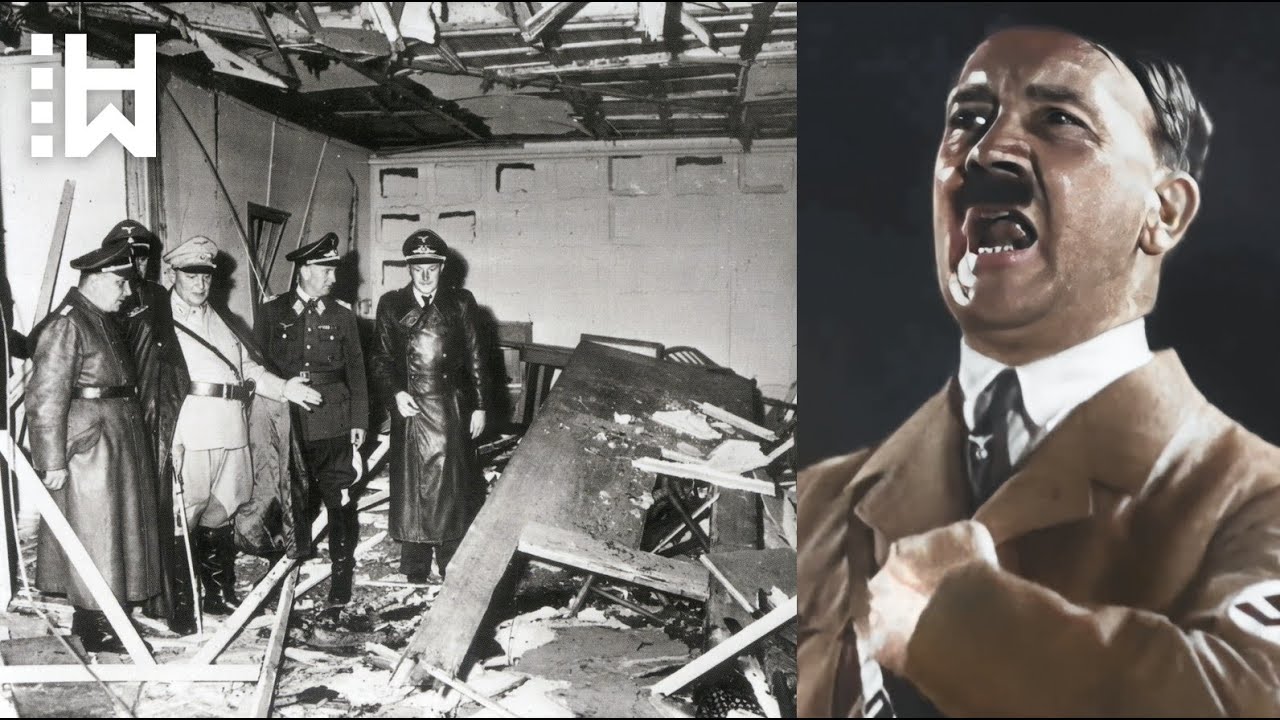
On July 20, 1944, just hours after German military officers attempted to assassinate Adolf Hitler at the Wolf's Lair, his East Prussian headquarters near Rastenburg, the Führer kept his appointments, including a meeting with Italy's fascist leader Benito Mussolini.
The plot was the culmination of efforts by several groups in the German resistance who hoped Hitler's violent death would signal an anti-Nazi revolt and the overthrow of the Nazi German government. Hitler survived the blast, and the coup attempt failed.
In the days that followed, Hitler ordered a massive hunt for conspirators. Executions would continue to the last days of the war.
The key conspirators in the July 20 plot can be divided between civilians and active army officers. Almost all shared a conservative nationalist perspective and an aristocratic background.
The civilians were mainly individuals who had resigned from the Nazi regime in the 1930s. Carl Friedrich Goerdeler, for example, had been mayor of Leipzig from 1930 to 1937 but resigned in opposition to Nazi anti-Jewish policies. Ludwig Beck, another important civilian, was a former general who had resigned in opposition to Hitler's aggressive war plans in 1938.
The most important military conspirators were General Friedrich Olbricht, Major General Henning von Tresckow and Colonel Claus von Stauffenberg, along with Carl Heinrich von Stülpnagel, the German military commander in France.
The motivations of the conspirators were likely varied and remain contested to this day. Some, like Goerdeler, objected to Nazi anti-Jewish policy as well as the general mismanagement of the war leading Germany to ruin. Tresckow appeared deeply dismayed by the Nazis' anti-Semitic policies and privately described the Kristallnacht program, the coordinated violent riots against Jews throughout Nazi Germany and recently incorporated territories on November 9 and 10, 1938, as an act of barbarism.
Yet motivations varied widely and should not be viewed solely in the context of the Holocaust, as a number of the conspirators were themselves implicated in both war crimes and the genocide of European Jews. German general Carl Heinrich von Stülpnagel had closely cooperated with the Einsatzgruppen in their mass murder of Jews when he commanded the 17th Army in the German-occupied Soviet Union.
The quartermaster of the army, General Eduard Wagner, who supplied the escape aircraft, had coordinated Einsatzgruppen cooperation with the Army and created the plans to starve Soviet prisoners of war, resulting in millions of deaths. Arthur Nebe, leader of the Kriminalpolizei, had commanded Einsatzgruppe B in the Soviet Union, responsible for the murder of over 45,000 Jews.
For many of the conspirators, the attempted assassination had a more pragmatic objective: to rescue Germany from catastrophic defeat brought about by Hitler's increasingly irrational management of the war.
In late 1942, Tresckow and Olbricht formulated a plan to assassinate Hitler and stage an overthrow during Hitler's visit to the headquarters of Army Group Center at Smolensk in March 1943 by placing a bomb on his plane. The operation was codenamed Operation Spark, because the conspirators believed Hitler's death would be a spark, a signal that it was time to launch an internal coup d'état to overthrow the Nazi regime and end the war.
However, the bomb failed to detonate, and a second attempt a week later, with Hitler at an exhibition of captured Soviet weaponry in Berlin, also failed.
By mid-1943 the tide of war was turning decisively against Germany. The Army plotters and their civilian allies became convinced that Hitler should be assassinated so that a government acceptable to the Western Allies could be formed and a separate peace negotiated in time to prevent a Soviet invasion of Germany.
In August 1943 Tresckow met for the first time a young staff officer, Lieutenant Colonel Klaus von Stauffenberg, who had been severely wounded in North Africa. Stauffenberg was a political conservative and a zealous German nationalist.
From early 1942 Stauffenberg had come to share two basic convictions with many military officers: that Germany was being led to disaster, and that Hitler's removal from power was necessary. After the Battle of Stalingrad in December 1942, despite his religious scruples, he concluded that Hitler's assassination was a lesser moral evil than Hitler's remaining in power.
Stauffenberg brought a new tone of decisiveness to the ranks of the resistance movement. When Tresckow was assigned to the Eastern Front, Stauffenberg took charge of planning and executing the assassination attempt.
After a failed bomb attempt to assassinate Hitler on his airplane, the conspirators focused on an existing contingency plan codenamed Operation Valkyrie. This operation was originally designed to militarily combat potential civil unrest in Germany. The conspirators modified the plan for their own aims, with the intention of taking control of German cities, disarming the SS and arresting key Nazi leaders.
As part of the plan, Colonel Stauffenberg would travel to the Wolf's Lair, Hitler's headquarters in East Prussia, where he would place a briefcase containing two bombs under Hitler's briefing table. Once Hitler died in the explosion, the military would claim the assassination had been part of an attempted coup by the Nazi Party and would then implement Operation Valkyrie.

The Reserve Army would seize key installations in Berlin and arrest high-ranking Nazi officials, including Minister of Propaganda Joseph Goebbels, while disarming loyal SS units. Meanwhile, upon receipt of the Valkyrie orders, Stülpnagel would consolidate Army power in France.
In the confusion of Hitler's death, Hermann Göring, Heinrich Himmler and other major Nazi leaders would be arrested, and a new government established with Goerdeler as chancellor and Beck as president. This government would then be positioned to negotiate an armistice to end the war on more generous terms for Germany.
On July 20, 1944, Stauffenberg placed one of the two bombs in a briefcase under the table in Hitler's briefing room at the Wolf's Lair. However, he was unable to arm the second bomb in time, and after Stauffenberg left the room the briefcase was coincidentally moved under the heavy support of the table leg. It detonated but failed to kill Hitler.
This was not immediately known to the conspirators. An ally at Hitler's headquarters cut off all communication, and Stauffenberg returned to Berlin to coordinate the implementation of Valkyrie.
At first the plans seemed to go smoothly as the Reserve Army began to take action, but delays, confusion and poor communication robbed the coup of its initiative. Eventually the fact of Hitler's survival was broadcast, and the plot quickly unraveled.
As a result of the failed coup, every member of the Wehrmacht, the German Armed Forces, was required to re-swear his loyalty oath by name to Hitler. On July 24, 1944, the military salute was replaced throughout the Armed Forces with the Hitler salute, in which the arm was outstretched and the salutation "Heil Hitler" was given.
Major Otto Ernst Remer, who played a major role in stopping the plot, was promoted to colonel and ended the war as a major general. The conspirators fared far worse.
In the days that followed, Hitler ordered a massive hunt for conspirators which continued for months. In August 1944 some of the arrested perpetrators of the failed assassination were brought for punishment before the notorious People's Court, presided over by Roland Freisler, a fanatical Nazi judge.
Hitler had ordered that those found guilty should be hanged like cattle. The proceedings were filmed in order to be shown to the German public in cinema newsreels and to portray how Freisler ran his court.

He would often alternate between questioning the defendants in an analytical manner and then suddenly launch into a furious verbal tirade, even going so far as to shout insults at the accused from the bench. The shift from cold clinical interrogation to fits of screaming rage was designed to psychologically disarm, torment and humiliate those on trial, while discouraging any attempt on their part to either defend or justify their actions.
At one point Freisler yelled at Field Marshal Erwin von Witzleben, who was trying to hold up his trousers after having purposely been given old oversized beltless clothing: "You dirty old man, why do you keep fiddling with your trousers?"
However, the defendants never lost their dignity. The closing words that Erwin von Witzleben addressed to Freisler are said to have been: "You can hand us over to the executioner. In three months the outraged and tormented people will hold you accountable and drag you alive through the mud of the streets."
A leading figure of the resistance in France interrupted Freisler after he had interrupted him several times, saying: "You be silent now, here, Freisler, because today it is about my head. In a year it will be about your head."
When Freisler sarcastically pictured General Erich Fellgiebel's impending death, Fellgiebel told Freisler: "Then hurry up, Mr. President, otherwise you'll hang before we do."
Fellgiebel, ravaged by the conditions of his detention, was brought to court without a belt and tie. He too tried to preserve his dignity. He stated that his opposition to Hitler was due to the many murders in Germany and abroad. He was constantly interrupted by a furious Freisler, who finally shouted him down in a rage and told him: "You really are a lousy piece of trash."
Thousands of others were executed, often on the barest evidence. Some of the executions were carried out within two hours of the verdict being delivered.
Some conspirators, such as Eduard Wagner, committed suicide, and some others, such as Ludwig Beck, made an unsuccessful attempt at suicide before they were executed. Executions continued to the last days of the war.
Wilhelm Canaris, a German admiral and chief of the Abwehr, the German military intelligence service, from 1935 to 1944, was hanged on a butcher's hook, a method deriving from medieval times.
Major General Henning von Tresckow, leader of the conspirators, killed himself the day after the failed plot by use of a hand grenade in the no man's land between Russian and German lines. Before his death Tresckow said: "The whole world will vilify us now, but I am still totally convinced that we did the right thing. Hitler is the arch enemy not only of Germany but of the world."
He continued: "When in a few hours' time I go before God to account for what I have done and left undone, I know I will be able to justify what I did. In a struggle against Hitler none of us can bewail his own death. Those who consented to join our circle put on the robe of Nessus. A human being's moral integrity begins when he is prepared to sacrifice his life for his convictions."
In the end, more than 7,000 people were arrested and 4,980 of them were executed.