On August 9, 1944, in Edinburgh, Indiana, the temperature reached 91 degrees in the shade. In the cornfields, there was no shade at all. A truck was due to turn off Highway 31 carrying eleven German prisoners of war, men who had recently arrived by troop transport from Normandy. They were being brought to detassel corn under the punishing Indiana sun.
Nothing about that assignment should have frightened a soldier who had survived the counterattack at Omaha Beach and three weeks of aerial combat. But something would happen in that field that day which American artillery had never managed to do. It would free something in these men that they would carry for the rest of their lives.
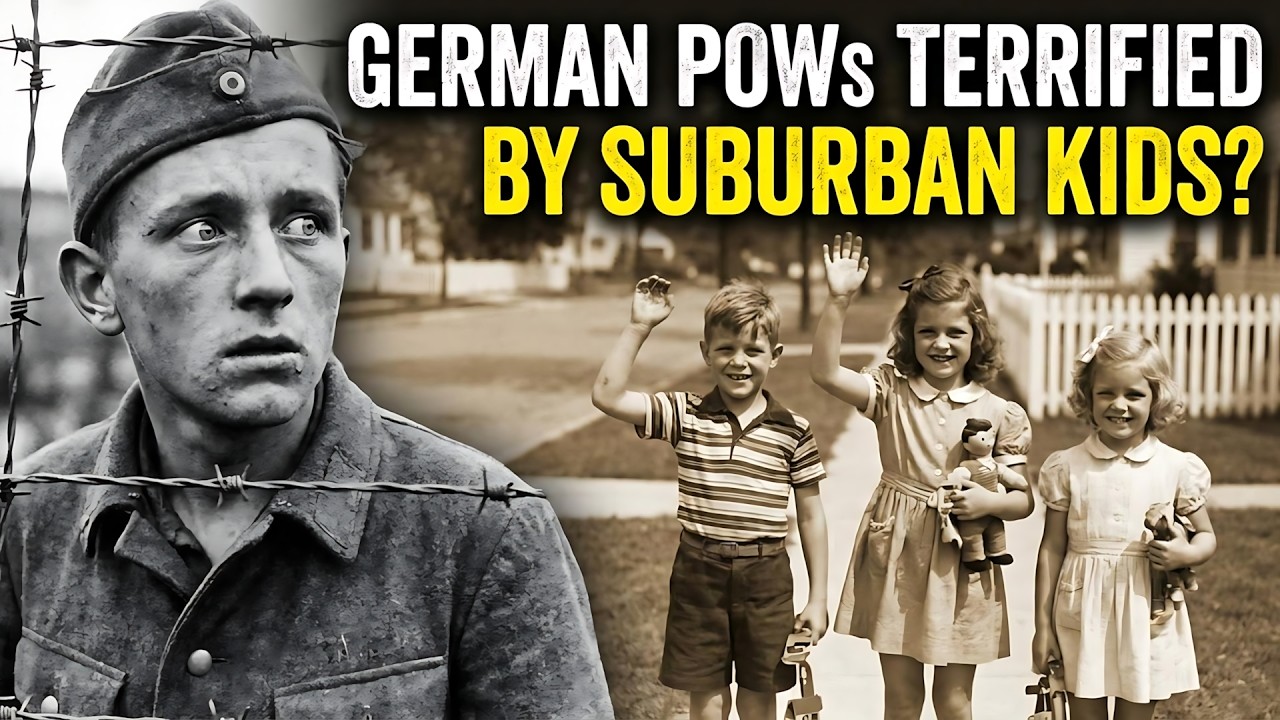
It would not be a cannon, a tank, or a general. It would be the sight of American children riding bicycles down a dirt road, laughing.
To understand why that image could wound more deeply than a bullet, you have to go back six weeks, to a hedgerow outside Saint-Lô, where a young German soldier named Heinrich Bauer lay face down in wet mud, listening to the rumble of an American armored column. He could not see it, but he could feel a low thunder moving through the ground and up into his ribs.
Bauer represents the kind of young man who filled these camps. His story is assembled from letters, diaries, and oral histories left by German soldiers. It is not a documented account of one single person, but everything that happened to him happened to someone in exactly this way.
He had been in Normandy for eleven days. He had not eaten a hot meal in four. In his breast pocket he carried a photograph of his three-year-old son standing in front of a destroyed apartment building in Munich, because that was where his family now lived after the building next to their home was hit in an air raid the previous winter. His wife had written that the boy had begun flinching at loud sounds. Bauer had not yet replied, because he did not know what to say to a woman raising a frightened child alone in a city that kept shrinking.
Two nights before his position on Hill 192 fell, Bauer's company was dug in behind a hedgerow so dense it was almost a wall. An older sergeant, a man who had fought in Poland and France and possessed the flat calm of someone who had used up most of his fear, passed along a rumor that would turn out to be only partly true, as rumors always are in an army running short of good news. He said the Americans were running out of everything back home. A reckless push toward nothing. Entire cities on strike. He said it the way you say something that has to be true.
Bauer, twenty-six years old, with only three days left before his capture, wanted desperately to believe it. Because if it were true, this war of attrition against a country that would collapse before Germany was survivable.
He had no way of knowing, lying in that trench, that 1,100 miles away in a Chicago rail yard, a boxcar of Indiana sweet corn was being loaded for shipment east. Or that the farm boy who would one day drive him to detassel corn near Edinburgh was at that same hour coming home from baseball practice, asking his mother what was for dinner. A question that had never once been left unanswered in his life.
Two entirely different wars were being fought that night, and only one side knew it.
He was captured two days later near Hill 192 when the enemy overran his position and the officer beside him was killed trying to pick up a grenade he never managed to throw. Bauer raised his hands.
He had been told through his training, by his officers, and through the pamphlets distributed to soldiers that the Americans did not take prisoners in the field. That surrender itself was a death sentence, if a slower one. And if he survived the moment of capture by chance, what awaited him across the ocean was a country groaning under total war. Its people starving and exhausted, its cities blacked out, its factories running on their own ashes because everyone who could work had been swallowed by the war machine.
This was not a passing rumor. It was settled doctrine. Goebbels' ministry had spent years insisting that the American home front was on the verge of collapse at any moment. That rationing had emptied its kitchens. That its pampered people could never withstand a two-front war. That the whole Allied project was a bluff waiting to be called.
Bauer believed some of it. He had no good reason not to. He had never seen America. Almost none of the men in his battalion had.
What happened next was almost routine for how little drama it carried, which was itself a kind of horror. He was herded into a barn with hundreds of other men, most of them younger than he was. Some were boys who had lied about their ages to put on uniforms before the line became unnecessary after recruiters stopped asking.
They were searched, tagged, photographed, and eventually moved onto trucks, then trains. Then, in Bauer's case, onto the Argentina, a converted passenger liner that sailed from Cherbourg about ten days after his capture, one of hundreds of ships that would ultimately carry roughly 425,000 German prisoners across the Atlantic.
Throughout the war, ships were mostly moved west as ballast or to fill cargo space on transports that would have returned to America empty after unloading troops and equipment, part of wartime shipping logistics that changed the lives of hundreds of thousands.
Bauer expected the crossing to be brutal. He had heard stories, perhaps invented, perhaps real. He could no longer tell about prisoners starved on these voyages, used as human cargo in the ugliest sense of the word, packed into the hold as if they were goods to be replaced.
On the third day of the voyage, he was handed a tray with white bread, a pat of real butter, canned peaches, and coffee that did not taste like roasted acorns. He did not eat it immediately. He sat with the tray on his knees for a moment, turning it slightly the way you turn something you suspect is a trick.
One of the guards watching him finally said, flatly, "Eat it. You're not going anywhere."
Bauer ate it. He would later write in a letter that his censors allowed through without leaving any noticeable mark on it that it was the first meal in eight months that made him feel for a few minutes that he was not just an animal kept alive for some purpose.
He did not yet know that this feeling, gratitude that quickly turns to confusion, was only the beginning of something much larger that would be imposed on him gradually over the following weeks, until it stopped being a feeling of comfort and began to be a feeling of grief.
Under the 1929 Geneva Convention, a signatory state is obligated to feed, house, and treat prisoners of war according to standards no lower than those provided to its own garrison troops. America did not merely meet this requirement. At the time, it was feeding its own soldiers better than almost any other army in the history of warfare.
Under the treaty, that same standard extended, through the wire fences of camps in Texas, Indiana, Kansas, Wisconsin, and dozens of other states, to men who had been trying to kill American soldiers weeks earlier.
One of the oddities of this war was that a German prisoner working on a Kentucky tobacco farm during part of 1944 was likely consuming more meat, butter, and sugar in a single week than his children in Munich consumed in a month.
Bauer did not yet know this in numbers, but he was about to learn it in a way worse than numbers, in a way that showed on faces.
He went through processing at Camp Shanks in New York, then was moved by train over three days to Camp Atterbury, a sprawling collection of cardboard barracks and guard towers set amid the fertile farmland of central Indiana, about forty miles south of Indianapolis.
The train windows were not blacked out. No one had told him they would be, and it had not occurred to the guards that this mattered, because they simply saw the Midwest passing by: silos, grain elevators, church steeples, and scattered gas stations with Coca-Cola signs hanging on chains.
Bauer watched from a wooden seat, his forehead almost touching the glass. These were the first uncensored glimpses of enemy territory he had seen in his life, and none of them suggested a country falling apart. The fields were green and unbombed. The barns were red and standing. Nothing was rationed down to a shadow.
He found himself counting, unintentionally, the number of undamaged buildings he passed in a single hour. Then he stopped counting, because the number had ceased to be meaningful and had become unbearable.
He arrived at Camp Atterbury in the last week of July and was assigned a bed in a compound of about 3,000 men. Within days, he was receiving the same basic rations as an American trainee: eggs, bacon, fresh milk, white bread free of sawdust or potato flour, oranges. Real oranges, which many of the younger prisoners in his barracks had never tasted in their lives. The effects of wartime rationing had been with them since childhood, before citrus ever reached their tables.
Some men overate during the first week and made themselves sick. Camp doctors recorded, with considerable surprise, a mild outbreak of stomach ailments among newly arrived prisoners, ailments unrelated to disease, caused instead by digestive systems that had simply forgotten what abundance meant.
Bauer ate more cautiously. He had begun, without fully admitting it to himself, to distrust his own hunger, because every time he satisfied it here, another part of him, the part that kept a photograph of a three-year-old boy flinching in his breast pocket, began to ache in an entirely different way.
The camp itself, behind its wire, seemed strangely humane. There was a canteen where prisoners could buy beer and cigarettes with the modest wages they earned from their labor. There was a soccer field. Men who showed artistic talent were given paints and canvases. Men who showed musical talent were given instruments. In the evenings, the barracks filled with the echoes of German folk songs.
As the months passed, jazz music broadcast over American radios grew more popular, because no one had forbidden these prisoners from listening to the radio. And so they did, gathering around a shared set after lights out, catching fragments of Glenn Miller and, more disturbingly, censored war news that did not match reality.
One briefing they received before being sent out. Here the second crack began to appear. Not in the food, but in the information.
Bauer heard for the first time from a source he had no reason to doubt that the war in the East was going very badly, that the Allies had broken out of Normandy and were moving fast, and that Paris was about to fall. None of this had been in anything he was told before his capture. It turned out all of it was true.
But the first real crack, the one that preceded the bicycle incident and paved the way for what was coming, happened during a supply mission into Edinburgh itself, three weeks after Bauer arrived at Camp Atterbury, when he and four other prisoners were sent under guard to help unload feed sacks at a grain elevator one building away from Main Street.
It was a short walk from the elevator to the truck, past the front of a grocery store, and Bauer, carrying nothing, glanced in the way anyone glances at a lit storefront. Then he stopped walking so suddenly that the guard behind him nearly bumped into his shoulder.
The window was full of cans, unrationed, without chalk marks setting a fixed price that changed with every round of the war, not guarded behind a counter that required a coupon book to approach. Simply stacks of peaches, green beans, and condensed milk, three or four layers deep. A pyramid of tomato soup built by a shopkeeper who had enough extra cans to display them. An act of commercial confidence no German shopkeeper could have afforded since 1941.
Beside the cans, in a wire basket, was a pile of chocolate bars wrapped in shiny paper. The kind of thing his son had never held, because chocolate had not existed for children in Munich for years. Not really, not real chocolate. It was only a ration substitute, so low in cocoa that mothers had stopped calling it chocolate and begun calling it simply "the brown bar."
Bauer stood in front of that window for about four seconds before the guard gently asked him to keep moving. He kept moving. But something had quietly shifted its weight inside him, the way a house's foundation shifts before anyone notices the crack in the wall above.
It was the work details, though, that did the real work on him. Because a work detail does not just supply you with information. It places you in the middle of an ordinary American day and asks you simply to stand there and endure it.
Nearly half of all German prisoners held in the United States were eventually assigned to agricultural or industrial labor. It was a program born of desperate need. With millions of American men in military service overseas, the country faced a labor shortage at the very moment its farms needed to produce record crops to feed its troops, its allies, and its civilians.
Farmers in Indiana, Wisconsin, Texas, and dozens of other states applied to the government for prisoner labor the same way they would have applied for a tractor loan. By the summer of 1944, it had become a familiar sight across the vast American countryside to see a truck loaded with German soldiers, guarded by a single armed soldier often younger than the prisoners themselves, being driven to cornfields, cotton picking, or tobacco harvesting, through the same towns these soldiers had been trying to help defeat weeks earlier.
On the morning of August 9, Bauer's detail, eleven men, one guard, and a farmer named Delbert Hawkins, who had three sons currently serving somewhere in the Pacific whose names he was not allowed to mention, was driven along Highway 31 toward a cornfield outside the small town of Edinburgh.
It was a short trip. The road ran about a quarter mile, passing directly by a row of modest homes on the edge of town. The kind of street with a small store, a church with a white steeple, and a cluster of children enjoying the last weeks before school started.
Bauer sat near the tailgate of the truck. He rested his forearms on his knees, watching the town pass the way you watch anything to pass the time. Then the truck slowed at a stop sign.
For about eleven seconds, nothing happened in the world except a residential street in southern Indiana, going about its business the way residential streets do on a hot summer morning.
There was a boy on a bicycle, perhaps eight years old, weaving lazily back and forth across the empty road, not using his hands, testing his balance the way boys test everything. There was a girl on the sidewalk wearing sneakers and short white socks, turning a jump rope for two smaller children while counting something out loud. A rhyme Bauer did not understand, but whose rhythm he recognized immediately, because children's counting songs sound the same in every language. That sing-song cadence that belongs to childhood itself and not to any particular country.
Somewhere off to the side, a dog was barking at nothing in particular, happy with itself. A screen door banged shut. A mother called one of the children's names from a porch. Not urgently, just a calm call from a woman who was not in the least afraid that her child would come to harm in the next five minutes.
In Edinburgh, Indiana, in August 1944, a child on a bicycle not coming to harm was the default assumption of the day.

Bauer did not move, and neither did many of the men around him. One of the younger prisoners, a nineteen-year-old soldier named Gard, who had not spoken more than a dozen words since Normandy, stared at the boy on the bicycle with a look that Hawkins, the guard watching from the cab mirror out of habit, later described to his wife as that of a boy who had seen a ghost.
But it was the reverse, wasn't it? Hawkins said. He isn't looking at the dead. He's looking at the living. He's looking at a kid who has never missed a meal in his life. And that's worse for him than any corpse.
What Bauer was looking at, and could not stop looking at, was not simply a healthy child. Germany had healthy children too, or had once. What he was looking at was a child who had never had to think about being healthy, with round cheeks and sun-darkened skin, indifferent to his own safety in a way only a child who has never known bombing can be.
He threw his bicycle down in the dirt without a thought, because bicycles in this world were replaceable, and childhood in this world was not something that had to be defended.
He thought of his son, not gently. The thought came like a blow. The photograph in his breast pocket was suddenly unbearably heavy, three pieces of paper that now felt like they weighed as much as the truck he was sitting in.
His son was three years old and flinched at loud sounds. His son had learned, at the age when this boy on the bicycle was learning to ride without hands, to recognize the particular pitch of air-raid sirens and to run rather than walk toward the nearest shelter. His son had eaten, on his best days this year, food an American farm dog might refuse.
And here, forty miles from a city Bauer had never heard of eight weeks ago, in a country whose government had sworn it was collapsing under the weight of war, a boy the same age his son would be next year or the year after was riding in circles on the road because he was bored, because there was nothing more urgent to do, because the greatest danger facing this child on this Tuesday morning was scraping his knee.
This is the moment the title refers to, and it deserves to be said plainly, without hedging. This is what terrified them. Not the artillery, not Omaha Beach, not the fortifications, not the tank column outside Saint-Lô.
What stirred something in the men who had survived all of that was a street full of children who did not know they were supposed to be afraid, because that scene was, within eleven seconds, conclusive proof of two things at once. A soldier can survive believing one hard thing, but he rarely survives believing two.
The first thing it proved was that everything he had been told about America was a lie. The propaganda pamphlets, the confident assurances of collapse, the entire structure of belief that had made this war look winnable, had been built on nothing. Because this could not be fabricated. A child carefree enough to throw down a bicycle in a country supposedly starving.
The second thing it proved was worse, and none of the letters home said it explicitly, though you can read it in everything they circle around. If this country was not about to collapse, then the war was already lost, and perhaps had been lost for some time. And every man who had died since the moment the war became unwinnable, friends, cousins, the officer beside him reaching for a grenade he never got to throw, had died for nothing anyone could name as a cause.
This is not fear the way a bullet causes fear. It is slower and colder. The camp records, alongside the letters, hundreds of which were preserved in postal censorship archives because every outgoing prisoner letter was read and copied before being allowed to leave the country, are full of men trying to describe it without quite managing to.
One prisoner held at a camp in Oklahoma wrote to his family that he had seen American children eating candy in front of a movie theater and had to walk away because he did not trust what his face would do. Another at a camp in Wisconsin described watching a Fourth of July display from behind a fence and wrote that it was the first time since his capture that he had cried not from homesickness but from something he called, in his broken phrasing, "the death or the understanding."
The realization, the understanding, the moment of comprehension comes whether you invite it or not.
At Camp Hearne in the flat woodlands of central Texas, prisoners assigned to a nearby farm reported almost identical reactions to a group of local children who rode out on horseback most afternoons just to watch the Germans work. They waved from a safe distance, imposed by the guards more out of habit than real concern. One of these prisoners later wrote that the strangest feeling he had during his captivity was not fear of the children, but the intense envy he felt watching them ride with no purpose at all. Not to escape, not to carry a message, not in fear of bombing roads, but simply because riding on a Tuesday afternoon was, for them, a form of entertainment.
At Camp Crossville in Tennessee, a prisoner remembered the sound of a high school band practicing in a field behind the barbed wire and said what disturbed him was not the music itself, which was ragged and off-key, but the fact that a country at war could apparently spare the time, the instruments, and its teenagers' leisure for something as trivial as carrying information for unthreatened pleasure.
Bauer's own letter, written that same night in the Camp Atterbury barracks by the light of a lamp the Army had hung for that specific purpose, is shorter than most. He tells his wife the food is good. He tells her he is not being mistreated. Then, in a sentence his censors appear to have considered too oblique to bother flagging, he writes: "I saw a boy on a bicycle today, and I could not stop thinking about what we did to our bicycles."
He did not send it for three days. He carried it folded in the same pocket as the photograph, took it out twice to read it again, thought about tearing it up both times, and finally handed it to the mail clerk on a Thursday morning with the deliberate motion of a man setting down something heavy he had carried for a long time.
It would take nearly six weeks to reach Munich, crossing the ocean by ship the same way he had, arriving in a city that had endured two more air raids since he last heard from it. His wife would read it standing in the doorway of an apartment whose windows were boarded shut, and she would not fully understand what he meant. How could she, thousands of miles from a cornfield in Indiana? But she would understand the tone beneath the words, the profound exhaustion of a man who had stopped believing the war could be won and had begun fighting it himself. Instead, he was simply trying to survive it and come home.
Bauer's reaction was not unusual. It was, if anything, the rule, and American camp officials noticed it almost immediately, though they did not fully understand what they were seeing.
At first, camp commanders across the country began filing reports describing a marked despondency among prisoners after work details near towns, especially those that placed them near schools or playgrounds or, worst of all, grocery stores stocked with goods. One report from a camp in Nebraska noted, in an almost scientific style, that prisoner morale, which the Army was obligated to track under Geneva Convention commitments, had declined noticeably after agricultural work assignments, and that this decline was not linked to harsh treatment, which was extremely rare, but to unsupervised exposure to ordinary American civilian life.
The irony in that sentence is almost self-evident. The kindest possible treatment of these men produced some of the deepest psychological wounds they suffered during captivity, because of the cruelty they had been prepared for. The consolation offered by the enemy to a soldier who had just seen his country ration his son's bread to 100 grams a day is hard to bear while maintaining one's view of the world.
For its part, the United States government was not blind to the propaganda opportunity behind this psychological collapse. In 1944, the government established an entire secret apparatus to exploit the phenomenon. It was formerly known as the Special Projects Division for Prisoners of War, administered from Fort Kearny and later from Fort Eustis in Virginia, where prisoners classified as anti-Nazi or simply disillusioned were directed toward a weekly newspaper called Der Ruf.
The paper was filled with uncensored war news, articles about democratic governance, and most importantly, photographs of ordinary American life, from supermarkets and suburban streets to schoolchildren. These were precisely the images that had already done half the government's work in corn and cotton fields across the country.
Some historians have described it as one of the most successful psychological operations of the war, not because it succeeded in converting committed Nazis, which it mostly did not, but because it gave men like Bauer, who had already been deeply affected by what they had seen with their own eyes, a framework and a vocabulary for describing their feelings.
By the end of the war, tens of thousands of German prisoners had passed through some version of these reeducation efforts, and a remarkable number of them requested, when repatriation began in 1945 and 1946, not to go through punitive processing centers in the American zone of occupied Germany, but ultimately, if they could, to the United States itself, not as prisoners but as immigrants.

Thousands of them did exactly that in the years after the war, choosing to build their lives in towns near the camps and farms where they had picked cotton or detasseled corn under armed guard. Some married local women. Others entered business partnerships with the very farmers who had been legally entitled to work them twelve hours a day for fifty cents.
Not every prisoner processed the shock the way Bauer did. An honest telling of this story has to account for that, because a single unified reaction from 400,000 men would itself be a kind of propaganda.
In a number of camps, committed Nazis, often young men raised entirely inside the Hitler Youth who knew no other framework for understanding the world, responded to the same evidence with the opposite conclusion, treating America's abundance itself as a kind of proof. Not of truth, but of decadence: a degenerate civilization that would collapse the moment it faced real hardship. The children on bicycles were simply evidence of a people too comfortable to fight.
Some of these men turned that anger toward their own barracks. Camp administrators at several facilities, including one not far from Atterbury, documented secret Nazi tribunals held after lights out. Show trials convened to punish prisoners suspected of what the hardliners called defeatism. In at least some recorded cases, the punishment turned violent. Sometimes it was fatal, with men beaten or, in the most extreme documented incidents, killed by their own countrymen for the crime of being seen enjoying an American meal in public or speaking too warmly about a guard.
Gard, the nineteen-year-old who had frozen at the sight of the boy on the bicycle, spent months afterward acting with deliberate coldness toward Bauer in the barracks, having decided that whatever Bauer had allowed to happen to himself on that road, he would not allow to happen to him.
Nearly two years later, long after returning home, a letter reached Bauer from a mutual friend informing him that Gard had finally absorbed it, not in a camp in Indiana, but in a bread line in occupied Munich, watching his own countrymen queue for rations even smaller than those that had helped ignite the war in the first place. It turned out this was a lesson every man on that front had to learn in his own time and place.
Whether that lesson reached him on a bicycle or in a bread line, Bauer's story does not end with a bicycle in a cornfield. Though that moment never entirely left him.
He spent the rest of the war moving between various jobs at Camp Atterbury, picking tomatoes in September, apples in October, then working for a time in a canning plant that winter. In each of these jobs, in small ways he mostly kept to himself, that boy on the bicycle kept reappearing. He noticed that he watched children more attentively than anything else during these jobs. Just as a man returns, involuntarily, to the site of an injury to check whether it still hurts.
This happens every time. But something else happened very slowly over the eighteen months he spent as a prisoner in the American Midwest. Something his homeland's propaganda had not prepared him for.
The guards stopped feeling like captors. Delbert Hawkins, the farmer who had driven the first truck to the cornfield outside Edinburgh, began bringing an extra sandwich most mornings. Not because he was forced to, not because anyone ordered him to, but because he had three sons somewhere in the Pacific and had decided, in his own quiet Midwestern way, that feeding another man's son was a kind of prayer for his own.
By the following spring, Bauer knew the names of Hawkins' sons. He had seen their photograph kept in the truck's glove box. Three young men in three different uniforms. There was a strange, unspoken understanding that passed between the two men every time that photograph appeared. Not friendship, not yet, but something close to it. Something neither side's propaganda machine had accounted for.
The possibility that the people you had been sent to fight might simply be, on a hot morning in a cornfield, people.
In March, a telegram arrived at the Hawkins farm, and the news spread across the county the way it always does in a place that size, reaching the prisoners the next morning before Hawkins himself had said a single word about it. His middle son had been wounded in Luzon. Not killed, the family was careful to specify, wounded, a leg that would heal crooked but would heal.
For two days, Hawkins did not come out to drive the truck at all, sending a hired man in his place, a stiff, silent substitute who watched the prisoners as if they were responsible for what had happened 8,000 miles away in the Philippines.
On the third day, Hawkins was back behind the wheel, and no one said anything about it until near the end of his shift, unloading tools at the edge of the field, Bauer found himself standing beside him and said, in his slow, careful English, that he was glad the boy would live. It was a short sentence. It cost him something to say it, a German soldier expressing relief that an American marine had survived.
Hawkins acknowledged it with a simple nod instead of walking away, which would have been easier for him. The two men never mentioned it again, but the extra sandwich kept appearing in the morning. It even began appearing in greater quantity.
He was repatriated in the summer of 1946, nearly two years after that morning outside Edinburgh, after first being sent to a punitive labor camp in France. A bitter irony: the country that had fed him better than his own army had simply handed him over to an ally less inclined toward the generosity of the Geneva Convention, and he spent another four months on a demolition crew outside Le Havre before finally being released and put on a train heading east.
When he finally reached Munich, the city did not resemble the one in the photograph in his breast pocket, the one showing the destroyed apartment building behind his son. It looked worse. Farther in, piles of rubble. A small grocery reopened in what had once been someone's living room. A woman selling flowers from a cart. A pit where a fountain had been.
His wife was thinner than her letters had suggested. His son was now five, taller than Bauer had expected, still a little quiet for a child his age, but no longer flinching at loud sounds the way he used to. Because the loud sounds, for the most part, had finally stopped. And because a five-year-old, given a little quiet, will usually return to himself.
Bauer did not tell his son directly about the cornfield, or the bicycle, or the eleven seconds that had broken something in him that three weeks of combat had never touched. But years later, when his son grew older and asked him, as children always do, what the worst part of the war had been for him personally, worse than the fighting, worse than the capture, worse than watching a friend die trying to reach a grenade, Bauer would think about it for a long moment. The way you think about something you have turned over in your mind a thousand times but never spoken aloud. And he would simply tell him about a road in Indiana. And a boy no older than his son riding a bicycle with no hands, throwing it down in the dirt without hesitation.
In that boy's world, nothing bad was supposed to happen to a child on a summer morning. And he would say that was the moment he realized they had already lost. Not the war, but something behind it, something none of them had ever been issued.
He kept one other thing from those years besides the memory of the bicycle, though he did not show it to anyone for a long time. It was a small, cheap toy car, made of red-painted tin, given to him by Hawkins in the week before Bauer's detail was transferred from the Edinburgh farm for the last time. It was not a grand gesture, just something the older man had picked up in town, pressed into his hand as if embarrassed by it, saying only that it looked like something a father would bring to his son.
Bauer carried it through the rest of the war in the same pocket as the photograph, and it was waiting for him on the mantel shelf of a rebuilt apartment in Munich on the day his son turned six. A piece of tin from Indiana sitting in a city that had spent years trying to erase every trace of America from its name. His son played with it for years, never once knowing where it had come from, and never knowing anything about a cornfield, a bicycle, or that particular kind of grief that comes from watching a stranger's child live a childhood you could not give your own.
The bicycle does not exist in the history books. No official report mentions it as a factor in German morale. No war college studies it as a case study in psychological warfare, because no one planned it. No one used it as a weapon deliberately, and no one could have. It happened the way the truest things in this war often happened. Sideways, by accident, in the space between a stop sign and a cornfield, where a farmer's truck slowed for eleven seconds and let two childhoods separated by an ocean and everything that ocean stood for look directly at each other for the first and last time.
One of those childhoods survived that summer gap. The other had already been torn apart piece by piece in a war its country insisted it was winning. And somewhere in the space between them, between a boy whose father had never known fear and a father whose fear for his son had never stopped, is the real explanation for why hardened German soldiers, men who had crossed a beach under enemy fire and survived, came home from America not talking about the guns they had faced, but about the children they had seen.
Because the guns had only tried to kill them. The children had shown them what they had already lost.