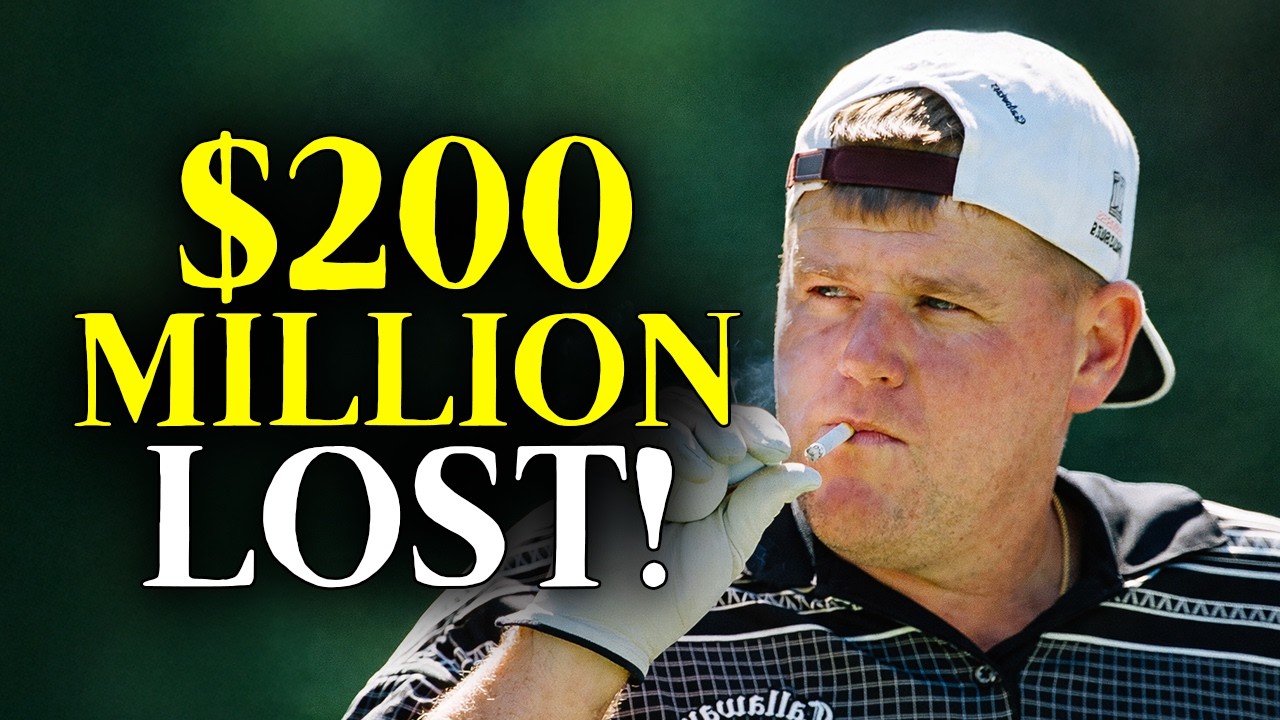
John Daly lost an estimated $60 million gambling in Las Vegas, and then he went back to the casinos and asked for more credit. That request came after he had already publicly documented his losses in his own autobiography, a fact that has made his story one of the most striking cautionary tales in modern sports. Before he became synonymous with gambling losses, Daly was known for something entirely different: a golf swing unlike anything the sport had seen. Born in Carmichael, California in 1966, he grew up in Dardanelle, Arkansas, a small town where his father introduced him to golf at age four.
The raw power he displayed from that first swing set him apart, and he was playing off scratch by the time he was 12. Daly has been candid about the fact that heavy drinking began early in his life, well before fame arrived. He has said he was drinking heavily throughout his college years at the University of Arkansas, and he turned professional in 1987, spending years grinding through minor tours where prize money barely covered expenses. His breakthrough came at the 1991 PGA Championship at Crooked Stick in Indiana.
Daly was the ninth alternate for the event, meaning eight other players had to withdraw before he even received a call. He drove through the night from Memphis, arrived without a practice round and with a caddie he had never worked with, and then won the tournament by three shots at 12 under par. The gallery abandoned the established stars to follow the unknown blonde with the mullet who hit the ball distances no one else could reach. He won his second major at the 1995 British Open at St.
Andrews, defeating Costantino Rocca in a playoff. By age 29, Daly had two major championships, something most professional golfers never achieve in an entire career. Sponsorships from Callaway, Wilson, and Reebok followed, and working-class America embraced him in a way the sport had rarely seen. He wore loud pants, ate fast food, drank, and made no effort to hide who he was.
The same authenticity that made him beloved also fed the behavior that would cost him so much. Las Vegas became his second home, and slot machines became his particular obsession. Daly has described sessions that lasted 18 to 20 hours, starting in the afternoon and ending when the morning shift arrived. Addiction researchers have called slot machines the crack cocaine of gambling because they are engineered to produce compulsive behavior.
The near-miss effect triggers the same dopamine release as an actual win, and the random reinforcement schedule is one of the most powerful behavioral conditioning mechanisms known. Daly has said the machines also offered something he could not find anywhere else: solitude. A place where he did not have to perform or be the public character known as Long John Daly. In his 2006 autobiography, My Life In and Out of the Rough, Daly wrote that he had lost somewhere between 50 and 60 million dollars over the course of his gambling career.
His total career earnings on the PGA Tour were approximately $9. 9 million, meaning his gambling losses were roughly six times everything he ever earned playing professional golf. He described playing $5 slot machines at the Wynn and the Bellagio, where each pull cost $500. At that level, he could burn through $25,000 in an hour.
He described one session where he lost $1. 65 million in five hours. Daly did not hide his gambling the way many addicts do. He wrote about it in a book, told interviewers directly, and acknowledged the losses publicly.
And after doing so, he continued to receive casino credit from various establishments and continued gambling heavily. His personal life accumulated its own wreckage during this period. He went through four marriages, multiple rehab stints, and a six-month PGA Tour suspension after police found him intoxicated outside a Hooters in North Carolina at 2:00 in the morning. One of his wives was eventually arrested for money laundering connected to a cocaine distribution ring.
He underwent lap-band surgery in 2009, lost weight, and gained it back. In 2019, Daly announced on Twitter that he had been diagnosed with stage four bladder cancer. He said he planned to keep playing golf and keep showing up, and he did. Corporate sponsors largely stayed with him through the public chaos.
Hooters sponsored him and put their logo on his bag. Loudmouth Golf, the company known for aggressive patterns, built a lasting relationship with him. From a marketing perspective, the decision made sense: people watched him, talked about him, and remembered him. Daly’s story resists a neat conclusion.
He is not a villain or a straightforward cautionary tale that ends with redemption or ruin. He is a man of extraordinary talent who found in slot machines something the golf course could not provide: a way to stop being the public figure and simply disappear for a few hours. Vegas did not create his addiction. The drinking began long before the casinos.
But Vegas gave the addiction a place to live and a machine to feed. The image that lingers is Daly sitting alone in a casino at 2:00 in the morning, well known to everyone working there, feeding the machines while trying to vanish. Daly continues to appear at events, sign autographs, and smile for cameras.
The record books still hold his two major championships from 1991 and 1995, and those wins remain untouched by everything that followed.