In March 1945, with the Third Reich collapsing, a column of German officers approached American lines in western Germany with white flags raised. These were not ordinary soldiers but Wehrmacht officers, well-dressed in clean uniforms and polished boots, some still wearing medals. They had heard the rumors that the Americans were soft and civilized, and that they followed the Geneva Convention to the letter.
One German major later described the expectations he and his fellow officers carried. "We believed we would be treated as fellow officers," he said. "Proper quarters, hot meals, perhaps even cognac." They were wrong.
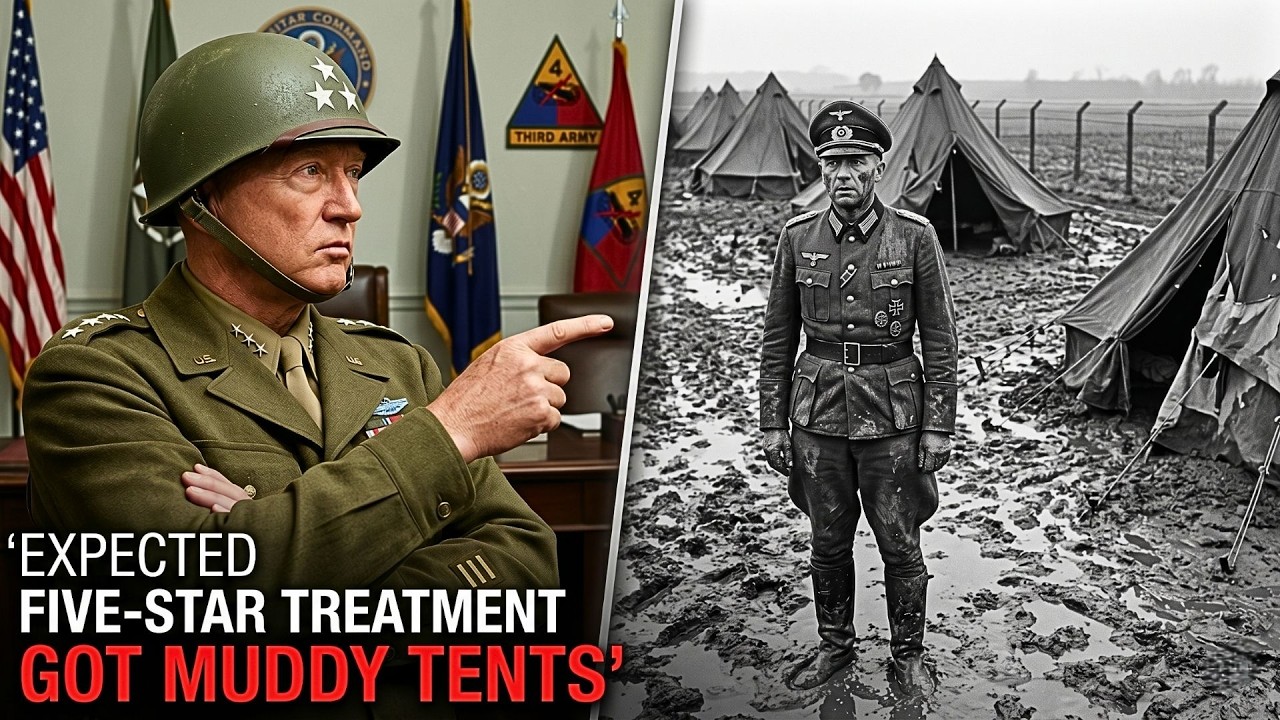
The American unit that accepted their surrender was part of General Patton's Third Army, and Patton held very specific views on German POWs, especially officers. The Germans were loaded onto trucks and driven to a processing camp. They expected barracks, perhaps even individual rooms and officer privileges. What they got was a muddy field, wire fencing, and canvas tents, half of them torn, sitting in six inches of mud. There were no beds, no heat, and no hot food.
One German officer protested and demanded to speak to the camp commander, citing the Geneva Convention article, verse, and subsection. The American sergeant looked at him, smiled, and said, "The general says you get what our boys got in your camps, mud and all." The German officer went pale, because he knew exactly what conditions American POWs had endured in German camps.
Patton had made a decision, and a controversial one. German officers who had overseen prisoner camps, or who had allowed or ordered the mistreatment of Allied POWs, would not receive special treatment. They would experience exactly what they had given.
To understand why Patton made this decision, one has to understand what American soldiers found when they began liberating German POW camps in early 1945. The stories were horrific, consistent, and well-documented. American POWs held in German camps, especially Stalags and Oflags, had been subjected to conditions that violated every article of the Geneva Convention.
Starvation rations amounted to 800 calories a day, sometimes less. Men who had weighed 180 pounds at capture were down to 90. There was no medical care, wounds were left untreated, and diseases were allowed to spread, including frostbite, dysentery, and tuberculosis. Forced labor violated officer protections and basic humanity, with American officers forced to dig ditches, build fortifications, and work in factories.
Then there was the cold, brutal and deliberate. Barracks had no heat in German winters where temperatures dropped below zero. Men slept three to a bunk for warmth because there were no blankets.
When Patton's forces overran Oflag 64 in late January 1945 near the Polish border, they found 1,500 American officers emaciated and sick. Some could barely walk. The camp commandant, a German colonel, was still there. He had not fled, and he genuinely believed he would be treated as a fellow officer. He was wrong.
Patton arrived at the camp two days after liberation. He walked through the barracks and saw the bunks with three men per frame. He saw the kitchen, the tiny rations, and the scale that showed exactly how little food had been provided. He saw the unmarked graves outside the wire where men who hadn't survived were buried without ceremony and without names.
The German colonel approached Patton, saluted, and requested a formal officer-to-officer discussion. Patton looked at him for a long time, then turned to his aide, Captain Rosevich, and said, loud enough for everyone to hear, "This man ran a starvation camp. He is not an officer. He is a criminal. Treat him accordingly." The colonel was arrested, stripped of his insignia, and sent to a detention facility for war crimes processing.
But Patton didn't stop there. He issued a directive to all POW camps under Third Army control. German officers who had commanded POW facilities, or who were identified as having mistreated Allied prisoners, would receive what he called reciprocal accommodations. They would be housed, fed, and treated exactly as they had treated Allied POWs.
If they had provided starvation rations, they would receive starvation rations. If they had housed prisoners in unheated barracks, they would sleep in unheated tents. If they had denied medical care, they would receive minimal medical attention. It was, technically, within Geneva Convention parameters. The convention required adequate food, shelter, and medical care. It did not specify luxury, comfort, or special treatment. Patton's camps provided adequate, nothing more.
The muddy tent camp near Kassel became infamous among surrendering German officers. It was located on what had been a German artillery training ground. The ground was clay, heavy and dense. When it rained, which it did constantly in March, the entire camp turned into a swamp.
The tents were standard US Army issue, but deliberately the oldest available. Canvas was torn, poles were bent, pegs were missing, and there were no wooden floors or platforms. The tents sat directly on the mud, six inches deep and sometimes more. Each tent held 12 men.
There were bunks, technically wooden frames, with no mattresses and no blankets initially. Later, thin wool blankets were issued, one per two men. The latrine was a trench, open air, with no privacy and no cover.
Food was adequate by technical definition, 2,000 calories, the minimum required, but it was deliberately unpleasant. Boiled cabbage, watery soup, hard bread, no meat, no sugar, no coffee. One meal was hot per day, and the rest were cold rations. The German officers, many of whom had been eating well even as their own nation starved, were shocked.
A German captain, a former commandant of a work camp, complained to the American officer in charge, a lieutenant named Morrison. "This is unacceptable," he said. "We are officers. We deserve proper treatment." Morrison pulled out a file, the captain's service record.
"You ran Stalag 4B near Dresden. Is that correct?" The captain hesitated and said yes. "Our records show American POWs at that camp received 900 calories per day, worked 10-hour shifts in a quarry in winter with inadequate clothing. Is that correct?" The captain's face went red. "That was different," he said. "Wartime necessity."
Morrison smiled. It was not a kind smile. "You're getting 2,000 calories, no forced labor, and a tent. Wartime necessity, sir." He walked away. The captain stood in the mud, staring, beginning to understand.
Not all German POWs were treated this way. Patton's directive was specific. It applied to officers who had commanded POW camps or who had documented records of mistreating prisoners. Regular Wehrmacht soldiers, conscripts, and even regular officers with no connection to POW operations were housed in standard camps with barracks, adequate food, and proper treatment.
This was not collective punishment. This was targeted justice, and Patton was meticulous about documentation. Every German officer sent to the muddy camps had a file: service record, camp assignments, and reports from liberated Allied POWs identifying officers and describing treatment. If there was no evidence, the officer went to standard processing. If there was evidence, mud.
The policy was controversial. Eisenhower, the supreme commander, received complaints from the Red Cross, from German representatives, and even from some American officers who felt it was beneath American standards. Eisenhower reviewed the policy, read the reports, and visited a muddy camp himself. He saw the conditions, spoke to the German officers, and listened to their complaints.
Then he visited a liberated American POW camp, saw the survivors, and heard their stories. He returned to headquarters and called Patton. The conversation was brief. Eisenhower asked, "Is this policy within Geneva guidelines?" Patton replied, "Adequate food, shelter, medical care, all provided. Nothing in Geneva requires comfort."
Eisenhower paused. "Are you documenting which prisoners receive this treatment and why?" "Everyone. Full records, service history, witness statements." Another pause. "Continue." That was it. Eisenhower let it stand.
The muddy camps operated until May 1945, when Germany surrendered. In total, approximately 800 German officers passed through what became known informally as Patton's mud spas. After the war, during war crimes trials, several of these officers were prosecuted. Their time in the mud was ironically used as evidence of American adherence to Geneva. They had been treated poorly by their standards, but they had been fed, sheltered, not executed, and not tortured.
One German officer, asked why he hadn't been given a warm barracks, was told by a prosecutor, "You were given exactly what the Geneva Convention requires, and exactly what you gave. Fair, isn't it?" He had no answer.
Patton never apologized for the policy, and he never defended it publicly either. When asked after the war why he had done it, he said, "I wanted them to understand that actions have consequences. They treated our men like animals. I treated them like they treated ours. The Geneva Convention allows that. Morality demands it."
Whether one agrees or not, the policy achieved something. It sent a message to every German officer who had mistreated Allied POWs that there would be an accounting, not just legal, but personal. You would feel what you inflicted.
Today, the muddy camp sites are farmland again. There are no monuments and no markers. But in the archives in Kassel and in the National Archives in Washington, the records remain. Files on 800 German officers, service records, camp assignments, and a single notation: "Reciprocal accommodations provided per directive General Patton, March-May 1945."
The notation is bureaucratic and clinical, but behind it lies a very human story. Of men who expected privilege and received justice instead. Of a general who believed that the Geneva Convention didn't mean luxury, it meant minimum standards applied equally. And of American soldiers who had survived German camps and watched as their captors learned what cold, hunger, and mud actually felt like.