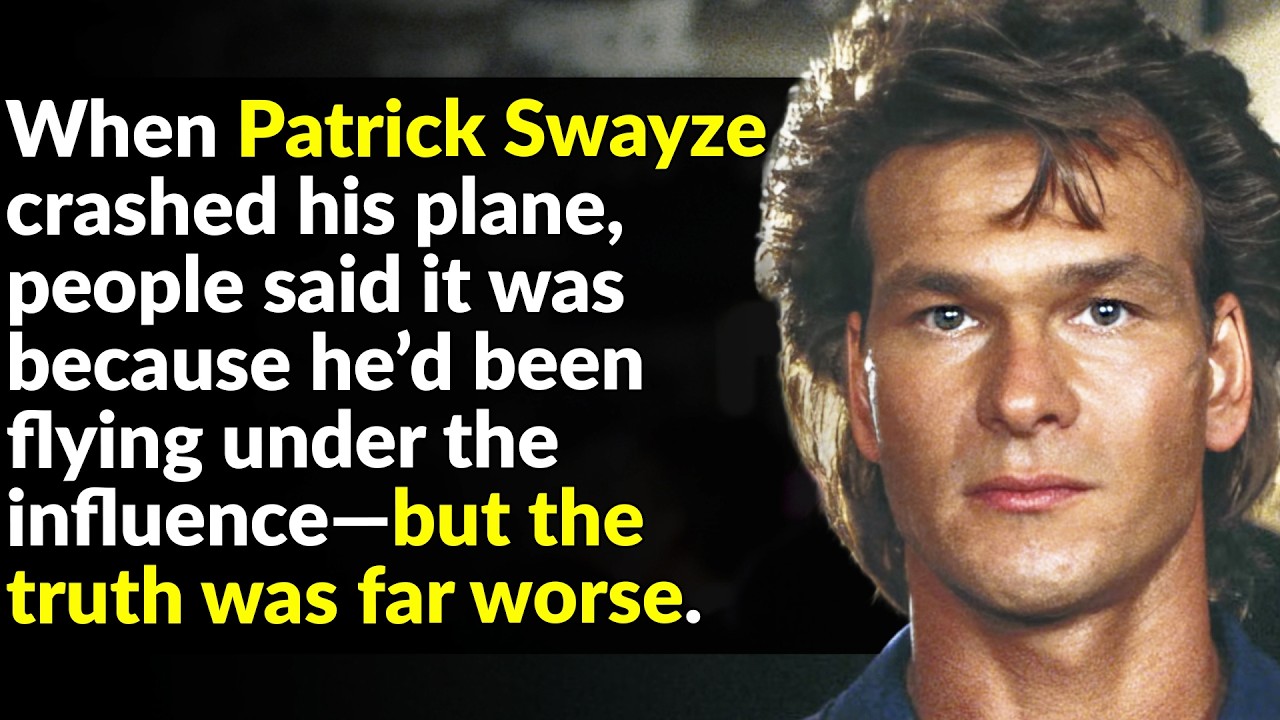
Patrick Swayze was best known for his charm and versatility, excelling in action films, romances, and musical performances. He could even dance like a professional. So when he crashed his plane, many assumed he had been flying under the influence. The real explanation, however, was far more serious.
Born on August 18, 1952, in Houston, Texas, Patrick Wayne Swayze grew up in a household that fostered his artistic side. His father was an engineer, but his mother, Patsy Swayze, was a dancer, choreographer, and dance teacher who clearly passed her talents down to her son. Despite his artistic interests, Swayze was also athletic and played football in high school, hoping to use a sports scholarship to pay for college. At the same time, he faced torment from classmates who mocked his love of dance, something that left him filled with rage.
He found an outlet for that anger through martial arts. After graduating, Swayze moved to New York City, where he trained with the Joffrey Ballet Company and worked as a figure skater. At 18, he met 14-year-old Lisa Niemi, one of his mother’s dance students. The two eventually began dating, and once Niemi turned 19, they married, beginning a lifelong partnership.
Swayze’s early career included performing in Disney on Parade, a Pabst Blue Ribbon commercial, a single episode of MASH, and a music video for Toto. He briefly led the biker series The Renegades, which lasted only one season. His big break came when producer Fred Roos, who had noticed him in Skatetown U. S.
A. , pushed for Swayze to audition for Francis Ford Coppola’s adaptation of The Outsiders. Coppola cast the film using group auditions, with actors competing against each other for various roles. Swayze secured a part in the film, which was a box office success, opening to over $5 million in its first weekend.
At that point, Swayze’s name was firmly at the top of the cast list for the 1984 film Red Dawn, even though he was over 30 and again playing a high school student. Red Dawn, a fictional story about a World War III invasion in Colorado, featured Swayze and co-star Jennifer Grey in an intimate scene set in a sleeping bag. According to Grey, the scene was cut because Swayze couldn’t remember his lines, allegedly because he had too much to drink. Grey also acknowledged that she was high on marijuana at the time.
Critics were not enthusiastic about Red Dawn, but audiences responded well, with the film earning over $8 million in its opening weekend. The success of Red Dawn was followed by the TV mini-series North and South. Then came the script for Dirty Dancing. Swayze was interested, but he had a knee injury and had kept dancing off his resume for some time.
He liked the script enough to risk performing with his bad knee. He also knew he would be reuniting with Jennifer Grey, but their time on Red Dawn had been tense. Grey disliked Swayze’s pranks on that set. Before their screen test for Dirty Dancing, Swayze pulled Grey aside to apologize for his behavior on Red Dawn and pleaded with her, telling her he loved her.
Grey knew he was working her, but she saw chemistry between them. The film’s writer, Eleanor Bergstein, whose life story inspired the movie, watched them dance together and called it breathtaking. Swayze and Grey got the roles. Despite their successful screen test, the chemistry faded once filming began.
In one scene, where Swayze had to brush his hand against Grey’s underarm, a tired Grey kept giggling at 4:00 in the morning. Swayze was also exhausted and visibly annoyed, and his irritated expression was caught on camera. Editors kept the moment, deciding it made sense for his character to look annoyed. The crew showed the two stars the footage of their first dance to help restore their connection, and the chemistry returned.
The producers of Dirty Dancing expected it to be a minor release, planning a single week in theaters before it went to video stores. It ended up earning about $214 million on a $4. 5 million budget. The sudden fame was difficult for Swayze.
He later admitted to turning to drugs and alcohol to cope with the attention, calling that period “Crazy Swayze. ”
Swayze lost his father in 1982. In an interview with Barbara Walters, he became visibly emotional and cried on camera. That moment caught the attention of producer Bruce Joel Rubin, who was looking for a masculine star unafraid to show vulnerability.
Swayze had just come off a string of tough-guy roles in films like Road House and Next of Kin and felt he wasn’t showing his sensitive side. He quickly agreed to join the project, which was Ghost. Director Jerry Zucker, known for spoof films like Airplane and Top Secret, was taking Ghost seriously and did not want Swayze for the part. Rubin convinced Zucker to at least audition him.
Swayze read the end of the movie, and by the time he finished, everyone in the room, including Zucker, had tears in their eyes. Swayze got the part. While critics were mixed on Ghost, it became a massive box office hit, collecting over $505 million on a $23 million budget. The film earned Whoopi Goldberg her only Academy Award and Golden Globe nominations for Swayze and Demi Moore.
Swayze followed Ghost with the surfing thriller Point Break, starring Keanu Reeves. He refused to use a stunt double, even though he barely knew how to surf. During the shoot, he pushed himself so hard he cracked four ribs. Point Break was another financial success, bringing in over $80 million worldwide and prompting People magazine to crown Swayze the Sexiest Man Alive.
At the height of his career, Swayze agreed to appear in a low-budget HBO film called Letters from a Killer. It was a critical and commercial failure, and during the production, he suffered a horseback riding accident that broke both legs. In 2000, Swayze was flying his Cessna 414 when he had to make an emergency landing on a dirt road. The plane’s wing hit a pole, but Swayze walked away unharmed.
Three witnesses, construction workers aged 20, 23, and 27, reportedly said Swayze was acting as if intoxicated and appeared to be asking for help to hide evidence of drinking onboard. Swayze avoided authorities for a few hours before emerging. When he was finally examined, his erratic behavior was blamed not on alcohol but on carbon monoxide poisoning from the plane’s engine exhaust, compounded by his chain-smoking, which left him severely short of oxygen. The three witnesses later faced legal trouble for allegedly fabricating the story to harm Swayze.
With no evidence of drinking, Swayze faced no charges. Swayze eventually returned to work. He starred in the London West End production of Guys and Dolls and later joined FX’s TV series The Beast, playing an FBI agent. Just after filming the pilot, he sought medical attention for stomach pain.
In January 2008, doctors diagnosed him with stage four pancreatic cancer. Tabloids immediately predicted his death was near. Despite the diagnosis, Swayze continued working on The Beast. In May 2008, he appeared at a Los Angeles Lakers game, showing the tabloid reports of his decline were exaggerated.
In September, he received a standing ovation at the Stand Up to Cancer simulcast. In January 2009, he joined Barbara Walters again and downplayed his illness, asking her to tell viewers he was “kicking it. ” Shortly after that interview, he was hospitalized with pneumonia caused by chemotherapy, but returned home two weeks later. In April 2009, doctors delivered more devastating news: the cancer had metastasized again.
On September 14, 2009, five months after that update, Swayze died at home. He was 57. He was survived by his wife, Lisa Niemi, who had been with him since they were teenagers. The couple shared ranches in California and New Mexico.
After his death, the Mountain Lake Lodge in Virginia, where Dirty Dancing scenes were filmed, honored him with a granite stone and displayed the guest registry page where he had signed his name. Swayze often resented his heartthrob status, which may explain why he never won major awards or full critical acclaim. It was in The Beast, his final project, that critics hailed his performance as the best of his career and the performance of a lifetime.