Stevie Nicks has spent more than five decades turning her most painful experiences into music, but there is one song she has never been able to bring herself to perform live. The song is “Illum 9/11,” written in the aftermath of the September 11 attacks. Unlike the heartbreak and band drama she has revisited on stage for years, this particular piece opened a door she refuses to walk through in concert. Born Stephanie Lynn Nicks on May 26, 1948, in Phoenix, Arizona, she was singing duets with her country-western singer grandfather by age four.
Her family moved frequently due to her father’s work, and she lived in several cities including Los Angeles, Albuquerque, El Paso, Salt Lake City, and the San Francisco area. Music was the constant that moved with her. She received her first guitar shortly before turning 16 and almost immediately wrote a song inspired by a teenage crush who chose her best friend instead. During her final year of high school in California, she met Lindsey Buckingham at a Young Life gathering.
They began performing together, eventually forming the band Fritz, which opened for artists including Jimi Hendrix and Janis Joplin. When Fritz ended in 1972, the couple continued as Buckingham Nicks, releasing an album that failed commercially. With their record deal gone, Stevie waited tables and cleaned houses while Lindsey focused on music. During this period, she wrote songs that would later define her career, including “Rhiannon” and “Landslide.
”
In late 1974, producer Keith Olsen played the Buckingham Nicks track “Frozen Love” for Fleetwood Mac drummer Mick Fleetwood. Needing a guitarist, Fleetwood called Lindsey with an offer on December 31. Lindsey’s response was conditional: he would only join if Stevie could come too. Fleetwood agreed.
Fleetwood Mac’s 1975 album, simply titled Fleetwood Mac, changed the scale of her life almost overnight. Her songs “Rhiannon” and “Landslide” helped define her image, and her live performances of the former were described by Mick Fleetwood as feeling like an exorcism. She also developed the flowing skirts, shawls, and platform boots that became her signature look with designer Margie Kent. Privately, her relationship with Lindsey was already falling apart.
Stevie later said they were breaking up as they entered Fleetwood Mac but tried to hold things together long enough for the band to become stable. By 1976, she ended it. However, they still had to rehearse, record, tour, and sing songs increasingly about each other. Work on the album Rumours began in 1976 amid widespread personal collapse within the band.
Christine and John McVie were divorcing, Mick Fleetwood’s marriage was failing, and Stevie and Lindsey were separated but forced to work side by side. Christine later described the atmosphere with one word: drama. What emerged from that tension was brutally personal. Lindsey wrote “Go Your Own Way” after the breakup.
Stevie hated the line about packing up and shacking up, later saying she wanted to kill him every time he sang it because he knew how much it bothered her. She responded with “Dreams,” which became the band’s only number one single on the Billboard Hot 100. Christine wrote “You Make Loving Fun” about a new relationship while her marriage to John was ending. Cocaine, alcohol, and long hours made the sessions unstable, but the chaos did not destroy the album.
Rumours spent 31 weeks at number one in the United States and won Album of the Year at the Grammys. One song, however, did not make the final track list. Stevie had written “Silver Springs” about Lindsey and believed in it deeply, but the band felt it was too long and did not want too many slow tracks. Mick Fleetwood informed her it would be replaced by “I Don’t Want to Know.
” Stevie later recalled screaming bloody murder and saying every mean thing she could think of. She was told she could sing the replacement or have only two songs on the record. She gave in but stayed angry. “Silver Springs” became the B-side to “Go Your Own Way,” sharpening the irony that both songs concerned the same broken relationship.
Touring did not calm things down. During one ugly onstage fight, Christine later said she confronted Lindsey because she believed he had mocked Stevie in front of a paying audience. During the Rumours tour, Stevie and Mick Fleetwood had a brief affair despite his marriage. Stevie later said she ended it quickly because continuing might have destroyed the band.
She described life inside Fleetwood Mac as a soap opera that was pretty scandalous and pretty incestuous. By the end of the 1970s, Stevie had more songs than the band could use. Around the same time, a relationship with Eagles singer Don Henley led to one of the biggest personal decisions of her life. Stevie later said she became pregnant in 1979 and had an abortion because she could not imagine raising a child while Fleetwood Mac was working constantly and drugs were everywhere.
She said she would have named the baby Sarah if it had been a girl. Her first solo album, Bella Donna, arrived in 1981 and went to number one on the Billboard 200. Songs like “Edge of Seventeen” and “Leather and Lace” proved she could succeed outside Fleetwood Mac. Yet the success arrived alongside the deepest loss of her life.
Her best friend, Robin Anderson, was diagnosed with leukemia while pregnant and died in 1982. Stevie later said she never really got to enjoy Bella Donna because something inside her disappeared during that period. Grief pushed her into a decision she later called a terrible, terrible mistake: she married Robin’s widower, Kim Anderson, to help care for the baby. The marriage ended after three months.
Drugs were becoming harder to control. In 1983, Stevie became involved with Eagles guitarist Joe Walsh, whom she later described as one of her greatest loves. Their relationship lasted until 1986, but both were struggling with addiction. Joe eventually pulled away, reportedly fearing that one of them would die.
By 1985, a plastic surgeon warned Stevie that another hit of cocaine could cause a serious medical emergency. After an Australian tour with Bob Dylan and Tom Petty, she checked herself into the Betty Ford Center for 30 days. She later made a point of saying nobody forced her to do it, adding, “I managed to save myself. ”
Cocaine was finally leaving her life, but the next problem arrived in a safer-looking form.
Friends worried she might relapse, so a psychiatrist prescribed Klonopin. Instead of giving her peace, the sedative slowly took over. Stevie later said it became worse than the drug she had gone to rehab to escape. During the late 1980s, she kept working, but she later said she had almost no memory of her 1989 tour.
By 1990, the medication was being prescribed in increasing amounts. That same year, tensions with Fleetwood Mac came to a head. Stevie wanted “Silver Springs” for her solo collection Timespace. Mick Fleetwood refused because he wanted to save it for a Fleetwood Mac box set.
Stevie called his action vile and said he would not even return her calls. After the tour, she left the band. Meanwhile, Klonopin was still controlling her days. She gained weight, stopped writing, and later described those years as a non-time.
In 1993, after falling at home and cutting her forehead, she entered the hospital and went through a painful 47-day detox. By the middle of the 1990s, Stevie was trying to rebuild. Fleetwood Mac reunited in 1997 for The Dance, bringing the classic Rumours lineup back together for a tour. “Silver Springs,” the song removed from the album 20 years earlier, was finally placed at the center of the story.
Stevie sang it while facing Lindsey, and the performance carried years of unfinished feeling. The live version earned a Grammy nomination. In 1998, the band was inducted into the Rock and Roll Hall of Fame. Stevie returned to her solo career, and a push from Tom Petty helped her start writing again.
When she asked him to write a song for her, he refused, which pushed her to do it herself. The result was Trouble in Shangri-La in 2001, which restored her solo career. By then, Stevie had survived addiction, public criticism, and years when creativity almost disappeared. But later in 2001, she found herself in New York on a morning when the world changed.
On September 11, Stevie was staying high up in the Waldorf Astoria Hotel. She remembered looking down around 7:30 that morning and seeing the normal city below, including a sea of yellow cabs. She decided to sleep a few more hours. Her assistant did not wake her until after the second plane had hit.
When she looked outside again, everything was gray with no normal sign of life. Years later, she said the day still felt like yesterday. Stevie had written about death before, but September 11 affected her in another way. She said she had never thought of herself as a political person, yet suddenly she felt trapped inside history.
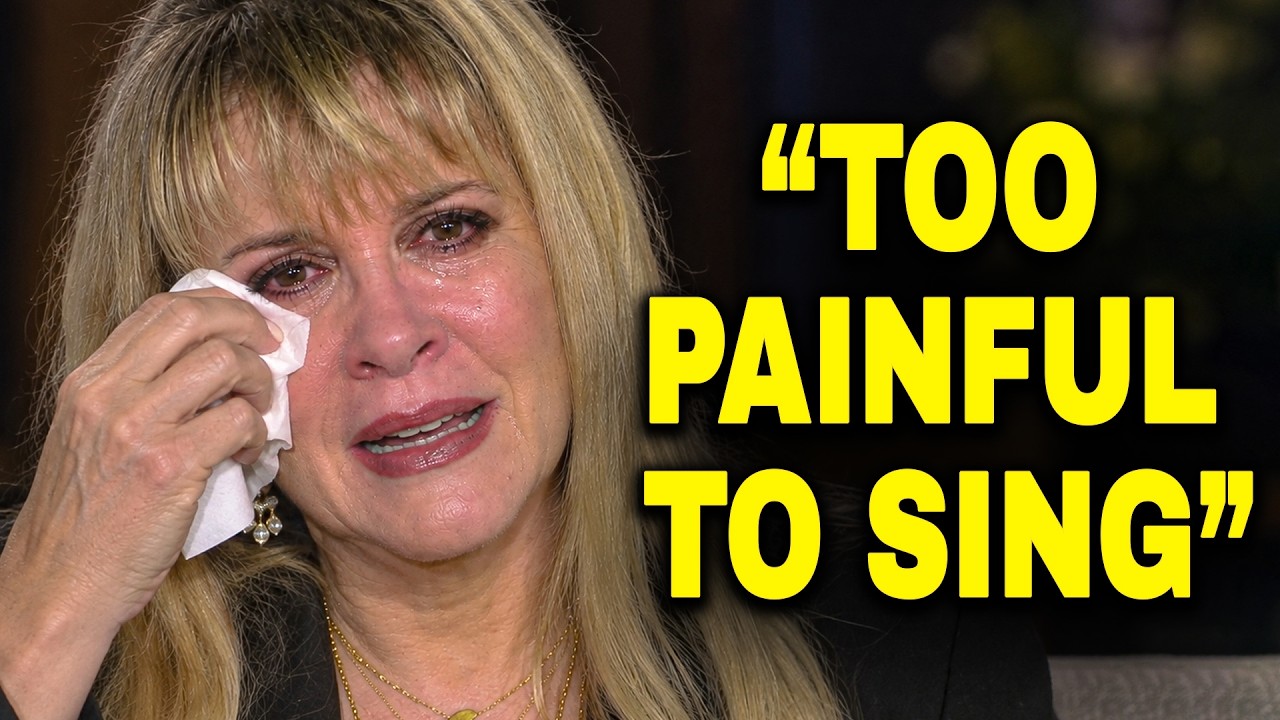
She remembered being almost hysterical and feeling as if all her songs were somehow about what had just happened. She wrote the song “Illum 9/11,” later released on Fleetwood Mac’s 2003 album Say You Will. Writing it made sense. Performing it was another matter.
She later admitted, “I have never been able to sing it on stage. ” Even 19 years later, she said she could still hardly listen to it. After Say You Will, Stevie continued moving between Fleetwood Mac and her solo career. She played shows in Las Vegas, toured with Don Henley, released Crystal Visions in 2007, and returned to the road with Fleetwood Mac in 2009.
In 2010, she performed with Taylor Swift at the Grammys. A year later, she released In Your Dreams, her first solo album in a decade. She appeared as a fictional version of herself on American Horror Story, turning old rumors about being a witch into a joke she could control. In 2014, Christine McVie returned to Fleetwood Mac, and the group toured again.
In 2018, Lindsey Buckingham was fired from the band after years of tension. Lindsey later said Stevie had forced the decision. Stevie denied that, saying she did not demand his firing. She said she removed herself from a situation she believed had become toxic, and the band chose how to continue.
She later described the split as a long time coming. In 2019, Stevie became the first woman inducted into the Rock and Roll Hall of Fame twice, this time for her solo career. Christine McVie’s death in 2022 changed the way Stevie looked at Fleetwood Mac. She called Christine her best friend and musical soulmate, saying, “You just can’t replace her.
” She said her mission may not have been to become a wife and mother, but to write songs that could help women who were. Stevie kept moving forward. She worked with younger artists including Lana Del Rey and Harry Styles, recorded with Dolly Parton and Gorillaz, and released “The Lighthouse” in 2024. That same year, she admitted one political regret, saying she had not voted until she was 70.
In 2025, she continued touring, although a fractured shoulder forced some shows to be postponed. In 2026, her brother Christopher died after a long battle with cancer. That same year brought an unexpected change with Lindsey Buckingham. By August, Lindsey said they were talking all the time while working on a Fleetwood Mac documentary, calling the process healing.
Stevie has joked that she may live to 95 still dancing with an electric scooter nearby. With Buckingham Nicks newly revived and Fleetwood Mac’s past opening again, her story still appears to have room for another surprise.