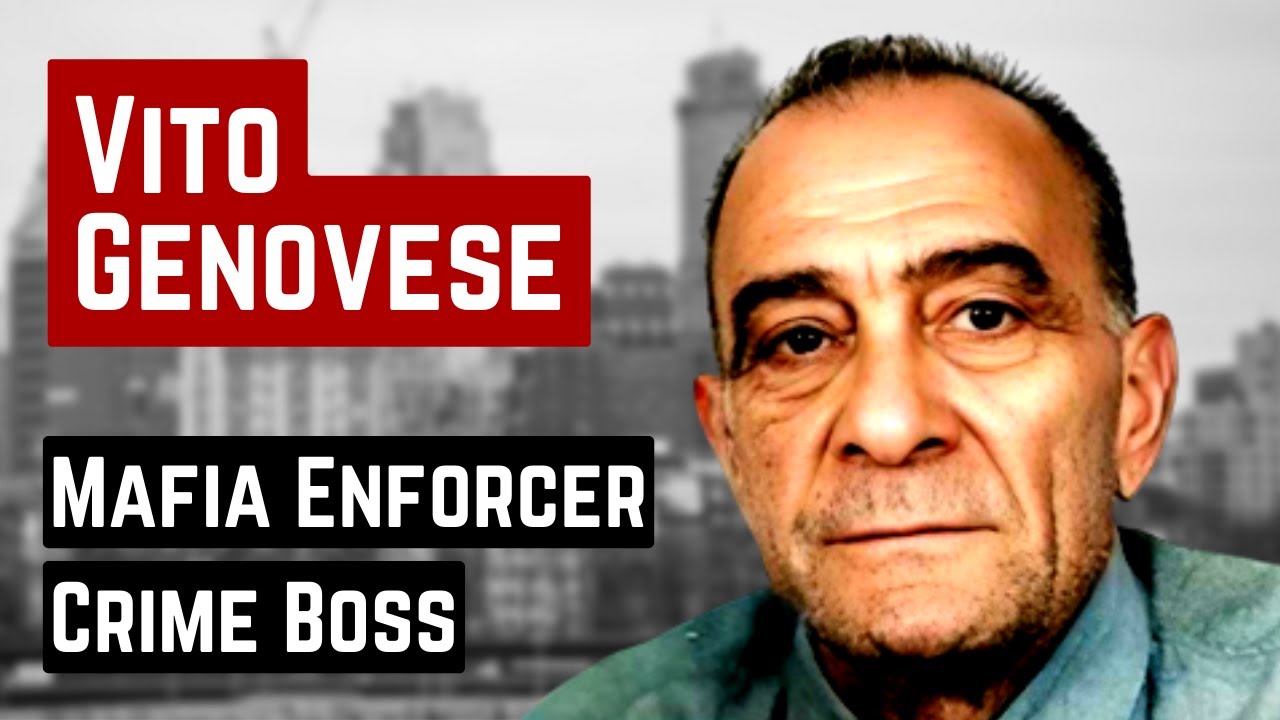
Vito Genovese rose through the American Mafia as a childhood friend and longtime associate of Lucky Luciano, eventually taking control of the crime family that would be renamed in his honor. Born in Resigliano, a frazione of Tofino in the province of Naples, Italy, on November 21, 1897, Genovese immigrated to the United States with his family in 1913 at age 15, settling in Little Italy, Manhattan. His criminal career began with robbing pushcart vendors and running errands for mobsters before collecting money from illegal lottery operations. At 19, he served a year in prison for illegal firearm possession.
By the 1920s, Genovese was working for Joe Masseria, the boss of a powerful Manhattan gang. Luciano and his associates, including Genovese, began working for gambler Arnold Rothstein, who recognized the financial potential of Prohibition and educated them on bootlegging. With Rothstein’s help, Luciano, Frank Costello, and Genovese launched their own bootlegging operation. Genovese allegedly ambushed Gaetano Reina, leader of a Bronx-based gang, as he left his mistress’s house on February 26, 1930, shooting him in the back of the head with a shotgun.
Reina had been a Masseria ally until Masseria suspected him of secretly assisting rival Brooklyn gang leader Salvatore Maranzano. The Castellammarese War erupted in early 1930 between Masseria and Maranzano. In exchange for receiving Masseria’s rackets and becoming Maranzano’s second-in-command, Luciano agreed to engineer the death of his boss. Luciano lured Masseria to a meeting where he was murdered on April 15, 1931, at Coney Island restaurant Nuova Villa Tammaro.
In September 1931, after Luciano received word that Maranzano was planning to kill him, Luciano and Genovese planned Maranzano’s murder. On September 10, 1931, when Maranzano summoned Luciano, Genovese, and Costello to a meeting at his office, Luciano sent four Jewish gangsters secured with the aid of Meyer Lansky and Bugsy Siegel to kill Maranzano first. After his first wife died of tuberculosis in 1931, Genovese announced his intention to marry Anna Petillo, who was already married to Gerard Vernotico. Vernotico was found strangled to death on a Manhattan rooftop on March 16, and on March 28, 1932, Genovese married Anna, who was his cousin through her mother.
Genovese allegedly ordered the murder of mobster Ferdinand Boccia in 1934. Genovese and Boccia had planned to defraud a wealthy gambler of $150,000 in a high-stakes card game. Boccia demanded $35,000 after the game because he had introduced the victim to Genovese. Genovese decided to have Boccia murdered rather than pay him, and on September 19, 1934, Genovese and five associates allegedly shot and killed Boccia in a Brooklyn coffee shop.
On June 18, 1936, Luciano was sentenced to 30 to 50 years in prison for pandering. With Luciano imprisoned, Genovese took over as acting boss of the Luciano crime family. Genovese became a naturalized U. S.
citizen on November 25, 1936, in New York City. Fearing prosecution for the Boccia murder, Genovese fled to Italy in 1937 with $750,000 in cash and settled in Nola near Naples. With Genovese’s departure, Frank Costello became acting boss. Genovese befriended Galeazzo Ciano, Benito Mussolini’s son-in-law, after bribing fascist party members.
It is believed Genovese supplied Ciano with cocaine, and by the end of World War II, he had donated nearly $4 million to Mussolini’s fascist party. He was awarded the Order of Saints Maurice and Lazarus and made a commendatore after assisting in establishing a new fascist party headquarters in Nola. Genovese allegedly ordered the murder of Carlo Tresca, the publisher of an anarchist newspaper in New York and a Mussolini enemy, in 1943 as a favor to the Italian government. Tresca was shot and killed outside his newspaper office in Manhattan on January 11, 1943.
Carmine Galante, a member of the Bonanno crime family, was later identified as the shooter, but no one was ever charged in Tresca’s murder. When the Allies invaded Italy in September 1943, Genovese switched sides and offered his services to the U. S. Army.
Former New York Governor Charles Poletti accepted a 1938 Packard sedan as a personal gift from Genovese while serving in the U. S. Army. Genovese was assigned to U.
S. Army headquarters in Naples as an interpreter and liaison officer, quickly becoming one of the most trusted employees of the Allied Military Government for Occupied Territories. Poletti and the entire AMG department were unaware of his background. Together with Italian gangster Calogero Vizzini, Genovese established one of the largest black market operations in southern Italy.
Vizzini sent truck caravans loaded with basic food commodities northward to hungry Naples, where Genovese’s organization distributed the cargo. AMG administration in Naples and Sicily issued passes and export papers for all the trucks, and some corrupt American army officers contributed gasoline and trucks to the operation. In the summer of 1944, mobster Ernest “The Hawk” Rupolo, a former Genovese associate, implicated Genovese in the Boccia murder. Rupolo had decided to become a government witness to avoid a murder conviction.
On August 27, 1944, U. S. military police arrested Genovese in Italy as part of an investigation into his involvement in a black market ring. Genovese was discovered to have stolen trucks, flour, and sugar from the Army.
When Criminal Investigation Division agent Orange C. Dickey investigated Genovese’s background, he discovered Genovese was a wanted fugitive for the 1934 Boccia killing. However, neither the Army nor the federal government appeared interested in pursuing Genovese. After months of frustration, Dickey finally made preparations to ship Genovese back to New York for trial, but faced increasing pressure.
Genovese personally offered Dickey $250,000 for his release, then threatened him when the offer was turned down. Dickey was even advised by his superiors not to pursue Genovese but refused to be dissuaded. Genovese was arraigned on murder charges for the 1934 Boccia killing on June 2, 1945, after arriving in New York by ship the day before, and entered a not guilty plea. Jerry Esposito, another prosecution witness, was found shot to death beside a road in Norwood, New Jersey, on June 10, 1946.
Earlier, another witness, Peter La Tempa, was discovered dead in a protective custody cell. Without anyone to corroborate Rupolo’s testimony, the government’s case crumbled and Genovese’s charges were dropped on June 10, 1946. Judge Samuel Leibowitz stated: “I cannot speak for the jury, but I believe that if there were even a shred of corroborating evidence you would have been condemned to the chair. ”
Genovese rejoined the Luciano family in New York after his release from custody in 1946, but neither Costello nor his underboss William Moretti were willing to relinquish power to him.
Meyer Lansky convened a meeting of the heads of the major crime families in Havana in December 1946, known as the Havana Conference. The heroin trade, Cuban gambling, and what to do about Bugsy Siegel and the struggling Flamingo Hotel project in Las Vegas were the three topics discussed. The conference lasted a little more than a week at the Hotel Nacional de Cuba. During the conference, Luciano had a private meeting with Genovese in Luciano’s hotel suite on December 20.
Luciano, unlike Costello, had never trusted Genovese. During the meeting, Genovese attempted to persuade Luciano to become a titular boss of bosses, allowing Genovese to run everything. Luciano declined, saying: “There is no boss of bosses. I turned it down in front of everybody.
If I ever changed my mind, I will take the title, but it won’t be up to you. Right now you work for me, and I ain’t in the mood to retire. Don’t you ever let me hear this again, or I’ll lose my temper. ”
On October 4, 1951, Moretti was assassinated by order of the Mafia Commission.
The mob bosses were dissatisfied with his testimony during the Kefauver hearings and concerned that syphilis now affecting his brain might lead him to talk to the press. Genovese was then appointed as the new underboss by Frank Costello. Anna Genovese sued her husband for financial support in December 1952 and later divorced him in 1953, testifying to Vito’s involvement in criminal rackets, a first by the wife of a mob figure. She had left the family home in New Jersey two years before and requested $350 per week from the judge.
Vito countersued the divorce on grounds of desertion. According to Anna, Vito ruled the Italian lottery in New York and New Jersey, bringing in over one million dollars per year. These claims were dismissed in the New Jersey Superior Court Appellate Division in 1954. Genovese allegedly ordered the murder of mobster Steven Franse in 1953.
Genovese had tasked Franse with keeping an eye on Anna while he hid in Italy. Outraged by Anna’s potential love affairs and her lawsuit, he directed Joseph Valachi to arrange Franse’s murder. Genovese made the decision to go up against Costello in the mid-1950s. He also needed to eliminate Costello’s close ally on the Commission, Albert Anastasia, boss of the Anastasia crime family.
Genovese began plotting with Anastasia’s underboss Carlo Gambino to have Anastasia killed. Genovese directed Vincent Gigante to murder Costello, who was shot and wounded outside his apartment building on May 2, 1957. Despite the wound being superficial, it persuaded Costello to cede power to Genovese and retire. A doorman identified Gigante as the gunman, but Costello testified in 1958 that he could not identify his assailant, and Gigante was acquitted on attempted murder charges.
Genovese was now boss of what became known as the Genovese crime family, and his longtime lieutenant Anthony Strollo was promoted to underboss. Genovese and Gambino allegedly ordered Anastasia’s murder in late 1957. Genovese had heard rumors that Costello was plotting to reclaim power with Anastasia. Anastasia went to the Park Central Hotel barber shop in Midtown Manhattan on October 25, 1957, for a haircut and shave.
While relaxing in the barber chair, two men with scarves covering their faces shot and killed him. Witnesses were unable to identify any of the gunmen, and competing theories about their identities persist to this day. Genovese wanted to legitimize his new power by holding a national Cosa Nostra meeting. On November 14, 1957, powerful mafiosi from the United States and Italy gathered at Joseph Barbara’s estate in Apalachin, New York.
State Trooper Edgar D. Croswell had become aware that Barbara’s son was reserving rooms in local hotels and having a large quantity of meat delivered to the Barbara home. Croswell became suspicious and decided to keep an eye on the house. When state police discovered a large number of luxury cars parked at Barbara’s house, they began recording license plate numbers.
After discovering many vehicles were registered to known criminals, reinforcements arrived and began erecting a roadblock. When the mobsters became aware of the police presence, they began fleeing the gathering by car and foot. Many managed to escape through the woods surrounding the estate. Officers pulled over Russell Bufalino’s car, which was carrying Genovese and three other men.
Genovese said he was just there for a barbecue and to discuss business with Barbara, so police let him go. Genovese testified under subpoena in the U. S. Senate McClellan hearings on organized crime on June 2, 1958.
He refused to answer any questions, citing his Fifth Amendment rights 150 times. Luciano allegedly assisted in the payment of part of $100,000 to a Puerto Rican drug dealer to falsely implicate Genovese in a drug deal. On July 7, 1958, Genovese was charged with conspiracy to import and sell narcotics. Nelson Cantellops, a Puerto Rican drug dealer who claimed Genovese met with him, was the government’s star witness.
Genovese was convicted of conspiracy to violate federal narcotics laws in New York on April 4, 1959, and sentenced to 15 years in the Atlanta Federal Penitentiary on April 17, where he attempted to run his crime family from prison. Genovese allegedly ordered the murder of Anthony Strollo in April 1962 after concluding Strollo was involved in the plot that landed him in prison. Strollo left his house on April 8 for a walk and was never seen again; his body was never found. In 1962, an alleged murder threat from Genovese propelled mobster Joseph Valachi into the public spotlight.
Valachi supposedly mistook another inmate for a mob hitman sent to kill him and murdered the inmate instead. After receiving a life sentence for that murder, Valachi turned government witness on August 24, 1964. Ernest Rupolo’s body was recovered from Jamaica Bay, Queens, with two concrete blocks attached to his legs and his hands tied. It was widely assumed Genovese had ordered Rupolo’s murder for testifying against him in 1944.
Genovese died of a heart attack at the United States Medical Center for Federal Prisoners in Springfield, Missouri, on February 14, 1969.