Graham Sutherland’s portrait of Winston Churchill was one of the most controversial artworks in British political history. It was commissioned by both houses of Parliament as an 80th birthday gift, unveiled before 2,500 people in Westminster Hall, and then vanished. By the time the public learned what happened to it, the painting had been ash for more than two decades. The story only came out in January 1978, roughly a month after the widow who ordered its destruction was buried.
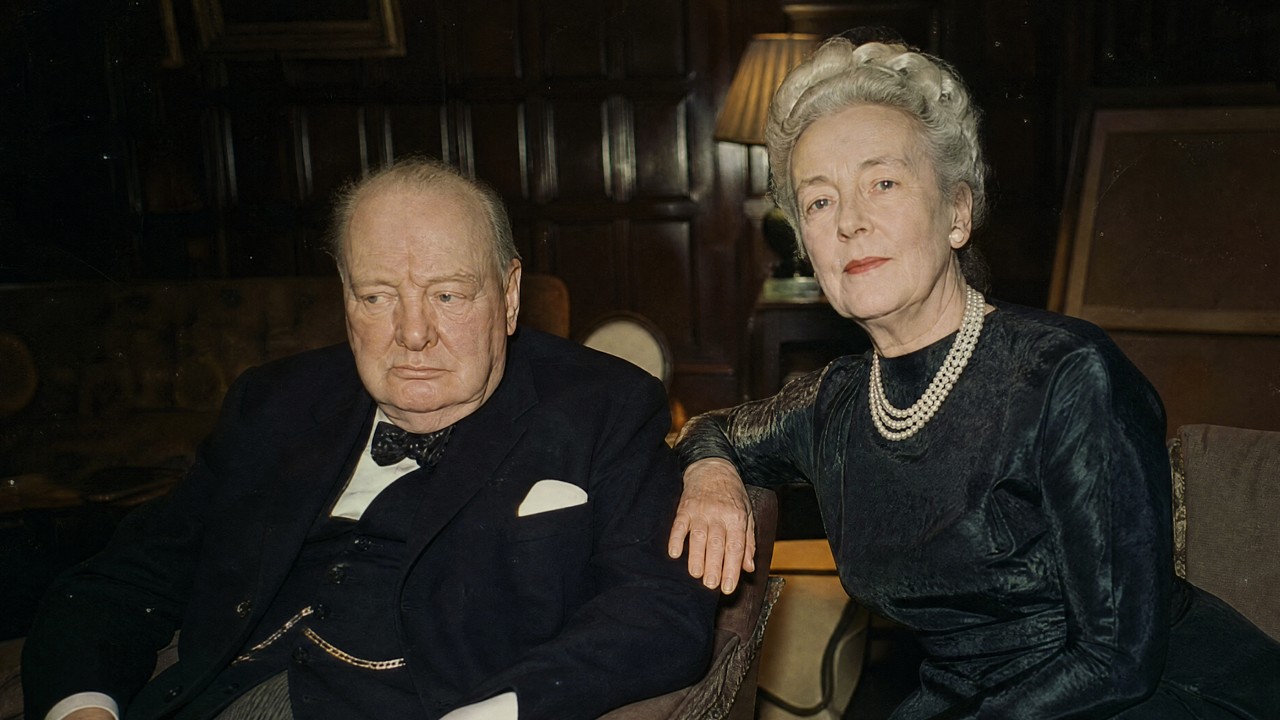
Clementine Churchill was born Clementine Ogilvy Hozier in Mayfair in 1885, on the drawing-room floor of a Grosvenor Street house. Her father has never been definitively identified. On paper, she was the daughter of Colonel Sir Henry Montague Hozier and Lady Blanche Ogilvy, a daughter of the Earl of Airlie. In practice, the record was far less settled.
Henry Hozier was reportedly set against having children and reputedly incapable of them. Lady Blanche was known for a series of affairs, and two men are named in the historical record as candidates for Clementine’s real father. Both remain guesses, and she reportedly never knew for certain which man had made her. Her childhood was marked by instability.
Her parents separated after a failed divorce suit in 1891, and for roughly eight years the family moved between furnished lodgings every few months, partly to stay ahead of creditors. In 1900, her elder sister Kitty died of typhoid at 16. Clementine was sent away to Scotland while her mother nursed Kitty alone. By her early twenties, she had been engaged three times and broken off every engagement.
She met Winston Churchill at a ball in 1904, where he was reportedly tongue-tied. They met again in March 1908 at a dinner hosted by Lady St. Helier, where the conversation lasted the entire evening. He proposed on 11 August 1908 at Blenheim Palace.
They married on 12 September 1908 at St. Margaret’s, Westminster, with Lloyd George as a witness and a gift from King Edward VII. Despite the crowds and the political prominence of the event, no photograph of the wedding day has ever been located. The marriage ran on paper.
Between 1908 and his death in 1965, the couple exchanged a vast correspondence, which their daughter Mary Soames edited and published in 1998 under the title Speaking for Themselves. The money was always tight. Members of Parliament were not paid a salary until 1911, and Churchill overspent for most of his life. In the autumn of 1922, Churchill bought a house in Kent without consulting his wife.
The property was called Chartwell. It had failed to sell at auction, and he paid 5,000 pounds for it after inspecting it for dry rot. He told her only after the sale was concluded. The rebuilding cost more than double its estimate, and by 1924 he and the architect were communicating through lawyers.
The property eventually included five reception rooms, 19 bed and dressing rooms, eight bathrooms, 80 acres, three cottages, and a heated swimming pool. The years around the purchase were brutal for Clementine. Her brother Bill shot himself in a Paris hotel in April 1921 after being ruined by gambling debts. That August, her two-year-old daughter Marigold died of septicemia at Broadstairs.
Marigold was buried at Kensal Green in London and remained there until 2019, when her remains were reburied at Bladon beside her parents. Clementine ran Chartwell with exhausting precision. Those close to her described what they called emotional electric storms behind the public composure. She demanded perfection from her staff and more from her children.
She was the only parent in the household who corrected them. Three of her five children died before she did. Diana, the eldest, struggled with depression for years and died by suicide in 1963 at 54. Randolph, the only son, drank heavily and died of a heart attack in 1968.
Sarah, who went on the stage, struggled with alcoholism for most of her life. Mary, the youngest, outlived them all and wrote the family’s history. In January 1935, Clementine sailed without her husband on a four-month voyage to the Dutch East Indies, Borneo, the Celebes, and the Moluccas aboard Lord Moyne’s yacht. Among the guests was an art dealer named Terence Philip.
Whether they had an affair was never established and remains unknown. What is documented is that she returned home, and when her pink dove from Bali died, she buried it in the garden at Chartwell beneath a sundial. The sundial carries an inscription: “Here lies the barley dove. It does not do to wander too far from sober men.
But there’s an island yonder. I think of it again. ” The sundial is still there. Five weeks after Churchill became Prime Minister in 1940, Clementine wrote him a letter, tore it up, and then wrote it again and sent it.
Dated 27 June 1940, it is the only letter between them known to survive from that year. She warned him that his rough, sarcastic, and overbearing manner risked making him disliked by his colleagues. “My darling Winston,” she wrote, “I must confess that I have noticed a deterioration in your manner, and you are not so kind as you used to be. ” She signed it, “Your loving, devoted, and watchful, Clemmie.
” No reply survives. Mary Soames concluded that they must simply have talked about it. During the war, Clementine took on an enormous public role of her own. In October 1941, she was appointed to head the British Red Cross Aid to Russia Fund.
By the end of the war, it had raised about 8 million pounds, much of it in pennies from knitting circles, flag days, and factory collections. In April 1945, she traveled to the Soviet Union with a small party that included her private secretary, Grace Hamblin. In the Kremlin, she presented Stalin with a gold fountain pen from her husband, saying she hoped he would write many more friendly messages with it. Stalin smiled and replied that he only wrote with a pencil.
She was awarded the Order of the Red Banner of Labor, and in June 1946 the Labour government made her a Dame Grand Cross of the British Empire. In November 1945, friends organized by Lord Camrose raised 55,000 pounds and handed it to the National Trust, which bought Chartwell from Churchill. The Churchills stayed on a 50-year lease. By the time the portrait arrived, they were tenants in a house that belonged to the nation.
In the summer of 1954, an all-party committee of both houses met to decide what Parliament should give Churchill for his 80th birthday. Their first choice of artist, Sir Herbert James Gunn, was rejected as too expensive. The Labour member Jennie Lee proposed Graham Sutherland, on the recommendation of Lord Beaverbrook and with the support of Kenneth Clark. The choice was unanimous.
Sutherland was one of the most serious artists in Britain. His work was built on bomb damage, crucifixions, distorted organic forms, and thorns. He had painted exactly two notable portraits, both of which had shocked their subjects. His portrait of Somerset Maugham had been described by a fellow painter as making Maugham look like the madam of a brothel.
His portrait of Beaverbrook had drawn from the sitter the verdict, “It is an outrage, but it is a masterpiece. ”
Sutherland arrived at Chartwell in late August 1954. He worked in Churchill’s own painting studio in the garden. Churchill asked at the first sitting whether he was to be painted as a bulldog or a cherub.
The painter replied that it depended on what Churchill showed him. Churchill sat in the afternoons, writing, dictating letters, and drinking claret. He was not allowed to see the canvas. When he asked to look, Sutherland said he never permitted his work to be seen until it was done.
Churchill’s physician, Lord Moran, warned Sutherland that Churchill was always acting and advised him to catch him with the greasepaint off his face. Sutherland did exactly that. He found the breakthrough while watching Churchill play a combative game of bezique. A surviving sketch, annotated in pencil, notes the color details of Churchill’s face while he played cards with his son-in-law six days before the portrait was shown to anyone.
There was one argument about clothes. Churchill wanted to be painted in garter robes. The committee’s brief specified ordinary parliamentary dress. Sutherland borrowed a set of robes anyway and had his own solicitor sit in them.
That study was sold to Beaverbrook after the presentation. On 20 November 1954, ten days before the ceremony, Clementine Churchill was shown the finished portrait. Somerset Maugham, who was present, reported that she was very moved and full of praise. Simon Schama records that she told the artist, with tears in her eyes, “I can’t thank you enough.
”
Then her husband saw it. Mary Soames wrote that he felt betrayed by the artist he had liked and with whom he had felt at ease, and that he found in the portrait causes for mortal affront. Ten days before the ceremony, he wrote to Sutherland to say the painting would not feature in it at all. Charles Doughty, the committee’s secretary, persuaded him that cancelling would insult the members who had subscribed their own money.
Clementine changed her mind completely. Mary Soames, who was watching both parents, wrote that Clementine had at first seemed inclined to like the picture, but later came to share Winston’s feelings. Seeing how deeply he was upset, she promised him that the painting would never see the light of day. On 30 November 1954, 2,500 people gathered in Westminster Hall.
Clement Attlee unveiled the portrait. Gasps went around the hall, followed by a thunder of applause. Churchill’s public verdict was two sentences long. “The portrait is a remarkable example of modern art.
It certainly combines force and candor. ” The room laughed. Then he turned to the illuminated book presented by the Commons and spoke with real warmth about it. It was, he said, the most memorable public occasion of his life.
Sutherland had published a statement in the Daily Mail that morning saying he did not paint pretty pictures just to win applause. Clementine wrote in her diary that night that she felt sick with disgust. The verdicts split along party lines. Aneurin Bevan called it a beautiful work.
Viscount Hailsham called it disgusting and said he would throw Sutherland into the Thames. In private, Churchill was blunter. Lord Moran recorded him spluttering, “Filthy. I think it is malignant.
” His last private secretary recorded him saying it made him look like a down-and-out drunk picked out of the gutter in the Strand. The most famous line, “It makes me look half-witted, which I ain’t,” was not made public until 1978, released by his widow’s executors in the same statement that revealed the portrait had been destroyed. The painting had a brief life above ground. It was not displayed at a Downing Street reception on 1 December 1954.
It was briefly hung in a basement at the Churchills’ London house, where it was agreed it looked better in subdued light. A magazine owner named Hans Juda offered to take the painting off Churchill’s hands. It was delivered to his home, and two days later it was shipped straight back. During those two days, his wife Elspeth took color slides of it, which is the reason anyone today knows what the picture looked like.
Sutherland later complained the slides were too dark and said the background had been pure yellow ochre. After that, the painting was crated and placed in a cellar at Chartwell behind the boiler. It was never publicly displayed again. Twice it was requested, by Churchill College in 1960 and by a cousin in 1962.
Both requests were refused. Sometime in 1955 or 1956, Lady Churchill came to her private secretary Grace Hamblin, much exercised, and Hamblin offered to deal with it. The account rests entirely on a recording Hamblin made as an old woman, found by biographer Sonia Purnell at the Churchill Archive Centre and published in 2015. Hamblin’s account is that she got her burly brother, a gardener, to come to Chartwell in the dead of night.
They carried the heavy painting out to his van, drove several miles to his house, built a huge bonfire in the back garden where it could not be seen from the street, and burned it. The next day she told Lady Churchill, who replied: “We will never tell anyone about this because after I go, I do not want anyone blaming you. But believe me, you did exactly as I would have wanted. ” There is no support for the popular story that the canvas was cut into pieces first.
Clementine Churchill had destroyed portraits of her husband before when she disliked them, including work by Walter Sickert, the painter who had been a friend of her mother’s household in the years when the family had nothing. In October 1957, she wrote to Lord Beaverbrook about the Sutherland portrait and told him it would never see the light of day, writing in the future tense about an object that was already ash. Churchill died on 24 January 1965 at Hyde Park Gate. He lay in state in Westminster Hall, the same room where the portrait had been unveiled ten years earlier.
A third of a million people filed past. The funeral was a state occasion, the first for a non-royal since Wellington. Clementine was 79. At St.
Paul’s, the coffin was carried by Grenadiers. That evening, she said to her daughter Mary, as her grandson Nicholas Soames recalled, “It was not a funeral, Mary. It was a triumph. ”
In February 1965, she sailed for New York.
On the crossing, one month after burying her husband, she told Mary and Christopher Soames that the Sutherland portrait no longer existed. Mary wrote that they were both flabbergasted. She later wrote that she did not believe Clementine ever specifically told Winston what steps she had taken, but that her original pledge had calmed him. He died without knowing.
Clementine gave up Chartwell within months. The house opened to the public in 1966. Its first administrator was Grace Hamblin. In 1969, Clementine gave her husband’s papers from after 1945 to Churchill College, Cambridge, because they were hers to give.
On 1 November 1973, she unveiled the 12-foot bronze statue of her husband in Parliament Square, in daylight, in front of the cameras. The Queen had declined the honor so that it could go to “darling Clementine. ”
Clementine Churchill was created Baroness Spencer-Churchill of Chartwell in 1965 and sat in the Lords as a crossbencher. She voted for the abolition of capital punishment.
She died of a heart attack on 12 December 1977 in Knightsbridge at the age of 92. She was buried at Bladon beside her husband, beside Marigold, and beside Diana. In January 1978, roughly a month after the funeral, the executors of her estate made a statement to the press. It was all three executors together: Mary Soames, Sir John Colville, and Peregrine Spencer-Churchill.
The portrait, they said, had been destroyed by Lady Churchill on her own initiative before Sir Winston’s death. She neither consulted anyone nor informed anyone of her intention. They released his line about it along with the confession. The New York Times carried the story on 12 January 1978.
Graham Sutherland, then 74, said he felt no rancor but believed the destruction of his painting was an act of vandalism unequaled in the history of art. He also told the Daily Express that there was no proof it had been destroyed, and that it was conceivable it had not been. He died in February 1980 without entirely believing her. Whether the picture had been hers to burn has never been settled.
Mary Soames pointed to a document assigning sole and exclusive copyright to her father and said there were no strings attached. Sutherland said the opposite, that he had been told it would revert to the House of Commons after Churchill’s death. No deed of reversion has ever been produced. What remains of the portrait is a short list: twelve pencil and charcoal studies and six oil sketches, most bought by Beaverbrook and now in New Brunswick; a squared-up drawing at the National Portrait Gallery in London; a set of color slides; and a full-size copy kept in the attic of the Carlton Club.
In June 2024, one preparatory oil study of Churchill’s head, given by the artist to his framer, sold at Sotheby’s for 660,000 pounds. The finished portrait, bought by both houses of Parliament for a thousand guineas, was burned on a bonfire in someone’s back garden in 1955 or 1956. Clementine Churchill kept the secret for 22 years. She told her daughter once, on a ship.
The country found out a month after they buried her. She had promised her husband the painting would never see the light of day, and she was the only person alive who could make that true.