The polished vision of the future that Star Trek presented to audiences concealed a set filled with rivalries, resentment, and secrets that would take decades to fully surface. Before it became a cultural landmark, the show nearly died before it even began, and once it became a hit, the struggles only intensified. Some cast members stopped speaking to each other, others carried grudges for years, and certain moments that happened when the cameras stopped rolling were remembered differently even by those who lived through them. In 1964, television was dominated by westerns, family comedies, and conventional adventure shows.
Science fiction was rarely treated as serious adult storytelling, but Gene Roddenberry wanted to change that. He imagined a series set far beyond Earth, following a starship crew as it encountered strange civilizations and confronted problems that were really reflections of humanity itself. To make the idea easier for executives to understand, he described it as “Wagon Train to the stars. ”
The western comparison was only a disguise.
Roddenberry imagined a 23rd-century civilization that had largely moved beyond the divisions of the 20th century, including racism, poverty, and war. The Enterprise was more than a spaceship; it was a vehicle for exploring questions about morality, prejudice, politics, religion, and what human beings might become if they overcame their worst instincts. Knowing he could not simply sell executives a philosophical experiment, he sold them an adventure. The first major obstacle came when Desilu Productions, the studio associated with Lucille Ball, took an interest in Roddenberry’s concept.
Since Desilu had a first-look arrangement with CBS, the project was initially taken there, but CBS had another science fiction series already in development, Irwin Allen’s Lost in Space. The network passed on Roddenberry’s idea rather than develop two competing space adventures. For most projects, that rejection would have been the end. Instead, Star Trek found a lifeline through Desilu and Lucille Ball, who backed the expensive project and took it to NBC.
NBC agreed to finance a pilot. That pilot, eventually titled “The Cage,” looked very different from the Star Trek audiences would later know. Jeffrey Hunter played Captain Christopher Pike, Leonard Nimoy appeared as Spock, and the tone was more cerebral and psychologically strange than the fast-moving adventure NBC executives expected. When they watched it in early 1965, they rejected it, believing it was too intellectual and did not deliver enough action.
Normally, that should have been a death sentence, but NBC saw enough potential to ask for another pilot, an extraordinary second chance. Roddenberry rebuilt the show. Jeffrey Hunter did not return as Captain Pike, choosing to focus on his film career, so Roddenberry turned to William Shatner, whose energy brought a more dynamic and adventurous presence to the captain’s chair. Shatner became James T.
Kirk, while Leonard Nimoy remained Spock, refined into the controlled, logical figure that would become one of television’s most recognizable personalities. The second pilot, “Where No Man Has Gone Before,” was filmed in 1965 and convinced NBC the show could work. Nichelle Nichols joined the regular cast as Lieutenant Uhura, holding a position of professional authority on the bridge at a time when American television was still struggling with meaningful racial representation. The bridge was a striking image of Roddenberry’s future, with people from different backgrounds working together as colleagues.
Star Trek officially premiered in the United States on September 8, 1966, but the series immediately faced another problem, ratings. Its Nielsen performance was not strong enough to make NBC comfortable, and the network repeatedly moved the show around the schedule. By the end of the first season, cancellation was a genuine threat. Then the fans intervened.
In 1968, Bjo and John Trimble helped organize a grassroots campaign urging NBC not to cancel the series. NBC eventually received more than 115,000 letters supporting Star Trek, one of the largest fan campaigns of its era. The pressure worked, and NBC renewed the series for a third season, but that renewal came with conditions that dramatically changed the production. NBC moved the show to Friday nights at 10 p.
m. , a difficult time slot for its younger audience, and the third season was made under tighter budget restrictions. The production had fewer resources to create the illusion of expansive alien worlds, and stories increasingly had to work within existing sets and recycled costumes. Roddenberry stepped back from day-to-day management during the third season, and the shift was quickly noticed by fans.
Some episodes became increasingly campy or disconnected from the ambitious tone that had defined the strongest earlier stories, with one of the most notorious examples being “Spock’s Brain. ”
As the series approached its final episode, another controversy emerged. “Turnabout Intruder,” broadcast on June 3, 1969, centered on Dr. Janice Lester, a former acquaintance of Kirk who switches bodies with him after resenting a career path she believes was denied to her because she was a woman.
The episode contained a line suggesting Starfleet regulations prevented women from becoming starship captains. For a show that had presented a future where race, nationality, and gender were supposedly less restrictive, the contradiction was striking, particularly as real-world social movements were challenging traditional ideas about gender and authority. Beyond the creative battles, the relationships between the cast members were far less harmonious than they appeared on screen. William Shatner’s relationship with the supporting cast became one of the most controversial aspects of the original series.
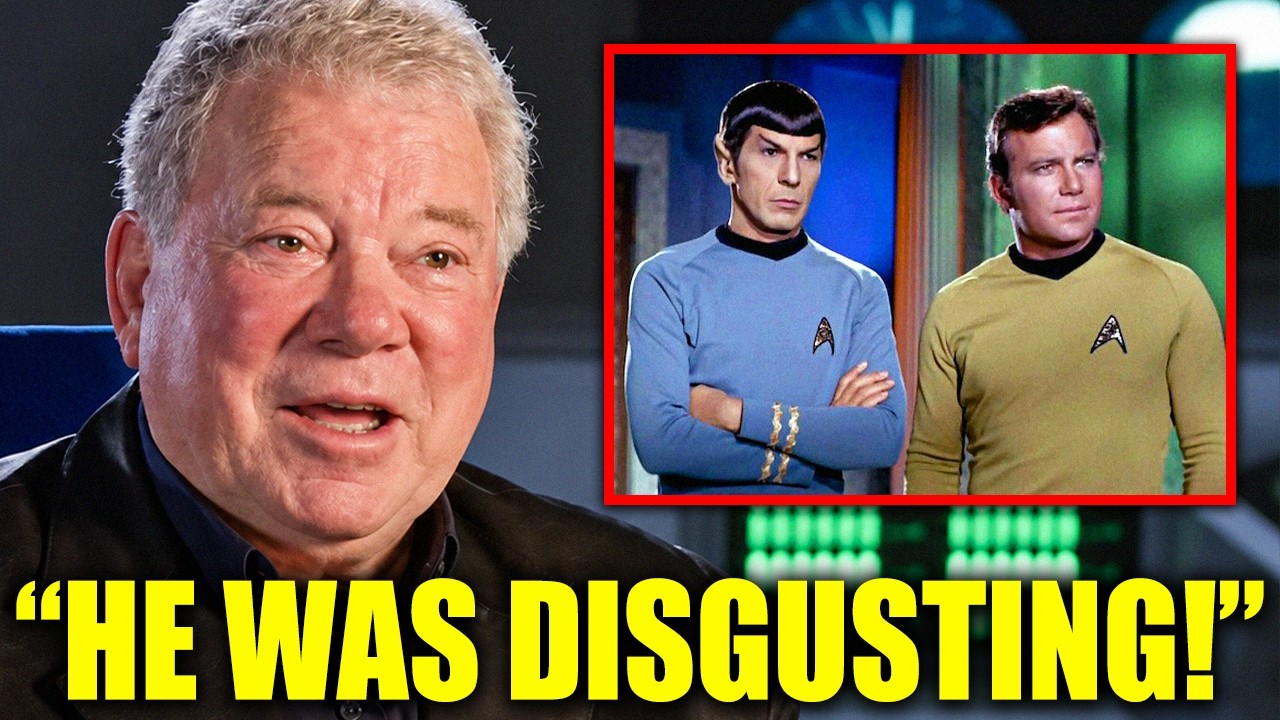
George Takei has repeatedly described an atmosphere in which Shatner behaved as though Star Trek was essentially his vehicle, focused intensely on his own performance and responsibilities. Takei has said he felt Shatner treated the supporting actors as obstacles rather than collaborators, particularly regarding screen time, and there have long been allegations that Shatner sometimes pushed for dialogue or close-ups to be shifted toward Kirk. The tension between Shatner and Leonard Nimoy was also significant. When Star Trek began, Shatner was unquestionably the star, but Spock became a phenomenon.
The volume of fan mail arriving for Nimoy reportedly became a source of concern for Shatner, who later admitted jealousy played a part in the tension. One of the most famous stories involved Nimoy’s bicycle, which he used to get around the studio lot. According to Nimoy’s retelling, Shatner took the bicycle and had it tied up in the rafters of the sound stage. In the years before Nimoy’s death in 2015, the friendship suddenly collapsed.
Nimoy stopped speaking to Shatner and apparently refused attempts at communication. Shatner later admitted he never understood exactly what had caused the break, describing the silence as heartbreaking in his 2016 book about Nimoy. Whatever happened between the two men, they never publicly resolved it before Nimoy died. The feud with George Takei escaped the set and became a decades-long public war.
Takei continued criticizing Shatner’s behavior, while Shatner pushed back against what he viewed as Takei’s attempts to portray him as a terrible colleague. The feud erupted again in 2008 when Takei married Brad Altman. Shatner publicly complained he had not been invited, while Takei’s camp disputed the accusation, maintaining Shatner had in fact been invited. James Doohan, the actor behind Chief Engineer Montgomery Scott, also had a strained relationship with Shatner, reportedly becoming increasingly unwilling to participate in events where Shatner was present.
The biggest revelations about Star Trek were not always about who hated whom. Some involved what was allegedly happening when the camera stopped rolling. By the time Bill Mumy stepped onto the set of Star Trek: Deep Space 9, he had already spent decades in science fiction. Audiences knew him as Will Robinson from Lost in Space, and he had spent five seasons on Babylon 5 buried beneath prosthetics as the alien Londo Mollari.
When Star Trek came calling, he had one condition: he had no intention of spending another day hiding behind an alien face. Mumy’s connection to Deep Space 9 was personal before it was professional. He was friends with executive producer Ira Steven Behr, who wanted to bring him onto the show, but Mumy had turned down several opportunities to appear on Star Trek because the roles required him to play aliens. Behr eventually offered him the role of Kellin, a human Starfleet engineer serving on the front lines of the Dominion War.
Mumy immediately said yes. The episode was “The Siege of AR-558,” the eighth episode of Deep Space 9’s seventh season, which first aired in November 1998. Unlike the polished optimism traditionally associated with Star Trek, this story plunged its characters into the brutal reality of prolonged ground combat. The Federation soldiers stationed on AR-558 were exhausted, traumatized, and hardened by months of fighting.
Director Winrich Kolbe, a Vietnam veteran, drew on his own understanding of combat when shaping the episode’s visual language. For Mumy, the experience behind the camera was almost as intense as what audiences saw. He later recalled extremely long working days and several forced calls during the shoot, something he said never happened during his five seasons on Babylon 5. The crew treated him well, but he was struck by how exhausted everyone seemed.
He also discovered how tightly controlled the production was when he made a tiny adjustment to one of his lines. Adding the word “well” to a line required authorization because the dialogue was part of the approved script. Mumy was stunned and joked that he initially thought Behr was playing a prank on him, but the production really was that strict. Mumy’s character, Kellin, was not going to survive the episode.
During the story, he dies in Ezri Dax’s arms after becoming part of the desperate battle. For Mumy, the death was not a problem; after decades in science fiction, he understood the appeal of going out in a memorable way. When his death scene was completed, Behr reportedly turned to the crew and announced that Star Trek had just killed Will Robinson. In 2018, Mumy returned to the Lost in Space universe for Netflix’s modern re-imagining of the series, appearing as an adult version of Dr.
Zachary Smith alongside Parker Posey’s new version of the character. His experience on “The Siege of AR-558” revealed how different Star Trek could be when the camera stopped presenting the polished future and started confronting the realities of production, including exhaustion, rigid schedules, unforgiving scripts, and a crew working under enormous pressure.