In September 1940, London was burning every night. German bombs cracked open the sky above the city, families dragged their children into underground shelters, and hospitals ran out of beds. Streets that had existed for centuries were reduced to rubble by morning. The British people were bleeding, but they were not surrendering.
Inside Nazi intelligence headquarters in Berlin, Hitler's strategists believed they had found a weapon more powerful than any bomb. Not steel, not explosives, but a woman. An American woman, twice divorced, socially brilliant, and romantically connected to a deposed king.
According to MI5 files that would not be declassified for decades, she was potentially feeding secrets directly to the Nazi high command. Her name was Wallis Simpson. The plan built around her, code named Operation Willy, came within inches of collapsing the British Empire from the inside.
Bessie Wallis Warfield was born on June 19, 1896, in Blue Ridge Summit, Pennsylvania. Before she could form a single memory, life stripped her of her first advantage. Her father, Teackle Wallis Warfield, died before she was one year old.
Her mother, Alice Montague, was left to raise a daughter alone in Baltimore with almost no money and no safety net. Most people in that position accept a smaller life. Wallis Simpson never once considered it.
By 1912, her uncle had arranged her enrollment at Oldfield School, the most exclusive girls' school in Maryland. This was not a charity placement. It was the school where Baltimore's wealthiest families sent their daughters.
Wallis Warfield, the fatherless girl from a struggling household, walked through those doors. Within weeks, her teachers were already writing about her in terms that felt almost clinical. Determined, precise, socially calculating in a way that was striking in someone so young.
A classmate later described her simply: she studied everyone in that room, figured out what they respected, and then became exactly that. She graduated and moved through society with the same controlled ambition.
In 1916, at 20 years old, she married Earl Winfield Spencer Jr., a United States Navy aviator who looked magnificent in uniform and was quietly disintegrating outside of it. The marriage was suffocating. Spencer drank heavily, sometimes dangerously.
He was transferred constantly to remote postings, leaving Wallis alone in unfamiliar cities for months at a stretch. But loneliness for Wallis was never passive. It was productive.
During her years abroad, particularly in China, moving through Shanghai and Beijing's diplomatic circles, she built relationships with powerful men that would fuel gossip for the rest of her life. One story claimed she had become pregnant during an overseas affair and undergone a procedure that left her permanently unable to have children.
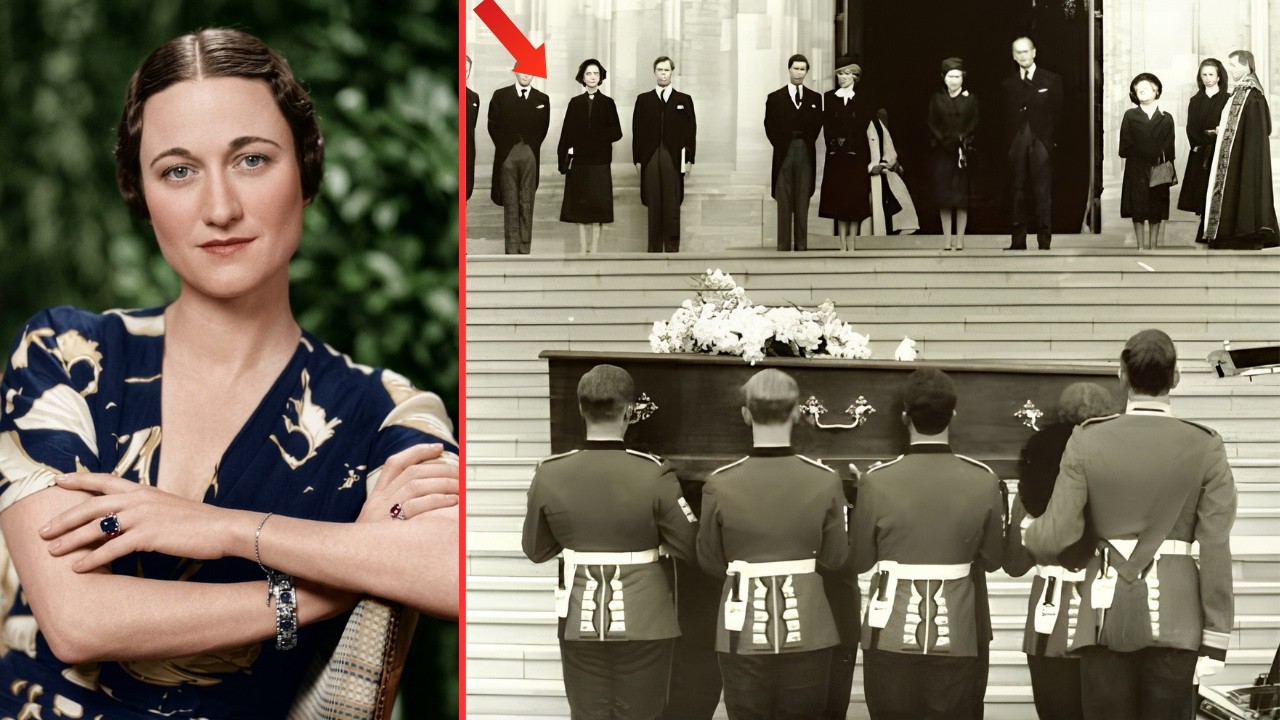
No confirmed evidence ever materialized, but in the world Wallis inhabited, a rumor didn't need proof to become permanent. By December 1927, she divorced Spencer. She was 31 years old, already scandalous in polite society, and completely unbroken.
In 1928, Wallis married her second husband, Ernest Aldrich Simpson, an Anglo-American shipping executive who was steady, intelligent, and genuinely devoted to her. He divorced his first wife to be with Wallis. They relocated to London together.
It was here that Wallis Simpson finally found the arena she was built for. London's upper-class social scene was sharp, competitive, and obsessed with wit and presentation. Wallis thrived in it immediately.
She threw dinner parties that people talked about for weeks afterward. She dressed with an almost architectural precision. She had a tongue quick enough to make Earls laugh and sharp enough to make them nervous. British high society found her genuinely baffling and completely addictive.
And then she met Edward. Edward, Prince of Wales, heir to the British throne, was the most photographed royal in the world and, by nearly every first-hand account, one of the most unhappy men in England. He carried the crushing weight of a destiny he had never asked for.
Duty felt to him like a life sentence. Every official engagement, every formal dinner, every diplomatic obligation was another link in a chain he couldn't escape. With Wallis, for the first time in his life, he felt free.
She didn't perform reverence. She didn't treat him as untouchable. She challenged him, argued with him, and teased him in ways that no one inside the palace walls would dare. Royal staff later confirmed that by January 1934, the relationship had crossed every boundary.
Something Edward flatly denied to his own father, King George V, even as palace servants reported seeing the two of them together in circumstances that removed all ambiguity. When King George V died in January 1936, Edward ascended the throne as King Edward VIII.
Immediately, clearly, openly, and without apology, he informed the British government that he intended to marry Wallis Simpson the moment her second divorce from Ernest was finalized. The British establishment responded as if the building were on fire.
The Church of England, of which the king was supreme governor by law, strictly prohibited the remarriage of divorced persons whose former spouses were still living. Prime Minister Stanley Baldwin delivered the message with no softening. Parliament would refuse this marriage.
The dominions of the British Empire, Canada, Australia, and South Africa, would not accept it. His own mother, Queen Mary, considered the situation beneath discussion. Edward listened to all of it. Then in December 1936, he abdicated the throne.

His farewell radio broadcast reached an estimated 200 million listeners worldwide. In quiet, measured tones, he said simply that he could not carry the burden of kingship without the support of the woman he loved. It was the most dramatic royal moment of the 20th century.
To romantics across the world, it was the greatest love story of the age. To the British establishment, it was an act of catastrophic, self-indulgent irresponsibility. To Wallis Simpson, who had already fled to France before the broadcast, it was the moment she became the most despised woman in the British Empire.
She had not asked him to give up the crown. She later wrote that she had begged him not to, but the throne was gone, and the whole world knew whose name was attached to its disappearance. Wallis married Edward, now styled the Duke of Windsor, in June 1937 at a private chateau in the Touraine region of France.
She became the Duchess of Windsor. The royal family, in a deliberate and calculated act of exclusion, denied her the title of Royal Highness, a formal, permanent marking that she would never be accepted as one of them. The couple settled into a luxurious European exile.
In October 1937, the Duke and Duchess of Windsor accepted a formal invitation from the Nazi government and traveled to Germany. They toured factories. They visited model housing estates. They smiled beside Nazi officials for photographers. They inspected new highways built by forced labor.
At Berchtesgaden, Hitler's personal mountain retreat, they sat across from Adolf Hitler himself for a private meeting. The photographs from that visit never disappeared from the historical record. But the photographs were only the surface.
Intelligence agencies on both sides of the Atlantic were watching Wallis Simpson specifically and with serious concern. The FBI had accumulated reports indicating she maintained regular private contact with Joachim von Ribbentrop, first the German ambassador to London, later Hitler's foreign minister, and one of the architects of the Nazi war strategy.
According to intelligence sources referenced in multiple government files, Ribbentrop had sent Wallis 17 red carnations, one according to the story for each time they had been intimate. Wallis denied it completely and permanently.
MI5 files declassified in the decades after the war confirmed that British intelligence had classified her as a potential security risk, actively fearing she might pass sensitive British information to Germany through her personal connections. Then France fell.
In the summer of 1940, in one of the most shocking military collapses in modern history, France surrendered to Germany in just six weeks. The Duke and Duchess fled south through panicked crowds of refugees, eventually reaching Franco's Spain, then Portugal. It was in Lisbon that the most dangerous chapter of Wallis Simpson's life began.
Operation Willy. German documents captured by the Allies after the war, formerly known as the Marburg files, revealed the plan in precise bureaucratic detail. Nazi officials intended to exploit Edward's documented sympathies with German-style order, his deep bitterness toward the British royal establishment, and his personal grievances against Winston Churchill.
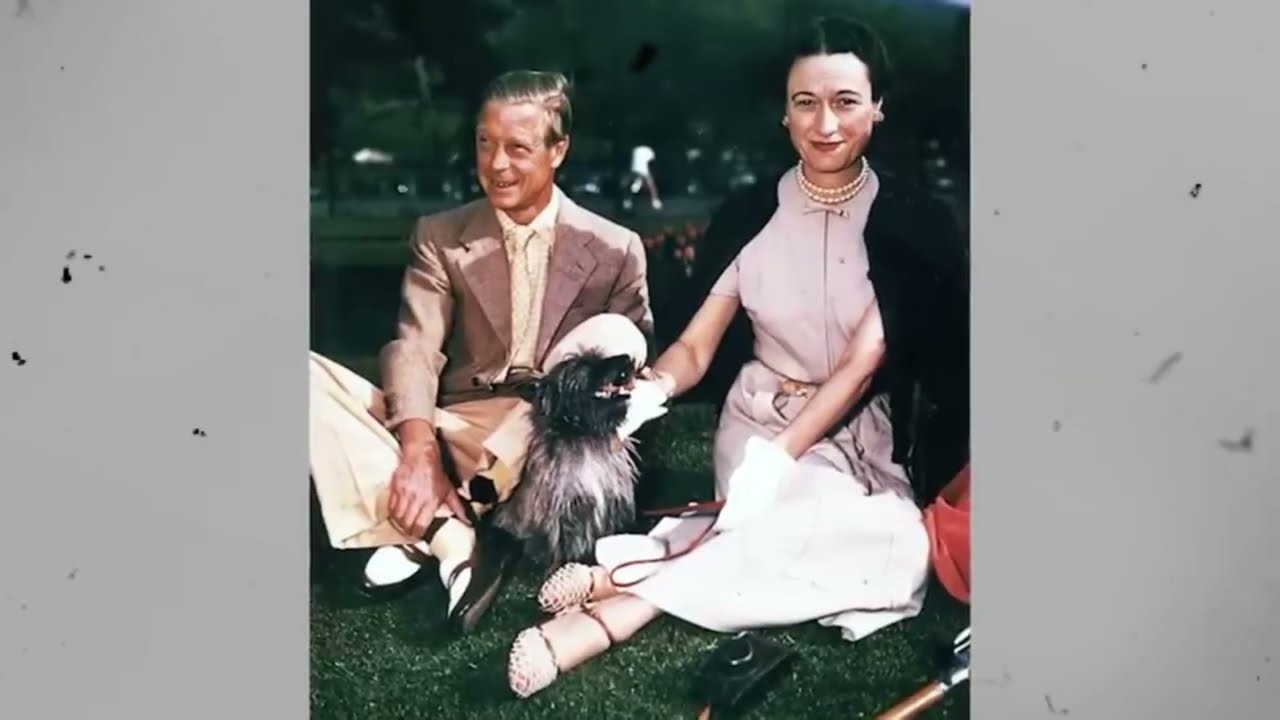
The goal was to lure, or if necessary, kidnap the Duke of Windsor and install him as a puppet king over a conquered Britain, a friendly familiar royal face on a Nazi-controlled throne. Whether Edward ever genuinely encouraged this scheme is a historical question that has never been fully resolved.
What is confirmed in the documents is that German agents in Lisbon made direct personal approaches to him. Winston Churchill, fighting for Britain's survival with everything he had, sent urgent unambiguous warnings. The British government's solution was swift.
Edward was appointed governor of the Bahamas, removing him from Europe entirely. Operation Willy died without a king. The Bahamas were safe, tropical, and professionally humiliating for a man who had once been king of England.
Nassau was hot, colonial, and isolated from everything the Windsors had known. Wallis dedicated herself to charitable work, hospitals, schools, and fundraising drives for the war effort. In public, she was gracious and composed. In private correspondence, both she and Edward made their bitterness unmistakably clear.
Edward made statements that expressed admiration for aspects of German social organization. Wallis directed openly racist remarks toward the local Bahamian population. When the war ended in 1945, they returned to France.
Their Paris home became a gathering place for the fashionable and famous, a glittering world of jewelry, dinner parties, and magazine features that looked from the outside like complete triumph. But the Marburg files, released publicly in the 1950s, cracked that image open.
The documents confirmed what intelligence agencies had suspected for years. Nazi leadership had viewed the Windsors as real political assets. Wallis defended herself until the end of her life, insisting she had never supported fascism and that her only motivation in the pre-war years had been to prevent another catastrophic World War.
Edward's health deteriorated through the 1960s. He died of throat cancer on May 28, 1972. Their marriage had produced no children. Wallis spent her remaining years in their Paris home as her own health declined steadily.
By 1980, dementia had taken her voice entirely. She was bedridden, unreachable, visited only by her doctor and nurses. Wallis Simpson died on April 24, 1986. She was 89 years old.
She was buried beside Edward at Frogmore on the grounds of Windsor Castle. The royal family that had denied her a title for 50 years allowed her to lie among them in death. Whether that was justice, irony, or simply the cold mathematics of history, no one has agreed on an answer yet.
Wallis Simpson was the American divorcee who brought down a king, walked smiling into Nazi Germany, and spent decades tracked by intelligence agencies on two continents. Real history is never as clean or comfortable as the version we were taught.
The people at the center of the world's most dangerous moments are always more complicated, more human, and far more frightening than the textbook summary. Was Wallis Simpson a genuine threat to Britain, or simply a woman caught inside a world that was already burning?