In April 1945, the war in Europe was nearly over. The Germans knew it, and the Americans knew it. But knowing the war was lost and accepting it were two different things.
Deep in Bavaria, near the town of Moosburg, over 100,000 Allied prisoners were being held in a complex of camps. Americans, British, French, and Soviet soldiers had been captured months ago, years ago, some as far back as 1940. They had survived the camps, the winter, and years of captivity.
Now, with American forces just days away, they faced a new danger. The SS did not intend to let them go.
On April 27th, a German civilian escaped through American lines. He brought a message. He had overheard officers discussing orders from Berlin. The orders were clear: if American forces approached within striking distance of the camps, the prisoners were to be executed. All of them. Ten thousand at minimum, possibly more.
The civilian had a name, unit designations, and a timeline. Forty-eight hours.
The message reached Patton's headquarters that evening. His intelligence officers went to work. The civilian's information matched other reports. The SS units near Moosburg were not unknown. They had a history. They had carried out executions before, and they would do it again if the order came.
Patton did not need more convincing. He looked at the map. Moosburg was 60 miles away. He looked at his tank columns, where they were, and how fast they could move. Then he looked at the clock. Forty-eight hours.
Patton called his commanders together that night, not the next morning. It was past 10:00 when the meeting began. His senior officers arrived still buttoning jackets and pulling on boots, reading the urgency in the summons.
The 14th Armored Division was the closest, commanded by Major General Albert Smith. Patton put the situation to him directly. No theatrics, no lengthy briefing, just the facts as the civilian had delivered them and his intelligence had verified.
"I have information that SS units near Moosburg intend to execute Allied prisoners if we don't reach them within 48 hours," Patton said. "I need the 14th at Moosburg by tomorrow evening."
"What do you need from me?" Smith asked.
Smith studied the map for a long moment. He considered the roads, the German positions between them and Moosburg, and the terrain that would channel his armor into predictable routes.
"The roads are contested, sir," Smith said. "We'll take fire the whole way."
"I know. We could lose a lot of men," Patton replied.
"I know that, too."
"But there are 10,000 men in those camps who will definitely die if we don't move," Patton said. "Your soldiers have a chance to fight back. They don't."
Smith nodded slowly. "We'll move at first light."
"Move at midnight."
Smith looked at him. Night movement through contested territory was dangerous. Visibility would be low, and coordination would be harder. But the advantage was surprise and the extra hours it would buy them.
"Midnight," Smith agreed.
Patton made two more calls that night. The first was to his air support commander. He wanted fighter cover over the roads to Moosburg from first light. Anything moving on those roads that was not American was a target. He wanted the German artillery positions on those hills found and destroyed before the column reached them.
The second call was to his logistics officer. Fuel. The tanks would need fuel. The fastest route to Moosburg ran through terrain that would consume fuel faster than normal operations. He needed supply trucks rolling behind the armor. Every hour mattered. A tank that stopped for fuel was a tank that was not at Moosburg.
The 14th Armored Division moved out at midnight. What followed was 20 hours of the hardest driving the division had done since crossing the Rhine.
German units fought from every elevated position along the route. Artillery fired from hills that American air support had not yet fully cleared. The roads deteriorated as they pushed deeper into Bavaria, farm tracks and secondary roads that had not been designed for armor, but that the tanks used anyway because the main roads were more heavily defended.
Bridges that should have been destroyed were not, because German engineers had run or been captured before they could complete the job. Villages that should have been defended were not, because the Wehrmacht soldiers in them looked at the column coming and decided the war was not worth dying for today.
The tanks kept moving. Lieutenant Colonel Creighton Abrams led the spearhead. His name would later become famous, first as one of the finest tank commanders in American history, and eventually as the name given to the main battle tank of the United States Army. But in April 1945, he was a lieutenant colonel in a hurry, and his philosophy was the one Patton had taught him. Speed is armor. If you stop, you become a target. If you move, the enemy cannot fix on you.
Abrams moved. Behind him, the column stretched back for miles. Trucks, half-tracks, infantry riding on tank decks, engineers to clear obstacles, and medical units positioned to treat casualties without slowing the advance. Everything needed to push through 60 miles of contested territory in a single day.
The Germans knew they were coming. A retreating SS officer had gotten a message back. The camp commanders at Moosburg received orders at 3:00 in the morning on April 29th. Execute the prisoners. Begin with the American officer.
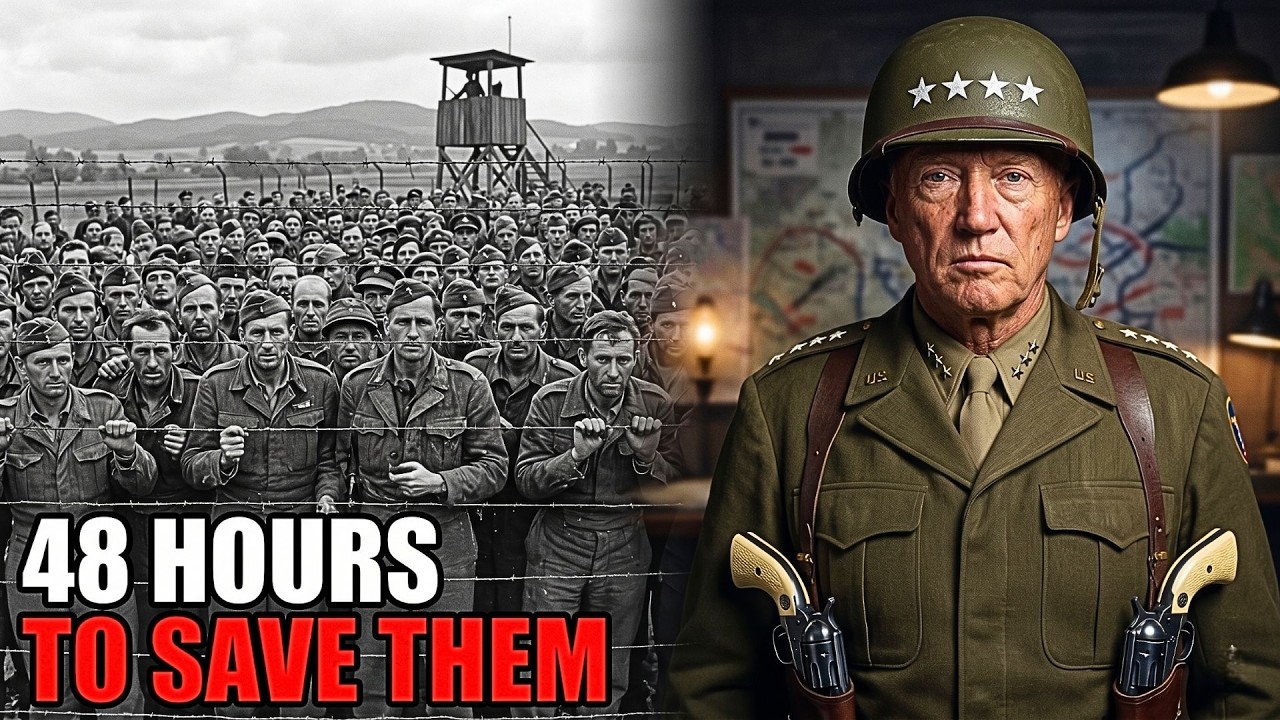
Inside the camps, something was happening that the SS did not fully understand. The prisoners had their own intelligence network. Men who have survived years in captivity develop instincts that civilians never acquire. They could read guard behavior. They could interpret the nervousness in the SS men's movements, the hushed conversations, and the way officers disappeared into the command building and came out with changed expressions.
They knew something was different. They could also hear the artillery. To the west, growing closer over the past two days, the sound of American guns had become a constant background noise. In the camps, men listened to that sound the way dying patients listen for footsteps in a hospital corridor.
Brigadier General Arthur Vanaman was the senior American officer inside Stalag Luft 7A. He had been a prisoner since 1944, shot down over Germany, and in the months since he had organized the American officers into a functioning command structure. When there was nothing to command, he maintained the structure anyway, because the day might come when it mattered.
This was that day. He gathered his senior officers in the early morning hours of April 29th and told them what he suspected was happening outside the wire. He told them what he needed from every man in the camp. Keep the men calm. Keep them in the barracks. No movements that could be interpreted as threatening. No groups gathering near the wire. If shooting started, everyone to the ground inside the buildings, away from windows. Do not give the SS an excuse to open fire.
The SS camp commander received his execution order at 3:00 in the morning. He read it once, then he sat down and thought for a long time. He looked at his forces. They were sufficient to carry out the order. The prisoners were unarmed, malnourished, and confined. It could be done.
He looked at the reports coming in from the west. American armor was moving at speed, not stopping for anything. Estimated arrival was the afternoon. He made a calculation.
If he executed 10,000 prisoners and American tanks arrived four hours later, there would be no question who gave the order. Every survivor, every witness, every document would point to him. He would hang, not as a soldier who lost a war, but as a murderer. If he delayed, perhaps the Americans would arrive before the order could be executed. The decision would be taken from him. He could claim he never intended to follow through.
He delayed. He sent a message back up the chain saying he was awaiting confirmation of the order before proceeding. A stall, the kind that bought hours.
Abrams reached Moosburg at 12:40 in the afternoon on April 29th. His tanks came through the outer streets of the town at speed, German resistance collapsing before them. Some German soldiers dropped their weapons and raised their hands before the tanks had even stopped moving. Others ran. A small number fought briefly and were overrun.
The tanks reached the outer wire of Stalag 7A at 12:50. What Abrams saw through his periscope stopped him for a moment before he gave the order to advance. Over 100,000 prisoners pressed against the wire, standing on anything that gave them height, packed so tightly that the wire itself bowed outward.
Americans, British, French, Russians, Poles, and Belgians stood in the remnants of uniforms. Men who had been prisoners for five years, and men who had been there five months. All of them pressed against the fence watching American tanks come through the dust of the Bavarian afternoon.
The cutting of the wire was the work of minutes. Tank crews used bolt cutters and then simply drove through the sections that remained. The SS guards, those who had not already run, surrendered immediately when they understood what they were looking at.
The prisoners poured through the gaps. Some ran. Some walked carefully, not trusting that this was real. Some stood where they were and wept. Some looked for specific people, calling names and searching faces in the crowd.
General Vanaman emerged through one of the gaps in the wire. He found an American officer and, through force of professional habit that five years of captivity had not broken, reported in properly. "Brigadier General Vanaman, senior American officer, Stalag 7A, ready to report."
The officer who received this report was 24 years old. He had no idea what to say to a general. He said, "Welcome back, sir." Which was probably exactly right.
Patton arrived later that afternoon, driving into a camp that was already in the process of organized chaos. Medical teams moved through the crowd. Logistics officers tried to organize transport. Military police attempted to establish some order at the wire perimeter. And 100,000 men who had been prisoners tried to understand that they were free.
His Jeep moved slowly through the crowds, men pressing toward it from every side, reaching out to touch it, calling out in languages he did not speak. He stood up in the vehicle so they could see him. He was not a man who showed emotion easily. He had spent his career cultivating the image of controlled ferocity. It had served him well.
Standing in that Jeep, surrounded by the liberated men of Stalag 7A, he came close to losing that control. He did not. But it was closer than almost anyone had ever seen.
He addressed the men within earshot. He told them the war was nearly over. He told them they were going home. He told them to hold on a little longer while the army worked out the transport. The words were simple. They always are at moments like this. The meaning was carried by the fact of the tanks, the cut wire, and the open gates.
Then a large American flag appeared. One of the prisoners had kept it hidden for years, sewn inside a coat, moved from camp to camp, preserved for exactly this moment. It was raised over Stalag 7A.
A sound went through the crowd of 100,000 men that Patton would describe, years later in his diary, as something he had never heard before and never heard again in his life.
The SS camp commander was brought to Patton afterward. The man who had delayed the execution order, who had, whether from cowardice or calculation, kept 10,000 men alive long enough for the tanks to arrive. Patton looked at him. He did not speak to him. He did not ask questions. Just looked. Then he turned away.
The SS commander was taken away for trial. He was convicted of war crimes for other activities during his command and executed in 1946.
The 10,000 men in Stalag 7A went home. All of them. The 14th Armored Division lost over 40 men in the drive to Moosburg. Forty soldiers who died in the last days of a war that was already decided, pushing 60 miles through German resistance to reach a camp in time.
Patton never spoke publicly about whether those 40 deaths were worth the price paid. The math is not simple. Forty certain deaths against 10,000 probable ones. Whether that calculation is clean depends on what you believe about the value of human life, the responsibilities of command, and what it means to reach people who are counting on you before the clock runs out.
What Patton believed was simpler than the math. Those men were in the camps because American forces had not been able to prevent their capture years earlier. The debt was real, even if it was abstract. As long as it was within his power to bring them home, that is what he would do.
He had the power, he used it, and 40 men died so that 10,000 could live to go home.
Moosburg was liberated on April 29th, 1945. Germany surrendered nine days later on May 8th. Those 10,000 men were home by summer.