At 4:30 in the morning on April 7, 1972, Joey Gallo was sitting at a butcher block table inside Umberto's Clam House at 129 Mulberry Street in Little Italy, Manhattan.
He was eating shrimp and scungilli with his wife, his 10-year-old stepdaughter Lisa, and his sister. The smell of garlic and fried clams hung in the air. Checkered tablecloths covered the tables, and voices stayed low.
It was Gallo's 43rd birthday.
Then four men walked through the door carrying .32 and .38 caliber revolvers. They opened fire. Twenty shots tore through the small restaurant.
Gallo swore and tried to pull his own gun. He flipped the table to shield his family. He took bullets in his back, his left elbow, and his buttock.
Bleeding through his pinstripe suit, he staggered toward the front door, stumbled out onto Hester Street, and collapsed next to his black 1971 Cadillac. His bodyguard, Pete the Greek, was hit in the hip. His sister screamed. Lisa watched the whole thing.
The entire hit took less than 30 seconds. Joey Gallo bled out in the street on the same day he was born.
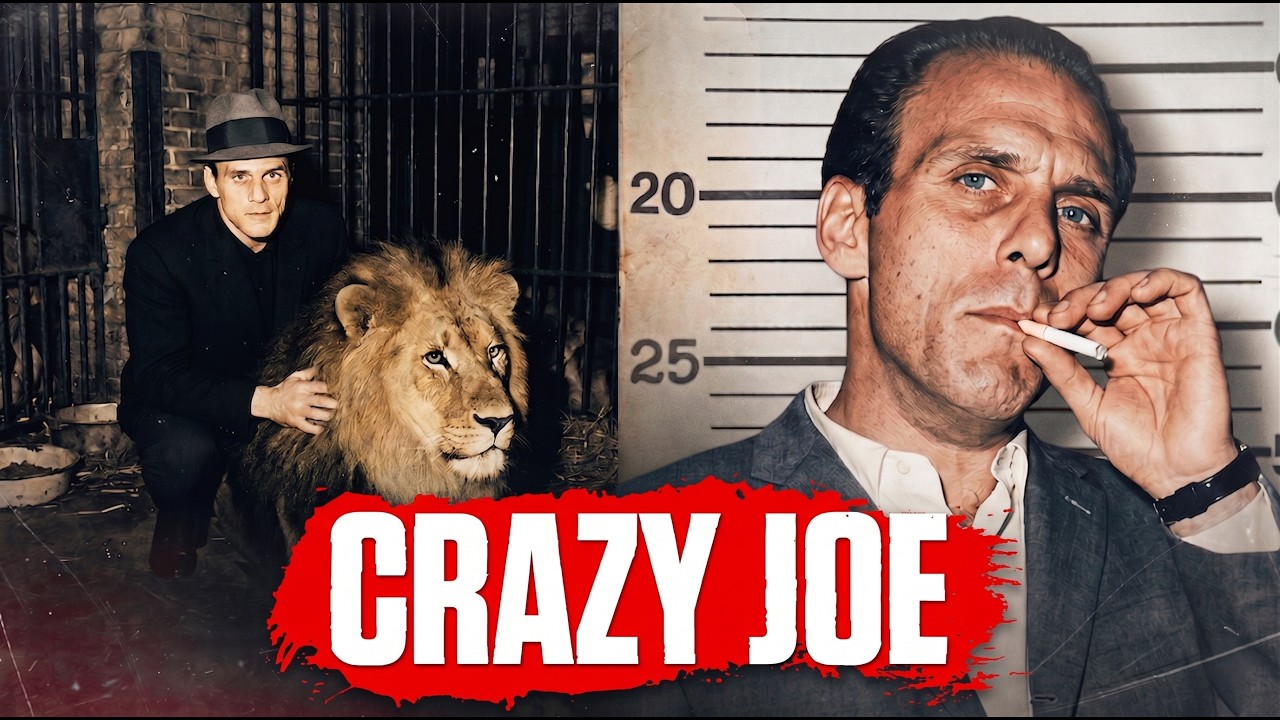
This was not just another mobster getting clipped in a restaurant. Joey Gallo was the man who kept a pet lion named Cleo in his Brooklyn basement. He read Sartre and Camus in prison. He befriended black gangsters when no Italian mobster dared sit next to one.
He kidnapped his own bosses' top men and declared war on the entire Profaci crime family. He walked into Bobby Kennedy's Senate hearing room, looked at the carpet, and said, "Nice carpet. Good for a crap game."
He stood 5'6", with blond hair and blue eyes, and a court psychiatrist had diagnosed him as a paranoid schizophrenic. He was also considered the most dangerous man in Brooklyn.
His story runs from President Street to prison to the Copacabana to a pool of blood on Mulberry Street. But the part most people never discuss is what Gallo tried to build.
He did not just fight the Colombo family. He attempted something no one in the Mafia had ever tried. He worked to unite black and Italian criminal organizations into a new kind of power structure. For a brief, wild moment in the early 1970s, he almost pulled it off.
To understand Joey Gallo, you have to understand where he came from.
Red Hook, Brooklyn, in the 1930s and 40s was a neighborhood where the docks ran everything. Longshoremen drank their paychecks, and wise guys collected the rest.
Joey was born on April 7, 1929, to Umberto and Mary Gallo. His father, Umberto, was a bootlegger during Prohibition who invested his earnings into a loan-sharking operation. He ran a greasy spoon restaurant in the Kensington section of Brooklyn, and he did nothing to discourage his three sons from following him into the life.
Joey was the middle child. His older brother, Larry, was quiet and calculating. His younger brother, Albert, known as Kid Blast, was the loyal soldier. Joey was different. Joey was electric.
He dropped out of high school at 16. Shortly after, a car accident left him with a permanent nervous tick. Some people thought it made him look unstable. He used that impression.
Around this time, he formed a small crew with his childhood friend Pete Diapoulas, known as Pete the Greek, and a man named Frank Illiano. They started with jukebox and candy machine rackets.
The scheme was simple. They would approach a bar or restaurant owner and tell him he needed a jukebox. If the owner said no, Joey would pull a knife and hold it to his throat until the man changed his mind.
Within a few years, Joey Gallo controlled the jukebox racket across a wide stretch of Brooklyn. People in the neighborhood started calling him Joey the Blond.
What set Gallo apart from every other street kid running rackets was his obsession with movies, specifically the 1947 film Kiss of Death. In it, Richard Widmark played Tommy Udo, a cackling, unpredictable psychopath.
Gallo did not just watch the movie. He studied it. He quoted Tommy Udo, walked like him, talked like him, and adopted that same unhinged energy. Combined with a real capacity for violence, the performance became genuinely terrifying.
After an arrest in 1950, court psychiatrists diagnosed him with paranoid schizophrenia. The diagnosis followed him for the rest of his life. People started calling him Crazy Joe. He never tried to shake the name. He wore it like armor.
By the mid-1950s, the Gallo brothers had caught the attention of Joe Profaci, boss of one of New York's five families. Profaci saw potential in the wild kids from Red Hook and brought them into the fold.
Almost immediately, he put them to work on one of the biggest hits in Mafia history.
On October 25, 1957, Albert Anastasia, boss of what would later become the Gambino family and known as the Lord High Executioner of Murder Inc., was sitting in a barber's chair at the Park Sheraton Hotel on 7th Avenue in Manhattan. He was getting a shave.
Two gunmen walked in and did not hesitate. They shot Anastasia multiple times. He died in that chair surrounded by shattered mirrors and blood-soaked towels.
The hit became one of the most famous in Mafia history, and Joey Gallo later bragged about it openly. "You can just call us the barbershop quartet," he told people.
Most men who kill a Mafia boss keep their mouths shut for the rest of their lives. Joey Gallo made jokes about it.
Gallo expected a serious reward for his role in the Anastasia killing: a bigger cut of the family's rackets, more territory, more respect. Joe Profaci did not deliver.
Profaci was old school. He hoarded money and demanded a $25 tribute from every member of the family. It was not the amount that mattered. It was the principle. He expected his soldiers to kick up constantly while he sat on his fortune.
The Gallo brothers watched Profaci collect while they scraped for scraps. Joey decided he was done waiting.
On February 27, 1961, the Gallo brothers kidnapped four of Profaci's top men. They grabbed Joseph Magliocco, the underboss and Profaci's own brother-in-law. They grabbed Frank Profaci, the boss's brother. They grabbed Caporegime Salvatore Musacchia and soldier John Simone.
Four of the most important men in the family were snatched off the streets in a single coordinated move. Profaci himself barely escaped, fleeing to Florida.
This was a soldier kidnapping his own bosses. In the Mafia, that was not rebellion. It was a declaration of war.
The Gallos held the hostages and demanded a complete restructuring of how the family's money was divided. They wanted a bigger cut, respect, and what they believed they had earned.
Profaci's consigliere, Charles LoCicero, negotiated a deal. The hostages were released peacefully, and Profaci agreed to give the Gallos better terms.
Profaci had no intention of keeping that deal.
On August 20, 1961, Profaci sent men to kill Larry Gallo and a crew member named Joseph Gioeli, known as Joe Jelly. The hit on Joe Jelly succeeded. He disappeared and was never seen again.
The attempt on Larry Gallo became one of the most infamous scenes in Mafia history. Carmine Persico and Salvatore D'Ambrosio lured Larry to the Sahara Lounge on Utica Avenue in Brooklyn.
While they sat at the bar, Persico wrapped a garrote around Larry's neck and started strangling him. Larry was seconds from death when a police officer walked in on a routine check. The killers fled. Larry survived with rope burns across his throat.
That scene later inspired one of the most famous moments in The Godfather, when Luca Brasi is strangled at a bar.
Now the war was fully on. The Gallo-Profaci conflict raged through Brooklyn for the next two years. Nine men were murdered. Three more vanished. Bodies turned up in car trunks. Men disappeared from social clubs and were never found.
The Gallos operated out of their headquarters at 51 President Street in Carroll Gardens, a three-story brick tenement they called the dormitory. It was there that Joey Gallo kept his pet lion, Cleo, in the basement.
A full-grown lion lived in the basement of a Brooklyn walk-up. Gallo would bring people down to see it and use it to intimidate rivals. Sometimes he brought Cleo out on a leash. The neighbors on President Street had a lion living below them.
The war caught up with him. In November 1961, Gallo was convicted of conspiracy and extortion for trying to muscle in on a businessman's operation. On December 21, 1961, he was sentenced to 7 to 14 years in prison.
While Joey Gallo sat behind bars, the world outside kept turning. Joe Profaci died of cancer on June 7, 1962. Leadership of the family eventually passed to Joseph Colombo, and the Profaci family became the Colombo family.
The Gallos never forgot. And Joey Gallo, locked away in a cell, was about to undergo the most extraordinary transformation of his life.
Most men go to prison and come out harder, angrier, more violent. Joey Gallo went to prison and came out a philosopher.
He was incarcerated at three New York State prisons: Green Haven, Attica, and Auburn. At Auburn, he took up watercolor painting, using bright, emotional colors on canvas. He worked as an elevator operator in the prison woodworking shop, but the real change happened in his mind.
Gallo taught himself the Evelyn Wood speed reading technique and then read everything. Sartre, Camus, Nietzsche, Machiavelli, Kafka. He read up to 10 books at a time. He gave himself what amounted to a graduate-level education in philosophy, political theory, art history, and literature.
He wrote poetry and called himself the Walt Whitman of the streets. He proposed a book of verse he wanted to title Cracked Bricks. He debated existentialism with anyone who would listen. He once asked a visitor whether they preferred Sartre or Camus as casually as another man might ask about the Yankees.

But Gallo did not just educate himself. He did something far more dangerous, something that would set off a chain of events leading directly to his death.
At Green Haven, he befriended an African-American drug trafficker named Leroy Barnes, known as Nicky Barnes. Barnes would later become one of the most powerful heroin dealers in Harlem, known as Mr. Untouchable. It was Gallo who mentored him.
Gallo recognized something no one else in the Italian Mafia was willing to see. The power structure in Harlem was shifting. Black criminal organizations were gaining territory, muscle, and independence. Rather than fight them, Gallo decided to ally with them.
He coached Nicky Barnes on how to professionalize his operation and upgrade his organization from a street crew into a real criminal enterprise.
In 1964, Gallo even sued the Department of Corrections after he was punished for allowing a black barber to cut his hair. In a Mafia where black men were not even allowed to enter Italian social clubs, Joey Gallo was building bridges.
That took either incredible foresight or a complete disregard for the rules, probably both.
During a prison riot at Auburn, Gallo rescued a severely wounded corrections officer from a mob of angry inmates. The officer was so grateful that he later testified on Gallo's behalf at a parole hearing.
A diagnosed schizophrenic, a convicted extortionist, and a suspected killer saved a guard's life during a riot while reading Nietzsche in his cell at night.
On April 11, 1971, after nearly 10 years behind bars, Joey Gallo walked out of prison and back onto the streets of New York City. Everything had changed.
His brother Larry was dead. Cancer had taken him in May 1968. The family Gallo had gone to war for was now run by Joseph Colombo, a man Gallo considered a pretender.
Colombo sent a peace offering of $1,000. Joey Gallo looked at the money and laughed. He demanded $100,000. Colombo refused. That refusal set the final clock ticking.
Before the violence resumed, something strange happened. Joey Gallo became a celebrity.
His first wife, Jeffie Lee Boyd, was a Las Vegas showgirl who had previously been married to jazz saxophonist Gerry Mulligan. Through Jeffie, who lived on 8th Street in Greenwich Village, Joey entered a world of jazz clubs, beatnik pads, and downtown bohemian culture.
He fit right in. He could discuss German expressionism and its influence on film noir. He could debate the merits of fascism versus communism over cocktails. He was charming, articulate, and genuinely brilliant. He was also a violent criminal who had spent a decade in prison for extortion.
That combination was irresistible to the New York literati. Actor Jerry Orbach and his wife Marta became close friends. Ben Gazzara, Peter Falk, Joan Hackett, playwright Neil Simon, and comedian David Steinberg were also part of the circle.
Gallo was even scheduled to appear alongside writer Gore Vidal, activist Abbie Hoffman, and filmmaker Otto Preminger at an event. Susan Sontag, a voice of the city's intelligentsia, later said, "I wish I'd had the chance to talk to Joe Gallo before he died."
Writer Gay Talese put it simply: "He almost became one of the beautiful people."
Gallo loved the attention. He loved walking into Sardi's, the famous theater district restaurant, where you could hear a pin drop when he entered. He dressed impeccably in pinstripe suits, dark shirts, and white ties. He leaned into the gangster image for his artistic friends.
His second wife, Sina Essary, later told reporters that people were mesmerized by him. He had a quality that attracted people no matter who they were. He was extremely intelligent and could talk about anything: art, theater, politics, philosophy, all the things he had been reading about in prison.
Meanwhile, Jerry Orbach had just starred alongside a young Robert De Niro in the 1971 film The Gang That Could Not Shoot Straight, based on columnist Jimmy Breslin's novel about the Gallo crew. Orbach played Kid Sally Palumbo, a character loosely based on Joey himself.
An actor was playing a gangster based on a real gangster who was his actual friend. The lines between reality and fiction had completely dissolved.
But while Gallo sipped cocktails with celebrities, the streets had not forgotten him.
On June 28, 1971, Joseph Colombo was shot three times at an Italian Unity Day rally in Columbus Circle, Manhattan. The gunman was a black man named Jerome Johnson, who was killed immediately after the shooting. Colombo survived but was left in a vegetative state. He spent seven years in a coma before dying of cardiac arrest.
Everyone in the underworld looked at the same evidence: a black gunman and an unprecedented hit on a Mafia boss. Joey Gallo, the only Italian mobster with deep connections to black criminal organizations, had been released from prison two months earlier.
The streets drew their own conclusion. Whether Gallo actually ordered the Colombo hit has never been proven. Some investigators believe Carlo Gambino, the most powerful boss in New York, orchestrated the whole thing and used Gallo as a convenient scapegoat.
The accounts vary, but the truth did not matter. What mattered was what the Colombo family believed, and they believed Joey Gallo had shot their boss.

Carmine Persico, the same man who tried to strangle Larry Gallo with a garrote at the Sahara Lounge in 1961, was now positioning himself to take over the Colombo family. He wanted Gallo gone.
But Joey Gallo was not hiding. That was never his style. He walked through Little Italy like he owned it. He ate at the best restaurants and attended shows at the Copacabana. He was working on a book deal with Viking Press and meeting with Hollywood producers.
Three weeks before his 43rd birthday, he married Sina Essary, a 29-year-old actress. He had a stepchild he adored. Life was good. Life was also about to end.
On the night of April 6, 1972, Joey and Sina joined Jerry and Marta Orbach at the Copacabana to see comedian Don Rickles and singer Peter Lemongello perform. It was the night before Joey's birthday.
After the show, the group drove downtown in that black Cadillac. They arrived at Umberto's Clam House after 4:00 in the morning.
Joey, Sina, his 10-year-old stepdaughter Lisa, his sister Carmela, Pete the Greek Diapoulos, and Pete's girlfriend sat down. They ordered shrimp, scungilli, and clams.
They were between seafood courses when the door opened. A Colombo associate named Joseph Luparelli had spotted Gallo earlier and driven to a social club to alert members of the crew. The gunmen arrived quickly.
Four men with revolvers walked into the dining room without hesitation. The first shots hit Gallo in the back. He swore and reached for his own weapon. Twenty shots filled the small restaurant.
Gallo grabbed the butcher block table and flipped it, creating a barrier between the gunmen and his family. Even with bullets in his body, he moved toward the door. Witnesses said he was trying to draw fire away from his wife and stepdaughter.
He stumbled through the entrance, crossed onto Hester Street, and collapsed beside his Cadillac. Pete the Greek took a bullet in the hip. Carmela screamed. Little Lisa watched everything.
Police arrived minutes later and found Joey Gallo dying on the pavement. He did not make it to the hospital alive. Time of death was approximately 5:00 in the morning on April 7, 1972. His 43rd birthday, the same date he had entered the world.
Three days later, at his funeral, his sister Carmela stood by the casket and made a promise everyone in the underworld heard: "The streets are going to run red with blood, Joey."
She was right.
In the months that followed, at least 10 more men were killed in a new wave of warfare between the Gallo faction and the Colombo family. It was the most violent Mafia conflict New York had seen in decades. The war dragged on for years before what remained of the Gallo crew negotiated peace and rejoined the Colombo family.
The gunmen who killed Joey Gallo were never officially identified. The leading theory points to a Colombo hit squad. Frank Sheeran, the mob enforcer who later claimed to have killed Jimmy Hoffa, also took credit for shooting Gallo, saying the bosses wanted him eliminated because his flashy celebrity lifestyle was drawing too much attention to organized crime.
Most mob experts doubt Sheeran's claim. What is documented is that the Colombo family had the motive, the opportunity, and the manpower. The rest remains in the shadows.
Three years after the killing, in 1975, Bob Dylan was visiting the home of Jerry and Marta Orbach. He saw a painting of Joey Gallo hanging on the wall and asked about it. What the Orbachs told him that night inspired Dylan to write an 11-minute ballad called "Joey," which appeared on his 1976 album Desire.
The song paints Gallo as a romantic anti-hero, a man who stood alone against the machine. "I never considered him a gangster," Dylan later said. "I always thought of him as some kind of hero, an underdog fighting against the elements."
The song was not universally loved. Rock critic Lester Bangs called it one of the most mindlessly amoral pieces of repellent romanticist trash ever recorded. Plenty of people who lived through the Gallo wars agreed.
Joey Gallo was responsible for a conflict that killed over a dozen men. He terrorized business owners with knives. He was convicted of extortion. But he also read Camus. He also painted watercolors. He also saved a prison guard's life. He also tried to build alliances across racial lines that no one in the Mafia had ever attempted.
The truth about Joey Gallo does not fit neatly into a category, and that is exactly what makes his story worth telling.
What happened to the people around him tells you something, too. His brother Albert, Kid Blast, survived the wars and eventually faded from public life. Nicky Barnes, the man Gallo mentored in prison, went on to become one of the biggest heroin dealers in American history before being arrested and eventually becoming a government informant.
Jerry Orbach went on to become Detective Lennie Briscoe on Law & Order, one of the most iconic television roles in American history. He never forgot his friendship with Joey.
Sina Essary took her daughter Lisa and moved to Tennessee to escape the world her husband had left behind. Lisa grew up to become a casting director in Hollywood. The Colombo family continued its cycles of violence and internal warfare for decades. Carmine Persico eventually became boss and spent most of his life in prison.
Joey Gallo spent 43 years trying to be something the Mafia could not contain. He wanted to be an intellectual, a revolutionary, a celebrity, a kingmaker. He wanted to tear down the old order and replace it with something that crossed racial lines, cultural boundaries, and every rule the Mafia had ever established.
The Mafia does not reward visionaries. It eliminates them. Joey Gallo challenged a system designed to crush anyone who challenged it. He read Nietzsche and quoted Camus, but he forgot the one lesson every philosopher teaches: the world does not change because one man wills it. It changes when enough people are ready.
In 1972, the Mafia was not ready for Joey Gallo. He died eating scungilli at 4:30 in the morning on his birthday. A lion tamer with no lion left. A philosopher who ran out of arguments. A man who almost became one of the beautiful people, buried instead with bullets in his back.