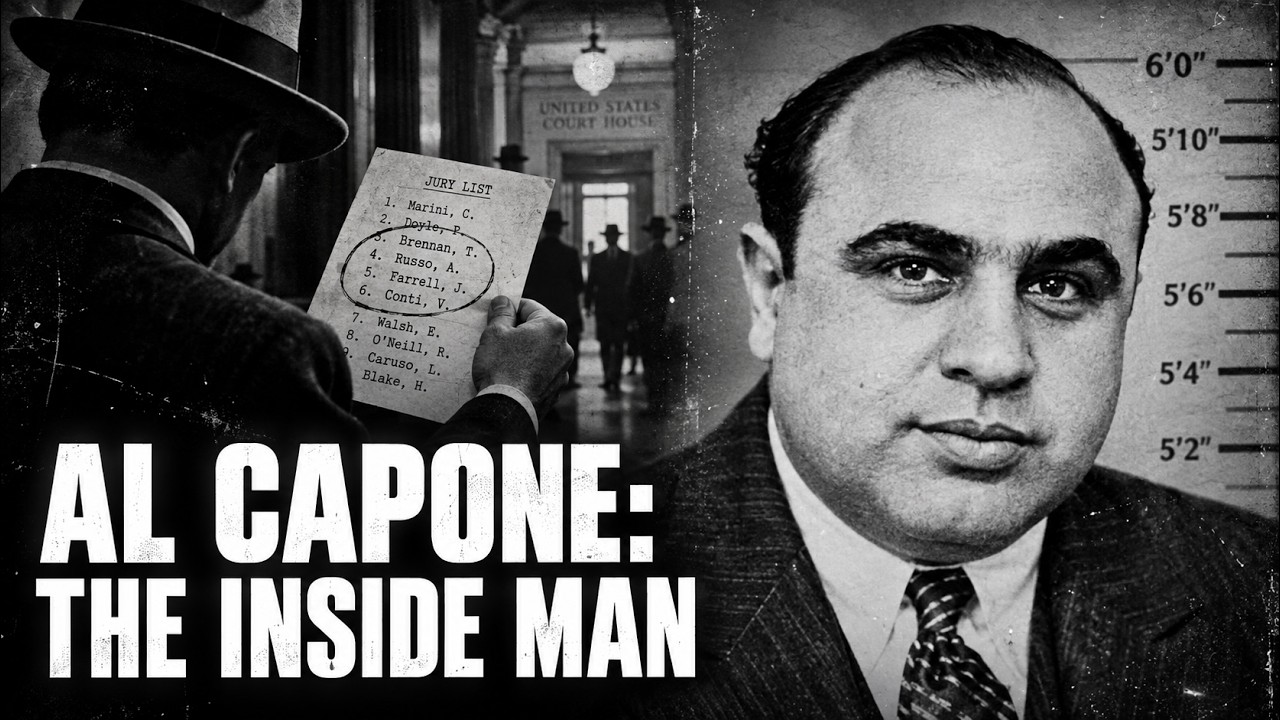
In October 1931, a federal court bailiff walked a corridor in Chicago carrying a list of names. Those names belonged to the men who would decide Al Capone's fate that morning.
Capone's organization had possessed the list for weeks. His people had visited the addresses. Thousand-dollar bills had changed hands, roughly $21,000 per juror in today's money. There had been promises of city jobs, tickets to prize fights, and visits that came with no gift at all.
The bailiff stopped outside another judge's courtroom. He did not deliver the list. He swapped it. The men who took the jury box at 9:00 were men Capone had never heard of.
The person who told the federal government that the first list had been bought was Capone's own lawyer. He had spent six years building the legal half of that empire. He was still on the payroll that morning.
What happened next cost Capone eleven years. It left a street in Cicero with a file nobody ever closed. And it put a name in front of tens of millions of Americans every year who have no idea where it came from.
Edward Joseph O'Hare was born in St. Louis on September 5, 1893. His parents were first-generation Irish immigrants. His father worked, his mother kept the house, and nobody in that family had ever argued a case in a courtroom.
He went by EJ. He married Selma Loth in 1912 when he was eighteen. Two years later, on March 13, 1914, they had a son and named him Edward Henry. The boy went by Butch almost immediately, and the name stuck for the rest of his life. Two daughters followed, Patricia and Marilyn.
St. Louis in those years ran on the river. The levee district moved freight, liquor, and money, all under arrangements that were understood rather than written down.
A man without family money had two ways up out of a neighborhood like his. He could get close to the men who ran the district, or he could learn the law that governed it. O'Hare learned the law.
He took his degree, hung out a shingle, and went to work in a city where the difference between a legitimate business and an illegitimate one was often a single license issued by a man who could be reached. He was good at it. He read a contract the way some men read a racing form, looking for the place where the language had been left loose.
He understood something that many better-born attorneys of that decade never grasped. Most of the new fortunes were not built by breaking a rule. They were built in the spaces where no rule had been written yet. The lawyer who got there first set the terms for everyone who came after.
By the time Prohibition arrived in January 1920, he was twenty-six years old and standing exactly where the money was about to land.
About three hundred miles northeast of St. Louis, on the farmland edge of Chicago, there was a piece of ground with an orchard on it. Nothing had been built there. It had a name: Orchard Field.
In the early 1920s, a man named Owen Patrick Smith solved a problem that had bothered gamblers for a generation. Dog racing had existed for years, and it had always used live bait. That made it illegal in most places and distasteful in the rest.
Smith built a mechanical lure, a fake rabbit running on a rail ahead of the pack, and the entire sport changed inside two seasons. No live animal meant no cruelty statute. No cruelty statute meant tracks could open. Once tracks opened, money that had been going into backroom card games started going through a ticket window instead.
Smith died, and his estate went into administration. According to Wikipedia's account of his career, O'Hare represented the administrator of that estate. That put a St. Louis attorney in the middle of the legal machinery behind the mechanical rabbit.
Every dog track in America needed it. And every dog track in America was, in most states, one court ruling away from being shut down. Racing was gambling. Gambling was regulated county by county. The statutes had been written for horses.
That is the business O'Hare walked into. Not the racing, the paperwork underneath the racing. It made him rich the first time. It also put him in rooms with the men who owned the tracks. By the middle of the decade, those men were no longer local.
In 1927, O'Hare and Selma divorced. She stayed in St. Louis with the two girls.
There is a story about the boy that comes from a single account, so take it as that account tells it. O'Hare came home one afternoon and found Butch stretched out on a couch reading a book and eating cake. He decided his son was drifting. He enrolled him at Western Military Academy in Alton, Illinois, about two hours up the river.
Whatever the truth of the cake, the enrollment is documented. Butch went to Alton in his early teens. He learned to shoot there. He learned to stand inspection and keep a uniform. He learned something about the country he lived in that most boys his age never had to think about.
An officer's career in the United States is a thing you apply for. Somebody in Washington reads the file. Somebody vouches for the name. That is the piece to hold. Not the school, the name.
In the same year that EJ O'Hare sent his son to a place where a family name would eventually be examined by the federal government, EJ O'Hare moved to Chicago and went to work for Al Capone.
By 1928, Capone's organization ran beer, liquor, gambling, and protection across Cook County. It did that with the cooperation of police captains, ward committeemen, judges, and a mayor's office, bought at retail and renewed like a subscription.
The outfit also ran dog tracks, among them the Hawthorne Kennel Club out in Cicero, and that is where O'Hare fit. He made a second fortune through the connection. He became engaged to Ursula Sue Granata, whose brother sat in the Illinois legislature and had ties of his own to the organization. By any reading of the record, O'Hare was inside.
Federal authority over Capone was thin. Washington could reach him in exactly two places: Prohibition law and income tax. Prohibition cases needed witnesses, and witnesses in Chicago had a way of leaving town, changing their story, or both.
So the Treasury sent a special agent named Frank J. Wilson. Wilson built the case out of paper.
Capone kept no bank account. He owned no property in his own name. He endorsed no checks. He paid cash for everything he touched. Wilson spent two years assembling what the man spent instead: the custom suits, the telephone bills, the town cars, the estate on Palm Island in Florida with its two new docks and its extra garage.
He also went after people. A cashier named Fred Ries had handled money for the outfit's gambling operations, and Wilson got him to testify that a stack of cashier's checks represented gambling profits paid to Jake Guzik. That testimony convicted Guzik in late 1930.
Wilson wanted Ries alive for the Capone trial, so he took money from a group of Chicago businessmen known as the Secret Six and put the witness on a boat to Uruguay until he was needed.
Working late in his own office in the fall of 1930, Wilson found something better than a witness. It was a ledger from a large gambling operation, with net income calculated every few pages and divided among three men identified only by initials. One line recorded that Frank had paid $17,500 for Al, about $375,000 today.
Then Capone's tax attorney, Lawrence P. Mattingly, made an offer. He put a letter in front of the Treasury men proposing figures his client would be willing to pay tax on. The press would later call it the confessional letter.
Mattingly's arithmetic had Capone earning $75 a week in 1924 and 1925, about $1,600 a week today, while supporting a wife, a son, a widowed mother, a brother, and a sister. It rose from there to roughly $26,000 a year in 1926, near $560,000 now, and to no more than $100,000 a year by the end of the decade, about $2.1 million in current money.
The government did not accept the figures. It kept the letter. And when Capone's lawyers went to U.S. Attorney George E. Q. Johnson and negotiated a guilty plea in exchange for two and a half years, that letter was already sitting in a federal file drawer, waiting for someone to ask for it.
Late September 1931, Judge James H. Wilkerson's chambers, Federal Building, Chicago. Three men are in the room. Frank Wilson is one, George Johnson is another, and Wilkerson sits behind the desk.
About two weeks earlier, an informant had come to Wilson with a claim. Capone's organization had the complete list of prospective jurors. They were already passing out $1,000 bills, about $21,000 each today. They were promising jobs in city government. They were handing out tickets to prize fights. And where a man wanted none of it, they were applying a different kind of pressure.
Wilson did not believe him at first. Two years of ledger work does not incline a man toward rumor, and the claim was enormous. A fixed jury would mean that every hour of that work was already spent.
Then the informant produced names, names and addresses, ten of them, and he could say exactly where on the list they sat, numbers 30 through 39.
Now Wilson is in chambers, and the judge is saying that his own list has not reached him yet. When it does, he will call them. It reaches him. Wilkerson reads it against the ten names on the paper in front of him. They match. Everyone in order.
The judge does not raise his voice. He does not order an investigation or call the marshals or send for the defense. He tells the prosecutors to bring their case into court as planned and to leave the rest to him. That is the entire meeting.
The United States government had just learned that the jury in the largest criminal trial in the country had been purchased. The man who would preside over it answered in two sentences and went back to his docket.
The informant walked out of the federal building, drove out to Cicero, and went back to work at a racetrack owned by the man he had just given up.
Go back four months to the summer of 1931. Frank Wilson is sleeping with a guard outside his door. He has been told that five gunmen came up from New York with a contract on him. An accountant had become a target because the accounting worked, which tells you what the ledgers were worth by then.
They were worth three indictments. One for Capone's 1924 taxes, one carrying twenty-one counts for 1925 through 1929, and a third under the Volstead Act, built from the work of a Prohibition agent named Eliot Ness, listing roughly 5,000 violations. Johnson held that third one back as the card to play if the tax case came apart.
Sources differ on the exact date of Capone's earlier legal troubles, with Britannica giving June 5 and the Mob Museum giving June 8. Capone was not walking into that courthouse clean either. He had done nine months in Pennsylvania on a concealed weapon charge, released in March 1930 for good behavior. And in February 1931 in federal court in Chicago, he had been convicted of contempt and given six months in the Cook County Jail. His appeal went nowhere.
Remember the six months. It comes back.
Then he pleaded guilty, and that is where the summer turned. He walked out of the building and told reporters he had a deal for two and a half years. With good behavior, he would be back on Palm Island well inside that. The papers ran it. The deal had been made in an office with the U.S. attorney, and as far as the defendant was concerned, it was done.
Wilkerson had not agreed to anything. He told the court that no bargain made in an office binds a federal judge and that it was time somebody impressed on the defendant that a federal court cannot be bargained with. Capone withdrew the plea on the spot. The trial was back on, and now it would be decided by twelve men whose names were already in circulation on the South Side.
The contract on Wilson had not come from an abstraction. It came from an operation with a street address, whose beer trucks rolled through neighborhoods where police captains drew two salaries, whose slot machines sat in corner stores that had never asked for them, whose collectors came back to the shopkeepers who fell behind.
The speakeasies paid it. The gambling houses paid it. The dog tracks paid it. And the dog tracks were where EJ O'Hare had spent six years keeping the legal half of the machine running.
He had taken a second fortune out of that machine. When he walked into that federal building in September 1931, he was an owner turning on the thing he owned. And he did it in a city where the last man to testify against the organization in a courtroom had been found on a road, and where a Treasury agent with a federal badge needed a guard outside his door to sleep.
O'Hare had no badge and no guard. He had a racetrack office in a town the organization effectively governed and a car he drove himself.
A frightened clerk walking into a federal building is one kind of story. A man who has been paid by both sides for six years, carrying ten names he could only have gotten from inside the room where they were bought, is another kind entirely.
Back to that corridor. Eight in the morning, Chicago, the day the trial opens. The bailiff carries the panelists to a different courtroom, the one belonging to Judge Edwards, and the two panels change places. It takes him about a minute.

The calendar is the one piece the records argue over. Wikipedia puts the switch just before proceedings began on October 5, and the Mob Museum records jury selection starting on October 6. Every account agrees on what the man did with the paper.
Capone arrives. The corridors are full. Reporters from hundreds of papers are working the building because this is the most anticipated criminal trial an American gangster has ever had.
Wilkerson takes the bench and asks in the flat ceremonial language of the court whether the defendant is present. The men who file into the jury box are farmers and shopkeepers. There is a grocer, a painter, a pattern maker, a hardware merchant, an insurance agent, a stationary engineer, a clerk.
They come from the rural edges of Cook County, from towns where the outfit's payroll had never reached. Capone's attorneys object to exactly that, arguing these men are not their client's peers.
Twelve men who had never been approached. Twelve men who had never been offered anything. Twelve men who, as far as the record shows, had never been told there was anything to be offered.
You may have seen a version of this scene. It was filmed in 1987 in a picture about Prohibition agents. On screen, the swap is one clean, triumphant gesture in open court. The file is colder than that. There was no confrontation and no speech. A judge received information in chambers, said he would handle it, and then handled it with a clerk and a corridor before anyone was in the room.
Then the government opened its case, and the paper came out of the drawer. Wilson took the stand and described the meeting where Mattingly had produced the letter. He said Mattingly had taken it from an inside coat pocket, turned it over slowly, looked out the window, and finally thrown the pages across the desk with the remark that this was the best they could do.
The defense fought to keep it out. Wilkerson sent the jury from the room and heard argument, and one of Capone's attorneys told the court that the government had his client nailed and that the letter was the last nail going in.
The ruling split the difference in a way that has confused people ever since. The letter would come in to show that the statement had been made. The jury could not treat its contents as proof of the figures inside it.
Capone never took the stand. His attorney, Michael Ahern, closed by telling the jury that all the evidence proved was that his client was a spendthrift.
It took the jury less than a day to decide what it proved. The jury had a tax attorney's own arithmetic about his client's income. It had a ledger found by a tired agent on a night shift. It had a witness who had been kept alive in South America on private money. And every one of those twelve men had been in the building for less than a day.
October 17, 1931. The jury came back after about eight hours. Here is where most retellings go wrong, and it is worth slowing down for.
Capone had been indicted on twenty-two counts. He was found guilty on five of them, three felonies and two misdemeanors, and acquitted on the rest. The verdict was strange enough that the prosecutors conferred among themselves before accepting it, and the New York Times headline the next morning told readers the defendant might get seventeen years and that the result had puzzled counsel.
Sentencing came a week later on October 24, and Wilkerson built the number carefully. Each felony carried up to five years and a $10,000 fine, about $214,000 today. The judge gave the maximum on the first count. He let the second run alongside it, which on its own would have meant five years total and an early parole date. Then he ordered the third to run consecutively, which made it ten.
On top of that, he added a year in the county jail for the remaining misdemeanor and the six months of contempt Capone was already carrying from February. Ten plus one plus six months. That is where eleven years comes from.
It was never a single sentence. It was four sentences stacked in a particular order by a judge who had already refused one deal in that courtroom and had already moved one jury out of it.
The fine came to $50,000, about $1.17 million now, on top of court costs and back taxes of roughly $215,000, close to $4.5 million in current terms.
The appeals failed. Capone entered the penitentiary at Atlanta in May 1932 as convict number 40886 and went to Alcatraz on August 22, 1934, as inmate number 85.
And EJ O'Hare stayed in Chicago. That is the part that fits no pattern.
Informants leave. They take a new name and a new state and a job nobody asks about, and their families learn to be vague at parties. O'Hare kept running the tracks. He kept his office at Sportsman's Park in Cicero, in the same town as the Hawthorne track he had helped build the paperwork for.
He kept his cars, his engagement, and his routine in the same county for eight years, while the man he had informed on sat in a federal cell counting down a sentence that would end.
He did not go quiet during those years either. He stayed a public figure in the racing business, a man with an office and a telephone and a name in the sports pages. He got engaged. He built the Sportsman's Park operation into one of the busiest tracks in the Midwest.
If he ever took a precaution beyond the one in his coat pocket, it is not in the record. A man who informs on an organization and then stays inside its territory for eight years has either decided he is safe or decided that leaving would announce what he had done. The record does not say which.
The afternoon of November 8, 1939, Cicero, Illinois. EJ O'Hare is at his office at Sportsman's Park. It is an ordinary working day at a racetrack in the fall, with the meet running and the books to go through.
He puts something in his coat that he does not normally carry. It is a Spanish-made .32-caliber semi-automatic pistol, and it has been cleaned and oiled. Whatever he is expecting today, he has been expecting it long enough to maintain the weapon.
He leaves the building and gets into his car, a black 1939 Lincoln Zephyr coupe, that year's model. He pulls away from the track and into traffic on a public road in the middle of the afternoon.
A dark sedan comes up alongside him. Two men are in it, and both of them are carrying shotguns. The Zephyr does not stop where its driver intended it to stop.

EJ O'Hare lost his life that afternoon. He was forty-six years old. The pistol was still in the car. He never drew it.
Eight days later, on November 16, 1939, Al Capone was paroled. He did not walk out of Alcatraz, though almost every telling of this story says he did. Capone had been moved off the island in January 1939 to the federal facility at Terminal Island in California. That is where his release came from. And the gap was eight days, not a week. Two small errors repeated often enough that they became the version people know.
Nobody was arrested for the shooting. Not that year, not that decade, not since. The reasons are mechanical rather than mysterious.
Cicero's police answered to a town government the organization had helped seat. The state's attorney's office in Cook County at that time had a record on organized crime homicides that speaks for itself. The shooting happened on an open road in daylight, and none of the people on that road could describe the sedan afterward. The one federal agency with a documented interest in EJ O'Hare had no jurisdiction at all over a murder in an Illinois town.
So the file sat. It sat through the war. It sat through the decades in which every man who might have given the order died of something else. It sat while the track changed hands and the neighborhood changed around it.
Then in January 2010, a Chicago alderman named Ed Burke asked the Chicago Police Department's Cold Case Squad to look at it again after a new book raised fresh allegations about the killing. Seventy-one years after the fact, detectives pulled a 1939 file on a murder outside a racetrack in Cicero. The Chicago Tribune reported the request that month. No charge has followed it, and the allegations in that book remain allegations.
The federal government got its conviction. It got the eleven years, the fine, the back taxes, and the cell on the island. The man who handed it the jury got no protection, no new name, and no file opened in his honor. He got eight years of ordinary afternoons, a road in Cicero, and seven decades of a folder nobody had a reason to reach for.
Capone served seven years, six months, and fifteen days of the eleven. He spent what was left on the Palm Island estate that Frank Wilson's investigators had once itemized down to the docks and the extra garage, the same house that had been used as evidence against him. By 1946, two doctors who examined him put his mental capacity at that of a child. He died in January 1947 at forty-eight.
Wilson went in the other direction. From 1937 to 1946, he was chief of the United States Secret Service. Before that, he had worked the Lindbergh kidnapping as a federal representative. The man who once slept behind a guarded door ended up running the agency that guards the president.
He never dressed up what O'Hare had been to him. Years afterward, he called him one of the best undercover men he had ever known. And the word he used for where O'Hare had been was inside.
Wilkerson kept the bench. He sat in the Northern District of Illinois for another seventeen years. He took senior status at the end of 1940 and died on September 30, 1948, still in office at seventy-eight. The seat was abolished after him. He had inherited it years before from Kenesaw Mountain Landis.
Fred Ries, the cashier who came back from Uruguay to say what the cashier's checks meant, walked out of that courtroom and out of the record. The Secret Six, the businessmen who had paid for his boat ticket, dissolved within a few years of the trial they had helped win. And the mechanical rabbit outlived all of them. The patent a St. Louis attorney once controlled the paperwork for went on pulling dogs around tracks across the country for another fifty years, long after every man who fought over that money was in the ground.
So why did he do it? The record gives two answers and does not choose between them.
One holds that EJ O'Hare was buying a future for his son. Butch was at Western Military Academy and headed toward an appointment that would require the federal government to look closely at the family name. A father with a Capone connection was a problem that only a federal favor could solve.
The other holds that he was saving himself. By 1930, the Treasury was working through the outfit's associates one at a time, and Guzik had already fallen. A lawyer who had made a second fortune out of that organization had reason to get on the government's side of the table before somebody put him on the other side of it.
Both readings come from the same documented facts, and historians have gone back and forth on them for eighty years. What every account agrees on is narrower and stranger. He did it. Nobody forced him. And he stayed in Cicero afterward, which is not what a man does when he has bought his way out of something.
The deal the Justice Department made was broken in open court by a judge who had never signed it. And that broken deal is the only reason there was a jury left to buy. Two and a half years became eleven because Wilkerson refused to be bound by an arrangement made in an office.
Butch graduated from Western Military Academy in 1932 and entered the United States Naval Academy at Annapolis in 1933. He was commissioned an ensign in 1937 and spent two years on the battleship New Mexico before he started flight training. Whatever his father's reason had been, the appointment happened.
February 20, 1942, the Pacific. On the approach to Rabaul, Butch O'Hare takes an F4F Wildcat toward a formation of nine Japanese bombers heading for the carrier Lexington. His wingman's guns jam on the way in. That leaves one armed fighter with four .50 calibers and enough ammunition for about thirty-four seconds of firing. He is credited with five of those bombers before he is done. He becomes the Navy's first fighter ace of the war and the first naval aviator to receive the Medal of Honor in it.
The night of November 26, 1943, off the Gilbert Islands, he leads the first night fighter interception ever launched from an American carrier. His Hellcat slides out of formation in the dark and is gone. A three-plane search and a flying boat find nothing.
For fifty-four years, the accepted story was friendly fire from the turret gunner of the Avenger flying with him, a sailor named Alvin Kernan. Then Steve Ewing and John Lundstrom published Fateful Rendezvous in 1997 and argued from the surviving crews' accounts that the rounds came from the nose gun of a Japanese bomber. Kernan's own crewmate had dismissed the friendly fire theory years before that.
What every source records is the same. No trace of the pilot or the aircraft was ever found. He was twenty-nine.
Four years and eighteen days earlier, his father had been in a car on a road outside a racetrack in Cicero. Both of them in November. Neither ending ever got a settled answer, and neither file ever produced a name.
Six years later, Chicago needed a name for the airfield northwest of the city. That was the piece of farmland with the orchard on it, the one with nothing built on it. It had been Orchard Field. On September 19, 1949, the city took that name off and put up a different one.
People say it now at ticket counters and read it off departure boards in every airport in the country. The code on their baggage tags is still ORD, the last three letters of the orchard. A Wildcat in Butch O'Hare's markings hangs in Terminal 2. Most people walk past it on the way to a gate.
A boy from St. Louis, whose parents came off a boat, who grew up to read contracts for a living, bought his way into the largest criminal organization in America and then handed the government a list of ten names that took it apart. He kept a pistol cleaned and oiled in the coat he wore to a racetrack, and he never got to use it.
His name is on tens of millions of boarding passes a year. Not his exactly. His son's. And the son never lived in Chicago at all.