On the morning of September 1, 1939, two telephones rang within hours of each other. In Berlin, German tanks were already crossing into Poland. In Washington, President Franklin Roosevelt picked up a different kind of weapon: a single sheet of paper with one name on it.
He crossed out 33 general officers who outranked the man he wanted. Men who had waited decades in line for that exact promotion. Men who believed the job belonged to them by right of service.
He chose someone else instead. A 58-year-old brigadier general almost nobody outside the army had ever heard of. A man who had never once commanded troops in battle. His name was George Catlett Marshall.
Within hours of taking command, Marshall inherited an army so broken it ranked below Portugal in size. An army still training with wooden rifles and trucks with the word "tank" painted on the side in white letters. He looked at the wreckage he had been handed and made a decision that would turn hundreds of powerful men into his enemies. He decided to fire almost all of them.
The call came into the War Department switchboard at 4 a.m. Washington time. German troops had crossed the Polish border. Panzers were rolling through farmland north of the border towns. Dive bombers were already in the air over Warsaw.
By the time Marshall reached his office that morning, the news had confirmed itself a dozen times over. Europe was at war again, 21 years after the guns had supposedly fallen silent for good. Marshall did not have the luxury of shock.
That same day, Roosevelt made the appointment official. Marshall would become Chief of Staff of the United States Army, the highest uniformed position in the nation's ground forces. On paper, it read like the natural culmination of a long and steady military career. In reality, it was one of the most startling personnel decisions Washington had seen in a generation.
Thirty-three general officers outranked Marshall in seniority. Thirty-three men who had spent longer in uniform, who had climbed the ladder more slowly and more patiently, who had every institutional reason to expect the appointment would fall to one of them.
Chief among them was Major General Hugh Drum, a decorated, politically connected officer who had held nearly every senior post below chief of staff. Drum had been quietly angling for the job since 1930. He had cultivated friendships in Congress and in the press. He believed with good reason that the position was his.
When word came down that Roosevelt had passed him over for a comparatively obscure brigadier general who had never led men into combat, Drum was stunned, then furious. His allies in the Senate were furious with him. Newspaper columnists who had already drafted congratulatory pieces had to scramble to explain who this Marshall person even was.
The truth was that most of official Washington barely knew him. Marshall had spent the bulk of his career not on the front lines but behind desks in planning offices, drafting training doctrine and organizing the logistics that keep armies fed, moved, and supplied.
He had shown extraordinary talent as a staff officer during the First World War, coordinating the movement of half a million American soldiers for the Meuse-Argonne offensive in a matter of days. The feat impressed the officers who witnessed it and left barely a ripple in the public consciousness.
He was 58 years old. He had only been promoted to brigadier general three years earlier, a rank most of his rivals had held for the better part of a decade.
So why him? Roosevelt had his reasons, and they had nothing to do with charm. Months earlier, in a meeting at the White House, Roosevelt had floated a proposal to a room full of senior officers and advisers. He wanted opinions. He got the kind of polite, careful agreement that presidents usually get from men who want to keep their jobs.
Then he turned to Marshall. "Do you agree, General?"
"No, Mr. President," Marshall said. "I am sorry, but I don't."
He explained exactly why the proposal was flawed, laying out the reasoning point by point without raising his voice, without softening the disagreement to make it more comfortable. The room went quiet.
Afterward, one of Roosevelt's aides pulled Marshall aside, certain the general had just ended his own career. "You don't talk to the president that way," the aide told him.
Marshall was not in the business of telling powerful men what they wanted to hear. He had built a reputation quietly over decades as a man who would tell the truth even when it cost him something. It was that exact quality, the refusal to bend, that convinced Roosevelt he had found the man he needed.
The president did not want a chief of staff who would nod along as the country drifted toward a war it was not remotely prepared to fight. He wanted someone who would say no to his face.
Marshall got the job. On his very first day, he discovered exactly how much work stood between him and an army capable of surviving what was coming.
The numbers alone were staggering in how small they were. The United States Army numbered somewhere around 190,000 men, a force that, according to widely cited comparisons of the period, ranked below that of Portugal in overall size. A ranking that stung all the more because it was essentially true.
Equipment told the same story. Warehouses across the country were still stacked with rifles and gear left over from the First World War, some of it two decades old, aging quietly in storage while the world outside changed beyond recognition.
Tanks were scarce enough that recent training exercises had relied on trucks with the word "tank" painted crudely on the side, because there were not enough actual tanks to go around. Soldiers drilled with wooden replicas standing in for rifles that did not exist in sufficient numbers.
One officer who observed the state of the force at the time summarized it in a single unsparing phrase: "All bone and no muscle."
Marshall walked the halls of the War Department that first week and understood with a clarity that must have been almost physically uncomfortable the size of the gap between what existed and what would eventually be required. If war reached the United States, and Marshall believed it eventually would, the nation would need an army perhaps 10 times larger than the one currently on the books.
Two million men, maybe more. A force capable of matching German mechanized divisions, tank for tank, in the kind of fast, coordinated warfare the Wehrmacht had just demonstrated in Poland with brutal efficiency.
That army did not exist. Worse, the men who were supposed to build and lead it, many of them were not capable of the task in front of them. And the reason had almost nothing to do with courage or loyalty.
The problem was structural, baked into the very bones of how the army promoted its officers. For decades, advancement had run almost entirely on seniority. Time and service, not talent, decided who moved up.
An officer did not get promoted because he had proven himself brilliant in the field. He got promoted because the men ahead of him in line had finally retired or died, opening a slot for the next man waiting patiently behind them.
The bottleneck this created was almost absurd. Officers could spend 15 years as a captain, 20 years as a major. Marshall knew this reality intimately because he had lived it himself.
During the First World War, he had held the temporary wartime rank of colonel, directing complex troop movements with real authority. When the war ended and the army shrank back to its peacetime size, Marshall was demoted back to his permanent rank of captain. It took him 15 more years of quiet, patient waiting before he became a colonel again through the ordinary channels of promotion.
He was not alone. By 1939, more than a thousand officers who had the age, the experience, and by most measures the ability to serve as lieutenant colonels were still wearing the rank of captain, trapped by a system that rewarded patience over performance.
Some of these men were genuinely gifted. Others were simply mediocre, coasting toward retirement. And a great many of them, regardless of talent, were something else entirely: too old, too set in their ways, trained for a war that no longer existed.
The senior colonels who commanded regiments were in many cases men in their 60s who had learned their craft studying cavalry charges and static trench lines, the defining images of the war Marshall himself had served in two decades earlier. They understood a battlefield where progress was measured in yards and armies dug in for months at a time.
They did not understand blitzkrieg. They did not understand what it meant to coordinate tanks, dive bombers, and motorized infantry into a single fast-moving weapon capable of shattering a defensive line in hours instead of months.
Germany had just given the world an unmistakable demonstration of exactly that kind of warfare, and the demonstration was terrifying in its speed. Poland, a nation with a substantial standing army and genuine will to fight, collapsed in a matter of weeks.
German Panzer divisions punched through defensive lines that would have held for months in the previous war. Dive bombers hunted down supply columns from the air before they ever reached the front. Poland's cavalry, brave but hopelessly outmatched, was cut apart attempting to resist tanks with horses and sabers.
Everything the aging colonels of the United States Army had spent their careers mastering was, in the space of a few terrifying weeks, rendered obsolete. And Marshall now bore the responsibility of building a force that could survive the kind of war Germany had just shown the world was coming.
In October 1939, barely a month into the job, Marshall spoke to his staff with a bluntness that must have unsettled the room. The present general officers of the line, he told them, were for the most part too old to command troops in battle under the terrific pressure of modern war.
Most of them had their minds set in outmoded patterns and could not change to meet the new conditions they might face if the country became involved in the war that had just started in Europe.
It was not an easy thing to say. These were not strangers to Marshall. Many of them were men he had served alongside for 30 years. Men whose careers he had watched unfold since he was a young lieutenant himself. Men who had built entire lives around their uniforms and their rank.
Marshall was effectively telling Congress, and by extension the country, that a large share of his own officer corps would fail catastrophically the moment real fighting began. He said it anyway, because the alternative — staying silent and allowing the country to walk into a modern war led by officers trained for an obsolete one — was unthinkable to him.
Marshall needed lawmakers to understand the stakes in unambiguous terms. If the army went to war with the leadership currently in place, it would lose, and it would lose in a way that cost American lives by the tens of thousands.
Quietly, Marshall had already begun preparing for what came next. He had spent years, long before becoming chief of staff, paying close attention to the officers passing through the infantry school at Fort Benning, where he had served as assistant commandant earlier in his career.
He watched hundreds of young officers move through their training there, and he noticed things. He noticed which lieutenants thought clearly under pressure. He noticed which ones improvised instead of freezing when a plan fell apart. He noticed which ones could organize men and equipment on the fly, and which ones led with genuine authority rather than simply barking orders because rank entitled them to.
Whether Marshall truly kept the black notebook of names that later became part of army legend, or whether the habit existed only in his memory, hardly matters. What is certain is that by the time he became chief of staff, Marshall already knew in considerable detail which younger officers deserved a chance the seniority system would otherwise deny them for another decade or more.
He simply did not yet have the authority or the political cover to act on what he knew. That cover arrived from an unexpected direction the following spring, when the war in Europe delivered a shock that not even the fall of Poland had managed to produce.
In May 1940, Germany launched its invasion of France, sending panzer divisions crashing through the Ardennes forest, terrain French military planners had long considered impassable to large mechanized formations. The German breakthrough was so fast, so completely outside what Allied commanders had prepared for, that French and British forces struggled even to understand what was happening to them before it was too late to respond.
Panzer columns raced for the English Channel. British forces barely escaped annihilation in the chaotic evacuation from the beaches at Dunkirk, leaving most of their heavy equipment behind on French sand. France, a nation that had held off the German army for four brutal years during the First World War at a staggering cost in blood, collapsed in six weeks.
For members of Congress who had spent months politely nodding at Marshall's warnings while doing very little to fund them, the fall of France changed everything. If a modern, well-equipped European power with a large standing army could be broken that quickly by a mechanized German assault, what exactly did anyone imagine would happen to an American army that ranked below Portugal, that trained with wooden rifles and trucks painted with the word "tank"?
There is a particular kind of dread that settles over a room full of experienced officers when they realize a warning they dismissed as excessive has just proven itself accurate in the worst possible way. Men who had listened to Marshall's blunt October assessment with polite skepticism now read newspaper accounts of German tanks parked along the channel coast and felt something closer to fear.
The maps in the War Department told a story that needed no embellishment. Six weeks. A nation of 40 million people. A professional army built around the memory of Verdun and the trenches of the Meuse, reduced to columns of refugees clogging the roads south of Paris in the span of a single summer.
Marshall did not gloat, and by every account those who worked closest to him insisted he took no satisfaction whatsoever in being proven right. What he felt, colleagues later said, was something closer to urgency sharpened into something almost unbearable.
Every week spent debating budgets in committee rooms was a week the United States Army did not have. Every colonel left in command past his capacity to lead was a name that might within a year or two appear on a casualty list because the men beneath him had been poorly positioned, poorly supplied, or poorly led into a fight they should have won.
He began drafting the outline of a plan that would reach further and cut deeper than anything the peacetime army had ever attempted. Not a gradual, gentle reshuffling of aging officers into quiet retirement over the coming decade — the sort of slow institutional churn Washington was comfortable with — but something faster, harsher, and far more likely to make him enemies among men who had spent their entire adult lives building relationships, favors, and reputations inside the very institution Marshall now intended to tear apart and rebuild from the ground up.
Congress moved with a speed that would have been unthinkable six months earlier. Buried inside the Second Supplemental National Defense Appropriation Act of 1940, passed in the panicked weeks after France collapsed, was a provision that read like dry legislative housekeeping but carried the weight of an earthquake inside the army's officer corps.
Seniority would no longer be the sole basis for promotion. Ability, performance, and demonstrated capacity for command could now count for something. For the first time in living memory, an officer's future did not depend entirely on how many men happened to be standing in line ahead of him.
Marshall did not wait for the ink to dry before acting. He established a board, six retired officers charged with reviewing the efficiency files of the army's aging colonels and generals — the men closest to the upper limits of the age scale, the men whose bodies and minds would soon face the terrifying pace of mechanized combat.
Marshall placed General Malin Craig, his own predecessor as chief of staff, at the head of the board. It was a telling choice. Craig understood exactly what the institution had been, understood its traditions and its loyalties, and understood precisely why those traditions could no longer be allowed to determine who commanded American soldiers in the coming war.
Almost immediately, officers inside the War Department began referring to it, quietly at first and then openly, as the "plucking board." The name stuck because it was accurate. One by one, names were pulled from the rolls of active command.
Marshall's instructions to the six men on the board left no room for sentiment. "Critical times are upon us," he told them. "Only today's performance matters."
He meant it literally. A distinguished record from the First World War. Medals earned two decades earlier for genuine bravery under fire. None of it counted for anything. If the officer in question could not answer one specific question — could this man lead soldiers in combat under the terrific pressure of modern mechanized warfare? — and if the honest answer was no, the officer's career in active command was effectively over, regardless of how honorably he had served in the past.
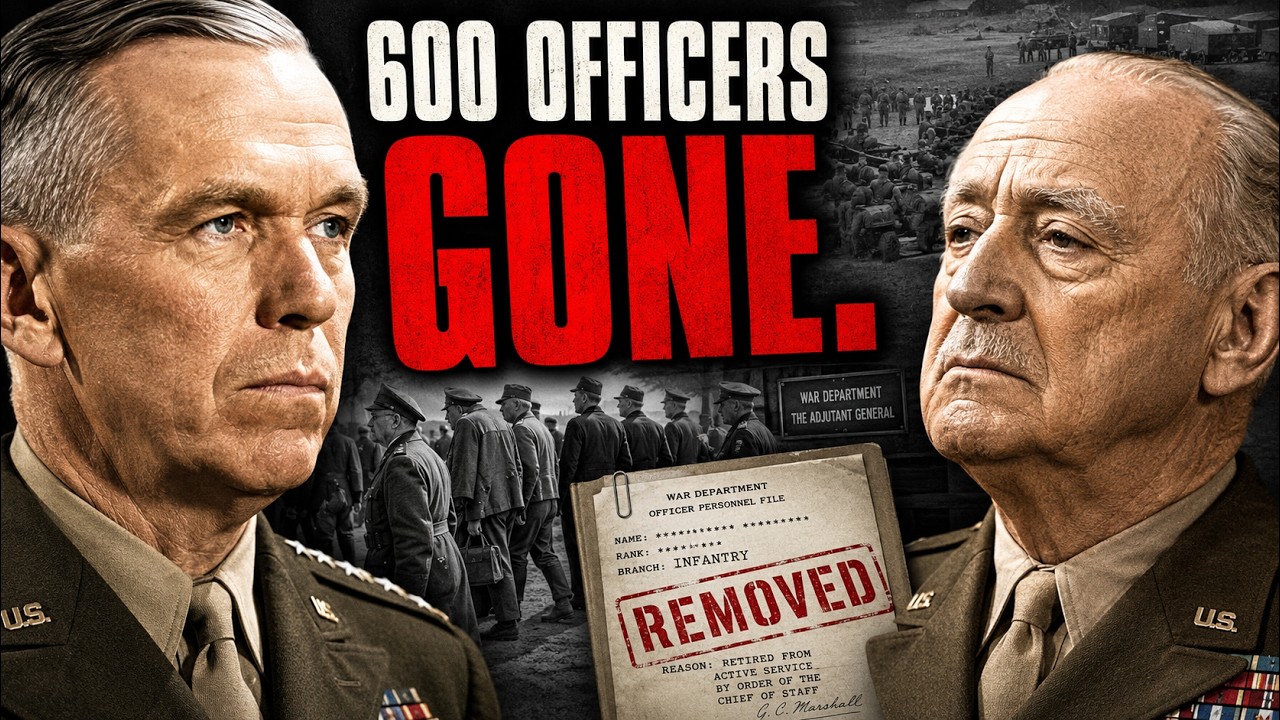
The board went to work quietly, methodically, and without mercy. In the first six months alone, 195 officers — captains, majors, lieutenant colonels, and full colonels — were removed from positions of active command.
Men who had spent 20, 25, 30 years building a career inside the institution suddenly found themselves handed retirement papers, or reassigned to administrative posts far from any battlefield, or simply informed that their service, as currently constituted, was no longer needed.
By the time the process wound down, several hundred colonels had been removed from active command, and well over a thousand officers across all ranks had been pushed out of positions where they might otherwise have been responsible for the lives of American soldiers.
The exact totals vary somewhat depending on which internal army accounting one consults, but every credible account agrees on the essential shape of what happened. This was not a minor trim around the edges. It was the most sweeping removal of senior officers the peacetime United States Army had ever undertaken.
Behind each of those numbers stood an individual man receiving individual news, and the process, however necessary Marshall believed it to be, was rarely gentle in the moment it landed.
A colonel who had spent three decades in uniform, who had commanded the same regiment through years of routine peacetime postings, might receive a short formal letter informing him that his file had been reviewed and that his active command was being reassigned, effective within weeks. There was no public hearing, no opportunity to argue his case before the men who had made the decision. The letters arrived, and careers that had defined entire adult lives ended on the strength of a few paragraphs.
Some officers accepted the news with the same discipline they had shown throughout their careers, quietly packing up offices they had occupied for years and reporting to whatever administrative post awaited them, or simply filing for the retirement the army was now gently but firmly suggesting.
Others fought back through every channel available to a man with decades of accumulated connections. Letters went to congressmen who owed old political debts. Op-eds appeared in hometown newspapers describing loyal, decorated officers cast aside by a chief of staff barely anyone had heard of two years earlier. A few officers requested meetings with Marshall directly, hoping personal history or personal appeal might reverse a decision the efficiency board had already finalized.
Marshall, by every account from those who worked near him during this period, remained polite in these meetings and immovable.
For members of Congress, the political calculation was genuinely uncomfortable. Many of these displaced officers were constituents, sometimes prominent ones, with family names attached to particular districts for generations. A senator fielding an angry phone call from a decorated colonel suddenly informed he was being shelved had every incentive to make noise about it.
Yet the same members of Congress had just months earlier watched newsreel footage of Warsaw in ruins and Paris occupied by German soldiers, and found it difficult to argue too forcefully that the nation's military leadership should remain untouched purely out of loyalty to men who had simply waited the longest.
For the men being removed, and for their friends still inside the institution, the word "purge" was not a metaphor. It was exactly how it felt. Veterans organizations wrote letters of protest. Newspaper columns accused Marshall of gutting the army's institutional memory, of discarding decades of hard-won experience in a reckless rush toward modernization.
One widely circulated criticism claimed Marshall had gotten rid of all the brains of the army, a line meant to wound, and one that undoubtedly did.
Marshall read the criticism. Colleagues who worked closely with him during this period later said he never once responded publicly to the accusations. Never defended himself in the press. Never explained his reasoning to the men he had removed beyond what the efficiency board's letters already stated. He simply continued the work.
Every week brought a new stack of files across his desk. Another round of names. Another set of quiet, difficult decisions about men whose careers, in many cases, he had watched unfold for decades.
Some of the officers being removed were men Marshall considered personal friends, colleagues he had served beside in France during the First World War, men whose company he had genuinely enjoyed over the years at postings scattered across the country. It made no difference to the process.
Marshall had concluded, with a clarity that must have been genuinely painful to hold on to in private, that friendship and shared history could not be allowed to outweigh the plain, unavoidable question of whether a man could still lead soldiers into modern battle and bring most of them home alive.
Not every officer near the danger zone of the age scale was removed, and the exceptions reveal almost as much about Marshall's thinking as the removals themselves.
Colonel George Patton was 54 years old in 1940, squarely inside the range the plucking board scrutinized most closely. On paper, Patton was exactly the kind of officer the reforms were designed to weed out: a man from an older generation, closer to retirement age than to the beginning of his career.
But Patton was not tired. Those who observed him during this period described a man with the physical energy and restless drive of someone half his age. A colonel who spent his own money and considerable personal effort studying the mechanics of tank warfare years before most of his peers took the subject seriously.
The board reviewed his file and reached a different conclusion than it reached for most colonels his age. His tactical instincts were sharp. His aggression, which had occasionally gotten him into trouble earlier in his career, was precisely the quality modern armored warfare seemed to reward. Patton stayed.
The distinction mattered enormously, and it undercut the simplest version of the criticism being leveled at Marshall in the press. This was never simply an assault on older officers as a category. It was an attempt, imperfect and occasionally brutal in its execution, to separate the men who could still adapt from the men who could not, regardless of the number written on their birth certificate.
Marshall was, in effect, staking his entire reputation — and quite possibly the lives of a great many American soldiers — on his own judgment about which officers belonged in which category.
If the men he had removed turned out to have been capable after all, history would likely remember him as the general who gutted his own army on the eve of its greatest test, a reckless reformer who mistook loyalty to an idea for wisdom. If his judgment held, if the men he kept and the men he was quietly promoting behind the scenes turned out to be equal to what was coming, he would have rebuilt the institution just in time. There was no comfortable middle ground available to him.
By the summer of 1941, with war clouds gathering visibly on two oceans at once, Marshall would finally get the chance to find out which version of history he was writing.
While the plucking board worked through its lists of aging colonels, Marshall was fighting an equally difficult battle several floors up inside the halls of Congress itself. An army being rebuilt from the ground up required money — enormous sums of it by the standards of a country that had spent the previous decade gripped by the Great Depression and a deep, stubborn strain of isolationist sentiment.
Many Americans, and no small number of their elected representatives, still believed the oceans on either side of the country offered protection enough, that the fighting in Europe was, however tragic, ultimately someone else's war.
Marshall appeared before congressional committees repeatedly during this period, laying out the same blunt assessment he had given his own staff the previous October, now dressed in the careful, measured language required for testimony that would be printed in the official record.
He resisted the temptation to exaggerate the threat for effect, a restraint that colleagues later said actually strengthened his credibility with skeptical legislators who had grown used to military leaders inflating budget requests. When Marshall said the army needed a specific number of tanks or a specific number of training camps, committee members increasingly came to believe he meant precisely that number. No more, no less.
The passage of the nation's first peacetime draft in September 1940 represented perhaps the single most consequential legislative victory of this campaign. Narrowly approved by Congress after months of contentious debate, it would later be extended by a single vote in the House of Representatives in the summer of 1941.
A margin so thin that the entire structure of the army Marshall had spent two years building might have collapsed on the strength of a handful of congressmen changing their minds. Had that vote failed, hundreds of thousands of draftees already in uniform would have been legally entitled to go home, gutting the very force Marshall had assembled just months before Pearl Harbor made the question permanently moot.
By June 1941, the army looked almost unrecognizable compared to the skeleton force Marshall had inherited less than two years earlier. The nation's first peacetime draft in its history, signed into law the previous autumn, had already pulled hundreds of thousands of young men into uniform. National Guard units from every state had been federalized and folded into the active army.
New training camps seemed to spring up across the South almost every month, vast tent cities where recruits who had never fired a weapon in their lives learned the basics of soldiering under officers who were themselves still learning how to command formations this large.
The raw numbers were staggering. Nearly a million men under arms, where fewer than 200,000 had stood less than two years before.
But Marshall understood something that pure arithmetic could not capture. An army is not simply a count of bodies in uniform. It is a question of whether the men leading those bodies actually know what they are doing when the shooting starts. And on that question, Marshall still had no real answer.

He had soldiers now. He needed proof that his officers — the survivors of the plucking board and the younger men he had been quietly advancing — could actually lead them.
Lieutenant General Leslie McNair, Marshall's director of training, proposed the solution. War games. Field exercises on a scale the United States Army had never attempted, designed not to showcase predetermined maneuvers for visiting dignitaries but to simulate as closely as peacetime training legally could the genuine chaos and pressure of real combat.
Officers would be tested not on a written exam or a parade ground inspection, but under the specific, revealing stress of command decisions made in real time, with real consequences for failure, even if those consequences stopped short of actual bullets.
Three major exercises were scheduled across the second half of 1941: Tennessee in June, Louisiana in September, Carolina in November. Of the three, the Louisiana maneuvers were planned on a scale that dwarfed anything that had come before.
An exercise so large it would, for three weeks, essentially convert a significant portion of the American South into a live laboratory for modern war. Nearly half a million soldiers took part — more men under arms for this single training exercise than had existed in the entire United States Army barely two years earlier.
Fifty thousand vehicles, wheeled trucks and tracked tanks, moved together across unfamiliar terrain, choking local roads never designed for military convoys of this size. Thirty-two thousand horses were also present, a reminder that even as the army raced toward mechanization, the older cavalry traditions had not entirely disappeared from its structure.
For three weeks, two full field armies would maneuver against each other across Louisiana and East Texas, fighting a simulated campaign for control of the Mississippi River Valley.
Marshall's instructions to McNair were blunt and specific. "I want the mistakes made down in Louisiana," he said, "not over in Europe. And the only way to do this thing is to try it out, and if it doesn't work, find out what we need to make it work."
Unlike earlier, more scripted training exercises where the outcome was essentially predetermined before the first soldier moved, the Louisiana maneuvers were designed to be genuinely open-ended. Commanders received broad objectives and considerable latitude in how to achieve them. Neutral umpires positioned throughout the exercise would grade performance based on what actually happened on the ground, not on how closely events matched a script written in advance.
For the first time, Marshall would be able to watch his officer corps operate under conditions that at least approximated the genuine uncertainty of real combat.
Lieutenant General Ben Lear commanded the Red Army, representing forces drawn from Kansas, Oklahoma, Texas, Missouri, and Kentucky. Lear had a reputation as a hard-nosed disciplinarian, quick to anger, not universally beloved by the men serving under him, but competent and demanding in ways that mattered under pressure.
Lieutenant General Walter Krueger commanded the opposing Blue Army, drawing forces from Arkansas, Louisiana, Mississippi, Alabama, and Tennessee. Krueger, in his early 60s, was in remarkably strong physical condition for a man his age, and colleagues considered him one of the most intellectually sharp and forward-thinking officers in the entire army.
Notably, he was among the very first senior commanders to genuinely grasp the tactical possibilities of large-scale armored warfare, rather than treating tanks as a novelty attached to traditional infantry formations.
The exercise began on September 15, 1941, and within hours it was clear this would be unlike anything the army had previously attempted. The sheer scale created chaos of its own. Entire small towns found themselves swallowed into the middle of active military operations, their main streets suddenly filled with convoys, their fields converted into makeshift bivouac areas for exhausted soldiers who slept wherever they could find open ground.
Supply columns stretched for miles along narrow country roads, and the communication systems the army had upgraded specifically for this exercise still buckled under the sheer volume of information trying to move between units spread across hundreds of square miles.
Marshall had insisted that senior commanders position themselves near the actual front lines of the exercise rather than directing operations from comfortable distant headquarters, a break from older habits that forced generals to feel at least partially the same disorientation and physical strain their soldiers were experiencing.
Colonel George Patton commanded the 2nd Armored Division, assigned to Krueger's Blue Army, and what he did in the exercise's second phase would become something close to legend within the army almost immediately.
Blue Army orders called for an assault on Shreveport, defended by Lear's Red forces, who held strong prepared positions supported by anti-tank units dug in and waiting. A conventional frontal assault against those defenses would have been slow, costly, and, by the standards of the new mechanized warfare Marshall was trying to cultivate, exactly the kind of outdated thinking he was trying to root out of his officer corps.
Patton chose something else entirely. He directed his armored division on a sweeping flanking maneuver that carried his tanks nearly 300 miles through East Texas, racing well outside the anticipated boundaries of the battlefield in an audacious attempt to come at Shreveport from a direction the Red Army's planners had never seriously considered defending.
When his tanks began running low on fuel partway through the maneuver, Patton did not wait for official supply channels to catch up with him. He simply bought gasoline directly from every country service station his columns passed, paying cash on the spot to keep his tanks rolling rather than lose momentum waiting for military fuel trucks that were miles behind his position.
His reconnaissance elements, moving ahead of the main force, seized part of Barksdale airfield, effectively knocking out the Red Army's ability to use air support in that sector of the exercise. Then Patton's tanks came roaring into Shreveport from the north, arriving from a direction Lear's forces had not adequately prepared to defend, while infantry and cavalry elements pressed the attack from the south simultaneously. Caught between two converging forces from unexpected directions, the Red Army found itself effectively surrounded.
On September 28, with the climactic battle for Shreveport about to unfold in full, exercise headquarters stepped in and halted the maneuver. The outcome was already beyond dispute. Blue Army had thoroughly routed the Red forces, and word of exactly how it had happened — an audacious 300-mile flanking march fueled partly by cash purchases at civilian gas stations — spread through the army almost overnight.
Marshall and McNair observed everything happening across the exercise with careful, deliberate attention, taking detailed notes on which officers demonstrated genuine tactical creativity under pressure, which ones froze or hesitated when circumstances shifted unexpectedly, and which ones proved capable of coordinating complex operations across the kind of vast distances that modern mechanized warfare demanded.
Colonel Dwight Eisenhower served as chief of staff for Krueger's Third Army throughout the exercise, and his performance drew attention almost immediately — not only from Marshall's own observers, but from the journalists covering the maneuvers for newspapers and radio audiences back home.
His planning was described as meticulous. His execution under pressure was calm and precise, even as he coordinated operations involving multiple divisions spread across a battlefield the size of a small European country.
CBS correspondent Eric Sevareid, reporting from the field, told listeners that Eisenhower made more sense than any of the rest of them. Drew Pearson, among the most widely read political journalists in the country at the time, wrote that Eisenhower had personally conceived and directed the strategy that routed Lear's Red Army, crediting him with what Pearson called a steel trap mind, combined with unusual physical vigor.
It was a remarkable amount of national press attention for a man who, under the army's old seniority rules, might have remained a lieutenant colonel for another decade simply waiting his turn. Marshall noted the name.
There was in fact nothing especially glamorous about Eisenhower's role during the exercise. He was not leading tanks on a dramatic flanking charge the way Patton was. He was sitting for long hours in cramped headquarters tents, coordinating supply schedules, resolving conflicting reports from units scattered across hundreds of square miles, translating Krueger's broad intentions into the kind of detailed, workable orders that actually moved half a million men and their equipment without the entire operation collapsing into gridlock on Louisiana's narrow country roads.
It was unglamorous, exhausting staff work — precisely the kind of work Marshall himself had built his early reputation on decades earlier during the First World War. Perhaps that similarity was part of what caught Marshall's attention in the first place. He recognized in Eisenhower's calm, methodical handling of chaos something of his own younger self.
He was not alone in catching Marshall's attention. Lieutenant Colonel Omar Bradley performed capably during the same exercises, demonstrating the kind of steady, unflashy competence that would later define his approach to commanding entire armies in Europe.
Lieutenant Colonel Mark Clark, who had helped plan significant portions of the exercise — reportedly relying at one point on nothing more sophisticated than a civilian gas station road map to work through logistics across the sprawling battlefield — showed a similar gift for improvisation under pressure.
Colonel Joseph Stilwell, known even then for his blunt, unsentimental manner, had already impressed observers during earlier exercises in 1940 with a fast-moving, blitzkrieg-inspired armored column that behaved nothing like the slow, methodical formations most senior officers still favored.
None of these men were the senior generals who had dominated the top of the army's command structure just two years earlier. They were younger officers, several of them still holding the rank of colonel or lieutenant colonel. Men who seemed to understand modern warfare almost instinctively in a way their older superiors, despite decades of honorable service, simply could not.
Two years earlier, under the old seniority rules Marshall had spent his tenure dismantling, most of these names would have remained buried in personnel files for another decade, waiting patiently behind colonels and generals who had never faced anything resembling the pressure Louisiana had just placed on them.
The Louisiana maneuvers, whatever discomfort and controversy the plucking board had generated back in Washington, delivered exactly the validation Marshall had been gambling on. The officers who remained after the purge, and the younger officers now visibly rising through the ranks, could genuinely fight the kind of war that was coming. The gamble, at least so far, appeared to be paying off.
The exercises also exposed real weaknesses that no amount of paperwork review back in Washington could have revealed. Communication systems needed further improvement to handle operations at this scale. Anti-tank doctrine required significant refinement, since umpires repeatedly found existing tactics inadequate against fast-moving armored columns.
Supply systems strained and occasionally broke down entirely under the pressure of moving fuel and ammunition to units advancing far faster than traditional logistics planning anticipated. Infantry units struggled to keep pace with the armored formations they were meant to support.
In several instances, horses used by cavalry units collapsed from sheer exhaustion during extended movements and had to be abandoned in the field — a small but telling detail suggesting how thoroughly mechanized warfare was already outpacing older methods. Wherever commanders had the option to choose between horse cavalry and mechanized reconnaissance units for scouting missions, they consistently chose the mechanized option, a quiet verdict on which approach actually belonged to the future.
Marshall absorbed every lesson the exercises produced. These were precisely the mistakes he had hoped to surface in the fields of Louisiana rather than on an actual battlefield somewhere in Europe or the Pacific. Mistakes that could still be corrected through training and doctrine rather than paid for in American lives.
The army would learn from what had gone wrong. It would adjust its equipment, its communication systems, its doctrine for coordinating tanks with infantry and air support. And critically, it now had a much clearer picture of exactly which officers deserved to lead it into whatever came next.
Journalists covering the exercises for a national audience sensed, even before Marshall's own internal reports were finalized, that they were watching something larger than a routine training drill. Reporters who had spent the previous two years writing skeptical pieces about the wisdom of pouring money into an army that might never fight suddenly found themselves filing dispatches about tank columns racing across three states and armies of half a million men maneuvering against each other with genuine tactical sophistication.
Public opinion, still cautious about the prospect of American involvement in another European war, began shifting almost imperceptibly. An army large enough and competent enough to conduct an exercise of this scale was, whether citizens fully registered it consciously or not, an army being prepared for something considerably more serious than parade ground ceremony.
For Marshall personally, the weeks following the Louisiana maneuvers offered something he had rarely allowed himself since taking command two years earlier: a measure of quiet vindication.
The blunt October assessment that had unsettled his own staff, the controversial removals that had earned him bitter enemies among the officer corps, the uncomfortable congressional testimony delivered again and again to skeptical committees — all of it had been building toward exactly this outcome. An army that could organize, maneuver, and fight at this scale, led by officers who could think clearly under pressure rather than simply follow rank and tradition.
He allowed himself very little public celebration. Those who knew him said he simply turned his attention to the next set of problems the exercises had revealed — the communication gaps, the anti-tank weaknesses, the supply bottlenecks — treating even this substantial validation as merely another item on an unfinished list.
The scale of the Louisiana exercise created its own strange, almost carnival atmosphere in the small towns caught in its path. Local residents who had never seen more than a handful of soldiers pass through their communities suddenly found their roads clogged with convoys stretching for miles, their diners and general stores overwhelmed by exhausted, mud-caked young men buying every available soda and candy bar within reach.
Farmers watched tanks cross fields that had never known anything heavier than a tractor. For three weeks, ordinary civilian life across a wide swath of Louisiana and East Texas simply folded itself around the largest peacetime military exercise the country had ever attempted — a preview, though almost no one recognized it as such at the time, of the scale of mobilization the entire nation would soon be asked to accept.
Not every officer who performed well in Louisiana was a young colonel on the rise. Krueger himself, already in his 60s, defied every assumption embedded in the plucking board's general approach to age, proving that the real dividing line Marshall cared about was never a birthday, but a mind's capacity to keep adapting.
Officers half his age struggled to process the pace of decisions the exercise demanded, while Krueger, moving among his forward units rather than directing from a comfortable rear headquarters, absorbed changing conditions and adjusted his orders with a fluency that impressed even skeptical observers sent from Washington specifically to evaluate him.

The contrast between Krueger's performance and the stumbles of several younger officers who had been expected to shine complicated any simple narrative about generational change. Marshall was watching for something more specific than youth. He was watching for officers, whatever their age, who treated the fog and friction of the exercise as a problem to be solved rather than an excuse for paralysis.
Some found that quality came more naturally at 54, as it clearly had for Patton. Others, like Krueger, proved it had never left them at all.
That picture would be tested far sooner than almost anyone expected. On December 7, 1941, just over two months after the Louisiana maneuvers concluded, Japanese aircraft struck the naval base at Pearl Harbor. The United States was suddenly and unambiguously at war on a global scale. And the army Marshall had spent more than two years rebuilding, often at enormous personal and political cost, would now face the exact test it had been preparing for all along.
Within two weeks of the attack on Pearl Harbor, Marshall's system was already operating with the ruthless speed he had spent two years building into it. Admiral Husband Kimmel and Lieutenant General Walter Short, the two commanders responsible for the defense of the naval base and its surrounding installations, were relieved of their posts. Major General Frederick Martin, who had overseen air defenses in the region, was removed alongside them.
There was no lengthy institutional debate about seniority or decades of prior service standing in the way. Failure at this scale, under these circumstances, ended careers immediately — exactly as Marshall's efficiency boards had already been treating failure for two years by the time Japanese aircraft appeared over Hawaii.
The pattern repeated itself across every theater as the war expanded. When Lieutenant General George Kenney took command of Army Air Force operations in the Pacific in the middle of 1942, one of his first acts was removing five generals he judged inadequate for the demands of the campaign ahead, along with roughly 40 colonels and lieutenant colonels he considered similarly unsuited to modern combat leadership.
Kenney had learned the lesson Marshall had spent two years teaching the entire officer corps, whether through direct instruction or simply through the example of his own conduct. Competence, not accumulated time in service, determined who commanded.
By Marshall's own later estimate, at least 600 officers had been forced out of the army before the United States formally entered the war in December 1941. And the process continued at a steady pace throughout the conflict itself.
Whenever a commander failed under the pressure of actual combat, whenever an officer proved unable to adapt to circumstances that shifted faster than his training had prepared him for, Marshall's system moved to replace him, without the years of institutional hesitation that had characterized the pre-war army.
The temporary wartime promotion system Marshall had also helped establish worked as a mirror image of the removal process, offering nearly unlimited advancement to officers who produced results under pressure and summary reassignment to those who could not.
The officers Marshall had identified during those years of careful observation at Fort Benning, and more recently under the genuine stress of the Louisiana maneuvers, now began rising through the ranks at a pace the old seniority system would never have permitted.
Dwight Eisenhower's advancement was perhaps the most dramatic illustration of exactly what Marshall's reforms had made possible. Barely weeks after his performance in Louisiana drew national press attention, Eisenhower was promoted to brigadier general in October 1941.
Within months of Pearl Harbor, Marshall brought him to Washington to help direct Army war plans at the highest level, recognizing in him the same calm, methodical staff instincts that had once defined Marshall's own early career.
By late 1942, Eisenhower commanded all United States forces in the European theater, overseeing Operation Torch, the invasion of North Africa. The following year brought Operation Husky, the invasion of Sicily. By June 1944, Eisenhower commanded Operation Overlord, the Normandy invasion, the largest amphibious military operation ever attempted in human history, coordinating land, sea, and air forces from multiple Allied nations across a battlefield spanning an entire coastline.
In less than five years, Eisenhower rose from lieutenant colonel to five-star general, commanding millions of Allied soldiers across an entire theater of war. Under the seniority system that had governed the army for decades before Marshall dismantled it, such a rise would have been simply impossible. Eisenhower would likely still have been waiting for colonels ahead of him to retire, might perhaps have reached the rank of general by 1945, too late to have commanded anything of real consequence in the war that was already ending by then.
Marshall's purge had not merely removed obstacles from Eisenhower's path. It had created the path itself.
He was far from alone. Omar Bradley, another lieutenant colonel whose steady competence Marshall had noted during the pre-war exercises, rose to command American ground forces in Normandy, directing the breakout from the beachhead that eventually shattered German defenses across northern France.
George Patton, the 54-year-old colonel the plucking board had chosen to spare rather than retire, went on to command the Third Army, driving across France with a speed and aggression that made him, by most accounts, the American general German commanders feared most on the entire Western Front.
Joseph Stilwell commanded Allied forces across the brutal China-Burma-India theater. Mark Clark, who had once planned exercise logistics with little more than a civilian road map spread across a folding table, commanded the Fifth Army through the grinding Italian campaign.
Each of these men owed his position in some direct and traceable way to a chief of staff who had been willing to dismantle a comfortable, familiar system and replace it with one built entirely around merit.
The numbers Marshall had inherited and the numbers he eventually presided over told the story more plainly than any single officer's career could. When Marshall took command on September 1, 1939, the United States Army numbered roughly 190,000 soldiers, a force widely described at the time as ranking below Portugal.
By 1945, that same army had grown to approximately 8,300,000 men, an expansion of more than 40 times its original size in under six years.
That force fought and defeated Nazi Germany and Imperial Japan simultaneously, across North Africa, Italy, France, Belgium, and Germany itself in one theater, and across the Philippines and dozens of Pacific islands in another. It succeeded in no small part because the men leading it at every level, from division commanders down to company officers, had been selected for their demonstrated ability to adapt under pressure rather than for how patiently they had waited their turn.
The praise that followed Marshall by the war's end reflected just how thoroughly his approach had been vindicated. The British chiefs of staff described him as the architect and builder of the finest and most powerful army in the nation's history. Winston Churchill, not a man given to loose praise of American military leadership, called him the organizer of victory.
Financier and presidential adviser Bernard Baruch referred to him as the first truly global strategist the United States had produced. President Harry Truman, reflecting on the war years afterward, said simply that Marshall was the man who won the war — a judgment other historians have debated in its particulars, but rarely disputed in its essential spirit.
What made Marshall's approach work was never simply the act of removing officers, and it was never simply the act of promoting talented ones, either. Both halves mattered, but the deeper insight sat underneath them.
Marshall understood, with a clarity that few of his contemporaries shared in 1939, that the tools of warfare — the tactics, the technology, all of it — could change faster than an institution's comfortable habits were prepared to follow. An army that clung to seniority over ability in a moment of rapid technological and tactical change was not merely inefficient. It was quite literally choosing to lose.
Germany had already demonstrated exactly this lesson in 1939 and 1940, reinventing the basic grammar of land warfare around speed, shock, and the close coordination of tanks, aircraft, and infantry moving together rather than in isolation. Poland fell in weeks. France, a nation that had fought Germany to an exhausting four-year standstill barely two decades earlier, fell in six.
The methods that had defined the previous war simply did not function against this new approach, and officers who could not recognize that fact, however honorably they had served in the past, had become liabilities rather than assets almost overnight.
Marshall had watched this exact dynamic play out once before from a very different vantage point during the First World War, when he had seen firsthand how outdated tactics and inadequate planning cost American soldiers their lives in engagements that better preparation might have avoided entirely.
That experience appears to have shaped, more than any single doctrine or theory, his uncompromising insistence two decades later that the army could not afford to repeat the same mistake on a vastly larger scale. He was not willing to let it happen again, whatever the cost to his own popularity within the institution he now led.
So he purged the officers who could not adapt. He elevated the ones who could. He built, through a process that was often genuinely painful and occasionally cruel to the individual men caught inside it, an officer corps capable of fighting the war that actually existed rather than the one an earlier generation wished still did.
The Louisiana maneuvers had served as his proving ground, the place where careful theory finally collided with messy, unpredictable practice, where officers revealed under real pressure exactly what they were capable of. Some rose to the occasion in ways that surprised even Marshall. Others confirmed doubts that had been quietly forming about them for months. Marshall noted every outcome and acted on what he learned.
After the war ended, Marshall did not retreat into the kind of comfortable retirement his decades of service would have easily justified. President Truman asked him to serve as Secretary of State. And in 1947, Marshall proposed what would become known as the European Recovery Program, though history would remember it simply as the Marshall Plan.
The initiative poured American resources into rebuilding the shattered economies of Western Europe, creating the kind of stable, prosperous conditions that allowed fragile post-war democracies to survive rather than collapse into the political extremism that had helped produce the war in the first place.
For this work, Marshall received the Nobel Peace Prize in 1953, the only professional army general in history to be so honored — a striking coda to a career that had begun with the deliberately unglamorous, often thankless work of firing hundreds of his own colleagues.
But Marshall's most enduring legacy was never really the Marshall Plan. Remarkable as that achievement was in its own right, it was the underlying principle that had guided his conduct as chief of staff from his very first weeks in office.
The conviction that positions of genuine consequence should be filled by the people demonstrably best equipped to succeed in them, not simply by the people who had been waiting the longest for their turn. That ability should outweigh seniority. That measurable results should outweigh accumulated time in service. That any institution's long-term survival ultimately depends on its willingness to remove people who cannot adapt to changing circumstances, and to promote — often ahead of schedule and against considerable internal resistance — the people who genuinely can.
The lesson Marshall taught during those tense, uncertain years beginning in 1939 remains strikingly relevant well beyond the specific context of military command. Organizations of every kind face constant pressure to change. Technology evolves. Methods that worked well under one set of conditions stop working when those conditions shift. Leaders who thrived under earlier circumstances are not automatically equipped to handle the new ones, no matter how distinguished their prior record might be.
The choice, as Marshall understood it, was rarely comfortable and rarely popular in the moment it had to be made: adapt, or eventually be replaced by circumstances that do not wait for permission.
Marshall made the difficult choice in 1939, when making it meant alienating friends, angering powerful allies in Congress, and absorbing sustained public criticism for what many called an unjust and needlessly brutal purge of loyal, experienced officers. He removed the men who could not lead a modern army into a modern war, and he promoted, often well ahead of where the old rules would ever have permitted, the ones who could.
When the ultimate test finally arrived at Pearl Harbor, and in the years of brutal fighting that followed, the army he had rebuilt from something smaller than Portugal's was ready for it. The officers he had chosen delivered victory across every theater the war eventually reached — from the beaches of Normandy to the banks of the Rhine, from the deserts of North Africa to the ruins of Berlin, from the jungles of Guadalcanal to the deck of a battleship anchored in Tokyo Bay.
It is worth remembering that none of this unfolded as a single dramatic moment of triumph. There was no ceremony marking the point at which the plucking board's work could be declared a success. No single battle whose outcome could be pointed to as final proof that Marshall's judgment had been correct.
The vindication arrived slowly, campaign by campaign, spread across six years and three continents, visible mainly in the accumulated weight of decisions that mostly went right rather than in any one decisive event.
Marshall himself, by every account from those who served closest to him, remained largely uninterested in claiming credit for any of it. He had never been building a legacy for its own sake. He had been trying, from his very first anxious weeks in office, to prevent a repeat of the kind of unnecessary bloodshed he had witnessed firsthand as a younger officer. And by that narrower, harder measure, the years of controversial removals and unpopular promotions had done exactly what he intended them to do.
The men he passed over, the hundreds of colonels and generals whose careers ended in the cold language of an efficiency board's letter, mostly faded from public memory, their names surviving today mainly in the personnel files and internal army histories that recorded the process Marshall had set in motion. Few of them ever spoke publicly about what happened, and fewer still lived to see the full scale of what their removal had ultimately made possible.
History rarely offers a tidy accounting of the ordinary careers quietly sacrificed to make room for the extraordinary ones that followed. Marshall's reforms were no exception to that pattern. What survived instead was the system itself, the underlying principle that outlasted any individual officer's personal disappointment, still shaping how the United States military selects its leaders generations after the last colonel Marshall's board removed had passed from the scene entirely.
On September 1, 1939, Franklin Roosevelt made a decision that stunned the Army's entire senior leadership, reaching past dozens of more senior officers to select a 58-year-old brigadier general who had never commanded troops in actual combat, a man most of official Washington had never heard of.
Roosevelt chose George Marshall. And Marshall spent the six years that followed proving, through hundreds of individually painful decisions, that genuine ability mattered more than accumulated seniority, that demonstrated results mattered more than institutional credentials, and that an organization's willingness to change when change becomes unavoidable often determines, in the end, whether it survives at all.