On a grey November morning in 1940, a letter waited on a desk at Bentley Priory. Air Chief Marshal Hugh Dowding opened it without ceremony, in the same quiet manner he had done everything for the past four years.
Outside the window, England was still standing. The invasion barges Hitler had massed along the French coast were already dispersing. The German Luftwaffe had been driven from British skies in the first great defeat of the Nazi war machine. Fighter Command, the force Dowding had built from nothing, had just won the Battle of Britain.
The letter informed him that his services were no longer required. Not because he had lost, but because he had won in a way that embarrassed the wrong people in the wrong places. A future RAF marshal would later say that Dowding was the only commander in history to win one of the world's decisive battles and be sacked for his trouble.
To understand how the man who saved Britain was rewarded with a dismissal letter, you have to go back four years, to an obstinate air marshal who refused to give up his fighters, refused to play the political game, and refused, even under pressure from the prime minister himself, to be wrong about the one thing that mattered most.
This is the story of Hugh Dowding, and it is one of the most shameful chapters in British military history.
Hugh Dowding took command of the newly formed RAF Fighter Command on July 14, 1936. He was 54 years old, a widower who had lost his young wife 16 years earlier, and a man the Air Ministry already considered difficult, humourless, and hard to manage.
His nickname among the pilots and staff officers who served under him was "Stuffy." It was not a term of affection born of arrogance. Those who knew him well understood it came from something quieter and harder to describe — a coldness that was not cruelty but reserve, a distance born of a man who had never learned, and had little wish to learn, how to impress important people.
He did not linger in the officers' mess, swapping stories over whisky. He did not cultivate friendships with the men who controlled promotions and appointments. He arrived at his office early. He left late. In between, he thought about one problem with a single-minded determination that unsettled those around him.
How do you stop the bombers from reaching London?
It was a question the RAF as an institution did not particularly want to hear. The doctrine governing every plan, every promotion, and every shilling of defence spending in the 1930s had been set by Hugh Trenchard, the founding father of the RAF, and it rested on one article of faith. The bomber will always get through. No fighter force, however large, could stop a determined air attack.
The only rational strategy, therefore, was to build more bombers than the enemy, strike their cities first, and accept that our cities would burn in return. It was a grim philosophy, but it was also the fastest route to prestige within the service. The men who had built their careers on the bomber priority dominated the Air Ministry in Whitehall, and they viewed the officer then responsible for home air defence with something close to suspicion.
Dowding's insistence on interception, on radar, on building a shield rather than a sword, struck many of his superiors as a distraction from the weapon that won wars. Some called him misguided. A few, in private, called him defeatist.
Dowding disagreed, and unlike most men who quarrel with the conventional wisdom of their institutions, he had spent the previous six years gathering evidence to prove his point. As Air Member for Supply and Research, and later Air Member for Research and Development, he had personally overseen the specifications that produced the two fighters that would ultimately save his country: the Hawker Hurricane and the Supermarine Spitfire. He understood aircraft design at a level few of his contemporaries could match.
In February 1935, he received something that would change the shape of the coming war entirely. A physicist named Robert Watson-Watt sent a memorandum to the Air Ministry suggesting that aircraft might be detected at a distance using reflected radio waves. Most men who read it filed it away and forgot it within a week. The idea of finding aircraft with radio waves sounded, to most ears in 1935, closer to science fiction than military engineering.
Dowding read the same memorandum and did something almost no one else in his position would have done. He picked up the telephone and demanded a demonstration.
On February 26, 1935, Watson-Watt and his young assistant Arnold Wilkins set up a receiver near a BBC transmitter outside the town of Daventry. A Handley Page Heyford heavy bomber flew a course above them. On the screen of an oscilloscope, a technician watched the reflected signal rise as the bomber passed through the beam. The experiment worked. An aircraft invisible to the naked eye had revealed its position through nothing but radio waves bouncing off aluminium and fabric.
Within days, Dowding had released funding. By the summer of that same year, the first device could detect a formation of bombers at 60 miles. Within five years, the chain of stations could track German aircraft assembling over French airfields from more than 120 miles away, giving Fighter Command roughly 15 minutes of warning before the enemy crossed the coast.
It is hard to overstate what that decision meant. Dowding did not invent radar, but he was the only man in a position of real authority who recognised its value immediately and instinctively, at a time when almost every senior officer in the RAF was planning to win the coming war with bombers alone.
Radar alone would not have won the Battle of Britain. But without it, there would have been no battle to win. There would only have been a slow, grinding defeat. Fighters scrambling too late, too low, and in too few numbers, chasing an enemy who had already dropped his bombs and turned for home.
What Dowding built over the next four years was not merely a chain of radar stations. It was something the world had never seen: an integrated system that took raw information from the sky and turned it into a decision in minutes across an entire nation. Historians later called it "the Dowding System," and it deserves to be remembered as one of the great engineering achievements of the twentieth century, military or otherwise.
Consider the scale of the problems that had to be solved. Detecting a raid from a great distance. Separating real threats from false echoes, flocks of birds, weather, and friendly aircraft returning from patrols. Converting raw signals into grid coordinates meaningful to an observer on the ground. Passing that information by telephone faster than any communications network had ever been asked to work. Tracking friend and foe simultaneously across hundreds of miles of coastline without confusing the two. And doing all of it fast enough that a young pilot sitting in his cockpit at readiness could take off, climb, and reach the interception point before the bombers reached their targets.
By September 1939, there were 21 Chain Home radar stations standing along the east and south coasts of England. Their steel transmitter towers rose more than 350 feet into the sky. Lower-level Chain Home Low stations filled the gaps the main chain could not see, detecting aircraft flying low over the water.
But the towers themselves were only the beginning. The genius of the system lay in what happened to the information after it left the radar operator's headset. Readings were converted into coordinates and telephoned directly to the filter room at Bentley Priory, Dowding's own headquarters. There, Women's Auxiliary Air Force plotters moved coloured markers across a vast map table. Each marker represented a track of aircraft somewhere over the English Channel or the French coast.
Above them, on a raised gallery, filter officers took the chaos of dozens of overlapping reports and reduced it to a single confirmed track, with number, height, and estimated strength. That filtered information was passed down the hierarchy to the relevant group headquarters. No. 11 Group covered the exposed southeast, the gateway to London. No. 12 Group covered the Midlands. No. 10 Group covered the southwest. No. 13 Group covered the north.
Each group commander decided which sector station should respond, and sector controllers — carefully chosen from former fighter pilots because Dowding believed only a pilot trusted another pilot's judgment — gave the scramble order and directed the intercepts by radio once the fighters were airborne. Once enemy aircraft crossed the coastline, volunteers of the Observer Corps took over, tracking the raid visually and feeding the same telephone network with their reports, while a system called "Pip-Squeak" used direction-finding stations to monitor the positions of friendly aircraft in return.
The result of all this invisible machinery was almost incredible by the standards of the time. Before the war, an interception rate of 30 to 50 percent was considered a victory. During the Battle of Britain, Fighter Command achieved interception rates approaching 90 percent.
The German fighter commander Adolf Galland, who led Luftwaffe squadrons against Dowding's pilots throughout the summer of 1940, later admitted that the British possessed an exceptional advantage that was never equalled at any point in the war: their radar and fighter-control network. Galland said it was a very bitter surprise. We had nothing to compare with it.
Dowding did not stop at building the system. He fought bitterly, and often without any grace at all, for the aircraft and equipment to make it work. Against the settled preferences of the bomber advocates, he imposed the specification for a fast, single-seat fighter carrying eight forward-firing machine guns — a requirement that eventually produced both the Hawker Hurricane and the Supermarine Spitfire.
He resisted, at real professional cost, pressure from his superiors to commit to the Boulton Paul Defiant, a fighter designed around a rotating gun turret instead of forward-firing guns. When his superiors ordered nine squadrons equipped with Defiants, Dowding's stubborn resistance meant that only two squadrons were ever equipped with the type. When one of those two squadrons went into combat for the first time on July 19, 1940, it lost seven of its nine aircraft in a single engagement — a savage vindication of a view no one at the Air Ministry wanted to hear.
He also fought for something as small and essential as glass. When his engineers proposed bulletproof glass for the cockpits of Hurricanes and Spitfires, the Air Ministry objected on grounds of cost. Dowding's reply became one of the most quoted lines of his career. He said that if Chicago gangsters could put bulletproof glass in their cars, he saw no reason why his pilots should not have the same protection in their aircraft. The armoured glass was fitted.
It was Dowding in miniature: blunt, indifferent to the effect of his argument, focused entirely on the young men who would do the fighting, and utterly unconcerned about whether it made him more enemies in Whitehall.
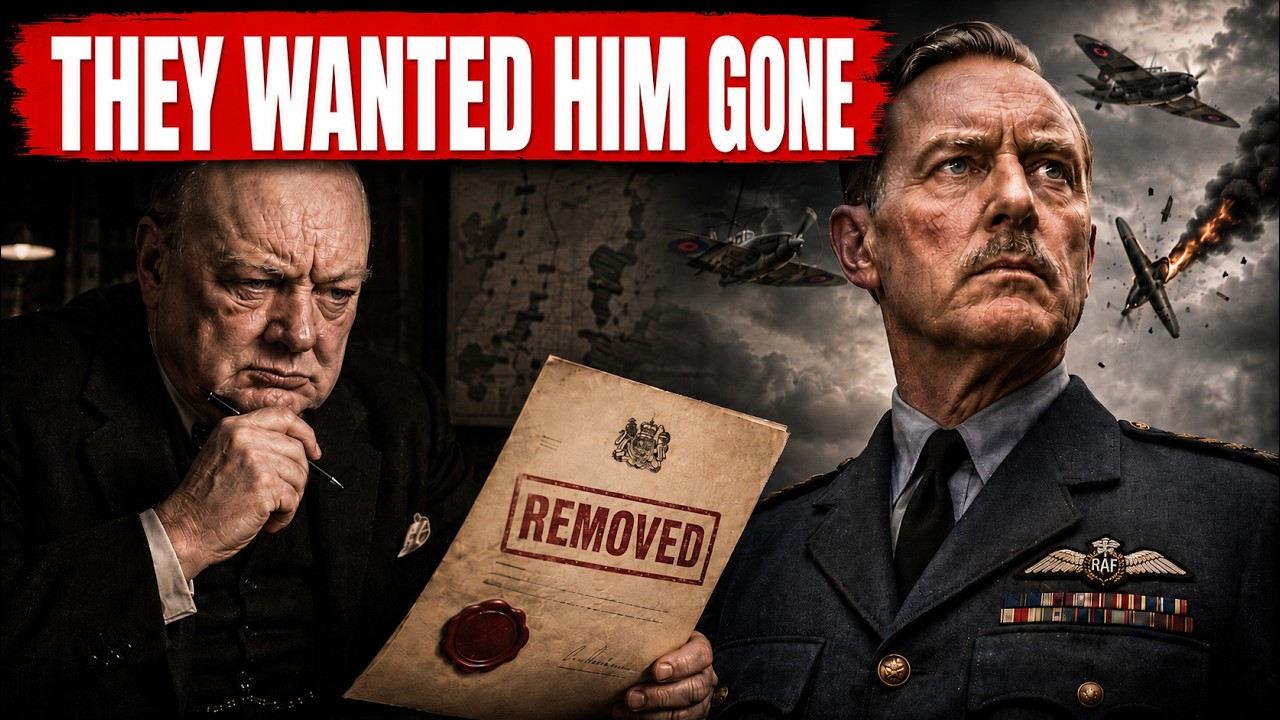
By the spring of 1940, he had built the best air-defence system on earth, and in the process had accumulated a quiet, patient collection of rivals who would remember every time he had been right and they had been wrong. Within weeks, the war would give each of those rivals the opportunity they had been waiting for.
To understand why Dowding behaved the way he did, it helps to understand what he had already lost. His wife Clarice had died when their son Derek was still an infant, about 16 years before he took his post at Bentley Priory. He raised his son largely through letters and short leaves during a peacetime military career, and something of that long, isolated discipline seemed to settle into the rest of his life.
He was not a harsh man. Those who worked closely with him — the young women of the WAAF who plotted his battles on the map table, the controllers who briefed him in the small hours — described a man capable of genuine tenderness toward those under his direct care, even as he was almost incapable of small talk with his peers. He simply did not spend emotional energy on people who could not help him win the war he saw coming. He spent it on the problem itself, and on the young men whose lives would depend on how well he solved it.
Bentley Priory itself, a grand country house on a hill north of London, requisitioned for the RAF, became less a headquarters under his command than a kind of monastery. Dowding worked from a modest office overlooking the grounds, arriving before most of his staff and rarely leaving before the last briefing of the day. Visitors sometimes described the atmosphere as eerily calm for an organisation preparing to fight for its country's survival, but the calm was deliberate. Dowding believed panic at headquarters bred panic in the air, and panic in the air killed pilots. He wanted the operations room to feel, even in the worst hours of the coming battle, like a place where decisions were made with a clear head.
That temperament, so well suited to the machinery of air defence, served him poorly in the corridors of the Air Ministry in Whitehall. The RAF of the 1930s, like most institutions of its era, was a place where advancement depended on connections as much as results. Dinner parties, clubs, the right word to the right person at the right time — all of it mattered in ways Dowding either did not understand or refused to acknowledge.
He had colleagues who understood the game far better than he did. Air Vice-Marshal Trafford Leigh-Mallory, with his ambition and his fighting spirit, made no secret of his frustration at being given command of No. 12 Group in the Midlands rather than the more glamorous No. 11 Group defending London and the southeast. Sholto Douglas, the Assistant Chief of the Air Staff, moved easily through the Air Ministry's social world in a way Dowding had never cultivated and never attempted. Neither man made any effort to hide his view that Fighter Command and the officer running it needed a firmer hand from above.
None of it mattered yet in the late 1930s. Not while the system Dowding had built was still an unproven theory drawn on paper and steel towers along an empty coast. The war had not yet tested it.
On September 3, 1939, when Britain declared war on Germany, Dowding's network had not fired a shot in anger. The Chain Home system had tracked training flights and manoeuvres only. It had never faced an enemy determined to crush it.
During the strange, quiet months that followed — a period some newspapers called the Phoney War — Fighter Command trained, experimented, and refined procedures that had existed only in theory a few years earlier. Dowding used the lull to press for more of everything: more radar stations, more fighters, more trained reserve pilots, arguing, as he always did, from cold calculations of what a real air campaign would require rather than what looked sufficient in a peacetime budget.
He did not have to wait long to test his theory. In the spring of 1940, the war that had seemed distant and abstract through the winter was about to become immediate, violent, and very close to home — and it would arrive first not over the fields of southern England, but across the Channel in the collapsing defences of France.
Germany launched its offensive in the west on May 10, 1940, and within days the quiet of the previous eight months vanished entirely. Six or seven Hurricane squadrons of Fighter Command were already stationed in France in support of the British Expeditionary Force. There, air-power theory met the brutal reality of modern lightning war.
The Fairey Battle, a single-engine light bomber sent across the Channel by the RAF in large numbers, was slow, under-armed, and hopelessly obsolete. But it was also what the RAF had available at that desperate hour, and the men who flew it paid for that shortfall in blood. On the first day of the campaign, the Battle squadrons suffered losses approaching 40 percent. On the second day, entire formations were wiped out. By May 14, the Advanced Air Striking Force had lost nearly three-quarters of its bombers. Aircrews who had eaten breakfast together were dead by mid-afternoon.
The French government, watching its army collapse before the fastest offensive Europe had ever seen, demanded reinforcements from London — specifically, ten additional fighter squadrons. On May 15, French Prime Minister Paul Reynaud telephoned Winston Churchill directly and told him, in words that needed no translation: "We have been defeated."
Churchill, only five days into his premiership, was desperate to keep his closest ally in the fight, and he leaned toward granting the French request. Before the War Cabinet met that day, Dowding asked for and was granted a few private minutes with the prime minister. He came prepared.
He placed on the table a single hand-drawn graph tracking recent Hurricane losses over the preceding days. The line sloped steeply, almost vertically, toward the bottom of the page. Dowding told Churchill plainly that if losses continued at that rate for another ten days, there would not be a single Hurricane left in France or England.
It was not rhetoric. It was arithmetic, and Dowding had never in his career cared about anything but arithmetic. Air Ministry planners had calculated that a minimum of 52 squadrons was required to organise an effective defence of the British Isles against a serious air attack. By mid-May, Dowding's actual strength, drained by the fighting in France, amounted to roughly the equivalent of 36 squadrons, many of them critically short of aircraft and exhausted pilots. The gap between what the defence of Britain required and what Britain actually had was widening by the day. And every squadron sent across the Channel to France made that gap wider.
What happened next is the moment most serious historians of the battle see as having settled the outcome of the war in the west before a single German bomber crossed the Kent coast. While Churchill travelled to Paris the following day and found French officials in the gardens of the Quai d'Orsay burning government documents in preparation for the fall of the capital, Dowding sat down and wrote a letter.
It was addressed to the Under-Secretary of State at the Air Ministry, dated May 16, 1940, and it remains one of the most important documents of the Second World War. He wrote that if an adequate fighter force was kept in Britain, if the fleet remained intact, and if home defences were properly organised against invasion, the country could carry on the war alone for a long period, perhaps indefinitely. But if the home defence force were drained away in a desperate attempt to save the situation in France, then the defeat of France would bring with it the final, complete defeat of Britain as well.
The letter did not plead. It reminded the Air Council, with barely suppressed anger, that their own estimates had set the minimum requirement at 52 squadrons. It demanded to know exactly what strength would remain to Fighter Command once that minimum was reached. And above all, it demanded an assurance that once that minimum level was reached, not one more fighter would be sent across the Channel.
However urgent and desperate the appeals for help, Churchill initially resisted, emotionally committed as he was to supporting the French, and continued sending limited reinforcements, allowing squadrons to fly missions from French airfields by day and return to England each night rather than being permanently based in France. But pressure from Dowding did not soften, and by May 19 he had persuaded the Chief of the Air Staff, Sir Cyril Newall, who carried Dowding's arguments directly to Churchill's War Cabinet, to halt any further reinforcement of the French campaign.
It was, by any measure, one of Churchill's hardest decisions in the early days of his premiership, taken against every instinct of loyalty to an ally being destroyed in front of the world's eyes. And it was taken because one air marshal refused to soften his numbers to make an unbearable decision easier to accept.
By the time the last Hawker Hurricane squadrons were withdrawn from France on June 18, roughly 450 aircraft had been lost and nearly 300 fighter pilots had been killed or taken prisoner. In the aftermath of Dunkirk, Fighter Command's front-line strength had fallen to just 331 Hurricanes and Spitfires, with only 36 aircraft in reserve behind them.
Had Dowding's letter not been written, and had Churchill's instinct to support France to the last squadron prevailed, there is a very real argument that those aircraft and the pilots who flew them would have been destroyed over French soil in the following weeks, leaving nothing to contest the skies over England that summer. Dowding's refusal to comply — an act of professional disobedience in the form of a formal memorandum — may be the single decision most responsible for the fact that Britain still had an air force to fight the battle that was undoubtedly coming.
The Battle of Britain is officially dated from July 10 to October 31, 1940, though the most critical fighting was compressed into a much shorter and more savage period in the middle of that span. Against Dowding stood the German Luftwaffe, with more than 4,000 aircraft, including over 1,000 single-engine fighters, roughly 1,380 bombers, and more than 400 dive-bombers.
Fighter Command began the battle with about 56 squadrons and nearly 750 single-seat fighters, perhaps 520 of them actually serviceable on any given day. In raw numbers, the Luftwaffe outnumbered Fighter Command by nearly four to one.
Dowding's response to that imbalance was a strategy historians have since compared to the Roman general Fabius — a strategy of patient endurance rather than decisive confrontation. His assistant, Robert Wright, later recalled that Dowding understood with complete clarity that he could never fully win the war from his position at Fighter Command, but he understood with painful intensity that he was the one man who could lose it very easily.
He rarely, if ever, committed more than half his available force to a single engagement. He sent small formations, often no more than a squadron or two, to break up incoming bomber formations before they reached their targets, trading the drama of a single decisive clash for the quieter, harder discipline of controlled, sustainable attrition. Tactical decisions in the air were left to his group and sector commanders, closer to the fighting and better able to respond in real time, while Dowding kept the strategic vision from above and guarded above all the one resource that could not be replaced quickly: trained, experienced pilots.
His most important subordinate in this arrangement was Air Vice-Marshal Keith Park, who commanded No. 11 Group in southeast England — the sector that stood directly between the Luftwaffe and London and bore the overwhelming majority of the fighting. Park shared Dowding's philosophy exactly, launching small, fast, localised sorties designed to break up enemy bomber formations before they could deliver a concentrated blow, rather than waiting to mass his forces in large numbers.
The battle passed through clear phases during July and early August in what became known as the Channel battles. Dowding deliberately committed the minimum fighter force to protecting coastal convoys, aware that the Luftwaffe was trying to draw his forces into a costly battle of attrition on terms favourable to the enemy, and he refused to take the bait.
From August 13, in an operation the Germans called "Eagle Attack," the Luftwaffe shifted its focus to British airfields and, critically, to the radar stations themselves. Two days later, on August 15, a large Luftwaffe formation launched from bases in Norway attacked northern England to test whether Dowding had stripped that region of defences to reinforce the south. He had not. No. 13 Group inflicted such heavy losses on the attacking force that the Luftwaffe never again attempted a major daylight raid from Norwegian bases.
On August 18 — a day pilots on both sides would later call "the hardest day" — the Luftwaffe lost between 69 and 75 aircraft, and the Junkers 87 Stuka dive-bombers suffered so badly that they were effectively withdrawn from the battle altogether.

Then came the period that came close to breaking Fighter Command entirely: the last week of August and the first week of September, when the Luftwaffe threw its full weight against the sector stations, the nerve centres of Dowding's entire system. Biggin Hill, Kenley, Hornchurch, and North Weald were not ordinary airfields. Destroying a sector station did not merely stop its squadrons from flying; it blinded the network that controlled them.
Biggin Hill was bombed six times in three days. Its operations room was put completely out of action, and the WAAF plotters who ran it simply moved into a village butcher's shop and carried on working, rerouting communications through improvised lines while engineers raced to repair the station itself. It never stopped operating, though it came remarkably close.
On August 31, Fighter Command suffered its worst day of the entire battle. Thirty-nine aircraft were destroyed and 14 pilots killed. The trend behind those numbers was more alarming than the daily totals. Experienced pilots — men with hundreds of flying hours — were being killed faster than replacements with a fraction of that experience could be trained to take their place. A new pilot might reach his squadron with as little as ten hours on Spitfires before being sent against veteran Luftwaffe fighters.
On August 30, Fighter Command flew its highest number of sorties in a single day of the battle, more than 1,000, with ground crews and pilots alike operating on the edge of collapse. Some men flew four or five combat sorties in a single day, sleeping in their flying clothes beside their aircraft so that no time would be lost between landing and taking off again.
By September 3, Dowding reported to Churchill that a quarter of all Fighter Command pilots had been lost since the start of the battle. For a brief and frightening period, the production of new Hurricanes and Spitfires was actually falling behind the rate of losses in the air. Had those calculations continued unchanged for a few more weeks, Fighter Command would have ceased to exist as an effective fighting force.
In this desperate period, Dowding introduced what he privately called a desperate measure: a classification system dividing his squadrons into three tiers. Front-line units at readiness in No. 11 Group, rested units in reserve with Nos. 10 and 12 Groups, and training formations working to maintain a steady flow of replacement pilots into the battle. It bought time. But it did not solve the underlying problem.
What ultimately solved the underlying problem was a mistake made by the enemy, not by Dowding.
For all the graphs and squadron counts and arguments in Whitehall committee rooms, none of it meant much to the young men actually sitting in cockpits at readiness through that long summer. For them, the battle had an entirely different rhythm — one measured not in strategy but in minutes.
A telephone would ring in the dispersal hut beside the airfield. A voice would say: "Scramble." Within moments, pilots barely out of their teens, some not yet twenty, were running across the grass toward their parked Hurricanes and Spitfires, climbing into cockpits still warm from the last sortie. Engines coughed into life, and the smell of aviation fuel and hot metal filled the air.
They climbed hard, straining for altitude before the enemy arrived, scanning an empty blue sky that could fill in seconds with black specks growing with terrifying speed into aircraft carrying men trying to kill them every bit as much as they were trying to kill in return.
The fighting itself lasted only minutes, sometimes seconds. Flashes of tracer fire, sudden turns pressing a man's body into his seat with crushing force, the sound of machine-gun fire hammering the airframe, and then, most often, nothing at all. An empty sky again, the enemy gone, and a pilot flying home alone, wondering which of the men who had taken off beside him that morning would not be coming back.
Ground crews waited beside the runway, counting the aircraft that returned, doing the grim arithmetic of the squadron in real time. WAAF radio operators and telephone operators worked in overlapping shifts, tracking raids through headsets, passing coordinates, absorbing the tension of the entire chain of command without ever leaving the ground.
At Bentley Priory, Dowding read the casualty figures every day, and unlike many commanders of his era, he did not read them as abstract numbers. Those close to him described a man who carried the weight of every name on those lists personally, even as he maintained, in every meeting and briefing, the same steady outward calm that had marked his entire career.
That was, in its own way, one of the hardest parts of his job — harder in some respects than the engineering problems and the political battles combined: absorbing the human cost of a strategy he knew with complete clarity could not be changed without losing the war outright. He could not send more fighters into the air than the strategy allowed. He could not rest pilots faster than replacements could be trained. He could only watch, and calculate, and hold his position, knowing that every pilot who died was both an irreplaceable loss and a number he had coldly factored into his plans.
Against this backdrop, with men dying in the air over Kent and Sussex while headquarters in London debated tactics that had already been tried and failed, the campaign against Dowding gained its final momentum. The gap between the two worlds — the young pilots living and dying to the rhythm of the scramble bell, and the senior officers manoeuvring for position in Whitehall committee rooms — was vast. And it was the second world, not the first, that would ultimately decide Dowding's fate.
On the night of August 24-25, a formation of German bombers, either through a navigational error or confusion in the dark, dropped its bombs on central London instead of the intended industrial targets. Churchill ordered a retaliatory raid on Berlin. Hitler, enraged by bombs falling on his capital, ordered the Luftwaffe to abandon its campaign against Fighter Command's airfields and radar stations and direct its full weight against London itself.
From September 7, nearly a thousand German aircraft began bombing the docks and the East End of the capital day after day. German intelligence at the time believed Fighter Command was on the verge of complete collapse: its airfields destroyed, its pilots too exhausted to recover. In reality, the shift in targets could not have come at a better moment for Dowding.
With direct attacks on the sector stations halted, ground crews could finally complete repairs, damaged squadrons regained their strength, and exhausted pilots got their first real rest in weeks. Fighter Command's losses, for the first time in more than a month, began to fall below the rate at which new aircraft and pilots were arriving.
On September 15, a date still commemorated in Britain as Battle of Britain Day, the Luftwaffe launched the largest and most concentrated daylight attack of the entire campaign against London, involving nearly 1,500 aircraft. Keith Park directed almost every available squadron in No. 11 Group to meet it. Watching from the underground operations room at Uxbridge, Churchill turned to Park and asked what reserves remained. Park's answer became one of the most quoted exchanges of the entire battle: there were none.
The Luftwaffe lost between 56 and 61 aircraft that day. Fighter Command lost between 26 and 31. Two days later, on September 17, Hitler postponed Operation Sea Lion, the planned invasion of Britain, indefinitely. The plan was never revived. The threat of invasion that had hung over the country since the fall of France was finally over.
By the time the battle quieted at the end of October, the numbers told their own story. Fighter Command lost 1,087 aircraft and 544 pilots killed. Nearly 3,000 aircrew were later awarded the Battle of Britain clasp for their service. In return, the Luftwaffe lost nearly 900 aircraft, with more than 2,500 of its men killed and more than 900 taken prisoner.
Behind those figures lay another quiet part of the victory: the extraordinary production effort of Lord Beaverbrook, appointed Minister of Aircraft Production. In the same week France began to collapse, Beaverbrook drove British fighter production from 638 aircraft in the first four months of 1940 to 1,875 in the four months that followed, seizing factories and overriding bureaucratic delays in ways that made him thoroughly unpopular with the officials he bypassed. The month of July alone saw nearly two and a half times as many fighters produced as German industry managed in the same period.
Fighter Command's total strength actually rose during the battle, from 644 aircraft in early July to 732 by early October, despite months of relentless combat. Dowding could design the finest defensive system in the world, and Park could run it with unmatched skill. But none of it would have mattered without the steady stream of new Hurricanes and Spitfires arriving to replace those falling from the sky over Kent and Sussex every day of that long summer.
Britain had won. Yet even as the battle in the sky was being fought and won, an entirely different battle was unfolding inside the RAF itself — one waged by a faction that was losing without fully realising how far things had already come. Its instrument was a tactical dispute that became known as the "Big Wing" controversy.
Trafford Leigh-Mallory, commanding No. 12 Group in the Midlands, and Squadron Leader Douglas Bader, the legless fighter pilot commanding No. 242 Squadron under him, argued that Fighter Command should abandon Park's approach of launching small formations quickly in favour of massing large wings of three, four, or even five squadrons — 60 aircraft or more — into a single enormous formation before engaging the enemy.
In theory, the argument had a certain appeal: overwhelming force meeting overwhelming force. In practice, it was closer to impossible. Assembling a formation that size took far longer than the six minutes Leigh-Mallory claimed, usually 15 to 20 minutes or more, because individual airfields were too small to allow every squadron to take off at once, and No. 12 Group squadrons often had to fly first to a rendezvous point before the wing could even begin to form. If an enemy raid arrived somewhere unexpected, there was no reserve left to respond, because everything had already been committed to the wing. The radio equipment of the period made it nearly impossible for a single commander to control several squadrons simultaneously and in real time, and in practice the big formation tended to break up into separate, uncoordinated squadron actions once real combat began — precisely the outcome its advocates claimed to be avoiding.
Most damaging of all, the results the Big Wing claimed did not survive contact with the facts. On September 15 alone, the Duxford wing claimed 105 German aircraft destroyed out of 185 total claims that day. The actual Luftwaffe losses that day, as postwar research in German records later confirmed, were between 56 and 61 aircraft. A detailed postwar analysis by historian Dilip Sarkar showed that overclaiming ratios in some Big Wing operations reached as high as seven to one. Even pilots serving inside No. 12 Group itself were sceptical at the time. One squadron commander described the formation as frequently degenerating into chaos in the air. Another pilot later called it a disaster, because the wing often fell apart the moment it made contact with the enemy. A staff exercise run by Leigh-Mallory himself in January of the following year, intended to prove the Big Wing's effectiveness on paper, demonstrated the opposite, with his perceived mishandling of the attack leaving airfields exposed to bombing while aircraft were still stuck on the ground.
The deeper truth, more important than any tactical argument, was that the Big Wing controversy was never really about tactics at all. It was about politics and wounded institutional pride. Staff officers at the time noted that during the height of the battle there was remarkably little telephone contact between Leigh-Mallory and either Dowding or Park, his two named superiors, but a great deal of contact between Leigh-Mallory and Sholto Douglas at the Air Ministry — a man later described as a "hidden influence" working quietly in the shadows to undermine Dowding's position from within. Leigh-Mallory was reported to have told Bader that he could ignore orders from No. 11 Group, and even from Fighter Command itself, if he judged them wrong. Bader's assistant, a Member of Parliament, took the Big Wing case directly to Churchill, bypassing the entire chain of command through which the matter should have been raised. After a heated confrontation in 1939, Leigh-Mallory told colleagues, in words that left no room for misinterpretation, that he intended to do everything possible to see Dowding removed from his post.
The Air Ministry leadership had staked its prewar reputation, and in many cases its entire career, on the doctrine that fighters could never stop a determined strategic bombing campaign. Dowding and Park had just proved that doctrine catastrophically wrong, in the most visible and consequential way imaginable. The Big Wing controversy, whatever its tactical merits or lack of them, gave the embarrassed institution a respectable cover and a plausible professional argument for removing the two men who had exposed how wrong its core article of faith had been.
The decisive blow, though no one present described it in such blunt terms at the time, was struck at an Air Ministry meeting on October 17, 1940. It had been called by the Chief of the Air Staff, Cyril Newall, ostensibly to discuss fighter tactics and specifically the growing problem of night defence against German bombing. Newall himself fell ill before the meeting and could not attend. The chair passed instead to Sholto Douglas — the same officer who would take over Dowding's job entirely within weeks.
Dowding arrived expecting a professional discussion among senior officers, and an opportunity to summarise his strategy for the battle he had just won and to set out his plans for defence against the night bombing that was now beginning in earnest. Instead, he found Squadron Leader Douglas Bader, a junior officer several ranks below everyone else in the room, seated among the assembled air marshals. Leigh-Mallory had specifically arranged for Bader to attend, ostensibly so the ministry could hear the view of a serving fighter pilot. No squadron commander who supported Dowding's and Park's approach was invited to present an opposing view.

Bader spoke at length to the assembled senior officers about the merits of overwhelming force, restating the Big Wing case to an audience already inclined to agree with it. Douglas ran the session, according to at least one witness account, not as a neutral official but as a prosecutor building a case against the accused. Leigh-Mallory repeated his claim that a wing of five squadrons could be assembled in six minutes. No one in the room asked the obvious question: why did it actually take at least 15 minutes every time? Lord Beaverbrook later described the meeting bluntly as a gathering of air marshals conducting something like a trial, in which Dowding and Park were accused of failing in the very battle they had just won.
What happened next should, in any fair account of RAF history, have ended the careers of the men who arranged it. Instead, it ended the careers of the two men who had actually saved the country.
Park and Leigh-Mallory were a study in contrasts, and that contrast explains much about how their dispute was settled — not on merit, but on personality and connections. Park, a New Zealander who had fought in the trenches of the First World War before transferring to the fledgling Royal Flying Corps, shared Dowding's instinct for quiet, methodical competence over self-promotion. He flew his own Hurricane between airfields during the battle to see conditions on the ground for himself, trusted his sector controllers to make rapid decisions without waiting for permission from above, and rarely spoke to the press.
Leigh-Mallory, by contrast, understood publicity, sought it, and used it. He gave interviews. He hosted journalists. He made sure that when the Big Wing claimed large numbers of kills — however much those numbers were later shown to be exaggerated — the story reached newspapers hungry for good news after months of grim headlines. In the currency that mattered at the Air Ministry — visibility, alliances, and the appearance of decisive leadership — Leigh-Mallory was simply playing a game Dowding and Park had never learned and had no wish to learn.
The atmosphere in the room on October 17 reflected that imbalance perfectly. Dowding, by all accounts of those present, remained largely silent as the meeting unfolded around him, answering questions when asked but making no effort to defend his case with the passion or showmanship that might have swayed an audience already tilted against him. It was, in its own way, entirely consistent with the man. Across four years of building Fighter Command from nothing, he had never once tried to win an argument with charisma rather than evidence, and he was not about to start at the one meeting that might have saved him.
Some who observed him that day came away with the impression that he had not yet fully grasped the seriousness of the threat to his position. Others believed he understood it perfectly well but simply refused, on principle, to fight for his job in a room whose proceedings he considered to lack integrity.
News of the meeting reached Fighter Command headquarters within days, leaking through the usual channels of rumour and hearsay that travel through any large organisation faster than any formal memorandum. Officers who had served under Dowding during the battle realised, with a mixture of disbelief and suppressed anger, what was almost certainly about to happen. Some considered writing directly to Churchill in his defence. Nothing came of it. The machinery set in motion at that October meeting had gathered too much momentum among the men who effectively controlled Dowding's fate, and there was no longer any room for the pilots and controllers who had fought and won the battle to have a say in what became of the man who had led them through it.
On November 24, 1940, barely three weeks after the Battle of Britain officially ended, Hugh Dowding was relieved of command of Fighter Command. He was given roughly 24 hours to clear his office at Bentley Priory. His replacement was Sholto Douglas — the same officer who had chaired the October 17 meeting that had served as his trial in all but name.
Several forces combined to produce this outcome. Air Chief Marshal Sir Charles Portal, newly installed as Chief of the Air Staff, sided with Douglas and Leigh-Mallory on the tactical question. Archibald Sinclair, the Secretary of State for Air, had wanted Dowding removed for some time. The retired RAF commanders Hugh Trenchard and John Salmond lobbied relentlessly from outside the chain of command, using their considerable remaining influence to press the case behind closed doors. Salmond, who chaired a night-defence committee that had become critical of Dowding's methods, attached a private note recommending his removal. When Salmond raised the matter directly with Churchill, the prime minister was said to have responded angrily and nearly had him thrown out of the room. But Salmond later told Beaverbrook that Churchill, in his estimation, was beginning to lean toward the idea, and that if the prime minister failed to act, he was prepared to take the matter to the King himself.
Churchill's role in all of this was more complicated than that of a simple villain in the story, and understanding it tells us something important about how great leaders sometimes fail the best of those who serve them. Churchill had personally intervened twice to extend Dowding's service, when the Air Ministry had tried to force his retirement in earlier years. He had written to Sinclair describing Dowding as one of the best men available, calling his leadership an example of genius in the art of war. When Churchill visited Park's underground operations room at Uxbridge on September 15, witnesses reported seeing tears in his eyes as he watched the defence of London unfold in real time on the plotting table in front of him. He understood, to some degree, exactly what Dowding and Park had built and what they had achieved with it.
Yet Churchill had carried a private grievance since May of that year, when Dowding's arguments had persuaded the War Cabinet not to send more fighters to France — a decision Churchill himself had originally wanted to make. Churchill rarely forgot who had opposed him, and he found it difficult, even years later, to forgive people who had proved him wrong, however right they ultimately were. In his postwar memoirs, Churchill barely mentions Dowding by name, and even misstates a key detail of his famous letter — a slip historians have generally interpreted as an unconscious attempt to soften an episode Churchill was not entirely proud of. When the dismissal finally came, Churchill accepted it without public objection. He said in private, years later, that it had broken his heart.
If all of this sounds familiar — if you have ever seen someone lose their position not because they failed, but because they succeeded in a way that embarrassed the wrong people — you are not imagining the pattern. The RAF in 1940 operated by many of the same unwritten rules that governed every other British institution of the era. The right connections, the right instincts for internal politics, the right willingness to play a game whose rules were written down nowhere. Dowding had none of those instincts. He had only results. And in the rooms where his fate was actually decided, results were not enough.
The pattern completed itself within weeks. Keith Park was relieved of command of No. 11 Group in December 1940 and replaced by Trafford Leigh-Mallory — the same officer who had spent months campaigning against him. The man widely regarded as the finest tactical air commander in the RAF, who had personally directed every major engagement of the Battle of Britain from his operations room at Uxbridge, was instead moved to command of training, teaching trainees far from any front line.
Dowding's own departure from Bentley Priory was consistent with the rest of his career in its restraint. When Sholto Douglas arrived to take over the post and found Dowding still at his desk finishing paperwork, Dowding simply finished what he was writing, looked up, and said good morning. Then he left. There was no ceremony, no formal handover, no public acknowledgment of what the departing officer had actually achieved.
His final message to the men he had commanded, in its simple and understated language, was more powerful than any grand farewell. He wrote: "My dear fighter pilots, in sending you this, my last message, I wish I could say all that is in my heart. I cannot hope to surpass the simple eloquence of the prime minister's words: never before has so much been owed by so many to so few. The debt remains and will increase."
The two men who had won the Battle of Britain had been replaced by the two men who had spent months working to undermine them. As one historian later noted, RAF leadership treated Dowding and Park more harshly for winning the battle than Hermann Göring treated his defeated Luftwaffe generals — largely because Dowding and Park had proved the Air Ministry's founding doctrine wrong in front of the entire world.
When the Air Ministry later issued an official pamphlet telling the story of the Battle of Britain, it managed to omit the names of Dowding and Park entirely. Churchill, on seeing the pamphlet, was said to be furious, asking what would have been said if an admiral had told the story of Trafalgar and left Lord Nelson out of it completely. It remains a fair question, and the Air Ministry never answered it satisfactorily at the time.
History, as it often does, delivered its own quiet verdict before long. Douglas and Leigh-Mallory, who went on to run Fighter Command and No. 11 Group respectively, launched a series of offensive air sweeps over occupied France throughout 1941 — operations built explicitly around the large wing formations they had championed. The Luftwaffe, now fighting on its own terms and over its own territory, inflicted devastating losses on the attacking British formations, with kill ratios exceeding four to one against the RAF. Fighter Command lost the daylight fighter war over France that year, and many of its most experienced pilots were killed or captured, including, in a detail that borders on the poetic, Wing Commander Douglas Bader himself, shot down and taken prisoner in August 1941.
Keith Park, meanwhile, went on to vindicate his methods in the most dramatic way imaginable. After being appointed to command the air forces on Malta in July 1942, he arrived to find the island under near-continuous bombardment, its fighter force reduced to a handful of serviceable aircraft, and its morale close to breaking. Park applied precisely the same approach that had defined his leadership during the Battle of Britain: small formations intercepting the enemy far from the target, careful preservation of irreplaceable pilots, and disciplined economy of force rather than dramatic mass engagements. Within two weeks of his arrival, the bombing of Malta effectively stopped. The island held, and the broader Mediterranean campaign was fought on ground that Malta's survival helped secure.
Park was later promoted to air chief marshal and eventually took command of Allied air forces in Southeast Asia in 1945 — a post that, until shortly before, had been held by Leigh-Mallory, who was killed when his aircraft crashed in the French Alps in November 1944 while travelling to take up the same command. There is a harsh justice in the fact that Park ultimately inherited the position that cost Leigh-Mallory his life, though those who knew Park well doubted he took any satisfaction in it. He was not built that way.
Park spent his remaining years in quiet and unusual dignity. He became deeply interested in spiritual matters, and claimed — to the private amusement and sometimes public mockery of his former colleagues — that he could still communicate with the spirits of the pilots who had died flying under his command. Those who mocked him rarely stopped to consider the weight he carried: 544 of his pilots had died and thousands more had been wounded because he had sent them into a battle he believed, correctly, that Britain could not afford to lose. If he found comfort in the idea that he could still hear their voices somewhere, it is hard to know who earned the right to judge him for it.
He became a vegetarian, wrote books on theosophy, and campaigned publicly for animal welfare — interests the RAF establishment found somewhat embarrassing and mostly chose to ignore. He married his second wife, Muriel, in 1951, and on their fifteenth wedding anniversary he wrote her a short note saying: "To the love of my life. Isn't this fun? She's my wife too." A small, unguarded flash of warmth from a man the world had long since decided was cold and unreachable.
Dowding was made Baron Dowding of Bentley Priory in June 1943, but the Air Ministry flatly refused to promote him to the rank of Marshal of the Royal Air Force, citing a rule that only officers who had served as Chief of the Air Staff qualified for that rank. That same rule was quietly set aside at the end of the war when both Sholto Douglas and Arthur Harris were promoted to Marshal of the Royal Air Force, despite neither having held that specific post.
Dowding died on February 15, 1970, at the age of 87. His ashes were placed beneath the Battle of Britain memorial window in Westminster Abbey, at a service attended by 46 air marshals and many of the fighter pilots he had once called "my boys."
It took decades of slow, painstaking work by serious historians to restore his reputation. Robert Wright's biography, published in 1969 and reviewed personally by Dowding before his death, provided the first major public reassessment. Later studies, most notably Stephen Bungay's history of the battle published in 2000, concluded that the decisive weapon in the summer of 1940 was not radar alone, but the integrated command-and-control system Dowding built around it. The difference, as Bungay put it, is what made the difference.
Detailed statistical analysis by historians who checked wartime combat claims against surviving German loss records demolished, with forensic precision, the inflated reputation the Big Wing had long enjoyed. The judgments of Dowding's contemporaries, delivered after the political dust had settled, remained the most powerful testimony of all. General Sir Frederick Pile, who commanded anti-aircraft defences alongside Dowding throughout the battle, later wrote that Britain had behaved as it often does in such circumstances, rushing to criticise the man responsible for its deliverance. The politician Robert Boothby described the treatment of Dowding as shameful almost beyond description.
Even Douglas Bader, who had directed his energy and ambition so effectively against Dowding at the time, eventually reached a different conclusion in later life, writing that rarely in British history had a man deserved so much from his countrymen and received so little, and that Dowding certainly deserved his place alongside Nelson and Wellington among the nation's great commanders. At a memorial service for Keith Park decades later, Bader acknowledged with the same simple honesty that the weight of the country's survival in 1940 had rested directly on Park's shoulders.
Statues of Dowding and Park now stand outside St Clement Danes, the RAF church on the Strand in London. The inscription beneath Dowding's statue says that his judgment and wise and far-sighted leadership helped ensure victory against overwhelming odds, and thereby prevented the loss of the Battle of Britain and perhaps of the entire war, and that by him the people of Britain and the free world owe largely the way of life and the liberties they still enjoy. It is hard to think of another commander in British military history honoured with such eloquence in stone after being treated with such contempt in life.
Hugh Dowding's story, in the end, is not really a story about the Battle of Britain at all. It is a story about what institutions often do to the people who save them. Dowding was difficult, austere, and bad at the politics that protected lesser men, and temperamentally incapable of the flattery that might have secured his position. He had opposed Churchill and been proved right, a combination Churchill never entirely forgave. He had proved an entire generation of senior officers wrong about the most important strategic question of the war. And he had done it while working under the shadow of five separate retirement notices, each of which extended him just long enough to remain useful, but never long enough to feel secure in his post.
He understood his position with characteristic bitterness, once telling a friend that his job was to prevent the war from being lost, not to win it outright, and that when the task was finally accomplished, he expected to be discarded like a cork pulled from a bottle. He spoke about his losses with a frankness rare for a commander of his generation, saying once that people talked lightly of casualties, noting that losing four pilots in a day sounded simple, while it felt to him as though he had lost four of his own sons. Asked once about the knighthood he had received, he said that if it had been possible, he would have cut the medal into a thousand pieces and given one to each of the fighter pilots who had actually earned it.
The numbers alone tell the story with a kind of savage economy that needs no embellishment. Dowding built from nothing a system that achieved a 90 percent interception rate against a force nearly four times its size. His pilots destroyed nearly 2,000 enemy aircraft while losing just over a thousand of their own. Five hundred and forty-four of his men died holding that line — the "few" to whom so much was owed. And while Beaverbrook's factories ensured that nearly 500 new fighters arrived every month, and despite all of it, within weeks of victory he was handed a letter and given a single day to clear his office, replaced by the very man who had chaired his trial. His finest subordinate was in turn replaced by the officer who had sworn to destroy him.
It remains one of the most disgraceful episodes in British military history, and one of the most instructive — about the gap that so often separates what a person deserves and what an institution is actually prepared to give them. The next time you hear someone praised above all for being easy to work with, or for knowing the right people, or for managing their superiors with practised skill, it is worth remembering Hugh Dowding. He possessed almost none of those qualities. All he had was the ability to see clearly, build brilliantly, and win a decisive victory when his country's survival depended entirely on it. And yet the institution he saved cast him aside the moment he was no longer useful to the men who ran it.