For most of the world, the story of Edward VIII is finished. A king, a woman, and a crown left behind on a table. It is remembered as a dramatic romance about a man who had everything and chose to give it all up for love.
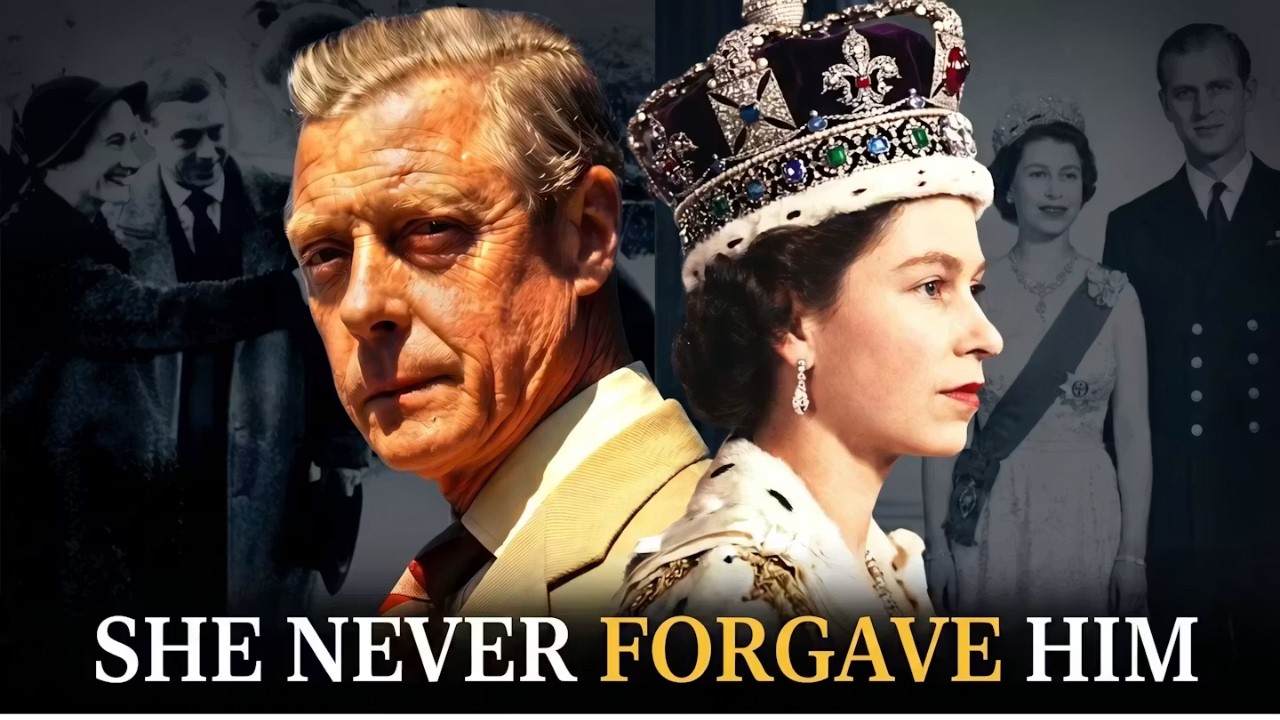
But one detail is often overlooked. Queen Elizabeth II, who reigned for seventy years and became known for her patience and almost superhuman composure, never closed the distance between herself and the uncle who changed the course of her life.
There was no open feud and no running bitterness. Instead, there was a quiet, permanent distance that time never softened.
For nearly ninety years, historians have circled a question that is not the one most people assume. It is not why Edward left. It is why Elizabeth, a woman not given to holding grudges, never let him back in.
To understand that, the story has to start somewhere most tellings never go. Not with Wallis Simpson, and not with the abdication itself, but with what Edward VIII actually believed about himself, and what those closest to him privately believed about him too. Those two things were very different.
By the time Edward took the throne in January 1936, he had spent two decades as Prince of Wales building a kind of popular admiration few royals ever see. He had charisma in ways his reserved, formal father, George V, never did.
He connected with ordinary people. He visited working-class communities in Wales and the industrial north, showed what appeared to be genuine interest in veterans and the unemployed, and offered a vision of the monarchy that looked genuinely modern.
Some who met him privately found a man capable of warmth and real loyalty, not the caricature of selfishness that harsher accounts tend to present. His instinct that the monarchy needed to evolve was not the instinct of a fool. The institution he inherited was deeply formal, deeply conservative, and resistant to the idea that the world around it had changed.
So when the establishment finally moved against him, the romantic version of the story was always ready to be written. A modern king against a rigid old guard, choosing love over a crown that revered rules more than people.
Millions believed it. Some still do.
But the romantic version of the abdication requires ignoring a much darker reality. Long before Wallis Simpson became a public scandal, Prime Minister Stanley Baldwin was watching the new king with growing alarm.
Not because Edward was modern, but because he was negligent in ways that had nothing to do with vision or ideology. Official papers were left unread for days. Official advice was received and immediately ignored. He held private conversations with foreign officials that no constitutional monarch should ever have.
Those around the king noted a consistent pattern. A man who loved the ceremony of monarchy but found its actual obligations boring. This was not a reformer being blocked by reactionaries. This was a man who loved being king but did not really want to do the job.
Wallis Simpson did not create that problem. She only made it impossible to keep pretending the problem did not exist.
Some historians reject this portrait, and their argument deserves to be taken seriously. The case against Edward's character was shaped, at least in part, by people who had reasons to justify what amounted to a forced removal. Baldwin and the palace establishment wanted Edward gone, and it is not unreasonable to ask how much of the evidence against him was assembled after the decision had already been made.
That argument, however strong, cannot survive the next layer of the story.
In October 1937, a year after the abdication, the Duke and Duchess of Windsor traveled to Nazi Germany on what was described as a study tour of workers' housing and industrial conditions. They were received with full ceremony, met senior officials, and on October 22, in Berchtesgaden, Edward met Adolf Hitler in person.
The British government had not been informed in advance. In documents kept secret for decades, the alarm deepened considerably.
German diplomatic telegrams from 1940, when France had fallen and Britain stood largely alone, described conversations in which Edward allegedly spoke of sympathy for a negotiated peace and discussed the possibility of being installed as a figurehead for a settlement that would in practice have meant British surrender.
Historians continue to debate how literally all of this should be read. Some argue the telegrams reflect Nazi wishful thinking more than Edward's real intentions. What is not disputed is that Winston Churchill found it necessary to send Edward a direct and forceful message about his conduct, and that British intelligence monitored his movements throughout this period. The concerns were real and were treated seriously at the highest levels of government.
But the most important thing in this chapter is not the geopolitical question of how sympathetic Edward actually was. It is something simpler and far more personal.
While Edward managed a comfortable distance from the war in the Bahamas, George VI was in London, standing amid the wreckage of a bombed Buckingham Palace, visiting streets where ordinary people had lost everything, embodying the symbolic steadiness the crown exists to provide.
Not because he chose the role, not because he was suited to it, but because someone had to do it, and he was the one left in place. That contrast is not incidental to this story. It is the story.
Consider what December 1936 actually looked like, not as constitutional history but as a human experience inside that family. George spent months watching the crisis unfold, still hoping to find a solution that would not require him to become king.

When that hope collapsed, he faced a reality he had days to absorb: a new title, a new home, and children whose futures were permanently altered without their consent. His wife, the future Queen Mother, later described the abdication as the most destructive event that ever struck their family.
Not because she doubted her husband's abilities, but because she could see clearly what the role would demand of him. She was right, and those demands never stopped.
While his brother managed his exile, George VI led Britain through its most dangerous years as his health quietly and steadily deteriorated beneath the surface. By 1948, he needed major surgery for an arterial blockage. By 1951, lung cancer had claimed his left lung.
When he died in February 1952 at just fifty-six, those close to him understood the truth. Historians are careful about linking stress directly to terminal illness, and rightly so, but the reality was plain to anyone who watched those sixteen years closely. George VI was worn down by the weight of a crown he was never meant to carry, placed on his shoulders the moment his brother decided to walk away.
Elizabeth watched all of it. She watched her father, a man who had not wanted this life, accept it without complaint and carry its burdens without relief. She watched the surgeries and the slow decline. She watched a good man age faster than he should have under the pressure of something handed to him the way you hand someone a problem you no longer wish to deal with.
Then, when he was gone, she picked up what remained. She became queen at twenty-five and did not stop for seventy years.
Every Commonwealth tour, every state visit, every crisis managed, every personal feeling suppressed in service of an institution she had been pointed toward since she was ten years old, when an afternoon in December 1936 rewrote her life without asking her permission.
Before the abdication, she was third in line to the throne. The reasonable expectation was that she would be a respected royal figure, but not the central one. That she might have something resembling a private life. After December 1936, that vanished entirely.
For three and a half decades, as that weight was redistributed and carried and eventually passed to her, Edward was in exile, nursing his grievances and shaping his narrative. He published his memoirs in 1951, while his brother was still alive and still king, a self-justifying account that those inside the palace found deeply objectionable.
He continued campaigning through various channels to have Wallis granted the title "Her Royal Highness." He gave press interviews. He maintained with remarkable consistency the posture of a man who had suffered greatly and wanted the world to understand exactly how much.
He did not fade away quietly or gracefully. He remained present at the margins, a constant reminder not of the love that was sacrificed, but of a man still focused primarily on what the story had cost him.
There is a deep paradox at the heart of all this. The people who actually paid the highest price for the abdication never told their side of the story at all.

George VI never wrote a defensive memoir or gave interviews detailing the cost of inheriting a broken institution. He left no public record of what he felt standing in bombed streets while his brother's name surfaced in German diplomatic telegrams. He chose silence, and Elizabeth inherited that same posture exactly.
For seventy years, her refusal to comment publicly on her uncle remained unwavering. No emotional interviews about how the events of December 1936 upended her childhood. No public responses to Edward's media campaigns. No complaints about a lifetime of obligation imposed on her.
Her silence was total and complete. And what filled that silence, what always filled it, was Edward's version of events.
For thirty-five years, the public consumed the Duke of Windsor's memoirs and wept over his tragic love story, entirely unaware of the reality behind the palace gates. That George VI had quietly carried the physical weight of that choice until his health broke. That Elizabeth was now left to carry it after him.
The man who bore the fewest consequences was the freest to shape how those consequences were remembered. The people who bore the greatest weight were the most constrained from speaking. George, by the dignity of his office and then by death. And for Elizabeth, constitutional reality dictated that a reigning monarch cannot publicly condemn a former king without damaging the very institution she exists to protect.
This is the hidden mechanism inside the story. Not a conspiracy, not an official cover-up, but the quiet, structural way power determines whose account of events will survive.
When Edward died in May 1972, the Queen arranged for his body to be returned to Britain. A funeral was held at Windsor. The Duchess of Windsor came to London and was briefly received at Buckingham Palace. It was one of the very few times her feet ever crossed those walls.
It was handled with precision and dignity. It was not friendly and it was not a reconciliation. It was a conclusion. The final line in a chapter that was never, for those inside the family, the love story the public always believed in.
So why did Elizabeth never forgive him? Not because of the abdication alone, and not even primarily because of his wartime conduct, but because of decades of evidence that followed. Because of the memoirs and the interviews and the grievances maintained from exile.
Because of the ongoing proof that Edward VIII, when confronted with what his choices had cost those around him, remained to the end the hero of his own story.
There is no document in which Elizabeth condemns him. No private letter has surfaced. Not even a trusted aide's account finally saying what the evidence suggests she felt. She was more disciplined than that, more committed to the institution, more aware that some things, once said, cannot be taken back.
So she said nothing, and showed everything. Duty where he chose desire. Service where he chose escape. Seventy years of unbroken commitment to a role she never asked for, built in the space his departure created.
Every year of her reign was, in a quiet and unremarked way, an answer to a question her uncle asked in December 1936. He had asked whether it should have been him. She spent her whole life proving that someone had to say yes, and that someone would not be her father's brother.
If historians are right, and the weight of evidence suggests they are, the real reason Elizabeth never forgave Edward VIII was not that he chose love over duty. It was that she spent seventy years living with consequences he never fully acknowledged, watching the people she loved most carry what he left behind, and then carrying it herself without complaint and without recognition for as long as she lived.
Edward spent the rest of his life telling the world what the abdication had cost him. Elizabeth spent the rest of hers proving that someone else had paid the price.