PRAGUE — Karel Čurda, the Czechoslovak paratrooper whose betrayal of the assassins of Nazi Reich Protector Reinhard Heydrich condemned hundreds of resistance fighters and their families to execution, was hanged at Pankrác Prison in Prague at dawn on April 29, 1947, closing one of the darkest chapters of the Nazi occupation of Bohemia and Moravia.
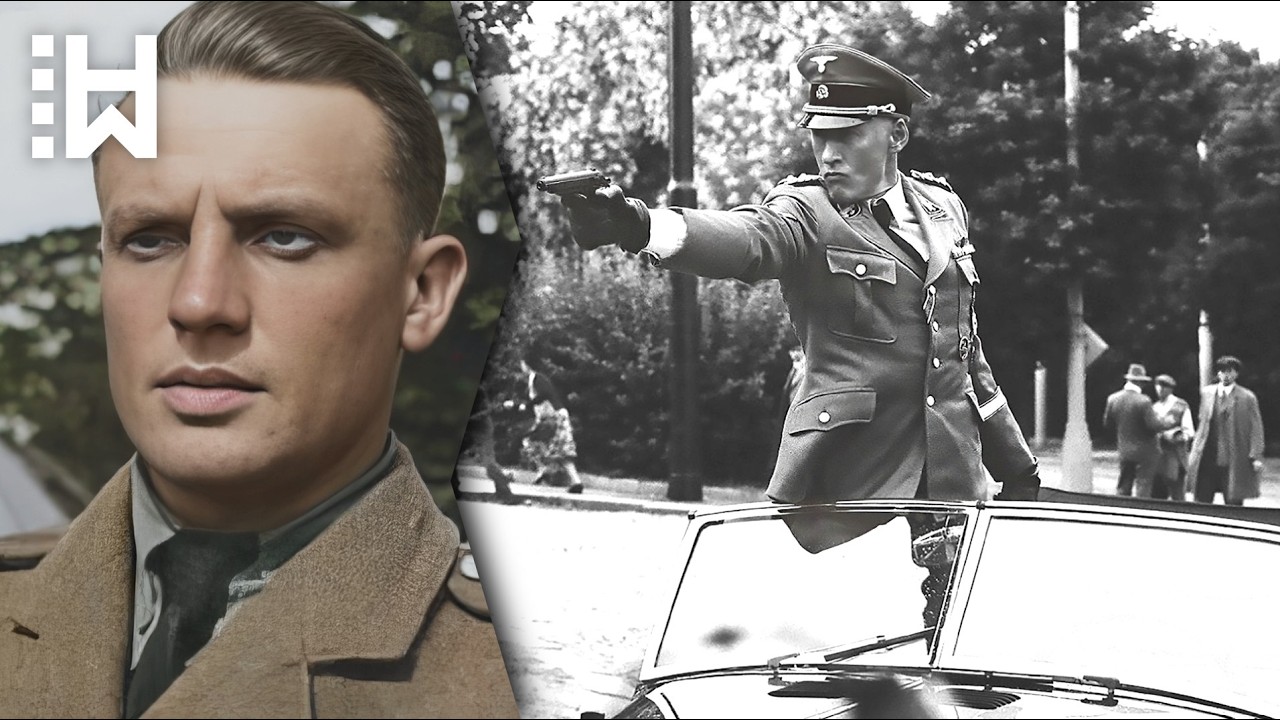
The 35-year-old former non-commissioned officer of the Czechoslovak Army went to the gallows without seeking clemency from President Edvard Beneš, offering no legal defense beyond the claim that he had feared for his family. His execution ended the life of a man whose single act of treachery on June 16, 1942, shattered the most important resistance network in the Protectorate of Bohemia and Moravia.
Čurda was born on October 10, 1911, in the small South Bohemian village of Nová Včelnice, then part of the Austro-Hungarian Empire. His father, František Čurda, earned a living as a worker, while his mother, Rosalie Čurdová, kept a modest household and raised six children. Karel, the youngest, completed local primary school and several years of lower secondary education before taking up a mason’s hammer on local building sites as a teenager.
In interwar Czechoslovakia, military service offered poor rural youths a bed, hot meals, and a small wage. In 1933, Čurda joined the 29th Infantry Regiment of the Czechoslovak Army. He excelled at drills, shot well on the range, and attended courses for non-commissioned officers.
By 1936, he had become deputy platoon commander at the NCO school, and his superiors consistently described him as disciplined, loyal, and politically reliable.
The republic he served was already dying. In September 1938, while Europe watched the Munich Agreement strip Czechoslovakia of the Sudetenland, Čurda was serving in the State Financial Guard, an armed customs force patrolling the new frontier for smugglers and German agents. On March 15, 1939, Nazi forces marched into Prague, dismembered Czechoslovakia, and proclaimed the Protectorate of Bohemia and Moravia.
For many young men, including Čurda, service under German rule was unthinkable. In June 1939, he slipped out of the protectorate and reached the camp at Bronowice near Kraków in Poland, where he met Josef Gabčík and Jan Kubiš — two men whose names would later become famous around the world. From Poland, Čurda traveled to France with the goal of joining the Czechoslovak army in exile.
Before the outbreak of the Second World War, independent Czechoslovak units could not be formed on French soil, so Čurda first enlisted in the French Foreign Legion. When war began on September 1, 1939, the Czechoslovak army was reconstituted, and Čurda transferred into its ranks. He trained under harsh conditions but never reached the front; after Nazi Germany defeated France in six weeks in 1940, he escaped on an evacuation vessel to Britain.
In Britain, he joined remnants of the Czechoslovak soldiers stationed in tents at Cholmondeley Park near Liverpool. Every exiled soldier knew that guard duty would not free their homeland. When Czechoslovak officers called for volunteers for special tasks, Čurda stepped forward.
From autumn 1941, he trained with the British Special Operations Executive, learning parachute jumps at Ringway and demolition at Arisaig.
His Czechoslovak instructors judged him cheerful, team-minded, and physically very strong — fit for independent and group tasks. In 1942, he, together with Adolf Opálka and Ivan Kolařík, formed the special operations team codenamed Out Distance. They flew out on the night of March 28, 1942, in a Halifax bomber bound for the protectorate.

Bad weather, a low drop, and a navigational error scattered the containers and the agents. Adolf Opálka injured himself during the landing, and Ivan Kolařík lost his false papers as well as information about his loved ones. A few days later, Kolařík chose death in a vain attempt to save his fellow agents and his family from the Gestapo.
Čurda and Opálka made it to Prague and hid in safe flats arranged by resistance fighters.
They had returned, but it was not the same country they had known before the war. Since September 1941, the newly appointed Deputy Reich Protector Reinhard Heydrich had ruled with an iron logic: the population would be dominated by the Nazis, with benefits for the workers needed for industry and war production, while those who resisted would be persecuted, tortured, and murdered by the Gestapo.
The end of Heydrich and his policy came on the morning of May 27, 1942, when Josef Gabčík and Jan Kubiš attacked his open-top Mercedes in Prague. Heydrich survived the initial attack but died of his wounds on June 4, 1942. The Nazi response was swift and brutal.
Thousands were arrested, hundreds were shot, and the Gestapo launched a massive manhunt for the attackers.
On the very day of the assassination, a state of emergency was declared for the entire territory of Prague. Within days, thousands of decrees were printed announcing both the emergency and a reward of 10 million crowns — equivalent to one million Reichsmarks — for information leading to the arrest of the perpetrators. The reward was later raised to 20 million crowns.
Anyone who knew anything about the perpetrators and failed to report it was to be shot along with their entire family. A curfew was imposed. All cinemas, theaters, and entertainment venues were closed, and public transport was halted.
On June 10, 1942, German troops destroyed the village of Lidice. All men were executed, most of the women were sent to the Ravensbrück concentration camp, and the majority of the children were later gassed at Chełmno.
Čurda had left the Czech capital on May 27 to visit his sister in Kolín, a town near Prague. He heard rumors of the assassination on the train and rushed back. Afraid of being caught in Prague, he managed to leave the city and went into hiding in Nová Včelnice, where his mother still lived.
There he hid for days, reading long lists of the executed posted in newspapers.
Posters promised millions of crowns and a full pardon to anyone who helped catch the assassins. According to Čurda’s postwar testimony, his mother wept, saying the family and their village would share Lidice’s fate if he remained. On June 13, Čurda sent an anonymous warning letter to the police in Benešov, but no arrest followed.
In this letter, later seized by the Gestapo, he gave information about the names of Heydrich’s attackers.

Early on June 16, he dressed, took a train to Prague, and walked to the Gestapo office in Bredovská Street. There he told Gestapo officer Heinz Jantur that he was an agent from England. He pointed out items belonging to the attackers that had been left at the scene on the day of the assassination and gave the Gestapo information about the attackers and the people helping Czechoslovak agents in the protectorate.
In a last flash of courage, Čurda tried to poison himself but failed. He was subsequently beaten, and afterward he continued to testify, even though he did not know the exact location where Heydrich’s assassins were hiding. But thanks to his information, the Gestapo arrested people who knew — and who, under torture, revealed the hiding place.
Until Karel Čurda came forward voluntarily on June 16, 1942, the Gestapo had no information about where the agents were hiding. It was only his testimony that pointed them in a direction that meant the deaths of hundreds of resistance fighters and their families — people who, before he betrayed them, had willingly helped even Čurda himself.
The famous siege of the Orthodox Church of Saints Cyril and Methodius in Prague on June 18, 1942, where Heydrich’s attackers and other agents were hiding, was a direct result of Čurda’s betrayal. Čurda allegedly urged his friends to surrender, saying, “Friends, surrender. Nothing will happen to you.
Nothing happened to me either.” The trapped men answered with gunfire and later killed themselves rather than fall into Nazi hands alive.
After a seven-hour fight, the bodies were carried outside. Čurda and another agent turned informer, Viliam Gerik, identified each body for the Gestapo. The German secret police paid part of the promised reward to Čurda and gave him a new Germanized name, Karl Jerhot.
Čurda adopted German nationality, received five million crowns, and the Gestapo soon used him as a walking trap.
He traveled across the Protectorate of Bohemia and Moravia, claiming to be a newly landed Czechoslovak agent who needed shelter and connection to the resistance movement. Many patriots accepted him and were later arrested within days by the Germans. Thanks to Čurda’s work, the Gestapo broke not only the ranks of the home resistance but also other groups of agents sent from Britain by Czechoslovak authorities.
Because other agents recognized him from Britain, his presence carried special weight. Each betrayal handed the Gestapo fresh addresses and snowballed into wider arrests. After becoming a Gestapo collaborator, he broke up with Karolina Jaklová, with whom he had a child born eight months after his departure from the protectorate in 1939, and married a German woman, Maria Bauer, the sister-in-law of a Gestapo official.
Drink soon ruled his evenings, yet he remained on the Gestapo payroll.
The worst harvest of his information came far from Prague. After months of torture, many supporters of the Czechoslovak resistance were moved to the Mauthausen concentration camp in Austria. On October 24, 1942, 262 Czechoslovak prisoners — 135 women and 127 men — were executed.
 Each victim gave a name and birth date, then an SS man shot them in the back of the neck. The bodies were burned in the crematorium, and their ashes were eventually dumped in a waste site behind the camp.
Among the murdered were mothers, fathers, brothers, and sisters of the resistance fighters. Additional mass shootings of supporters of Czechoslovak agents betrayed by Čurda followed on January 25, 1943, and on February 3, 1944. The youngest executed was Jindřiška Nováková, who was only 14 years old at the time of her death.
Every bullet traced back in part to Čurda’s treachery on June 16, 1942.
By late 1944, the Gestapo found Čurda less useful. He drank heavily and missed meetings with his superiors. In the chaos of April 1945, he fled westward toward the American line and hid in Manětín, a town near Plzeň.
On May 15, 1945, he walked to the local gendarmerie and allegedly said, “What must come, let it come.” He was arrested by Czechoslovak authorities.
A court in Prague formed after the war charged him with high treason, denouncing fellow soldiers, and helping the enemy murder Czechoslovak citizens. During public hearings in April 1947, he sat pale and silent, sometimes wiping sweat with a handkerchief. He offered no legal excuse and stated only that he had feared for his family.
The court found him guilty and sentenced him to death by hanging.
His fellow agent turned informer Viliam Gerik, from Operation Zinc, received the same fate. Neither man asked President Edvard Beneš for clemency. At dawn on April 29, 1947, warders led the 35-year-old Čurda to the gallows at Pankrác Prison in Prague.
The trap opened and ended the life of a man whose betrayal destroyed entire networks of resistance fighters and who remains, to this day, a symbol of collaboration with Nazi Germany.
The execution closed a case that had haunted postwar Czechoslovakia. For the families of the hundreds executed at Mauthausen and in Prague, the hanging could never restore what was lost. Yet for a nation rebuilding from occupation, the verdict carried a clear message: those who traded the lives of their countrymen for Nazi silver would answer for it before Czechoslovak law.
Historians note that Čurda’s betrayal remains one of the most consequential acts of treachery in modern Czech history. His information directly led to the deaths of the paratroopers who had assassinated Heydrich — an operation that remains a defining moment of Czech resistance — and to the destruction of the broader network that had sustained them. The names Gabčík, Kubiš, and Opálka are honored today as national heroes, while Čurda’s name is remembered only as a warning.
The case also underscored the terrible arithmetic of occupation. The Gestapo’s promise of a pardon and a fortune exploited a man’s fear for his family, but the court found that fear could not excuse the systematic destruction of hundreds of lives. In the end, the man who once trained to fight for his homeland’s freedom died at the end of a rope in the very city he had helped to terrorize.