Vincent “Mad Dog” Coll was one of the most feared gangsters of Prohibition-era New York, a ruthless killer whose career ended violently at the age of 23 in a phone booth. Coll was born in County Donegal, Ireland, on July 20, 1908, and immigrated to the United States with his family in 1909, arriving in New York as steerage passengers aboard the SS Columbia. He joined the Gopher Street gang at age 12 after being expelled from several Catholic reform schools, and by the time he was 16 he had been arrested for carrying a gun. By 23, he had been arrested a dozen times.
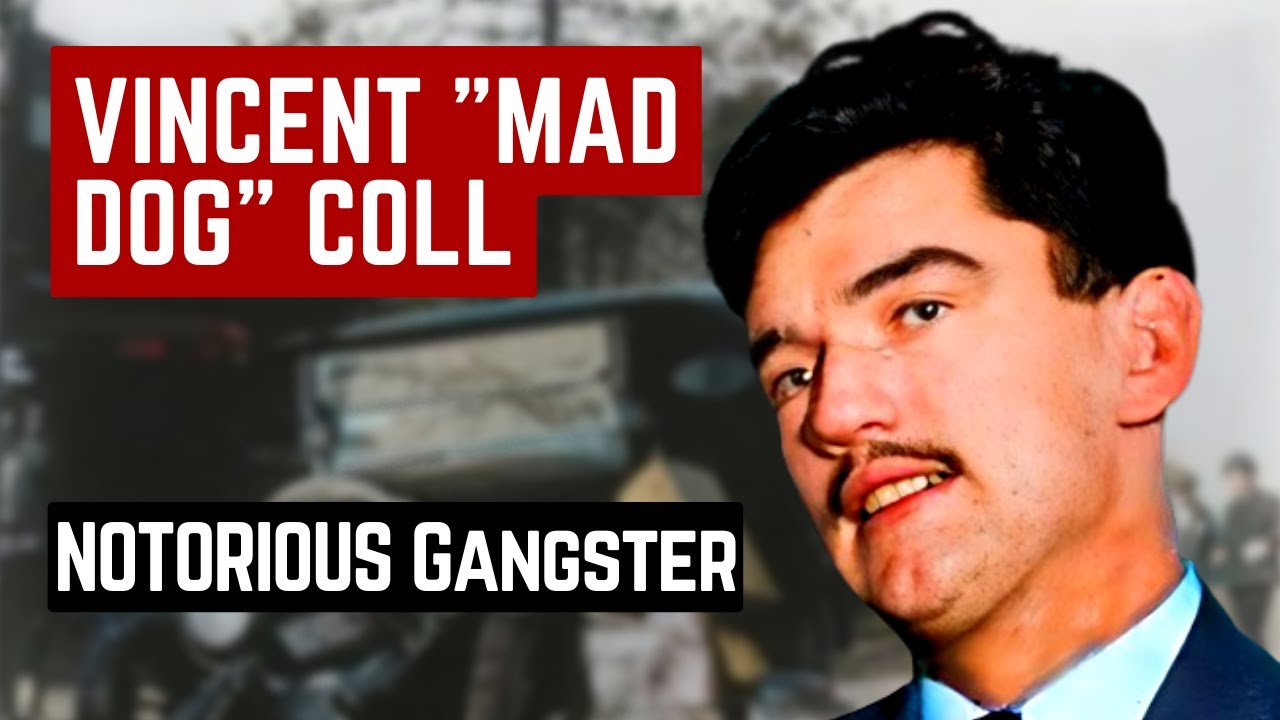
In the late 1920s, Coll began working as an armed guard for Dutch Schultz’s illegal beer delivery trucks. As Schultz’s empire grew, Coll was hired as an assassin, and his brutality initially made him a valuable enforcer. Coll was charged with the murders of Anthony Barello, a speakeasy owner, and Mary Smith, a dancehall hostess, when he was 19. The charges were dropped, and many believed Schultz’s influence was the reason.
Schultz, however, was not pleased with Coll’s actions. In 1929, Coll robbed Brock’s Dairy of $17,000 without Schultz’s permission. He and his gang posed as armed guards to gain access to the cashier’s room. When Schultz confronted him, Coll demanded to be made an equal partner.
Schultz declined. By January 1930, Coll had formed his own gang and was engaged in a shooting war with his former boss. Coll’s older brother, Peter, was shot dead while driving down a Harlem street on May 30, 1931. Grieving and seeking vengeance, Coll killed four of Schultz’s men over the next three weeks.
Around 20 men in total were killed in the bloodbath, though the exact figure is difficult to determine because New York was also in the grip of the vicious Castellammarese War. Coll and his gang broke into a garage owned by Schultz on June 2, destroying 120 vending machines and 10 trucks. To fund his new gang, Coll kidnapped rival gangsters and held them for ransom. He knew the victims would not report the kidnappings to police and would struggle to explain to the Bureau of Internal Revenue why the ransom money had not been reported as income.
One of his most well-known victims was gambler George “Big Frenchy” DeMange, a close associate of Hell’s Kitchen mob boss Owney Madden, who was released after an 18-hour kidnapping. Coll was accused of taking part in a kidnapping attempt that resulted in the shooting death of a child on July 28, 1931. His target was bootlegger Joseph Rao, a Schultz underling relaxing in front of a social club. Children were playing outside an apartment building when a large touring car pulled up and several men opened fire with shotguns and submachine guns.
Rao threw himself to the sidewalk, and the attack injured four young children. Michael Vengali, a five-year-old boy, later died at Beth David Hospital. New York City Mayor Jimmy Walker labeled Coll a “Mad Dog” following the murder of Vengali. Coll was apprehended by police on October 4, 1931, after an extensive manhunt.
He had dyed his hair black, drawn a mustache, and worn horn-rimmed glasses. During a police lineup, a defiant Coll stated he had been in Albany for several months and refused to answer further questions without an attorney. He was indicted for the Vengali murder by a grand jury on October 5. Coll’s trial began in December 1931, and he hired renowned defense attorney Samuel Leibowitz.
Coll claimed he was miles away from the shooting and was being set up by his adversaries. The prosecution’s case unraveled when their sole witness to the shooting, George Brick, admitted to having a criminal and mental health history, as well as giving similar testimony in a previous murder case in St. Louis. At the end of December, the judge issued a directed verdict of not guilty.
Coll married Lottie Kreisberger, a fashion designer, in New York soon after his acquittal. In September 1931, Coll was hired by Salvatore Maranzano, who had recently declared himself capo di tutti capi, to murder Charles “Lucky” Luciano. Luciano had ended the Castellammarese War months earlier by ordering the assassination of his own boss, Joe Masseria, leaving Maranzano as the most powerful boss in the five families. But Maranzano quickly concluded that Luciano posed a danger.
On September 10, Maranzano summoned Luciano, Vito Genovese, and Frank Costello to his Manhattan office at 230 Park Avenue. Luciano decided to act first. Knowing Maranzano had planned to murder them, he dispatched four Jewish hitmen, secured by two of his close associates, Meyer Lansky and Bugsy Siegel. Two of the gangsters posed as government agents and disarmed Maranzano’s bodyguards.
The other two, aided by Tommy Lucchese, who went along to point out Maranzano, stabbed the Sicilian boss multiple times before shooting him. According to government witness Joseph Valachi’s 1963 testimony, Maranzano had paid Coll $25,000 in advance for all three murders. But when Coll arrived at Maranzano’s office that same day intending to kill Luciano, Genovese, and Costello, he found Lucchese and the four Jewish hitmen fleeing the scene. Coll left the building after learning that Maranzano had died.
Dutch Schultz and Owney Madden each had $50,000 on Coll’s head. Schultz once walked into a Bronx police station and offered a house in Westchester to whoever killed Coll. On February 1, 1932, four or five gunmen stormed a Bronx apartment known to be frequented by Coll and opened fire with pistols and submachine guns. Coll’s gangsters, Patsy Del Greco and Fiorio Basile, as well as bystander Emily Tuncilo, were killed, and three others were injured.
Coll did not arrive until 30 minutes after the shooting. A week later, at 12:30 a. m. on February 8, Coll was using a phone booth at a drugstore on 8th Avenue and 23rd Street in Manhattan.
He was reportedly speaking with Madden and demanding $50,000 in exchange for the kidnapping of Madden’s brother-in-law. The line was being traced, and Madden kept Coll on the line. Three men arrived at the drugstore in a dark limousine; two came out while one waited in the car. One man stood outside while the other entered.
“Keep cool now,” the gunman said to the cashier before drawing a Thompson submachine gun from under his overcoat and opening fire on Coll in the glass phone booth. Coll was killed instantly. The assassins fled in their car while being pursued unsuccessfully up 8th Avenue by a foot patrolman who had heard the gunshots and commandeered a passing taxi. Coll was buried alongside his brother Peter in the Bronx’s Saint Raymond Cemetery.
Dutch Schultz sent a floral wreath with a message reading “From the boys” on it. Coll’s killers were never found. Dixie Davis, an attorney for Dutch Schultz, later claimed that gangster Bo Weinberg was the limousine’s getaway driver. One of Coll’s own men, Edward “Fats” McCarthy, was also a suspect.
The submachine gun that killed Coll was discovered a year later in the possession of “Tough Tommy” Prothero, a Hell’s Kitchen gunman who used it in a 1933 saloon killing. Prothero and his girlfriend, Elizabeth Connors, were shot and killed by unknown gunmen in Queens on May 16, 1935. Dutch Schultz operated his rackets for only a few years longer and was assassinated on October 23, 1935, at the Palace Chop House in Newark, New Jersey, allegedly on the orders of Luciano and the new national crime syndicate. Lottie Coll, Vincent’s widow, was convicted of carrying a concealed weapon and sentenced to six months in prison.
She refused to leave prison after her parole because she was afraid that the people who murdered her husband would also murder her. In 1935, Madden, still under police scrutiny for the Coll killing, moved to Arkansas, where he died in 1965.