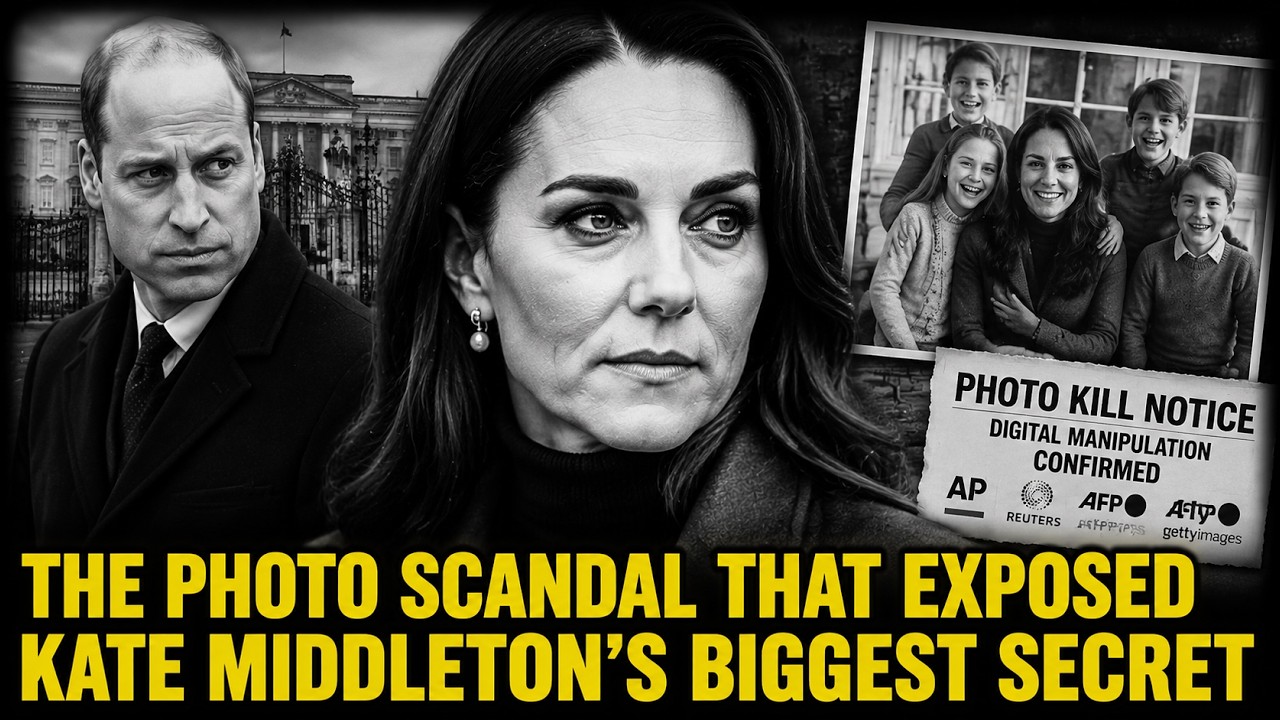
The photograph went out on a Sunday morning in March 2024, timed for Mothering Sunday in Britain. It showed Catherine, Princess of Wales, seated on a wooden garden chair surrounded by her three children, smiling in a soft cardigan. It was the first image of her released since major abdominal surgery two months earlier had pulled her out of public life entirely.
Within hours, photo agencies including the Associated Press, Reuters, Agence France-Presse, and Getty Images issued kill notices, pulling the image from circulation over what technical analysts identified as signs of digital manipulation. Catherine herself posted an apology, admitting she had personally edited the photograph, the kind of amateur retouching millions of people do to family pictures.
The apology did not calm anything. It confirmed the opposite of what it intended. If the Princess of Wales felt she needed to touch up a snapshot, and if a communications operation with decades of experience let it go out anyway, then whatever was happening inside Kensington Palace that winter was being managed with a level of care that looked, from the outside, indistinguishable from concealment.
The vacuum the photograph was meant to fill had already produced a viral hoax falsely claiming Catherine had died, spreading fast enough that several major news organizations ran explicit debunking articles stating she was alive.
That single afternoon compresses something that has been true of this marriage since before it was a marriage at all. The public version of William and Catherine has always been the most carefully produced image in the modern royal operation. A true story and a complete story are not the same thing, and the distance between what has been shown and what has been withheld is where this marriage has always lived its most interesting life.
This is a story about a couple who weathered a breakup, an alleged rift with a neighbor, a rupture with a brother that spilled into two competing published accounts, and a health crisis so tightly controlled that the control itself became the story.
Members of the royal family have for generations had their own private shorthand for their method, referring to the institution among themselves as "the Firm," a term reportedly coined by William's great-grandfather George V and adopted since by everyone from the late Queen downward. Image management here has always been understood internally as a business discipline rather than an incidental byproduct of fame.
To understand why William built his adult life around this kind of control, it helps to start with the six days that followed his mother's death. Diana died in the early hours of August 31, 1997, and the royal family remained at Balmoral rather than returning immediately to London, declining for several days to fly the flag at half mast over Buckingham Palace because tradition held that the flag flew only for the reigning monarch.
The pressure grew severe enough that the Queen returned to London, addressed the nation on television, and allowed the flag to fly at half mast for the first time in royal history for anyone other than the monarch. William and Harry were brought out at the Queen's own suggestion to walk among the crowds and floral tributes.
William was 15 years old and days later walked behind his mother's coffin through the streets of London alongside his father, his brother, his grandfather Prince Philip, and his uncle Charles Spencer. He has since described it as one of the hardest things he has ever done, undertaken in front of cameras broadcasting to an estimated worldwide audience in the hundreds of millions.
He has said he felt at the time he had no choice, and that he has spent much of his adult life trying to give his own children a version of grief, privacy, and childhood that would never have to be performed in public the way his was.
Catherine Elizabeth Middleton was born in January 1982 in Reading, into a family that had climbed into comfortable wealth within living memory. Her father, Michael Middleton, came from a line of solicitors and had worked as a flight dispatcher for British Airways. Her mother, Carol, had worked as an air stewardess before the two founded a mail order party supplies company called Party Pieces in the early 1980s.
Several biographers, including Katie Nicholl, have reported that Catherine was bullied during an earlier stage of her schooling at Downe House to the point that her parents moved her to a different school. The journalist and author Tina Brown, in her book The Palace Papers, described Catherine's temperament as approaching the project of becoming a senior royal with an almost military discipline.
Catherine went to Marlborough College and then in September 2001 to the University of St. Andrews in Scotland, initially to study art history. William arrived at the same university that same autumn, having chosen St. Andrews partly because it offered a degree of distance and ordinary student anonymity.
British royal culture has long drawn an informal distinction between the heir and everyone else, sometimes called the spare. William, as the direct heir behind only his father, received a level of protective institutional planning around his eventual marriage that Harry, born a spare, never received to the same degree.
The two lived in the same hall of residence in their first year and were friends before they were anything else. A famous charity fashion show in the spring of 2002, where Catherine walked a runway, became the flattened version of how they became a couple. The more accurate version describes something slower, a friendship that deepened across shared academic life before it became public knowledge that they were together sometime in 2003.
William began studying art history alongside Catherine, then switched to geography after his first year, and graduated in June 2005 with an upper second-class degree, the same classification Catherine received for her art history degree that same year.
In the summer of 2001, shortly before William began his first term, his father's press office negotiated an informal agreement with the Press Complaints Commission and the editors of Britain's major newspapers. The press agreed to leave William alone throughout his time as an ordinary student in exchange for a small number of organized photo calls. The agreement largely held for four full years.
That single arrangement is the actual origin point of the method traced through every subsequent decade of this marriage. The Middleton family's later work with media lawyers, the royal rota guidelines protecting the children, the near total blackout on the Rose Hanbury story, were built on the template that agreement had already proven could work.
Once the relationship became public, British tabloids treated Catherine with a mixture of fascination and open cruelty. She was given the nickname "Waity Katie," a framing that stripped her of agency and turned patience into a punchline. Any photograph of her could be sold to multiple outlets, with prices scaling directly with how candid or apparently private the image looked.
On her 25th birthday in January 2007, a pack of paparazzi reportedly numbering close to 20 followed her onto a public bus, prompting her lawyers to send a formal complaint to the Press Complaints Commission.
Her mother, Carol Middleton, became a target of English class snobbery, with one widely circulated account describing guests at a private party mocking her former career as a flight attendant by repeating the boarding announcement phrase "doors to automatic and cross-check" within earshot.
The family's solicitors, the London firm Harbottle and Lewis, waged a campaign on Catherine's behalf across roughly two years, using the Protection from Harassment Act to send cease and desist warnings to specific photo agencies. It was, by the assessment of media law specialists, one of the first times that statute had been used this aggressively on behalf of someone not yet married into the royal family.
Catherine spent much of this period working first briefly as an accessory buyer for the clothing retailer Jigsaw and later in a part-time marketing and photography role for her parents' company. Several biographers have credited Carol Middleton as the strategic mind behind the family's disciplined response, describing her as the one who pushed hardest for the legal complaints and the studied refusal to grant interviews.
Four months before that 25th birthday, in April 2007, William and Catherine broke up. The backdrop was a moment of unusually intense press interest in December 2006, when Catherine attended William's passing out parade at the Royal Military Academy Sandhurst as his acknowledged partner.
Some accounts pointed to William's demanding schedule at Sandhurst. Others pointed to reported tension over his social life, an era Fleet Street nicknamed "Bad Boy William," full of well-documented nights out at London nightclubs including Boujis. The split lasted a matter of weeks rather than months, and the two were seen together again by the middle of that same year.
Catherine was photographed attending Wimbledon that summer wearing sunglasses despite overcast weather, an image multiple outlets read as a woman trying to shield visibly reddened eyes from long lens cameras. Media critics later pointed to a clear asymmetry: William's nightclub photographs were treated as a young man sowing ordinary wild oats, while Catherine's patience was treated as a personal failing and her visible grief as a legitimate photographic target.
What makes those years relevant is what the Middleton family did in response. They did not go quiet and hope the attention faded. They hired specialist media lawyers, pursued formal complaints, and worked to build a relationship with the press that offered occasional access on their own terms in exchange for restraint the rest of the time.
By the time William proposed in October 2010 during a private holiday in Kenya, using the sapphire and diamond engagement ring that had belonged to his mother, the machinery for managing this couple's public exposure had been built, tested, and refined across the better part of a decade.
William proposed at the Lewa Wildlife Conservancy in Kenya, staying at a remote log cabin called Rutundu on the slopes of Mount Kenya that had no internet access and almost no mobile signal. The couple kept the secret for more than a month before Clarence House released a formal written announcement on November 16, confirming the engagement and stating the wedding would take place the following spring.
That evening, William and Catherine gave a single joint television interview to the broadcaster Tom Bradby, a family friend. The interview remains one of only a small handful of occasions on which either has spoken publicly at any length about their own relationship in personal rather than official terms.
In an era when royal correspondents can list dozens of significant broadcast interviews given by Harry, by Meghan, and by Andrew before his fall from public life, William and Catherine's combined tally of substantive personal interviews across more than 15 years of marriage can be counted on one hand.
The same publications that had spent much of the previous decade running "Waity Katie" headlines switched within hours of the Clarence House statement to warm celebratory coverage, treating that same patience as evidence of a steady, sensible young woman. No outlet involved ever acknowledged or explained the reversal.
In the weeks around the wedding, unconfirmed reports circulated suggesting the family had at least discussed the possibility of a prenuptial financial agreement. Clarence House declined then as now to confirm or deny, leaving open a basic factual question about the legal terms of the marriage itself that has never been answered on the record.
The wedding on April 29, 2011, at Westminster Abbey was watched by an estimated global television audience in the hundreds of millions. The dress designed by Sarah Burton at Alexander McQueen was kept so completely secret before the ceremony that even the bookmakers taking bets on the designer's identity had the wrong name until Catherine stepped out of the car.
The guest list ran past a thousand names and generated its own smaller controversies. Several of William's former girlfriends were reportedly invited, while former prime ministers Tony Blair and Gordon Brown were left off entirely. Argentina's ambassador was also excluded, a decision widely connected to diplomatic tension over the Falkland Islands. Both controversies burned through a single news cycle and were gone within days.
The detail the household guarded most successfully was the honeymoon. For several days after the wedding, speculation ran through the tabloids without any confirmation from Kensington Palace. It was eventually confirmed, well after they had already returned, that they had spent 10 days on the private island of North Island in the Seychelles, arriving and departing without a single photograph taken by anyone outside their own traveling party.
Reports beginning around 2012 described William and Catherine alternating select Christmases between Sandringham and the Middleton family home in Bucklebury, a break from strict precedent that the late Queen was reported to have accommodated without public comment.
Catherine spent much of the two years before the wedding being informally trained in royal protocol by aides within Prince Charles's and the late Queen's households, absorbing an enormous, largely unwritten body of convention. Several accounts describe her early public engagements as visibly carefully rehearsed, a contrast with the more natural ease she projected within a few years.
Rather than settling into full-time royal duties in London, William took up a posting as a search and rescue helicopter pilot with the Royal Air Force on the island of Anglesey off the coast of North Wales. The couple rented an ordinary farmhouse there rather than moving into a palace apartment.
For roughly two and a half years, until William's RAF posting ended in the autumn of 2013, Catherine did her own grocery shopping in the local supermarket, and William flew rescue missions that had nothing to do with the monarchy. Several biographers, including Robert Lacy, have described those Anglesey years as a kind of honeymoon period the institution mostly left alone.
Their first official overseas tour as a married couple, nine days across Canada and California in the summer of 2011, drew enormous, largely uncritical crowds, helped by an itinerary built for pure spectacle: a dragonboat race in Prince Edward Island, a rodeo appearance in Calgary, a red carpet film premiere in Los Angeles.
A second later period of comparable ordinary domestic life arrived during the coronavirus lockdowns of 2020 and 2021, when William and Catherine relocated the family to Anmer Hall and found themselves home schooling their children. Royal correspondents noted the couple seemed, if anything, more comfortable during that enforced retreat than during the packed diary years surrounding it.
In September 2012, while William and Catherine were staying at a private chateau in Provence belonging to his cousin, a photographer using a long lens from a public road roughly half a mile away captured images of Catherine sunbathing topless beside a swimming pool. The French gossip magazine Closer published the photographs days later, and an Italian magazine called Chi followed.
William and Catherine's lawyers filed both criminal and civil complaints in France, where privacy law is considerably stronger than in Britain, and pursued the case through the French courts for the better part of five years. In September 2017, a French court convicted the photographer and the editor of Closer of invasion of privacy, imposing fines and ordering Closer's parent company to pay damages directly to the couple.
In 2016, private photographs stored on Pippa Middleton's personal cloud storage account, including images of Catherine and Prince George, were stolen by a hacker who then attempted to sell them to tabloid newspapers, triggering a police investigation that ended with a man convicted of computer misuse. Around the same period, a British newspaper published aerial photographs of Anmer Hall taken from a drone, prompting a formal complaint from Kensington Palace to the press regulator.
When Pippa Middleton married the financier James Matthews in May 2017 at a church near the Middleton family home in Berkshire, the private event required a security operation on a scale more typical of a state occasion, including a temporary no-fly zone over the venue enforced by the Civil Aviation Authority.
It was at Anmer Hall, in the small social world of rural Norfolk aristocracy, that the most persistent and least resolved rumor of this entire marriage took root. Rose Hanbury, the Marchioness of Cholmondeley, is married to David Cholmondeley, the Marquess of Cholmondeley, whose family seat at Houghton Hall sits close enough to Anmer Hall that the two properties share a boundary with the wider Sandringham estate.
David Cholmondeley also holds the hereditary office of Lord Great Chamberlain, a ceremonial role with formal duties at state occasions including coronations. Rose Hanbury, a former model who had appeared on the cover of British Vogue in the 1990s, and Catherine were by multiple contemporaneous accounts genuinely close for a period spanning several years.
Sometime around 2019 that friendship visibly ended, and almost immediately American outlets including Us Weekly and In Touch published claims sourced to unnamed friends and acquaintances alleging that the end of the friendship was connected to an affair between William and Rose. The claims were specific enough to generate enormous circulation and vague enough in sourcing that no outlet with a serious legal department in Britain would touch them.
Kensington Palace's response across more than five years has been a single unwavering strategy: silence. No denial has ever been issued in William's name, and no confirmation either. Representatives for both families have on the rare occasions journalists asked directly declined to comment.
Rose Hanbury's own conduct throughout those five years mirrors William's. She has never given an interview addressing the rumor, never issued a personal denial beyond the same decline to comment pattern, and has continued to appear at public events near her own home in Norfolk.
The policy was tested again in 2021 when the British society magazine Tatler published a lengthy profile of Catherine that drew on claims from unnamed friends, describing feelings of exhaustion and constraint within her royal role. Kensington Palace took the unusual step of formally disputing elements of the piece, and Tatler subsequently issued a clarification.
The pattern that emerges is a household that treats different categories of threat very differently. A story that risks making Catherine look fragile or unhappy gets a rare targeted response. A story that risks implicating William in infidelity gets total silence indefinitely.
The rumor resurfaced with unusual force in the early months of 2024, at the exact moment Catherine's prolonged unexplained absence following her January surgery was already generating wider speculation. French and other continental European outlets revived the Rose Hanbury claims explicitly, with at least one French celebrity magazine publishing a cover story naming both William and Rose Hanbury directly. British outlets once again almost entirely declined to repeat the claims.
Running in parallel with the Rose Hanbury rumor was the collapse of William's relationship with his brother, a rupture that produced something almost unheard of in the history of the modern British monarchy: two competing book-length first-person accounts of the same family from two brothers who had grown up in the same household.
Harry's own title for his memoir, Spare, drew directly on the heir and spare framing, and he wrote plainly that the label was applied to him within his own family from early childhood. That structural difference played out concretely in how the two brothers' military careers unfolded.
Harry served two tours in Afghanistan, first in an undisclosed forward role in 2008, cut short once his presence was reported by foreign media, and again in 2012 and 2013 as an Apache attack helicopter pilot and gunner. William, as second in line, was never deployed to a combat zone. His own service channeled instead into search and rescue flying.
Harry served as best man at William and Catherine's wedding in 2011, delivering a speech widely reported by attendees as warm and genuinely funny. The two brothers spent the years immediately afterward presenting a united public front, including the widely publicized launch of the Heads Together mental health campaign in 2016, fronted jointly by William, Catherine, and Harry.
Harry's marriage to Meghan in 2018 was initially treated by the palace and much of the press as an expansion of that same unified project, the beginning of what royal correspondents nicknamed the Fab Four.
Meghan herself in the 2022 Netflix documentary series Harry and Meghan offered one small anecdote from those early days, describing an initial meeting where she went to hug Catherine in greeting, only to sense that the more reserved physical formality expected within the family made the moment noticeably awkward. Harry's memoir added a smaller data point, describing friction over Meghan using a lip gloss belonging to Catherine without asking.
The proximate trigger for the collapse, as reported at the time and confirmed later by both sides in different forms, was a set of allegations in 2018 that Meghan, then engaged to Harry, had bullied members of her household staff during preparations for her wedding. The allegations were first reported publicly by the journalist Valentine Low in The Times in 2021.
Buckingham Palace launched an internal investigation into those claims, an investigation whose full findings have never been published. What is documented through multiple sources, including Low's later book Courtiers, is that William reacted to the allegations with what several aides described as visible, sustained anger.
The handling of the dispute became one of several factors driving Harry and Meghan's household to be formally separated from William and Catherine's in the spring of 2019. The Royal Foundation, originally established in 2009 as a joint charitable vehicle for William and Harry, was formally divided in June of 2019.
The allegations themselves originated in a memo written in October 2018 by Jason Knauf, at the time the communications secretary shared jointly by William and Harry's household, who described concerns from two personal assistants about Meghan's treatment of them. Knauf's role became public knowledge only in 2021 during Meghan's privacy lawsuit against the Mail on Sunday.
The divide became fully public in January 2020 when Harry and Meghan announced through a statement posted directly to their own social media account, rather than coordinated in advance with the rest of the family, their intention to step back as senior working members of the royal family. The press immediately nicknamed the move "Megxit."
The announcement triggered an emergency meeting at Sandringham days later, attended by Charles, then still the Prince of Wales, along with William, Harry, and the late Queen, at which the terms of the couple's departure were negotiated in a matter of hours. William was, by multiple accounts published afterward, openly unhappy with how the announcement had been handled.
Harry and Meghan had spent close to 2.5 million pounds of taxpayer money channeled through the sovereign grant renovating Frogmore Cottage. In the wake of their departure and subsequent move first to Canada and then to California, they voluntarily repaid that full amount in 2020, a repayment Buckingham Palace confirmed in a brief statement without further comment.
Prince Philip died in April of 2021, and his funeral, held under strict pandemic-era attendance limits, produced one small heavily photographed moment in which William and Harry were seen walking and apparently talking together as the family left St. George's Chapel. Whatever ground that walk represented was largely undone within weeks once Harry and Meghan's Oprah interview aired that same spring.
Meghan described feeling suicidal during her time as a working royal, and both described specific instances of institutional coldness. Harry's memoir, Spare, two years after that, painted a picture of William specifically as resistant to reconciliation.
In the days before the 2018 wedding, British tabloids reported that a dress fitting for the young flower girls had ended with Meghan reducing Catherine to tears, a story sourced to unnamed palace insiders that ran widely and unchallenged for nearly three years. During the Oprah interview in 2021, Meghan stated plainly that the story had the two women reversed, that it was in fact Catherine who had made her cry, and that the two had subsequently made up. Kensington Palace said nothing at the time the original story broke, and said nothing when Meghan offered her contradicting account three years later.
The temperamental picture that emerges from Low's reporting and from the earlier work of Robert Lacy, particularly his book Battle of Brothers, is of a man whose public persona as the calm, dutiful, steady heir sits alongside a private reputation, described consistently by former staff across multiple independent accounts, for a short fuse and an exacting, sometimes harsh, management style.

Lacy documented what he described as William going "ballistic" over the bullying allegations against Meghan, treating them as a direct threat to the institution's reputation. Low's book separately documents an unusually high rate of turnover among William's private secretaries and senior aides.
Miguel Head, who served as William's press secretary and then private secretary for roughly 13 years beginning in the mid-2000s, is the clear exception that helps illustrate the rule, a tenure of genuine unusual length in an office where several of his successors moved on considerably faster.
What none of Low's or Lacy's reporting has ever produced is a single former aide willing to put a specific detailed personal criticism of William or Catherine on the record under their own name. Every account of temper, of turnover, of internal friction is attributed to unnamed sources speaking on background, a pattern consistent with the standard confidentiality agreements royal household staff are required to sign.
Numerous charity partners, event organizers, and colleagues who have worked alongside William and Catherine on specific projects, speaking on the record under their own names, have described both of them in considerably warmer terms, citing genuine attentiveness during hospital visits and, in Catherine's case particularly, a level of hands-on personal engagement with the early years research behind her patronage.
The single most serious allegation to enter the public record did not come from a journalist at all. It came from Harry himself in his own memoir, Spare, published in January 2023. Harry wrote that during an argument in 2019 at Nottingham Cottage, a confrontation over Meghan escalated to the point that William grabbed him by the collar, knocked him to the floor, and in the process broke a dog bowl that cut into Harry's back.
Kensington Palace, asked directly to respond to the allegation both at the time of publication and in the months since, has declined to comment, choosing neither to confirm nor deny an account that Harry himself has stood behind in subsequent television interviews.
Royal correspondents who cover the household closely have observed for years that press office responses to almost any difficult question tend to draw from a narrow, repeated set of phrases: a spokesperson declining to comment, a matter the family considers private, a statement that the individuals concerned do not wish to add anything further.
In interviews and documentaries stretching back more than a decade, William has repeatedly connected his own protectiveness over his family's private life directly to watching his mother Diana hunted by photographers for the entirety of his childhood. He has also said he did not properly process his own grief over Diana's death for close to two decades, describing a period of shutting down emotionally through his teens and 20s.
He has credited both the birth of his own children and specifically Catherine's encouragement for finally prompting him to speak with a grief counselor and to become publicly involved in mental health advocacy through the Heads Together campaign he launched jointly with Catherine and Harry in 2016. That campaign went on to help fund the creation of Shout, a free 24-hour crisis text messaging service.
The royal rota is a formal decades-old arrangement between the royal households and a rotating pool of British newspapers, broadcasters, and photo agencies, under which accredited outlets receive privileged access to official engagements in exchange for agreeing to follow guidelines set by the palace press office.
When Prince George was born in July 2013, Kensington Palace negotiated a specific set of guidelines with the Society of Editors and the major British newspaper groups, under which the press committed not to photograph or approach the children in unofficial settings in exchange for a small number of arranged photo opportunities released on the family's own terms.
Catherine suffered from hyperemesis gravidarum, a severe form of pregnancy sickness requiring hospital treatment during all three pregnancies. In each case, the resulting hospital admission forced Kensington Palace to confirm the pregnancy publicly, well before the 12-week mark most expectant parents wait for.
Catherine gave birth to all three children at the Lindo Wing of St. Mary's Hospital in Paddington, the same private maternity unit where Diana had given birth to both William and Harry. In each case, the couple emerged on the hospital steps within roughly a day of the birth for a brief stage-managed photo call.
Princess Charlotte's birth in May of 2015 carried a small piece of legal significance. Parliament had passed the Succession to the Crown Act in 2013, ending centuries of male preference in the line of succession, which meant Charlotte kept her place ahead of her younger brother Louis when he was born three years later.
The child's name was withheld for one to two days after each birth, then announced first through an official notice signed by the attending doctors and displayed on a gilt easel outside Buckingham Palace, a Victorian-era tradition maintained specifically because it gives the family a formal controlled channel for the single piece of information the public most wants immediately.
The move from Kensington Palace and the children's London school Thomas's Battersea to Adelaide Cottage in Windsor and a new school, Lambrook, in the autumn of 2022 was described by the household in general terms as an effort to give the children a quieter, more rural upbringing away from central London. Royal correspondents noted that the timing placed the family inside the tighter security perimeter of the Windsor estate.
Prince Louis, the youngest child, has been allowed a small, curious exception to the family's usual discipline. His unguarded, often comic facial expressions during official balcony appearances and the Trooping the Colour parade have gone viral repeatedly since his toddler years, and Kensington Palace has never attempted to suppress the coverage.
Since taking on royal duties full-time, Catherine has built her public profile almost entirely around causes carrying minimal controversy and maximal broad appeal, most consistently early childhood development. She commissioned her own research survey in 2020 and eventually founded the Royal Foundation Centre for Early Childhood in 2021, followed by a public awareness campaign called Shaping Us, launched in 2023.
The research survey behind that campaign gathered responses from more than half a million people across the United Kingdom, in what the Royal Foundation described as one of the biggest studies of its kind ever conducted on public attitudes toward early childhood.
Catherine's clothing choices function within that same managed system. She rewears outfits publicly and often, a practice fashion commentators have noted approvingly as a signal of relatability, and one that also generates a steady stream of low-controversy fashion coverage. Specific designers, including Alexander McQueen since the wedding dress, receive a commercial windfall each time she is photographed in their clothing, a phenomenon fashion journalists nicknamed the "Kate effect."
The official Prince and Princess of Wales social media accounts, run by a professional communications team rather than posted to directly by William or Catherine themselves, publish polished photography and official engagement updates, but almost nothing that reads as spontaneous or personally voiced.
Comments on the official accounts are moderated heavily, and during periods of intense speculation, most visibly across February and March of 2024, replies to official posts were restricted or turned off entirely on several platforms.
William has served as patron of Centrepoint, a charity supporting homeless young people, since 2005, a role inherited in spirit from Diana, who had championed homelessness causes and reportedly brought a young William along on unannounced visits to shelters.
He launched the Earthshot Prize in 2020, an annual award handing out substantial funding to environmental innovators, framed deliberately around optimism and solutions rather than the grimmer aspects of climate policy and staged as a glossy celebrity-studded televised ceremony rather than a policy forum. The framing has drawn some criticism from climate campaigners who argue it understates the scale and urgency of the crisis.
Since William and Catherine have been photographed and criticized on multiple occasions for taking short private helicopter flights between London and engagements a few hours away by train, Kensington Palace's standard response cites security requirements that make commercial or rail travel impractical for a family requiring close protection.
A few months before that transition, in March 2022, William and Catherine undertook an eight-day tour of Belize, Jamaica, and the Bahamas on behalf of the late Queen's Platinum Jubilee, a trip intended as an uncontroversial celebration of Commonwealth ties that instead produced some of the most sustained public criticism either of them had faced.
Photographs from the tour, including one widely circulated image of the couple shaking hands with children through a chainlink fence, and another showing them riding in an open-top Land Rover in a style visually reminiscent of colonial-era military parades, were widely read as tone-deaf given the tour's timing, arriving amid growing regional debate over reparations for slavery.
The government of Belize cancelled a planned visit to a cacao farm after local protesters objected to a land dispute involving a charity linked to William, and Jamaica's prime minister told the couple directly in a meeting captured by television cameras that the country intended to move toward becoming a republic.
Rather than the customary silence, the household issued a statement acknowledging that the trip had prompted important and necessary conversations, and William himself, in a rare personal statement issued toward the end of the tour, said directly that he supported the right of any country to choose its own future.
Queen Elizabeth II died at Balmoral in September of 2022. Within hours, William became Prince of Wales, and Catherine became Princess of Wales, titles that had not been held by anyone since Diana's death a quarter of a century earlier. The change also retired the titles Duke and Duchess of Cambridge.
In the 10 days between the Queen's death and her funeral, William and Catherine appeared together with Harry and Meghan outside Windsor Castle to view the floral tributes left by mourners. Catherine's composed, steady public presence throughout the funeral itself was widely credited by royal correspondents as one of the strongest individual performances of her public life.
William, walking a step behind his grandmother's coffin 25 years after walking behind his mother's, made the same journey once more, this time as a grown man of 40 with a wife and three children of his own standing somewhere in the watching crowd rather than beside him in the procession.
The following spring at Charles's coronation in May of 2023, William performed the formal act of homage to his father as the first in line to the throne, while Prince George, then not yet 10 years old, served in the formal role of page of honour to his grandfather, holding a corner of the coronation robe during the procession.
Kensington Palace announced in the middle of January 2024 that Catherine had undergone planned abdominal surgery, describing the procedure only in vague terms and stating that she was expected to remain out of public duties until after Easter, a gap of roughly three months.
Three weeks later, on February 5, Buckingham Palace announced separately that King Charles had been diagnosed with a form of cancer, discovered incidentally during treatment for an unrelated and benign enlarged prostate condition, and that he too would be stepping back from public duties while undergoing treatment.
Two of the most visible figures in the institution disappearing from public life within weeks of each other, both citing health without specifying details, created exactly the kind of informational vacuum the palace's long practice of silence had never previously been tested against.

Through February and into March, that reading hardened into an increasingly elaborate set of online theories, ranging from claims of a secret marital collapse to outright baseless speculation about Catherine's whereabouts. A grainy photograph published by a British tabloid in early March, showing William and Catherine at a farm shop near Windsor, had close to the opposite of its intended reassuring effect.
It is against that backdrop that Kensington Palace released the Mothering Sunday photograph. The manipulation itself was caught not by professional forensic analysts, but largely by amateur online sleuths, a loose, decentralized community active on forums and social media who spent the two months of Catherine's absence developing an unusually sophisticated shared vocabulary for picking apart every photograph the palace released.
The paparazzi economy described in the "Waity Katie" years, professional photographers selling exclusive images to print outlets, has been steadily displaced by a different, more distributed form of scrutiny, one in which the audience itself does the work of finding the crack in an official story.
Twelve days after that photograph collapsed rather than calmed the speculation, on March 22, Catherine released a personal video message filmed in the gardens of Windsor and addressed directly to camera in her own words. In it, she explained that the January surgery had initially been believed non-cancerous, that subsequent tests had found cancer was in fact present, and that she was now undergoing a course of preventative chemotherapy.
She said she was sharing the information in her own time and in her own way, in part because she and William had wanted to explain things to their children directly before the wider world found out, and she asked for privacy for her family while she completed treatment. She never named the specific type or stage of the disease, a boundary she has maintained ever since.
Buckingham Palace issued a supportive statement in the king's name within hours of Catherine's video, and Harry and Meghan separately released their own brief statement, wishing her a full and comfortable recovery. Harry reportedly traveled to see his father within days of the king's own diagnosis becoming public, a visit brief enough that several commentators read it as evidence the underlying family rift remained essentially unresolved.
William had already stepped back from a small number of engagements that winter without full explanation, including withdrawing at short notice from a memorial service in London for his godfather, the former King Constantine of Greece, in February, citing only a personal matter.
Catherine's own public return began carefully and incrementally. She attended Trooping the Colour in June of 2024, her first major public appearance since the January surgery, arriving by carriage rather than on foot and departing before the full event concluded.
The most closely watched single appearance of that entire period was Christmas Day at Sandringham that December, when Catherine joined the family's traditional short walk from the main house to St. Mary Magdalene Church, an event that in ordinary years draws only mild press interest but that in December of 2024 became an object of intense visual scrutiny.
In September, she released a further video statement announcing that she had completed her course of chemotherapy, describing the months since March as the hardest of her life and stating her intention to return to public duties when she was able. In January of 2025, close to a year after the surgery that started the entire sequence, she confirmed that she was in remission.
Throughout that year, King Charles was undergoing his own continuing cancer treatment in parallel, a fact the palace disclosed in broad terms while withholding the specific type and stage of his diagnosis. Polling conducted by several British research firms across that period recorded a measurable, if temporary, dip in public confidence in the monarchy's communication practices during the height of the February and March speculation, followed by a sharp recovery and sympathy once Catherine's video statement was released.
The information war between Charles and Diana did not begin in their final years. Charles was 32 when he married Diana, who was 19. Multiple biographers, including Jonathan Dimbleby in his authorized life of Charles, have documented that Charles's relationship with Camilla Parker Bowles continued in some form throughout the marriage's early years, a fact that became a matter of public record once a private telephone call between Charles and Camilla from 1989 was intercepted, recorded, and eventually published by British tabloids in 1993 under the nickname "Camillagate."
Diana gave extensive private interviews and diary material to the journalist Andrew Morton in the years before the 1992 publication of his book Diana: Her True Story, cooperating so completely and so secretly that even close friends who spoke to Morton on her behalf did not know at the time that Diana herself was the actual source.
In that book and later in her own words during the 1995 Panorama interview, Diana spoke openly about the isolation, the surveillance by royal protection officers she experienced as intrusive rather than protective, and a period of bulimia she described as a symptom of the pressure and unhappiness inside the marriage.
William was 13 years old when the Morton book was published and 13 when the Camillagate tape surfaced. Multiple people who knew him at that age, quoted across several biographies written since, have described a boy who grew noticeably more guarded and more protective of his own privacy across exactly that period.
What tabloids treated as a shameful illicit affair in 1993 had become by the time Charles and Camilla married in a civil ceremony in April of 2005 a low-key publicly accepted fact of royal life. By February of 2022, in a written statement issued for the Platinum Jubilee, the late Queen went so far as to state her own wish that Camilla be known as Queen when Charles eventually became king.
Charles and Diana's marriage was managed in its final years through an entirely different and considerably more destructive version of information control, one built not around the couple jointly managing what the public saw, but around each of them separately and often adversarially briefing sympathetic journalists against the other.
William's uncle Andrew's marriage to Sarah Ferguson in the same period followed a similar destructive logic on a smaller scale, with each side's difficulties playing out through competing tabloid narratives that neither Buckingham Palace nor the couple themselves ever fully brought under joint control.
Between Charles and Diana on one side of that generation and Andrew and Ferguson on the other, William grew up watching two out of his family's three senior marriages of the era collapse in full public view through exactly the adversarial media dynamic his own marriage has spent two decades explicitly avoiding.
Successive surveys conducted by YouGov across the years between roughly 2019 and 2024, tracking public favorability toward individual members of the royal family, placed William and Catherine consistently among the two or three most popular working royals in Britain, in most years ranking above every other senior royal, including at various points the king himself.
Critics of the monarchy itself, most visibly campaign groups like Republic under its chief executive Graham Smith, have argued for years that a family funded substantially through public money via the sovereign grant and the revenues of the Crown Estate forfeits some of its claim to the kind of total privacy an ordinary private citizen would be entitled to.
Since Charles's accession in September of 2022, William has held the title Duke of Cornwall alongside a set of honorary military appointments across the Army, Navy, and Air Force that he holds by virtue of his position rather than by any additional operational service.
With the duchy title comes the income generated by the Duchy of Cornwall, a private estate of farmland, commercial property, and investments spanning tens of thousands of acres across England, reported by the duchy's own annual accounts to generate revenue in the tens of millions of pounds each year. The duchy is not subject to corporation tax in the way an ordinary company would be.
Journalists at The Guardian and elsewhere have published multi-year investigations into specific duchy revenue streams, including money earned by leasing land to the state for infrastructure projects and rent collected from tenants with no other choice of landlord in their area. Reporting that has periodically embarrassed the household without ever producing full public transparency over the underlying finances.
William's father spent a full decade fighting through multiple rounds of litigation to prevent the publication of private letters he had written as Prince of Wales to government ministers, letters journalists nicknamed the "black spider memos" because of Charles's distinctive handwriting, in which he lobbied ministers on subjects ranging from architecture to farming to military procurement.
The Guardian journalist Rob Evans filed a Freedom of Information request for the letters in 2005, and the government fought the request all the way to the Supreme Court. The Supreme Court ruled against the government in 2015, and a selection of the letters was finally published.
The cost of round-the-clock protection provided to William, Catherine, and their children by the Metropolitan Police's Specialist Royal Protection Command is funded by British taxpayers, and the government has for decades declined on security grounds to publish any breakdown of what that protection costs for any individual royal.
The Dutch, Swedish, Norwegian, and Spanish royal families are by comparison considerably more transparent about internal difficulty. Sweden's Crown Princess Victoria has spoken candidly in interviews about a past eating disorder and the pressures of her role in ways no adult member of the British royal family has ever matched in specificity. Norway's royal family has addressed mental health struggles among its own adult children in direct named terms.
Harry and Meghan, once outside the institution's formal structures, made the opposite choice at every available turn, sitting for the Oprah interview, producing a multi-part Netflix documentary series in 2022, and publishing Spare, alongside a Netflix production deal reported at the time to be worth roughly $100 million.
William and Catherine, across the same years and facing many of the same pressures, have done the reverse. Despite reported publisher interest, neither has ever sold their own account of any of the events covered here. The couple has also never once pursued a defamation claim over any of the specific damaging allegations, even though English defamation law is notoriously favorable to claimants.
The title of this documentary asks whether the secrets of this marriage are more guarded than people think. Having walked through the actual record rather than the tabloid shorthand version of it, the honest answer is that the guarding has been real, consistent, and in most cases deliberate. But the secrets themselves are more mundane and more human than the version that circulates online.
There is no confirmed affair, only five years of an institution declining to say the word no, when the easier, cheaper answer would have been to say it plainly if it were true. No confirmed physical assault exists beyond one man's own published account of one incident, met with silence rather than either confirmation or denial for more than two years.
There is a marriage that broke up once briefly in its participants' early 20s under ordinary pressure that ordinary young couples face, and then chose deliberately and at real cost to keep almost everything difficult that followed behind a wall.
His parents' marriage lasted 15 years from wedding to formal separation and ended in acrimony. Andrew's marriage to Ferguson lasted a decade before divorce. Margaret's marriage to Anthony Armstrong-Jones ended within two decades amid its own well-publicized affairs on both sides.
Against that specific family history, a marriage that has now passed its 15th anniversary with both partners still visibly choosing each other, having weathered a breakup, a persistent rumor, a sibling rupture, and a life-threatening diagnosis without turning any of it into the kind of mutually destructive public war that defined three of the last four senior royal marriages before, is itself a form of quiet, unglamorous success.
The guardedness made that possible. It also, for two months in early 2024, nearly cost them the public trust that same guardedness had spent two decades building. Both of those things are true, and neither one cancels the other out.
William will in the ordinary course of succession eventually become king and Catherine Queen consort, and the entire apparatus described here was built specifically to scale upward with them rather than to be set aside once the roles change. If the pattern holds, whatever this marriage still has left to guard will simply move inside an even larger, even better funded, even more thoroughly guarded version of the same walls William has spent his entire adult life building around it.
What is actually guarded here is not a scandal. It is the ordinary private texture of two people's lives, protected with a level of discipline that occasionally serves them badly, as it did for two months in early 2024, but that has also by any fair reading of the last two decades done exactly what William has said for years he wanted it to do. It has kept three children out of the kind of childhood he had.