DANZIG, Poland — The woman known across Nazi-occupied Europe as the “Charming Ghost” of Stutthof concentration camp, a former fashion model whose angelic face concealed a capacity for cruelty that shocked even hardened SS veterans, was hanged before a crowd of some 200,000 people on July 4, 1946, after a trial that laid bare one of the most disturbing chapters of the Holocaust.
Jenny Wanda Barkmann, born in Hamburg in 1922, was executed on Biskupia Górka hill overlooking Danzig, now Gdańsk, alongside several other convicted Nazi criminals. The condemned were driven up the hill by truck, nooses placed around their necks, and the vehicles pulled away. Witnesses described a chaotic final moment when a woman from the crowd rushed forward and pushed Barkmann’s legs off the truck before the vehicle even started, so eager was the public for her death.
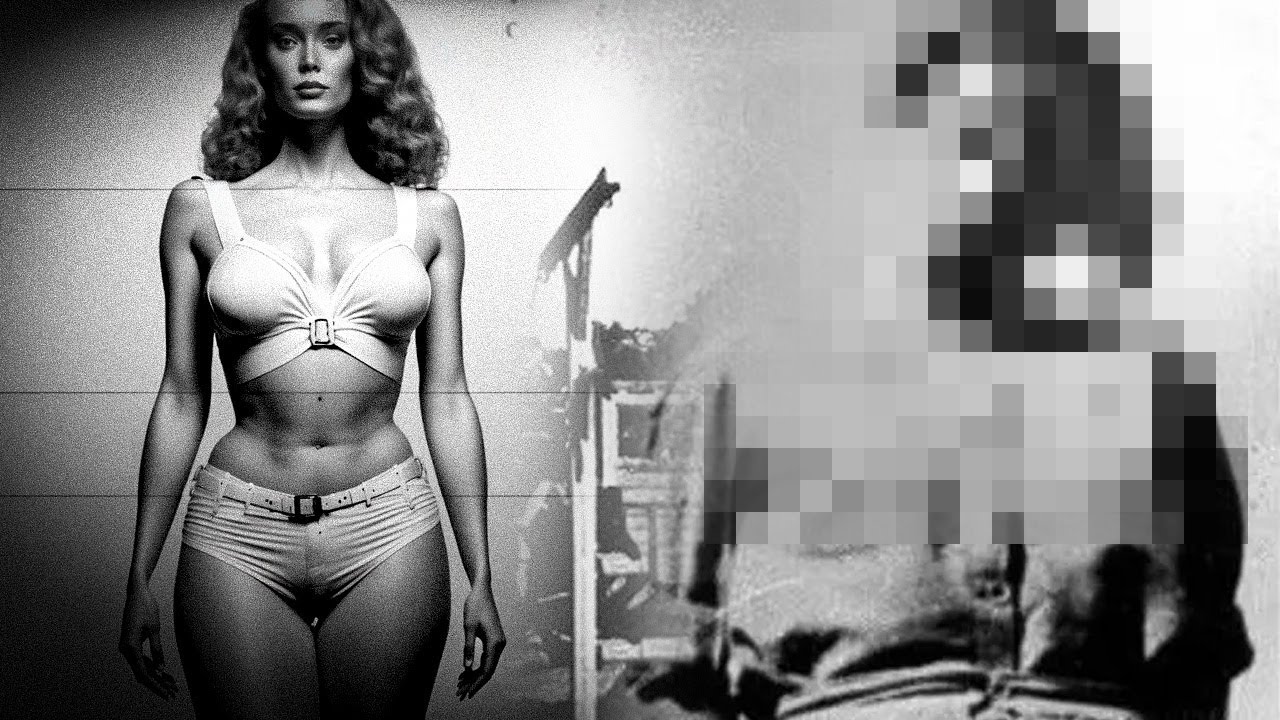
Her path from magazine covers to the gallows remains one of the war’s most chilling case studies in how ordinary vanity and ambition could curdle into mass murder. Orphaned at a young age, Barkmann was described by contemporaries as a pure soul with an angelic appearance that fit perfectly into the Nazi theory of the “true Aryan.” She dreamed of a modeling career, enrolled in Hamburg’s studio for the Performing Arts, and soon saw her photographs appear in fashion magazines and men’s publications alike.
Her Nordic profile and half-naked images were used to inspire German soldiers and officers, plastered across publications that reached troops from Africa to Stalingrad. By all appearances, her golden dream had become reality. But it was not enough.
In 1942, facing a shortage of personnel, Nazi authorities announced recruitment of civilians for positions as wardens and guards in the concentration camp system. High salaries, benefits, and prospects for advancement up to camp commander were dangled before potential candidates. In 1944, Barkmann answered the call and was assigned to Stutthof, near the town of the same name, about a dozen kilometers from Danzig.
The camp, nicknamed “Baliostrog” or “The Forest of the Gods” by a Lithuanian writer, was anything but divine for its prisoners. The only gods there were the guards and warders. The prisoners were the uncomplaining crowd.
From her first days as a warden, Barkmann distinguished herself as one of the cruelest and most inventive.
Inmates soon dubbed her the “Charming Ghost” and “Mad Jenny.” It was simply impossible, survivors said, to expect such atrocities from a delicate, angelic-looking girl. The former fashion model was particularly affectionate toward Jewish and Polish women, for reasons that have never been clarified.

She severely punished her subordinates for the slightest misdeed. Her favorite method was beating prisoners with a thin leather belt. According to witnesses, she beat several dozen women to death with this weapon alone.
Her second favorite pastime was separating mothers from children. She experienced abnormal pleasure in taking a child from its mother and sending the baby to the gas chamber before the mother’s eyes.
She perfected standard forms of torture by making her victims insane. She whipped the guilty on their feet and ankles, beat them with rubber sticks, and hounded them with dogs. She often invited local doctors to conduct human experiments on the unfortunates in the death camp.
According to accounts from former inmates, while a prisoner was being beaten to death, the angel’s face would change into the face of a demon. The mask of fury on Barkmann’s face at such moments frightened even her fellow servicemen.
Surviving accounts describe how Barkmann greeted newcomers. Many immediately fell into the trap of looking at the sweet, affectionate woman who smiled sincerely at the inmates. With the same sweet smile, she could give a child a poison candy and then enjoy the cries of the unhappy mother whom she herself would later brutally beat for showing disrespect.
Everyone was so terrified of Barkmann that they feared even a casual glance in her direction. At best, it meant a gas chamber. At worst, an agonizing death.
Stutthof was one of the last camps to be liberated on May 9, 1945. The camp administration managed to evacuate about 11,000 prisoners. Later, 3,000 people, mostly of Jewish nationality, were shot.
Many guards and warders decided to secretly flee to avoid falling into the hands of the advancing Red Army.

Barkmann fled with them, realizing she would certainly not survive if discovered. Unlike her colleagues, she was too presumptuous. For four months she hid in Poland.
Not only did she not immediately try to leave Germany’s borders, she did not even go there. It is difficult to understand what the criminal was hoping for after everything she had done.
She appeared boldly in Gdańsk, where she was about to take a train to leave Poland. But the confiscated archives at Stutthof, with files on all the camp personnel and testimonies from surviving prisoners, left her no chance of escaping punishment. Reference lists describing “Mad Jenny” were sent to all liberated cities of Europe.
In Poland, and especially in Gdańsk, one of the most horrible guards of World War II could be recognized by anybody.
Identified by military patrol at the railway station, Barkmann was arrested and imprisoned. During the investigation, she even tried to charm one of the guards, Polish Army Corporal Józef Łoś, using her looks. She secretly began to tell the corporal how she had actually saved Jews in the camp and how many people owed their lives to her.
But to obtain evidence of her supposed feat, she claimed, Jenny must go free.
Perhaps if the guard had been someone other than a Jew who had lost his wife and daughter at Stutthof, Barkmann might have had a chance. But when the corporal became acquainted with the materials of the indictment, he simply stopped going near the cell door. The only slim chance of salvation for the former photo model disappeared.
During the investigation, Barkmann was outspokenly delusional. At first she claimed she had been forced to become a guard because the Gestapo threatened to repress her family. When this was not convincing, she presented a new version: that she was an anti-fascist who had volunteered to work in the camp in order to alleviate the suffering of the unfortunate inmates.
The evidence played against her.
In the end, coming to terms with her fate, Barkmann calmed down, realizing her fate was clear. The Polish people would not forgive her for what she had done in the concentration camp. At trial, she behaved quite arrogantly, meeting old charges with a sneer and sometimes even with bravado, talking about her own methods of torture and extermination of prisoners.

The sentence was fully expected: death by hanging. The court file documented a phrase Barkmann said after the verdict was handed down. “Life really is a great pleasure,” she said, “and this pleasure usually doesn’t last long.”
The execution of Barkmann and several other Nazi criminals took place on July 4, 1946, at Biskupia Górka. The condemned were driven up by truck, nooses put around their necks, and the truck driven off. When it was Barkmann’s turn, after the loops were put on, the truck stopped.
A woman immediately ran out of the crowd and pushed exactly Barkmann’s legs off the truck. All the convicts waited for the car to start.
About 200,000 people were present at the execution, a massive public reckoning with the crimes of the Nazi occupation.
Some historians later asserted that after the execution, Jenny Wanda’s body was burned and her ashes flushed down the toilet. In fact, this is nothing more than a beautiful rumor. The Polish authorities, despite all their hatred, were not going to bother with the former executioners.
The government decided that the bodies of all executed Nazi criminals were to serve one last time for a great purpose: training future doctors and nurses.
They were sent to the Department of Anatomy and Neurobiology of the Gdańsk Medical Academy. So Barkmann ended her life on the gallows, and her beautiful body served as an exhibit for future medical luminaries for months to come.
Her story remains a stark reminder of how the banality of evil can wear a beautiful face. A girl who once dreamed only of shining on the podium became one of the most feared figures in the Nazi death camp system, and her name is now etched in infamy alongside the worst criminals of the twentieth century.