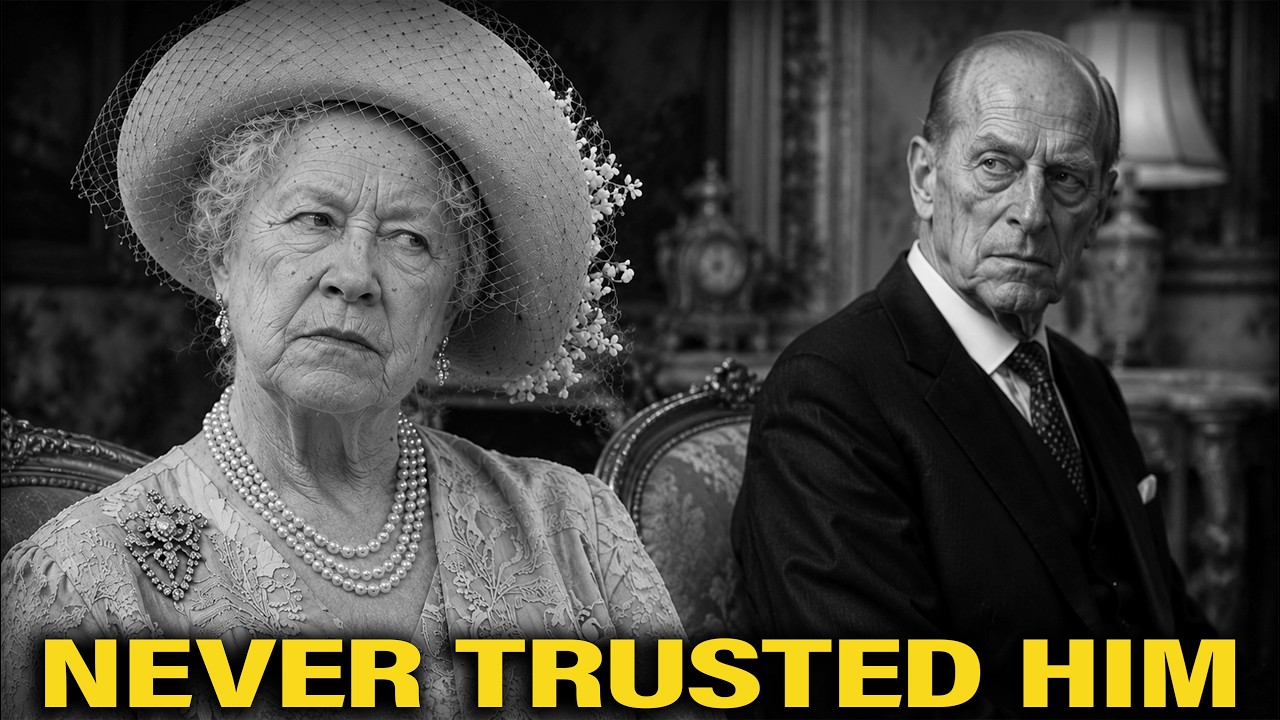
For more than half a century, the Queen Mother and Prince Philip shared a family, a dynasty, and a public life. Behind the lavender, the courtesy, and the photographs, they conducted one of the longest and most carefully managed cold wars the House of Windsor ever produced.
The Queen Mother smiled at almost everyone. The smile was the whole point of her — warmth that seemed to cost nothing, the gin and the horses and the easy laugh, the public face of a woman who understood early that being adored is a kind of power. That power holds best when it looks like an accident of temperament rather than the product of work.
There was one person in her own family the smile never quite reached. He had married her elder daughter in the autumn of 1947, taken his place one step behind a throne he would never sit on, and stood there for the next 54 years. His name was Philip.
He was sharp where she was soft, restless where she was settled. He was an exiled prince with no money, no country, and a family history the British establishment found embarrassing. He had walked into the oldest institution in the country and discovered that its most beloved woman had already decided he did not belong.
The word "despise" is too strong and not quite right. The Queen Mother did not hate Philip the way people consumed by hatred hate. She was not capable of being consumed by anything. That was the first and most important thing about her, and it made her formidable.
She did not lose her temper with him. She did not denounce him at her own dinner table or refuse to be in rooms with him. What she did was more durable and harder to name. She assessed him early, found him the wrong kind of man for the thing he had married into, and spent five decades managing the consequences.
To understand her judgment, you have to understand what each of them was. They were two complete and opposite theories of how power should work, placed inside the same family and pointed at the same target.
She believed in the surface. A monarchy survives by managing what people see, by maintaining warmth and continuity and the appearance of effortless grace over whatever complicated reality lies underneath. She had spent her whole life perfecting that surface until the maintenance became indistinguishable from her personality.
He believed in the engine. An institution survives by working properly, by being efficient and modern and honest about its own failings, by cutting waste and reforming rot and dragging the apparatus into the century it currently found itself in.
She thought his approach was vulgar and dangerous. He thought hers was sentimental and lazy. They were both, in their way, correct about each other. That was the part that made the feud so impossible to end.
She had been born Elizabeth Angela Marguerite Bowes-Lyon in the summer of 1900, the daughter of a Scottish earl, raised at Glamis Castle in the world of the old landed aristocracy. That world taught its daughters that class is performed rather than simply possessed.
She married Prince Albert, the shy second son with the terrible stammer, in 1923. She watched him nearly broken by the institution before she helped him survive it. Then in 1936, her brother-in-law Edward abandoned the throne for an American divorcee, and her stammering husband was forced to become King George VI.
By the time Philip arrived in her family's orbit, she had been at the very center of the British monarchy for more than a decade. She had run a wartime court, visited the bombed streets of the East End in her best clothes, refused to leave London during the Blitz, and built herself into a national symbol of fortitude and grace.
She was not a young woman learning the rules. She was the most accomplished practitioner of the monarchy's particular kind of power that the institution had produced in a generation. She knew exactly what she was looking at when she looked at the penniless Greek prince her daughter had decided to marry.
He had been born Prince Philip of Greece and Denmark in the summer of 1921 on a kitchen table on Corfu, in a house with no electricity and no hot water. Within a year and a half, his family was driven out of Greece.
His uncle, the king, had been forced to abdicate after a military disaster. His father, Prince Andrew, was arrested and put on trial, coming close enough to execution that a British warship had to intervene to get the family out. The story that the infant Philip was carried away in a cot improvised from a fruit crate sounds invented and is true.
He grew up with no fixed home and no real money, shuttled between relatives across Europe — a prince in title and a refugee in practice. His mother, Princess Alice, was deaf and suffered a mental health crisis when he was a boy, placed in a sanatorium for years during which she effectively vanished from his life.
His father drifted away to the south of France and a life of casinos and decline, dying there in 1944 and leaving his son almost nothing but a signet ring, some brushes, and a few personal effects. His four older sisters all married German princes, several with connections to the Nazi regime.
He was raised in the gaps left by his scattered parents, by his mother's English relatives — the family that had Anglicized its German name of Battenberg into the smoother Mountbatten during the First World War. His uncle, Louis Mountbatten, known to the family as Dickie, became the closest thing he had to a guiding father.
That fact alone would shape Philip's standing with the Queen Mother before she had exchanged more than a few sentences with him. The German sisters were not a minor awkwardness that good manners could paper over. They were a genuine and active liability.
One of his brothers-in-law held rank in the German military. Several of the family moved in the orbit of the regime in the way that German aristocrats of that period and class did. When his sister Cecil died in an air crash in 1937, along with her husband and two of her children, the 16-year-old Philip walked in the funeral procession through the streets of Darmstadt.
The photographs of that procession show the mourners flanked by the uniforms and banners of the new German state. The boy in the dark coat walking among them would, ten years later, marry the future queen of the country those banners would soon be at war with.
None of this was Philip's doing. He fought for Britain and served with distinction in the Royal Navy through the entire war against the regime his sisters' world had embraced. His own conduct was beyond reproach.
But conduct was not the only thing the Queen Mother's establishment weighed when it assessed a man. It weighed connection, association, the look of a thing, the way a marriage would appear. On every one of those measures, Philip's family was a problem no amount of personal gallantry could fully solve.
Into the vacuum left by his absent parents had stepped the Mountbattens, who gave the homeless prince an education, a direction, and above all a patron in his uncle. Philip had been raised, in effect, as a project of the Mountbatten interest, shaped and positioned for a future his uncle had begun imagining long before Philip was old enough to imagine anything.
He was sent to school in Germany for a time, to an institution run by the educator Kurt Hahn. When the rise of the regime made Germany untenable for a school of Hahn's character, Philip followed him to Scotland, to the austere and demanding Gordonstoun.
He emerged tough, capable, self-contained, and entirely self-made. The self-made quality, admirable in almost any other context, was faintly suspect in the context of the British monarchy. The monarchy valued men born into the right place and shaped by the right institutions, who carried the settled confidence of people who had never had to construct anything. Philip had constructed everything. He wore the construction lightly, but the Queen Mother's eye could see the seams.
A great deal of her wariness toward the young man was, at the start, wariness toward the man standing behind him. Louis Mountbatten was, to the old guard of the British aristocracy and to Elizabeth in particular, a deeply suspect figure — clever, restless, openly ambitious, with a way of arranging things to his own advantage.
The match between Philip and Princess Elizabeth was, by every credible account, something Mountbatten worked to bring about with great care. The Queen Mother saw exactly what he was doing. She had spent her life around men who arranged things, and she recognized arrangement when she saw it.
If Philip had arrived as simply a charming young naval officer, with no patron and no agenda, she might have assessed him on his own terms. He arrived as the chosen instrument of a man she did not trust. The distrust attached itself to him and never entirely came off.
The courtship began with a moment invisible to almost everyone at the time. In the summer of 1939, the royal family visited the Royal Naval College at Dartmouth, and a cadet named Philip was assigned to entertain the two young princesses.
The elder of them, Elizabeth, was 13. She watched the 18-year-old prince leap over a tennis net, eat several plates of shrimp, and behave with the loud physical confidence of a boy entirely at ease in the world. She was, by the accounts of those around her, captivated in a way that did not fade.
The romance developed slowly through the war, through letters and Philip's occasional visits to Windsor when his naval service permitted. By the time it became something the family had to take seriously, Elizabeth had made up her mind with a completeness that surprised the people who had assumed she would be guided by them.
She wanted Philip. She had wanted him for years. She was not going to be talked out of it. The firmness of her own daughter was the first thing the Queen Mother had to work around, because it meant the usual tool — patient discouragement — was not available.
If the marriage could not be prevented, then it would have to be managed, and the man at the center of it brought into the institution on terms that contained the parts of him she found dangerous.
The resistance to Philip before the engagement was real and came from several directions. The King himself was reluctant, partly from genuine caution and partly from the simple reluctance of a father to lose the daughter who was his great comfort. A tour of South Africa in 1947 functioned, among other purposes, as a test of whether the attachment would survive a long separation. It survived.
The courtiers were against the match almost to a man, and the courtiers were the Queen Mother's people — the old guard of the palace whose entire view of the world she shared and embodied. Their objections were specific, snobbish, and, by the standards of the time, not entirely unreasonable from the institution's point of view.
Philip was foreign — Greek and Danish by title, German by much of his upbringing and family connection. In 1947, two years after the end of a war against Germany, foreignness of that particular flavor was a genuine political liability. He was penniless, which mattered in a world where a suitable match was supposed to bring something to the table.
His manners were considered rough. His directness was considered alarming. His habit of saying exactly what he thought in rooms where nobody said exactly what they thought was considered a sign of someone who did not understand how things were done.
There is a word that attaches itself to accounts of the Queen Mother's view of Philip in this period: "Hun." It was the dismissive wartime term for the Germans, carrying all the contempt and suspicion six years of war had built up. In the circles around the Queen Mother, it was reportedly applied to Philip as a way of marking him as not one of us.
Whether she herself ever spoke the word is contested by the people who studied her most closely, and she was far too careful to have left a record if she did. But the contest over the single word misses the larger truth: the attitude it expressed was unmistakably the attitude of her world, and her world took its cues from her.
The courtiers who looked down on Philip's foreignness were her courtiers. The atmosphere of suspicion that surrounded him before the engagement was the atmosphere of her court. She did not need to use the word for the attitude to be hers.
The objections were those of a closed world protecting its borders. He was too blunt, too poor, too modern, too impatient with ceremony, too obviously inclined to ask why a thing was done a certain way rather than simply accepting that it had always been done that way. And he was too closely tied to his uncle, whose ambitions the establishment watched with weariness.
Every one of these objections was, from the establishment's point of view, a reason for caution, and the caution expressed itself as delay. The engagement, when it was finally permitted to be announced, came only after years of patient discouragement. It failed only because Elizabeth refused to be discouraged.
That produced one of the small, telling cruelties of the wedding itself — a cruelty Philip felt and never forgot. When he married Princess Elizabeth at Westminster Abbey in November 1947, his three surviving sisters were not invited.
The reasoning was sound in the cold institutional sense. It was too soon after the war. The German connections were too raw. The optics of German princesses at the heart of a British royal wedding were a risk the palace would not take.
So the sisters stayed away, and Philip stood at the altar of the most important day of his life as a man whose own family had been judged unsuitable to attend it, while his bride was surrounded by the vast and confident apparatus of the most secure royal family in the world.
His mother was there — the deaf princess who had sheltered Jews in Athens during the occupation and would later be honored for it, dressed in the simple gray habit of the religious order she had founded. Her presence was permitted because she was beyond reproach. The sisters were not.
Philip absorbed this in silence. He was good at absorbing things in silence, and he would get a great deal of practice over the following decades, much of it in response to decisions whose logic could be traced back to the woman who never raised her voice.
The marriage required Philip to give up almost everything he had been. He renounced his Greek and Danish royal titles. He gave up the Greek Orthodox faith of his childhood and was received into the Church of England. He became a naturalized British subject and took the surname Mountbatten.
He had been a prince of two countries. He became on paper a commoner, then was made a duke on the morning of his wedding — the Duke of Edinburgh, a British title to replace the foreign ones he had surrendered.
The man who walked out of Westminster Abbey that November was, in a sense, a newly manufactured person, stripped of his origins and reassembled to the institution's specifications. The reassembly had been necessary precisely because the institution and the woman at its emotional center had judged the original version unsuitable.
He understood that the unsuitability had been the point. He had been required to become acceptable, and the requirement carried within it the permanent implication that he had started out unacceptable. That implication is a difficult thing for a proud man to live alongside for the rest of his life. He lived alongside it for 54 years.
The wedding itself, on the 20th of November 1947, was a national event of the first order. The country was exhausted and gray, two years out of a war that had hollowed it out, still under rationing, still counting its dead. The marriage of the young heir to her handsome naval prince was exactly the brightness the moment needed.
The crowds were enormous. The bride wore a gown for which she had saved ration coupons like any other young woman of the period. The groom, made Duke of Edinburgh that very morning, stood beside her at the altar as the cameras and newsreels carried the spectacle to a country desperate for something to celebrate.
None of the public joy touched the quiet calculations behind it — the years of discouragement, the testing, the snobbery, the excluded sisters, the weariness of the woman who smiled through the whole occasion as the perfect mother of the bride.
The public saw the radiance. The public always saw the radiance. That was the entire point of the surface, and the Queen Mother was its supreme keeper. On the day her elder daughter married the man she had never wanted for her, she gave the country a portrait of maternal happiness so convincing that nobody would have suspected there was anything to keep beneath it.
The first few years of the marriage were, by a margin that would never be repeated, the happiest and most ordinary of Philip's royal life. Elizabeth was not yet queen. Her father was alive. The young couple occupied the position of an heir and her husband, which carried obligations but not the full weight of the throne.
Philip continued his naval career, which he loved and at which he was genuinely good. For a period in the late 1940s and early 1950s, he was posted to Malta, and Elizabeth came out to join him. They lived something approaching the life of an ordinary naval officer and his wife.
She drove herself. She went to the hairdresser like other women. He commanded his own ship. They were, for a brief window, a couple rather than an institution. People who knew them in this period describe Elizabeth as never happier than she was in Malta, free of the palace and the protocol and the great gravitational pull of her destiny.
That window was the thing Philip would spend the rest of his life on some level mourning, because everything that came after slowly absorbed the version of his wife he had married in Malta into the machine. And Philip held a particular set of people responsible for the machine. At the head of that set stood his mother-in-law.
The children came in those early years before the throne arrived to consume everything. Charles was born in 1948 at Buckingham Palace while Philip played squash to burn off the tension of the wait. Anne followed in 1950.
For a brief period the young family had the shape of an ordinary family — a father with a career he loved, a mother not yet weighed down by a crown, two small children, a home of their own. Philip threw himself into fatherhood in the way the men of his time and formation understood it: present in bursts, absent in stretches, away with the navy for long periods and then home to a household he wanted to run on his own terms.
It was in these years that the first faint outlines of the long contest with the Queen Mother began to appear. Philip had firm ideas about how his children should be raised — the ideas of a man whose own hard childhood had given him strong convictions about discipline and resilience and the dangers of softness.
The Queen Mother had the opposite ideas — the ideas of a woman who believed in warmth and gentleness and the cultivation of charm. The children were small enough that the difference did not yet matter. It would matter enormously later, when the question of Charles's schooling forced the two philosophies into open collision.
What turned an ordinary in-law friction into something with the potential to become a 50-year war was the thing about to happen that nobody in that household could prevent. Elizabeth was going to become queen.
The hinge of the entire story came on the 6th of February 1952. King George VI, whose health had been worn down by the strains of the war and the years that followed, died in his sleep at Sandringham at the age of 56.
The news had to travel halfway around the world to reach his daughter, who was in Kenya at the start of a Commonwealth tour, staying at a lodge built into a fig tree. Elizabeth had gone up the tree a princess and come down a queen.
The death of the king did three things at once, and all three set the Queen Mother and Prince Philip on a collision course the previous five years had only hinted at.
First, it left the Queen Mother shattered in a way that was entirely genuine. She had loved her husband. The marriage had been real. His death at 56, which she attributed in significant part to the burden the abdication had dumped on him, left her at 51 with the central relationship of her life suddenly gone and her purpose suddenly unclear.
She was no longer the queen. She was the queen's mother, the dowager, a figure whose role had to be reinvented because it no longer came with the position that had defined it. For a period after the king's death, she withdrew, genuinely grief-stricken, and there was real uncertainty about what she would become.
Second, the death handed Philip a defeat so immediate and so personal that it set the tone for everything that followed. It had to do with where the family would live, which sounds trivial and was anything but.
Before the accession, Philip and Elizabeth had lived at Clarence House, which Philip had taken a close personal interest in renovating and modernizing, treating it as the one domestic space that was genuinely his. After the accession, the new queen had to move to Buckingham Palace, and Philip did not want to go.
He argued that the family could continue to live at Clarence House and that he could commute to the palace for the business of state. He lost. The old guard insisted that the sovereign must live at the palace, that the symbolism required it, that the thing had always been done a certain way.
The new queen, young and uncertain and surrounded by people who had been managing the monarchy since before she was born, deferred to tradition rather than to her husband. And here is the detail that turned a logistical dispute into a small permanent wound: Clarence House, the home Philip had built for himself, was given to the Queen Mother. She moved in.
He had been pushed out of his own home and into the great machine, and his mother-in-law had taken the home he was pushed out of. He was a man who noticed everything and had a long memory. The symbolism was not lost on him for a moment.
Third, and most important, the death created a young, uncertain, 25-year-old queen who needed guidance, and placed two people in a position to give it. Those two people held diametrically opposed views about almost everything and were now in direct and permanent competition for influence over the single most powerful person in the country.
The Queen Mother had been inside the institution for 30 years. She understood it. She embodied it. And she had a daughter who trusted her judgment with the trust of a child for a parent who has never let them down.
Philip was the husband, the man Elizabeth loved, the father of her children. He had his own claim on her instincts and his own urgent ideas about what the monarchy needed to become. Both of them wanted to shape her. Both believed with complete sincerity that they knew what was best.
They could not both win. The contest between them, conducted entirely through their separate relationships with the same young woman, would run for the next 50 years.
The Queen Mother's grief in those first months was real, and it was also the foundation of her new authority. She reinvented herself over the following year as the keeper of her husband's memory and the guardian of the world he had represented.
That reinvention gave her a moral position over her daughter that no one else in the family could touch. She was the widow of the beloved king, the living link to the father the young queen had adored and lost. When she spoke to Elizabeth about how things should be done, she spoke with the authority of the man who was gone.
The implication was always present: this was how your father would have wanted it. The traditions she defended were the traditions he had upheld. To side with her was to honor his memory; to side against her was, in some unspoken way, to betray it.
It was an extraordinarily powerful position, built out of genuine grief. And the genuineness of the grief did not make the power any less real or any less useful.
Against this, Philip had almost nothing to set. He was the husband, and the husband's claim is strong, but the husband could not invoke the dead king. He could not wrap his preferences in the authority of the father the queen had lost. He could not make every disagreement a question of loyalty to a beloved memory.
The Queen Mother could and did, and the doing of it was so seamlessly woven into her grief and her warmth that it never looked like strategy at all. It looked like a mother and a daughter mourning together, holding to the things the father had loved.
That it was also a positioning — a securing of influence over the new sovereign at the precise moment when influence over her mattered most — was the kind of truth that lived permanently beneath the surface of everything the Queen Mother did. Visible to Philip, who understood exactly what was happening, and invisible to almost everyone else.
The first great battle was about a name. It sounds small. It was not small.
When Elizabeth became queen, a question arose that the constitutional machinery of the monarchy had not had to confront in living memory: what would the royal house now be called? The established practice was straightforward. When a woman inherits a throne and has children, those children take the surname of their father, and the royal house is named accordingly.
Elizabeth's father had been a Windsor, and the house had been the House of Windsor since 1917, when George V changed the family's German name in the middle of the First World War. But Elizabeth had married, and her husband's name, the name he had taken on becoming British, was Mountbatten.
By the ordinary logic of these things, her children would be Mountbattens, and the House of Windsor would give way to the House of Mountbatten. The throne, after a single generation, would pass to a new dynastic name — the name of the family that had spent a generation engineering its way upward from the discarded German Battenberg.
Louis Mountbatten understood this perfectly, and being Louis Mountbatten, he could not keep his understanding to himself. At a dinner at his estate in the weeks after the accession, he was reported to have remarked, with the satisfaction of a man watching a long campaign come to fruition, that the House of Mountbatten now reigned in England.
The remark did what indiscreet remarks always do: it traveled to exactly the people it should not have reached. It reached the old Queen Mary, the widow of George V, who regarded the dynasty as the great project of her life. She was horrified.
The thought of her late husband's house, the House of Windsor that he had created to make the monarchy safe in a hostile century, being swept aside in favor of the Mountbatten name within months of her granddaughter-in-law's accession was, to her, a kind of dynastic catastrophe.
The remark reached, through the same channels, the Queen Mother, who shared Queen Mary's horror completely and had her own additional reasons to want the Mountbatten ambition checked — reasons that ran back through her distrust of Louis Mountbatten to her weariness of the nephew he had installed in her family.
The two dowagers were aligned, and they were joined by a third and decisive figure: the Prime Minister, Winston Churchill, who had his own reasons of state to prefer the continuity of the Windsor name, and who carried the constitutional authority to do something about it.
The opposition assembled itself with the speed and quiet coordination of an establishment recognizing a threat to itself. And the machinery moved.
In April of 1952, within two months of her accession, the young Queen issued a proclamation declaring that her house and her descendants would continue to be known as the House and Family of Windsor. The Mountbatten name would not pass to the throne.
Philip's name — the name he had given up his own princely titles to take, the one thing of his own that he might have contributed to the line of succession — would not name his children or his dynasty. The thing was decided, and it was decided against him, and it was decided fast.
Philip's reaction was one of the few moments in his long royal life when the controlled surface cracked far enough for the feeling underneath to become visible. The feeling was rage and humiliation in roughly equal measure.
The line he was reported to have used has survived because it captured the wound so exactly. He said that he was the only man in the country not permitted to give his own name to his own children. In a darker register, he was reported to have described himself as nothing but a bloody amoeba — a creature with no function except to provide what the institution required and to be denied everything else.
The bitterness was not irrational. Consider what the proclamation said about his place. He had given up his nationality, his titles, his religion, and his naval independence to marry into this family. He had been required to make himself acceptable by becoming someone new. And now, when the moment came to contribute the one thing a husband and father ordinarily contributes, the institution had reached down and taken even that.
The question that matters is what role the Queen Mother played in producing that outcome. The answer is the answer that always applies to her: her role was real, and her role was almost entirely invisible.
There is no document in which she instructs the Prime Minister to overturn the Mountbatten name. There is no recorded conversation in which she directs the proclamation. There never was a paper trail for the things that needed to remain deniable. The absence of the paper trail was not a sign she was uninvolved. It was the proof of her method.
What there is instead is the consistent pattern. She wanted the Windsor name preserved, both because she shared Queen Mary's dynastic conviction and because preserving it dealt a defeat to the Mountbatten interest she distrusted. She communicated that preference through the channels she used for everything that mattered — above all her own daughter, in whose ear the warm and reasonable voice of a trusted mother carried more weight than any other voice in the country.
Churchill provided the constitutional muscle and the public face of the decision, which was useful precisely because it allowed the Queen Mother's hand to remain hidden behind the Prime Minister's. Mountbatten, watching his great dynastic prize taken away, blamed Churchill. He was right that Churchill had opposed him, and he underestimated how much of the outcome had been shaped before Churchill ever became formally involved.
The man whose ambition had been defeated never fully understood who had defeated him. He thought he had lost to the Prime Minister. He had lost in significant part to a woman who had never said a single word he could point to.
The name war did not end in 1952. The second act shows both the persistence of Philip's grievance and the limits of even the Queen Mother's ability to hold a line forever.
The defeat rankled in Philip for years, and in his uncle for longer. They kept the question alive, kept pressing, kept looking for an opening. The opening came toward the end of the decade, before the Queen gave birth to her third child.
By then the situation had changed. Churchill was gone from office. The old guard had thinned. The Queen herself, no longer the uncertain 25-year-old of 1952 but a confident monarch in the middle of her reign, was more willing to weigh her husband's wishes against her mother's.
The result, in 1960, was a compromise — a partial and quiet reversal of the total defeat of eight years earlier. A new declaration established that while the royal house would remain the House of Windsor, the personal surname of the Queen's descendants, for those who needed a surname and were not styled as royal highnesses, would be Mountbatten-Windsor.
Philip's name was admitted to the line at last, joined to the Windsor name in a hyphenated arrangement that gave him, finally, something of what he had lost. It was a small victory, a late one, and an incomplete one, but it mattered to Philip out of all proportion to its practical significance, because it touched the wound the original defeat had opened.
He had spent eight years as the man not permitted to give his name to his children. The compromise of 1960 meant his name would, after all, survive in the family he had married into. The timing, just before the birth of Prince Andrew, the first child born after the question was settled, gave it a particular resonance.
The Queen Mother did not fight the 1960 compromise with the intensity she had brought to 1952. The principle she cared about most — that the house remain Windsor — was preserved, and the concession on the surname was one she could live with. She was, whatever else she was, a realist who knew when a line could no longer be held.
But the eight-year gap between the total defeat and the partial reversal is itself a measure of how completely she had won the first round, and of how much patience and persistence Philip had needed to claw back even the fraction he eventually recovered. She had taken everything in 1952. He had spent the rest of the decade getting back a sliver.
The name war established the essential shape of how the two of them would deal with each other for the next half century. He pushed in the open and lost in the dark.
His wishes were always visible, always stated, always pressed with the directness that was his nature. The forces that defeated them were always invisible, always unstated, always operating through atmospheres and influences and the quiet shaping of the Queen's instincts that he could feel pressing against him and could never bring into the light.
He was a man fighting in daylight against an opponent who fought only at night. The asymmetry was maddening, and it was the source of so much of the famous Philip temper the public would later puzzle over. He was not difficult by nature so much as he had been made difficult by decades of this particular kind of losing — the kind where you can never see the hand that beats you and can never make anyone admit a fight is even taking place.
He knew the hand was hers. He had known it since 1952, and he could never, in 50 years, get her to put it on the table.
The second front of the long war was the palace itself — the apparatus of courtiers, private secretaries, and household officials who actually ran the day-to-day operation of the monarchy.
Philip arrived with the instincts of a naval officer and a reformer. He had run a ship. He understood efficiency, chain of command, the elimination of waste, the value of doing things in the most sensible way rather than the most traditional way.
What he found was an apparatus that struck him as absurdly antiquated, riddled with pointless tradition, staffed by men who had been doing things the same way for so long they had lost the ability to imagine doing them any other way, and resistant to any change with the deep and patient resistance of an organism protecting itself.

He wanted to modernize it. He had ideas about communications, about openness, about eliminating the small ridiculous customs that served no purpose except their own continuation. He pushed his ideas with characteristic force and ran straight into the old guard.
The old guard had a leader in the early years: Sir Alan Lascelles, known as Tommy, private secretary to the sovereign, a man of immense experience and immense conservatism who had served the monarchy since the reign of George V and regarded the institution as a sacred trust to be preserved exactly as he had received it.
Lascelles and Philip detested each other with the clean mutual contempt of two men who represent everything the other finds intolerable. To Lascelles, Philip was a brash, foreign, ill-mannered upstart who did not understand the institution he had married into and needed to be kept in his place.
To Philip, Lascelles was the perfect specimen of the suffocating old establishment, a man in gray whose entire function was to ensure that nothing ever changed and that the husband of the Queen was reminded at every turn of how little he was permitted to do.
The specific reforms Philip pushed for were not, in retrospect, the demands of a wild radical. He wanted the household accounts examined and the waste cut. He wanted the archaic structure of overlapping departments and inherited sinecures rationalized. He wanted the monarchy to communicate with the public it depended on — to let the cameras in, on the sound reasoning that an institution which hides itself completely will eventually be wondered about and then resented.
He took an interest in the running of the estates and modernized the farming at Sandringham and the management of Balmoral, dragging operations run for generations on the assumption that money grew on the grouse moors into something resembling efficiency.
Each of these was sensible. Each was also a disturbance of a settled order, and the settled order had its defenders, who regarded Philip's sense as an assault. The old guard did not argue with him on the merits, because that would have meant conceding there were merits. They slowed everything, referred it to committee, raised the obstacle of precedent, and waited with the patience of an organism that knows it will outlast any single irritation.
The point for this story is that the old guard was the Queen Mother's world. These were her people. Lascelles and the courtiers like him shared her values completely. They believed what she believed about the monarchy — that it survived through continuity and tradition and the careful preservation of the surface — and they resisted what she resisted.
She did not need to instruct them to obstruct Philip. They obstructed him as a matter of shared instinct because his project threatened the thing they all loved. And her presence behind them, the great patron and embodiment of the traditional way, gave their obstruction a weight and legitimacy it would not otherwise have had.
When Philip pushed against the old guard, he was pushing, in effect, against the Queen Mother, even though she was nowhere in the room and would have been genuinely surprised to be accused of involvement. The institution defended itself, and she was the institution's heart.
Philip won some of these battles eventually. Over the years he forced through a great many of his reforms, because he was relentless, because he was right about a fair amount of it, and because his wife did, in the end, trust him on the practical running of things. But the early years were a long, grinding war of attrition against an establishment the Queen Mother stood behind.
There was a financial dimension to the difference between them that was almost a comedy of incompatibility. Philip the reformer was, by the standards of his world, careful with money. He thought about cost. He resented waste. He believed the monarchy had an obligation to be seen to be reasonable in its spending, particularly in the austerity years after the war.
He took over the running of Sandringham and Balmoral and set about modernizing them, bringing commercial sense to operations that had been run for generations on the assumption that money was somebody else's problem.
The Queen Mother was the precise opposite in every particular. She spent without reference to what she had. She maintained an enormous household, kept racehorses, collected art, entertained on a scale her income could not support, and accumulated over the decades an overdraft at the royal family's bank that ran into the millions and was quietly absorbed by the institution's financial machinery.
To Philip, this was exactly the kind of unaccountable extravagance the monarchy could not afford — the spending of a woman who had confused her own pleasure with the requirements of the Crown, protected from the consequences of her habits by an institution too sentimental and too deferential to ever tell her no.
To the Queen Mother, Philip's concern with money was vulgar, the instinct of a man who did not understand that a monarchy was supposed to be magnificent and that magnificence had a cost. The penny-pinching of someone who had been poor and carried the anxieties of the poor into a position where they did not belong.
The careful reformer and the magnificent spender shared a family for 50 years, and each regarded the other's relationship to money as a small ongoing proof of the other's fundamental unsuitability for the institution they both served.
But the deepest battle between them, the one that cut closest to the bone because it involved a child they both loved, was the battle over how to raise the heir.
The boy was Charles, born in 1948. From his earliest years he was a sensitive, anxious, easily wounded child who needed warmth and reassurance and gentle handling. He had the misfortune to be born to a father who believed exactly the opposite was what a boy required.
Philip's own childhood had been hard. He had been shaped by upheaval and abandonment and the discipline of austere schools, and he had survived it, emerging tough and capable and self-reliant. He believed, with the complete sincerity of a man generalizing from his own experience, that hardship was what made a boy into a man, and that softness was a danger to be drilled out rather than a need to be met.
He looked at his sensitive son and saw a boy who needed toughening, and he set about toughening him with the best of intentions and the worst of results. He could be impatient with Charles, dismissive of his sensitivities, sharp in the way men of his generation and formation were often sharp with sons they found insufficiently tough.
The relationship between them was difficult from the start, and it caused Charles a kind of pain he carried into his adult life. Standing on the other side of Charles, offering him exactly the warmth his father withheld, was the Queen Mother.
She adored her grandson, and her adoration was the uncomplicated, unconditional, enveloping warmth she was so good at producing — the warmth that made a person feel completely seen and completely safe. To Charles, who got so little of that from his father, his grandmother became a refuge.
He was happy at Royal Lodge with her in a way he was rarely happy anywhere else. She represented for him the soft and gentle and aristocratic world of tradition and beauty and kindness. He loved her for it with a depth that lasted her entire life and his.
The bond between the Queen Mother and Charles was one of the great relationships of both their lives. It was also, among everything else it was, a quiet rebuke to Philip, because it represented everything he was not giving his son, offered freely by the woman he already had reason to resent.
The disagreement came to a head over the most consequential decision in a young aristocrat's life: his schooling. Philip had a clear and firm view. Charles should go to Cheam, the preparatory school Philip himself had attended, and then to Gordonstoun, the Scottish boarding school in the remote north that Philip had also attended and credited with making him the man he was.
Gordonstoun was a hard place, deliberately so. It was founded on the principle that boys are improved by physical hardship, cold discipline, the challenge of the outdoors, the stripping away of comfort and privilege. Philip had thrived there. He believed Charles would thrive there too, or that even if he did not, the hardship would be good for him.
The Queen Mother thought this was a terrible idea, and she said so — but not to Philip. She did not confront her son-in-law. She did not have a shouting match about the upbringing of the heir. What she did was make the case for the alternative, quietly and persuasively, to the person who could actually decide: the Queen.
The Queen Mother believed Charles should go to Eton, the great school just across the river from Windsor Castle, close to home, gentler than Gordonstoun, more suited to a sensitive and aristocratic boy. She wrote to her daughter making the case, arguing that proximity to Windsor mattered, that Charles's temperament suited Eton far better than the harsh isolation of Gordonstoun, that the boy should be educated in a way that fit who he actually was.
It was a real intervention made through her real channel — the warm maternal voice in the Queen's ear — and it was an intervention on behalf of the grandson she loved against the father whose plan she thought was cruel. She lost.
This time, the directness of Philip prevailed over the indirection of the Queen Mother, because the schooling of a son is one of the few areas where a father's authority was hard for even the Queen Mother to overcome. And because the Queen, caught between her mother and her husband, deferred to her husband on the upbringing of the boy who would be king.
Charles was sent to Gordonstoun, and Gordonstoun was, for Charles, exactly the misery the Queen Mother had feared. He was bullied. He was cold and homesick and unhappy. The hard regime that had suited his iron-built father was a torment to his sensitive nature. He endured years of it, he hated it, and the experience marked him.
The Queen Mother had been right about her grandson, and she had lost the argument anyway. The boy she loved had been sent away to suffer in a place she had warned against, on the insistence of the son-in-law she had never warmed to. It is difficult to imagine the outcome softened her view of Philip. It is easy to imagine it hardened it.
There was a daughter in this story too, and the way Philip related to her throws the quarrel over Charles into sharper relief. Anne, the second child, was everything Charles was not: sturdy, physically fearless, direct, unsentimental, a girl who rode hard and spoke plainly and met the world with exactly the kind of unflinching confidence Philip prized and understood.
He adored her. The relationship between Philip and Anne was the easy, uncomplicated bond of two people of the same temperament, and it stood in painful contrast to the strained, mutually baffled relationship between Philip and his sensitive elder son.
Philip was not a man incapable of loving a child. He was a man who could only be close to a child who was like him, and Anne was like him, and Charles was not. The difference was not Charles's fault, and not Philip's fault either, but the consequence of a mismatch of natures that no amount of effort on either side could resolve.
The Queen Mother, watching this, drew the conclusion she was always going to draw: that the problem lay with Philip rather than with the mismatch. That a better father would have found a way to reach the son who needed reaching, rather than lavishing his ease on the daughter who needed nothing. That Philip's difficulty with Charles was of a piece with everything else she had concluded about him — a failure of warmth, a failure of the gentler intelligence she possessed in abundance and that he, in her assessment, lacked.
She filled the gap herself. Where Philip was hard, the Queen Mother was soft. Where Philip was impatient, she was endlessly indulgent. Where Philip demanded the boy become something tougher than he was, she accepted the boy exactly as he was and told him, in a thousand small ways across his entire childhood, that exactly as he was was enough.
To a sensitive boy starved of approval at home, this was the difference between drowning and air. Charles attached himself to his grandmother with the gratitude of a child who has found the one adult who does not want to change him.
He spent as much time at her side as he could. He absorbed her tastes, her love of beauty and tradition, the gentle aristocratic pleasures, her way of moving through the world with grace rather than force. He became, in many respects, her creation, formed in her image, carrying her values into the next generation. The more he became hers, the less he became his father's.
Philip could see it happening and could do nothing to stop it. The boy was being claimed, gently and lovingly and irreversibly, by the woman across the family divide. Every year that passed bound Charles closer to his grandmother and left him further from his father. There was a quiet satisfaction in this for the Queen Mother that she would never have acknowledged and that was nonetheless real. She had lost the argument over Eton. She had won the boy.
Charles grew up loving a grandmother who represented one half of a divided family and fearing a father who represented the other. The division ran straight through him, and he carried it into his adult life as a man permanently uncertain of himself, permanently in search of the approval his father had withheld, permanently drawn to the warm and traditional world his grandmother had taught him to love.
The two people who shaped him most were pulling in opposite directions, and the boy was the rope. The strain left marks that never entirely faded. The Queen Mother loved him completely and genuinely, and her love was the great comfort of his childhood. It was also, viewed from a slightly colder distance, a move in a long game — the claiming of the heir for her side of a war the heir was too young to know was being fought. Both things were true at once.
Here, though, the honest account has to complicate the simple story, because the simple story is too small for what was actually happening between these two people. The Queen Mother and Prince Philip were not two cartoon antagonists locked in mutual loathing. They were two people of genuine conviction who held opposite convictions about the institution they both loved and the woman they both wanted to protect.
The Queen Mother believed the monarchy was a thing of surface and continuity and managed warmth — that its power lay in what it appeared to be, and that its survival depended on the careful preservation of appearances. Philip believed the monarchy was a thing that had to actually work, that survived by being reformed and modernized and made fit for purpose, that would die if it became merely a beautiful surface with nothing functioning underneath.
These were not petty positions. They were serious and defensible philosophies of how an ancient institution survives in a changing world. And the remarkable thing about the long reign that followed is that the monarchy ended up needing both of them — the Queen Mother's preservation of the magic and Philip's modernization of the machine.
Her wariness of Philip was not malice. It was the sincere reaction of a woman who looked at her son-in-law and saw a genuine threat to the things she believed the monarchy needed. She was not wrong that he was a threat to the careful surface she had spent her life maintaining. He was. He spent his career disturbing surfaces.
Her management of him — the containment, the quiet checking of his ambitions, the cultivation of her daughter's instinct toward the traditional course — was not the cruelty of a woman who enjoyed his suffering, but the considered work of a woman protecting the things she loved from what she sincerely believed was a danger to them.
She was wrong about some of it. She was wrong about Gordonstoun, and she was right and lost anyway. She was probably wrong in the long run about how much modernization the monarchy needed, because the institution did need a great deal of what Philip dragged it toward. But wrong or right, her opposition came from conviction, and conviction is harder and more durable than malice, because malice can be confronted and conviction cannot.
Philip's view of her was the mirror image — conviction rather than malice. He did not hate his mother-in-law in any simple way. He could be perfectly correct toward her, and there were moments of genuine warmth across the decades: family moments, shared griefs, the long familiarity of people who have been in each other's lives for half a century.
But underneath the correctness ran a steady, settled exasperation. The exasperation of a practical man toward a woman he regarded as sentimental, extravagant, evasive, surrounded by flatterers, addicted to the avoidance of difficult decisions, and protected by an institution too soft to ever require anything of her.
He found her infuriating in the specific way that a person who confronts problems finds a person who manages around them infuriating. She would never say no to him directly. She would never have the argument. She would smile and agree in the room, and then the thing he wanted would somehow fail to happen, blocked by an atmosphere he could feel and could not trace.
He knew, he always knew, that the atmosphere came from her, and he could never prove it. The impossibility of proving it was a low and constant aggravation that ran beneath 50 years of family Christmases and official lunches and photographed gatherings at which the two of them stood near each other and smiled.
That was the texture of it. Not the operatic hatred the title suggests, but something quieter and more corrosive and far more durable. Two people who shared a family and a love and an institution and almost nothing else, who disagreed at the deepest level about what the monarchy was and how the woman they both loved should be guided.
They never had it out. There was never a scene, never a moment of open rupture that a newspaper could report or a biographer could point to as the turning point. Both of them understood, with the deep professional understanding of people who had given their lives to the monarchy, that the surface had to be maintained.
So they maintained it. The Queen Mother maintained it because maintaining surfaces was the entire art of her life. Philip maintained it because he understood duty even when he resented the specific thing duty required, and because the woman he loved would have been hurt by an open breach with her mother. Philip, for all his prickliness, was not a man who would deliberately hurt his wife.
And there is the heart of why neither of them could ever win. The prize they were both fighting for — influence over Elizabeth — was also the person they both loved. Loving her meant neither could press the conflict to the point of forcing her to choose, because forcing her to choose between her mother and her husband would have been a cruelty toward the one person both of them were trying to serve.
So the war stayed cold. It stayed beneath the surface. It expressed itself in a thousand small contests over names and houses and schools and the running of the household and the guiding of the Queen's instincts. It never once broke into the open, because the open was forbidden by the love both of them felt for the woman in the middle.
Elizabeth spent her life as the contested ground between the two people closest to her. She managed it by keeping a careful distance from both of them on the questions where they disagreed, by deferring to her mother on some things and her husband on others, by never quite letting either of them win completely.
She had been raised from earliest childhood in the discipline of self-suppression the monarchy demands of its sovereigns — taught to subordinate her own feelings to her duty, to keep her counsel, to give nothing away, to be a surface on which the country could project whatever it needed to see.
The training that made her such a successful queen made her, in the matter of her mother and her husband, almost helpless, because the only tool it had given her was containment. Containment was exactly the wrong tool for a conflict that could only have been resolved by someone willing to force a confrontation. She was not willing. She was incapable of it.

So she did the thing she had been trained to do: she managed, balanced, gave each of them enough to prevent either from forcing the issue, and absorbed in silence the strain of being permanently pulled in two directions by the two people she loved most.
She gave her mother the field of the surface and the magic and the traditional warmth, deferring to her on how the monarchy should present itself and what it should feel like, because on those questions her mother was the supreme authority. She gave her husband the field of the machine and the modernization and the practical running of things, deferring to him because on those questions he was right more often than not, and because she loved him and wanted him to have something that was genuinely his.
She kept the two fields carefully separate, so that her mother's authority and her husband's authority rarely had to meet head on, so that the contest could continue indefinitely without ever being forced to a resolution that would have required her to choose. It was a masterpiece of management, and it held the family together for half a century.
It also cost her something she never spoke of. The increasing reserve, the retreat into duty, the sense that there were vast areas of her inner life she had simply sealed off because the alternative was unbearable. A woman pulled between her mother and her husband for 50 years, forbidden by her position from ever resolving the pull, learns to feel as little as she can. Elizabeth learned that lesson early and practiced it for the rest of her life.
There is an irony in all of this that the people involved were too close to see. An institution like the British monarchy needs two things that are in tension with each other. It needs to be magical, to maintain the surface and the warmth and the sense of continuity that makes people love it, because an institution that is merely functional inspires no devotion. And it needs to be functional, to reform and modernize and keep itself fit for a changing world, because an institution that is merely magical and refuses to change will eventually be overtaken by a world that has moved on without it.
These two needs pull against each other. A healthy institution has to hold both at once, and holding both at once is extraordinarily difficult because the two impulses are natural enemies.
The Windsor monarchy held both at once across the second half of the 20th century for a reason nobody designed and nobody intended: the two impulses were embodied in two people placed at the center of the same family. The Queen Mother held the magic with everything she had. Philip drove the function with everything he had. The two of them pulling against each other across the life of the Queen produced, as the unintended sum of their opposition, very close to the balance the institution needed.
The monarchy got its magic preserved because the Queen Mother fought for it. It got its machine modernized because Philip fought for it. And it got both at once because the two of them fought each other to a permanent draw for 50 years. The war that divided the family was the thing that balanced the crown.
There is one more complication the simple story of the despising mother-in-law leaves out. The contest was not, in the end, a thing one of them won and the other lost. It was a thing in which the prize itself was divided, and each of them got a different half.
The Queen Mother controlled the atmosphere. She shaped the surface, guided the instincts, embodied the tradition, won the dynastic battles, kept her preferred world intact, and outlasted, one by one, almost everyone who had ever opposed her.
But there was one thing she never had and never could have, and Philip had it from the autumn of 1947 until the spring of 2021. He had Elizabeth. He had the marriage, the partnership, the shared life, the love of the woman they both wanted in the ordinary daily intimate form that a husband has his wife and that no mother-in-law, however formidable, can ever take or even touch.
The Queen Mother could shape what Elizabeth thought about the monarchy. Philip was the man Elizabeth came home to. The Queen Mother won the institution. Philip won the woman.
In the long final accounting, across 54 years and four children and a partnership that became the steady center of the most watched family on Earth, it is not at all clear the Queen Mother got the better half of the bargain, however many visible battles she won. She had the Crown's atmosphere. He had its Queen. That may have been the thing that allowed him to endure all the defeats she handed him.
The decades that followed settled into a long managed coexistence. The two of them grew old in the same family, attending the same occasions, performing the same unity, while the cold current ran beneath. There were thaws and frosts, periods when family griefs drew everyone together and the old antagonisms receded, and periods when the old frictions sharpened over some new question.
Through the difficult years of the 1970s and '80s, through the scandals and the marriages and the slow erosion of the deference the monarchy had once enjoyed, the Queen Mother and Philip continued their opposite projects. She preserved the magic and the warmth and the traditional surface. He pushed the institution toward whatever modernization the moment demanded. And the Queen continued to balance between them.
There was one death in the middle of those decades that touched the old antagonism in a way nothing else did. In August of 1979, Louis Mountbatten, Philip's uncle — the man who had raised him and shaped him and engineered his marriage — was killed by a bomb planted by the Irish Republican Army aboard his fishing boat off the coast of Sligo.
The explosion killed Mountbatten, a 14-year-old grandson, a teenage local boy who worked on the boat, and an elderly relative. It was one of the most shocking acts of violence the conflict in Ireland produced.
For Philip, the loss was profound in a way few of his losses were, because Mountbatten had been, in the most literal sense, the closest thing to a father he had ever had. The man who had given the homeless prince a direction and a future was gone, murdered, blown apart on a summer morning. Philip's grief was real and deep and largely private, expressed in the controlled way he expressed everything, but unmistakable to the people who knew him.
Louis Mountbatten had been, for the entire span of the Queen Mother's adult life, one of the figures she trusted least and worked hardest to contain. She had distrusted him from the start. She had blocked his great dynastic ambition in the name war of 1952. She had spent decades reducing his influence over the royal family, regarding his maneuvering and self-promotion and endless angling for advantage as a danger to the institution.
So the murder landed on the two of them in entirely different ways. To Philip, it was the loss of his father, his mentor, his anchor, a wound that did not heal. To the Queen Mother, it was the violent end of a man whose influence she had spent her life working to limit.
Whatever genuine sorrow she felt at the manner of his death — and the manner of it was horrifying and would have moved anyone — the death itself removed from the board a figure she had never wanted on it. She did not rejoice. She was not that kind of woman. And the bomb that killed Mountbatten killed children too.
But the loss that devastated Philip was, for the Queen Mother, the disappearance of an old adversary. The gap between what the death meant to the husband and what it meant to the mother-in-law is as clean a measure as exists of how differently the two of them stood toward the same people and the same events across the long decades of their shared family.
Philip would have known this. He always knew where she stood, even when she said nothing. He would have understood that the woman expressing her condolences at his uncle's funeral had been the most consistent obstacle to that uncle's ambitions for 30 years. The knowledge would have sat there, unspoken, beneath the correct and decorous surface of a royal funeral.
They buried Mountbatten with full ceremony, the family united in public mourning, the surface immaculate. Underneath ran the truth the two of them had always known about each other: that they had stood on opposite sides of every contest that mattered, including the contest over the very man whose coffin they were now following.
The decades wore on after that, and the antagonism settled into the deep background of two very old people who had been in each other's lives for so long that the original heat had cooled into something more like a permanent climate.
They saw each other constantly. The royal year is a fixed calendar of gatherings: Christmas at Sandringham, the summer at Balmoral, the endless cycle of official lunches and family occasions and ceremonial duties. The Queen Mother and Philip moved through that calendar together for half a century, seated near each other at the same tables, photographed in the same groups, performing the same unity year after year.
The performance was, by this point, entirely automatic. Neither had to think about maintaining the surface anymore, because maintaining the surface had become as natural as breathing — a lifetime of practice on her side, a lifetime of duty on his.
They were courteous. They were correct. They were, on the occasions that called for it, even warm, because 50 years in the same family produces a kind of familiarity that is not affection exactly, but is not nothing either. The worn comfort of people who have known each other forever and have long since stopped expecting anything to change.
Beneath the courtesy and the correctness, the old judgment held on her side and the old exasperation held on his, unchanged by the passing years. Two convictions that had set in the 1950s and would not move now.
The Queen Mother grew, over those decades, into the beloved figure of national affection she had always been building toward: the nation's grandmother, the smiling and serene old lady with the gin and the horses and the wartime memories. The public adored her, and almost none of them had any idea of the formidable intelligence and iron will and half-century of quiet campaigns that lay beneath the lavender.
Philip grew over the same decades into the famously difficult and prickly figure the public came to know: the duke who said the wrong thing, the impatient and acerbic consort with the sharp tongue and the short temper. A great deal of that prickliness, though the public never connected it to its source, was the accumulated residue of a man who had spent his entire adult life losing battles to opponents he could never bring into the open.
The warm old lady and the difficult old man stood together in the family photographs, year after year, decade after decade. The photographs showed unity, and the unity was real at the level of the surface and false at the level of everything underneath — which was exactly how the Queen Mother had always wanted the world to work.
She died in March of 2002 at the age of 101, the longest-lived senior member of the royal family in its history. The nation mourned her with a sincerity few public figures ever earn. Some 200,000 people filed past her coffin.
The image she had built across a century of public life — the warm and serene grandmother — held perfectly to the very end, undisturbed by the campaigns and the conflicts and the long cold war with her son-in-law, none of which the public knew anything about. All of it preserved beneath the surface she had spent her life maintaining.
Philip, at her funeral, did what he had always done: performed the perfect public correctness, the dignity and gravity appropriate to the death of the Queen's mother and the matriarch of the family, whatever he felt underneath.
He outlived her. That is the part the romantic story, with its assumption that the formidable Queen Mother always had the last word, tends to forget. She did not outlive him. He outlived her by 19 years, dying in April of 2021 at the age of 99, two months short of his 100th birthday.
He spent those final 19 years as the senior figure of the family she had left behind — the last survivor of his generation, the man who had walked into the institution as a penniless outsider she had judged unsuitable, and who had remained at its center for almost three-quarters of a century, longer than she had, longer than anyone.
With her gone, the great opposing pole of his royal life was simply absent for the first time since 1947. The woman whose values had checked his at every turn, whose invisible hand he had felt behind every frustration, was no longer in the rooms, no longer shaping the atmosphere he moved through.
Her absence did not feel like a liberation so much as the removal of a fixed point he had defined himself against for so long that its disappearance left a strange flatness. An old man who has spent 50 years in a particular opposition does not simply become free when the opposition ends. He becomes unmoored, because the thing he pushed against had become part of how he stood.
He carried on in the way he carried on through everything, with the duty and discipline and refusal of self-pity that had defined him. He continued his work, his patronages, his decades-long projects, the modernizing instinct that had never left him. He stood beside Elizabeth through the long final phase of her reign, the two of them the last survivors of the world they had married into.
In those final years, with the Queen Mother gone and the old battles settled into history, the marriage that had been the one prize she could never take revealed itself more clearly than ever as the thing the whole long story had really been about.
Philip and Elizabeth grew old together. They had been married longer than any royal couple in the history of the country. They had built, out of the unpromising material of a contested wartime engagement, a partnership of such depth and steadiness that it became the still center around which the entire turbulent modern history of the family revolved.
The Queen Mother, for all her victories, had not been part of that. She had shaped the institution around the marriage. She had never been inside the marriage. The marriage was the one room she could not enter, and in the end it was the room where the real life happened. Philip had lived in it for 73 years.
When he died, he had outlived the Queen Mother by nearly two decades and had become, in his very last years, an object of a public affection that would have astonished the establishment that once dismissed him.
The penniless outsider, the man whose sisters could not attend his wedding, whose name was struck from the succession, who walked two steps behind his wife for 70 years and was told he could not give his name to his own children, had become one of the most respected figures in the country, admired for exactly the qualities the old guard had once held against him: the bluntness, the refusal of cant, the practical intelligence, the steel.
The reforms he had fought for had become the ordinary common sense of the institution. The modernization he had been obstructed on had become part of what helped the monarchy survive into a century that would have buried a purely magical version of it. He had been right about a great deal, and he had been proved right slowly, over decades, against the patient resistance of the world the Queen Mother embodied. The proof had come too late for either of them to acknowledge it to the other. But it had come.
What had it all been, in the end? Not the simple hatred the title promises, because the simple version is too small and the people involved were too complicated for it. It had been a 54-year conflict of conviction between two people of genuine seriousness, who loved the same woman and the same institution and disagreed at the deepest level about what both required.
The Queen Mother's wariness of Philip never softened into the open warmth of a mother-in-law who had finally accepted her daughter's husband, because she never did fully accept him. The things about him that had alarmed her in 1947 — the foreignness, the directness, the reforming energy, the influence of the Mountbatten interest behind him — were the same things that continued to alarm her for the rest of her life. Her alarm was sincere, and sincere alarm does not soften.
Philip's exasperation with her never resolved into the easy affection of a son-in-law who had finally come to appreciate the grand old lady, because the things about her that had infuriated him from the start — the extravagance, the evasion, the sentimentality, the invisible hand behind every atmosphere that frustrated him — were the same things that continued to infuriate him for the rest of her life. His exasperation was sincere too.
They were both, in their sincerity, correct about each other. She thought he was a threat to the surface that kept the monarchy alive, and she was right. He thought she was a threat to the machine that kept the monarchy functioning, and he was right too, in his way. They were two true things that could not be reconciled, placed in the same family.
The conflict between them was not a failure of either of them, but the natural and permanent friction between two genuine and opposite goods. The monarchy needed the magic she preserved. It needed the modernization he forced. It got both because the two people who provided them spent 50 years pulling against each other across the body of the woman they both loved.
And the woman in the middle held, and the institution held, and the surface held, and the public, looking at the smiling old lady and the difficult old man, never saw any of it.
So the word "despise" has to be handed back gently as the wrong word for the thing it tries to name. She did not despise him in the way small people despise, with heat and spite and the wish to see the other brought low. What she felt was colder than spite and more durable than hatred, and in its way more serious, because it was rooted not in personal dislike but in a genuine and considered judgment about what the institution needed and what he threatened.
She had looked at him across the length of half a century and concluded, again and again, that he was the wrong kind of man for the thing he had married into. She had acted on the conclusion with a consistency that never wavered and never announced itself. And the acting on it shaped his life and her life and the life of the woman between them.
That is not the operatic loathing the title promises. It is something quieter and harder and, in the end, sadder, because it was never going to change, and both of them knew it was never going to change, and they lived alongside the unchangeable fact of it in the same family for 54 years with perfect courtesy, giving nothing away.
Philip, for his part, did not despise her either, whatever the frustration of decades of losing to her might have justified. He found her maddening, extravagant, evasive, the embodiment of everything he thought was wrong with the old way of doing things, and he was right about a fair amount of it. His being right never won him a single one of the arguments that mattered while she was alive.
But underneath the exasperation there was something the long-shared decades produced, whether either of them willed it or not: a kind of grudging recognition between two people who had been adversaries for so long that the adversity had become a form of intimacy. The strange closeness of opponents who know each other better than friends do, because they have spent 50 years studying each other for weaknesses.
He understood her completely. She understood him completely. Neither of them ever liked what they understood. And they went on, year after year, in the understanding and the not liking — two of the most formidable people the institution ever produced, locked into a contest neither could win and neither would end until she was gone.
Then he carried it alone, and then he was gone too, and the woman who had stood between them, the one they had both loved and both fought over, outlived them both by a little more than a year, and took whatever she knew of the truth of it with her into a silence as complete as the surface the three of them had maintained for so long.
The smile covered it. The smile had always covered everything. It covered the campaigns and the extravagance and the debts, and it covered, for 54 years, the long cold current that ran between her and the husband of the daughter she loved more than anything in the world.
She smiled at him at the family gatherings, and she smiled at him in the photographs, and she smiled at him across the decades, and the smile gave him nothing to fight. That was the whole secret of her: the warmth that was also a weapon, the surface that was also a wall, the affection that concealed the judgment underneath.
She had judged him unsuitable in 1947, and she had spent the rest of her life acting on the judgment without ever once stating it. He had spent the rest of his life feeling the judgment and never being able to make her admit it.
That is not hatred, exactly. It is something rarer and harder and more interesting than hatred. It is conviction, maintained for 50 years behind a smile.