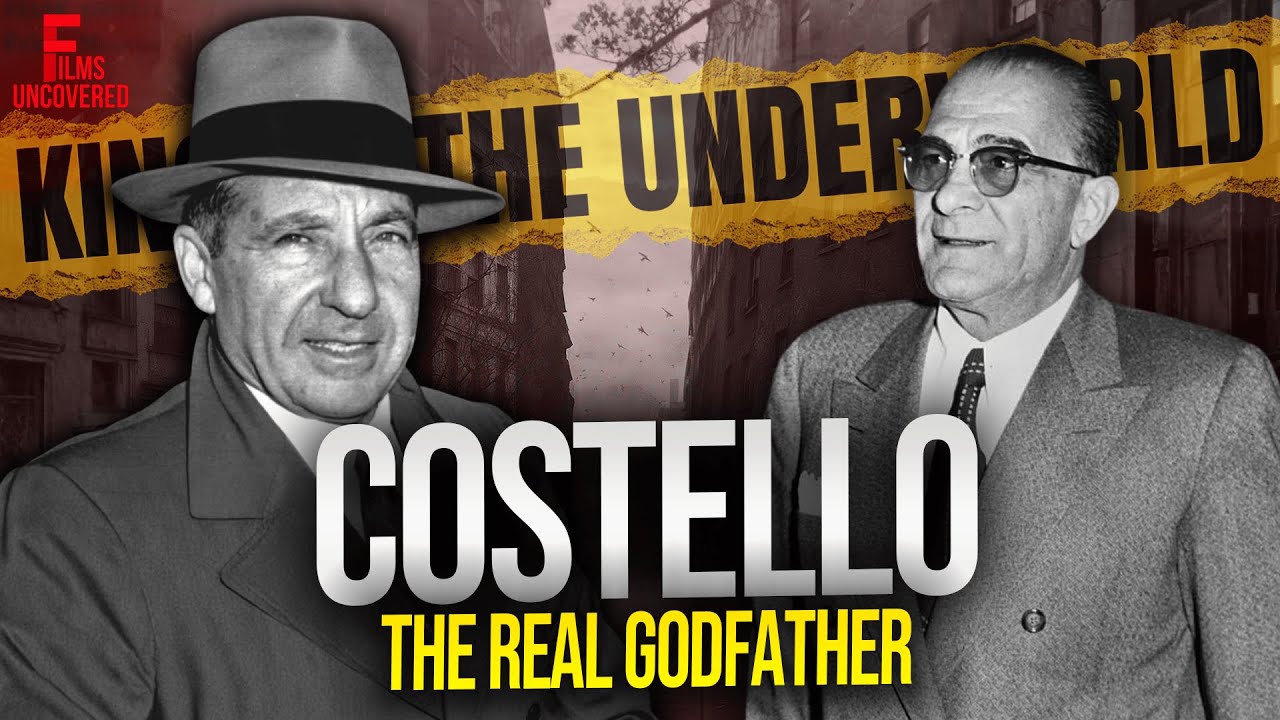
Frank Costello earned the nickname "the Prime Minister of the Underworld" because of his extensive political connections and his preference for peace over war within the mafia. He is considered one of the most respected and influential mobsters in mafia history, a man who had a slew of politicians under his thumb and used them to benefit the entire New York underworld.
He alone represented the most powerful political force in New York in the 1940s and 1950s. No one could become a judge, a high-ranking official, or even mayor of the city without Frank's approval.
His creed was always to avoid trouble, and he avoided it like the plague. While other gangsters killed each other in bloody turf wars, he calmly counted stacks of bills in his luxurious office.
In the 1940s, Frank Costello became the new godfather of the Luciano family after his friend Lucky Luciano was expelled from the United States. It was his ingenuity, determination, and developed business sense that propelled him to the highest echelons of the mafia.
His life story began far from the corridors of power. On January 26, 1891, in the Calabria region of Italy, a boy was born to Luigi and Maria Castiglia. He was the sixth child of a family that was already very poor, and his arrival was not going to improve their situation.
The parish priest asked what name they wanted to give the child. Francesco, they answered. Francesco Castiglia.
Around 1893, the Castiglia family split in two. Don Luigi decided to go to America in hopes of escaping the poverty of the Italian countryside. The meager resources at his disposal did not allow him to take his entire family, so he left his wife, two of his daughters, and his son Francesco behind in Calabria.
Don Luigi was certain he would earn more money in America and that the rest of the family would join him soon. For him, it was just a matter of time. The disappointment would be significant. Upon arriving in America, he struggled to save money. Life there turned out to be just as tough as in the Calabrian countryside.
Sell everything, even the bed sheets if necessary, he told his wife. But come to America. After two years had passed, the last tickets were purchased. In 1895, Francesco Castiglia set off for the New World.
He later recalled the crossing. It was just the three of us, my mother, my sister, and me, he said. All we took with us from the old country was this huge iron pot my mother liked to cook in. They fixed up the pot like a bed by lining it with a blanket, and that is where I slept for the entire crossing.
The Castiglia family settled into a precarious apartment in the Italian ghetto of East Harlem in New York. They did not feel too out of place, as the lively neighborhood was predominantly composed of people from Calabria. Everyone there spoke Italian.
To provide for his family, Luigi Castiglia opened a grocery store on 108th Street. The business brought in little income, just enough to cover housing and food. Despite help from Maria and the children, the growing offspring never had enough to satisfy their hunger.
Life was tough. At dinner, Francesco never failed to compare the contents of his plate with those of his siblings to ensure he received his fair share. One of his friends later recounted that when you dined regularly with Frank, you quickly learned not to touch the contents of his plate. This phobia traced back to his impoverished childhood.
At the age of nine, Francesco began attending school. It was during this period that his name first appeared in its English form. For young Frank, learning the language of Shakespeare was a challenge. In general, school was not his forte. He despised attending classes and preferred roaming the streets, where he could earn a bit of money.
His older brother Eduardo taught him how to improve his lifestyle by stealing fruit from local merchants. This enabled Frank to gradually but steadily tread the path of delinquency.
Go to school, my son, his father would say. I go to school, father. I go to school every day, Frank would answer. Francesco, I don't like the friends you have, his mother warned. They are no good and will amount to nothing. I will amount to something, mama, Frank replied. Something better than spending my life in a grocery store.
Frank would loathe and disdain his father throughout his life. He regarded him as too soft, too humble, and content with his lot. He simply could not comprehend why his father had accepted such a poor and mediocre life.
Frank permanently left school at the age of 13. From then on, he seamlessly blended into the petty delinquency of his neighborhood. The school of crime is where Frank had chosen to educate himself, a school that in the early 20th century would shape some of the greatest gangsters in the history of the United States.
In East Harlem, the neighborhood where Frank Castiglia lived, a Sicilian mob boss named Ignazio Lupo dominated the area in the early 1900s. Lupo the Wolf, as he was nicknamed, had managed to gain control of the city by merging his organization with Giuseppe Morello's family.
Originally, the mafia was a secret society created by Sicilians for Sicilians, eventually becoming a true state within a state. Once imported to the United States, however, mafia bosses decided to forget what had been the very essence of their organization and began extorting their fellow Italians.
Ignazio Lupo was one of these racketeers. His men would knock on the doors of merchants demanding payment of a tax in exchange for protection. If you were the merchant, you had better pay the tax, or they would beat you mercilessly. If that was not enough, they would simply burn down your shop.
Before they harmed you, the mafia generally warned you by sending a letter marked with a black hand, the emblem of their extortion method. These extortion gangs, known as the Black Hand, were not as organized as the modern mafia that would emerge in the 1930s. However, there was one rule that everyone scrupulously respected: omerta, the law of silence.
Frank Castiglia, who continued his apprenticeship in the streets of East Harlem during this time, conscientiously adhered to it. He had clearly observed that in his neighborhood, informants were not well received. Spilling the beans at a police station equated to being scorned in the streets, and in the worst cases, it simply meant signing one's death warrant. Frank understood this well, so much so that he would not betray a single person in his life.
Then one day, he was caught red-handed by a patrolling police officer. Suddenly, a city counselor who recognized him intervened. I'll take care of that little rascal, he said. The officer, not bothering, left it to the politician to deal with Frank.
I've just done you a favor, the politician told him. Now remember that when I need a favor. Frank was stunned. Why had this man done him this favor by releasing him from the hands of the police? Finally, he grasped it. He had just understood the importance of doing favors for others.
It was a bit like depositing money in the bank. You could withdraw from the account when you needed it, and the bigger it was, the more comfortable you were. It was a lesson he would not fail to put into practice later, developing one of the biggest influence trafficking operations in the history of organized crime in America.
It was during this period that Frank Castiglia changed his name. Henceforth, he went by Frank Costello. The exact reason is not clear. Perhaps he changed it to prevent the police from tracing it back to his parents, or maybe it was better to integrate into society. Costello, surprisingly, is an Irish surname.
According to the memoirs of Charlie Luciano, better known as Lucky Luciano, an Italian immigrant who, like Frank, was making a name for himself on the streets of the East Side, the two became acquainted at a movie theater in Times Square.
It was a Saturday night, Lucky recalled. We liked to go to the movies because them silent pictures had titles and they helped us learn English. This particular night, the manager threw us out, and at the same time he threw out some other guys. One of the guys was a little bit older than us and he had an outfit called the 104th Street Gang. We got together and it turned out that this older guy was not from Sicily. His name was Francesco Castiglia. Later on, though, he got famous under the name of Frank Costello.
Frank Costello and Lucky Luciano would later become very good friends. Both young men aspired to the same ambitions in life. They were both insightful, resourceful, and willing to do whatever it took to carve out a place for themselves in the underworld.
Later on, they would meet two other gangsters, two Jews also hailing from the East Side. Meyer Lansky was a small and cunning tough guy. Benjamin Siegel, nicknamed Benny or Bugsy, was a tall, handsome man whose appearance could be deceiving because he had an itchy trigger finger.
The four of them formed a gang, an association. Luciano finally recalled, We was the best team that ever got put together. We knew our jobs better than any other guys on the street.

According to Lucky, this is how Costello got his name. During their first heist together, Meyer Lansky objected to the Jews always taking the risks. Lucky responded, What do you mean two Italians? We are one Italian, one Irish, and two Jews. Where's the Irish? Meyer asked. Lucky pointed to Frank. Him, he's Irish. You know, Frank Costello. That's how Costello got his name, Lucky remembered. When we got up to our ears in New York politics, it didn't hurt at all that we had an Italian guy with us with an Irish name.
To play with fire is to eventually get burned, and Frank Costello was about to face the justice system. His first arrest occurred on April 25, 1908. Frank, accompanied by two other young thugs, was arrested in the Bronx after beating up and robbing a coal merchant. In front of the judge, he pleaded not guilty and was granted a dismissal. For this first one, he got lucky.
Then there was another arrest on October 16, 1912, on 18th Street, this time for armed robbery. Frank, again with two acquaintances, stole nearly $3,600 in cash and $220 worth of jewelry from a housewife. On the day of judgment, he pleaded not guilty again and miraculously escaped with a dismissal. Perhaps he had threatened the plaintiff to drop the charges. No one knows.
But then he committed one offense too many. The arrest took place in Manhattan on March 2, 1915, just a few months after Frank married a lovely brunette. By that time, Frank had made it a habit not to go out without his revolver. Unfortunately, on that day, he was arrested for carrying a concealed weapon.
Initially, he told investigators his name was Frank Saverio, a reference to his mother's maiden name, but eventually claimed his real name was Castello. Clearly, it was an attempt to confuse the authorities and prevent them from discovering his true identity. However, Frank realized that this time it would not be as easy to get away with it.
Pleading not guilty would not result in a dismissal, and the bail for temporary release was too high. With no other option, he had to accept it. He would have to languish behind bars before his trial. As time passed, the weight of prison gradually took its toll on him. He decided he would plead guilty.
Saverio, what is your real name? the judge asked. Costello, he answered. I find that in 1908, that is seven years ago, he was arrested for assault and robbery, and in that case he was discharged, the judge said. I find that in 1912 he was again arrested for assault and robbery and he was discharged in that case. In those cases he gave the name Frank Castello. In this case he gives his name as Frank Saverio. I have looked him up and I find his reputation is not good. On the contrary, it is bad.
Will your honor give me another chance? Frank pleaded. You have had chances for the last six years, the judge replied, and those chances have to cease sometime. Your honor, I took the plea just because I was in prison for one month and wanted to avoid trouble, Frank said. I was a married man, but the revolver wasn't found on me. It was found 100 feet away from me.
That is right, the judge said. And they saw you throw it there. The officers followed you and saw you throw the gun away, and they first captured you and then took you back and got the gun. In other words, your actions were those of a guilty man in every particular. I sentence you to the penitentiary for one year.
Frank served 11 out of the 12 months, his good behavior earning him a reduction in sentence. Released in April 1916, he returned to wandering the streets of East Harlem. While in prison, he had thought long and hard about his future. He was determined not to end up back behind bars.
Running through the streets with a firearm and the prospect of going back to prison, or worse, losing his life, was not part of his plans. That's when I realized I was stupid, he later said. Carrying a gun was like carrying a label that said, I'm dangerous. I'm a criminal. Get me off the street. I made up my mind I would never pack a gun again, and I never did.
Clearly, Costello needed a break away from petty crime. What he needed was serious business opportunities. At that moment, the most beautiful gift a small-time gangster like him could dream of arrived to change his criminal dimension. A major event that would soon transform his life and the lives of many other delinquents in the working-class neighborhoods of New York: Prohibition.
On January 16, 1920, at midnight, the 18th Amendment to the United States Constitution, ratified a year earlier, came into effect. It was now illegal to manufacture, transport, import, export, or sell alcoholic beverages. Prohibition had been inaugurated.
That night, a new era was about to begin in America, an era of fantastic disorder where the law would be constantly flouted. Years of Prohibition would turn out to be lucrative for a number of gangsters seeking prosperity, like Frank Costello and his associates, who were determined to seize the great opportunity that lay before them.
When Prohibition began, Costello, Luciano, Lansky, and Siegel were determined to play a significant role in this new market. They were ambitious, there was no doubt. What they lacked at the moment was experience. The four were barely adults and knew it would be challenging to compete with the bigwigs of the Italian mob in New York.
Among these bigwigs were Joe Masseria and Ciro Terranova, old-school Sicilians with a deep distrust of all non-Italians, especially non-Sicilians. This perspective was completely opposed to the new generation of gangsters like Costello, Luciano, and Lansky, who saw racketeering as strictly a business affair where origin was not a prerequisite for doing business. Collaboration instead of bloodshed was their creed.

And anyway, there was no time to waste. Prohibition was here, and Americans were eager for their thirst to be quenched. Their entry into the clandestine alcohol market began with Joe Adonis, a young man as ambitious as they were.
One day, Adonis was in Little Italy enjoying an ice cream with Charlie Lucky Luciano when he made him a proposition. Charlie, I know we never done no business together, but I need 10 grand to make a whiskey buy down in Philly, and I'll cut you in for half.
The day before, Adonis had met Waxey Gordon, a bootlegger from Philadelphia. Waxey had offered him a shipment of guaranteed authentic Scottish whiskey, but Adonis did not have enough funds to seal the deal. That is why he turned to Lucky Luciano.
Lucky recalled, I put my arm around Adonis' shoulder and I told him to keep his money, that he just found himself a partner who put up all the dough. I called Costello, Lansky, and Siegel, and we got together an hour later. The four of us put up 35 grand in cash. The deal was sealed, the first of many business ventures.
Luciano himself recounted the beginning of their involvement in the alcohol trade. The profits were far greater than could ever have been realized by crimes against innocent persons and their property, and the penalties were far less. Protection could be purchased at all levels. Ever since we was kids, we always knew that people could be bought. It was only a question of who did the buying and for how much.
It was Frank Costello a little bit later who really opened the door to the whole business of buying influence and protection, Luciano said. He had the style and the class of a guy twice his age. And with that Irish-Italian name we hung on him, he was able to move into all circles.
That's when we set up a private bank, not a real bank, Luciano recalled. We called it our buy money bank. It started with five grand and the pot was turned over to Costello to use any way he saw fit. We greased the police and the politicians. It was all part of the overhead, just like any other business.
So, thanks to Frank Costello, the gang had an entire network of politicians and cops on their payroll throughout Manhattan. This meant they could trade booze in peace.
In addition to his activities with Luciano, Lansky, and Siegel, Costello also partnered with one of the biggest alcohol traffickers during Prohibition, William Vincent Dwyer, an Irish gangster known as Big Bill. He was not called that because of his imposing physique, but due to his hefty bank account and significant political influence.
Dwyer and Costello joined forces in 1923. At that time, Dwyer, already well established in alcohol trafficking, reportedly received a proposition from Costello that guaranteed him complete protection against increasingly frequent raids. For a bootlegger, enduring such attacks meant losing a lot of money. So William Dwyer likely had no other choice but to accept Frank's proposal, risking major trouble otherwise.
The Costello-Dwyer partnership became one of the most effective and lucrative in Prohibition history. Every year they imported an average of $40 million worth of alcohol. They were the only bootleggers during Prohibition who never lost a single truck.
As money flowed in more and more, Frank started to gradually change his criminal dimension. Prohibition made him wealthy, more than just a bit, allowing him to invest in other ventures like real estate. The uncompromising businessman he was, he watched every dollar invested.
This success opened the doors to high society for him. In this world, Frank felt like a fish in water. He was friendly, naturally gained trust, and had the appearance of someone not remotely threatening. These qualities allowed him to mingle with whoever he pleased without arousing suspicion.
Frank then used this apparent credibility to expand his influence and contacts among high-profile individuals. He got acquainted with politicians, judges, journalists, city councilors, and even movie stars. He corrupted all these people, and in return they protected his and his associates' underworld businesses. Were you a Prohibition-era alcohol smuggler with a problem? Go see Frank Costello and he would solve it in a snap.
1929 was a significant year in the history of the underworld. From May 13 to May 16 of that year, the first organized crime summit took place. The idea for organizing this conference came from Johnny Torrio, the former head of the Chicago Mafia who was Al Capone's mentor.
Torrio aimed to establish a national crime syndicate, a kind of confederation where all American criminal organizations would be united. He envisioned dividing the United States into slices so that each criminal group would be allocated its fair share. Within this national crime syndicate, everyone would be welcome, not only Italian-American mobsters but also Jewish and Irish gangsters, as well as African-American criminals.
This convention aimed to lay the foundations for a new, more modern mafia, a visionary project that captivated Costello, Luciano, and Lansky, who shared Torrio's vision. They decided to help organize this conference. The location was chosen: Atlantic City. Frank Costello took charge of the invitations.
Thus, the New York delegation, the largest at the meeting, arrived in Atlantic City, including Johnny Torrio, Lucky Luciano, Meyer Lansky, Joe Adonis, Vito Genovese, and Dutch Schultz. Chicago was represented by Al Scarface Capone, Frank Nitti, and Jake Guzik. In short, the biggest names in the underworld were present.
All except Maranzano and Masseria, as they were not invited. Their traditional views, particularly working only with Italian gangs, did not align with the modern ideals and principles of Torrio.