The shattered bridge over the Elbe River at Torgau became the unlikely stage for one of history’s most consequential handshakes on April 25, 1945, when American and Soviet lieutenants met across twisted iron and broken concrete to mark the effective end of World War II in Europe. The American soldiers who reached that bridge belonged to the First United States Army, the largest American fighting force ever assembled on the European continent, a quarter-million men who had stormed Omaha Beach, broken through Normandy, seized the first German city, and captured the first bridge across the Rhine. Yet the name of the general who led them has been almost entirely erased from popular memory, a historical oversight that historians and military scholars are now working to correct.
His name was Courtney Hicks Hodges, and he remains the only soldier in American military history to rise from the rank of private to four-star general while commanding the largest field army the United States ever deployed in Europe. From the beaches of France to the banks of the Elbe, Hodges led his men through 337 consecutive days of combat, a grueling campaign that produced over 365,000 hospital admissions and more than 164,000 battle casualties. Yet in that entire span, he held exactly one press conference, a stark contrast to the flamboyant generals who dominated newspaper headlines and newsreels while he quietly directed the war from behind the scenes.
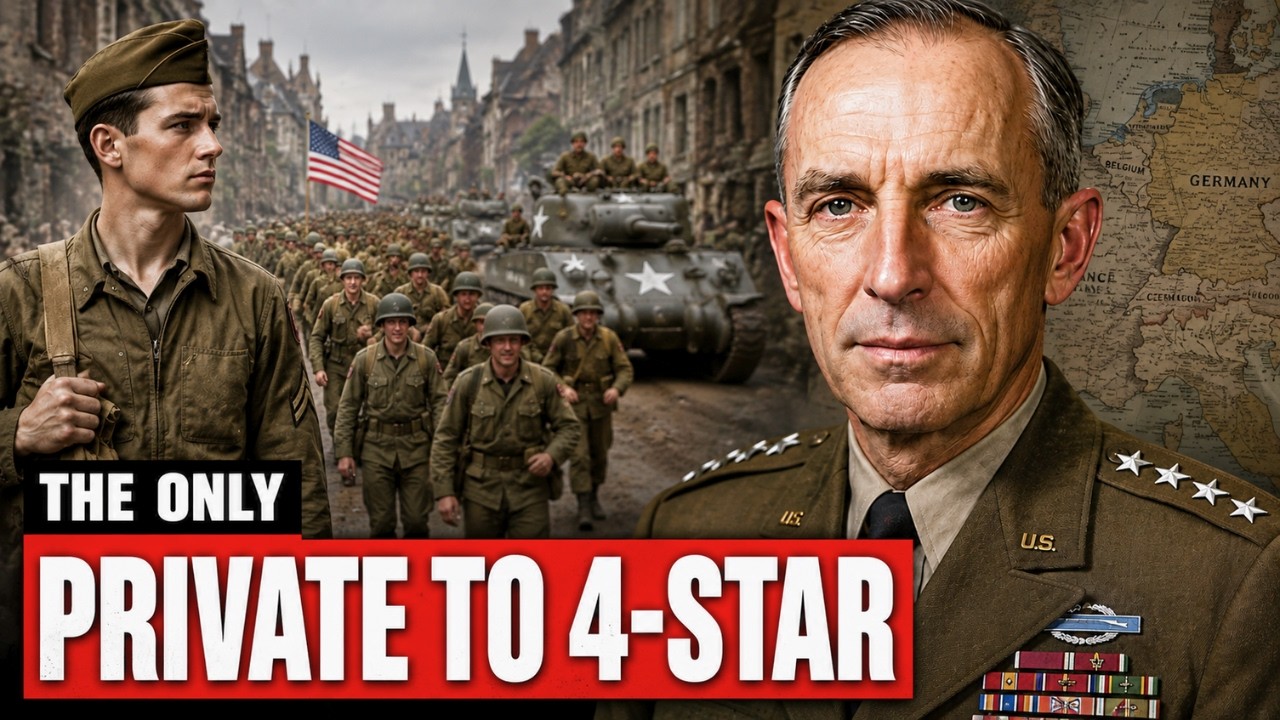 The story of how a boy from Perry, Georgia, rose to command a force larger than any American army before or since begins not with triumph but with humiliation. In 1904, Hodges entered West Point at seventeen years old, a thin, serious, unremarkable cadet from a small-town newspaper family. He lasted barely a year before the academy found him deficient in mathematics and sent him home in June 1905.
What makes this rejection particularly striking is that George S. Patton Jr. , a fellow plebe in the same class, also failed mathematics but was permitted to repeat the year due to his family’s wealth and influence.
Patton graduated with the class of 1909 and became a legend. Hodges was sent back to Georgia in civilian clothes, carrying nothing but the stigma of failure.
What Hodges did next reveals the character that would define his entire career. He did not enroll in law school, did not join his father’s newspaper, and did not abandon his military ambitions. Instead, he put on a grocer’s apron and swept floors in a general store for nearly a year while he formulated his plan.
On November 5, 1906, he took off the apron, walked out of the store, and enlisted in the United States Army as a private in Company L of the Seventeenth Infantry Regiment at Fort McPherson, Georgia. He wore the coarse wool uniform of an enlisted man, slept in barracks with forty other soldiers, and polished the boots of officers who had graduated from the academy that rejected him.
Hodges rose through the enlisted ranks with remarkable speed, earning promotion to sergeant faster than anyone expected. He possessed a quiet competence that commanded respect without demanding it, a calm dignity that silenced the loudest voices in the barracks when he entered. But it was his marksmanship that truly set him apart.
In 1908, at the National Rifle Competition at Fort Niagara, New York, a soldier named Courtney Hodges placed second in the entire United States Army, competing against officers and West Point graduates alike. The man who had been told he was not intelligent enough to learn engineering at West Point had become one of the finest riflemen in the entire American military.
In 1909, at the Presidio in San Francisco, Sergeant Hodges sat for the competitive examination for officers, a narrow and brutal path that allowed enlisted men to earn commissions based on merit alone. The army designed the test to be nearly impossible to pass, preferring West Point graduates for its officer corps. Hodges passed.
On November 13, 1909, he was commissioned as a second lieutenant of infantry and assigned to the Thirteenth Infantry Regiment. He had reached the same destination as his West Point classmates through a different door, relying on his own abilities rather than family connections or institutional privilege.
The army sent him to the Philippines in 1910, where he served alongside two other young lieutenants whose names meant nothing at the time. One was George Catlett Marshall, who would become the chief of staff of the United States Army and the architect of American victory in World War II. The other was Henry Harley Arnold, known as Hap, who would command every aircraft flown by the United States Army Air Forces during the war and become one of only four men promoted to five-star general.
Three lieutenants eating in the same officers’ mess, complaining about the same rain, patrolling the same jungles, none of them able to imagine what they would become.
In 1916, Hodges was in the Mexican desert leading a reconnaissance platoon under Brigadier General John Joseph Pershing, the old Indian fighter who was pursuing Pancho Villa across the border after the raid on Columbus, New Mexico. On the same dusty trails rode George Patton, now Pershing’s aide, and William Hood Simpson, a tall Texan who would one day command the Ninth United States Army in Europe. Four men who would hold major commands in the greatest war in human history rode together through the northern Mexican desert in 1916, and only one of them would be forgotten.
When America entered World War I, Captain Hodges sailed to France with the Sixth Infantry Regiment of the Fifth Infantry Division. By June 1918 he was a temporary major, and by October a temporary lieutenant colonel at thirty-one years old. The Fifth Division fought in some of the war’s hardest battles, including Saint-Mihiel in September and the Meuse-Argonne offensive, the largest American operation of the entire war.
More than a million American soldiers fought for forty-seven days in terrain so bloody that soldiers felt the earth itself was dying. It was near the French village of Pouilly on the nights of November 2, 3, and 4, 1918, just days before the armistice, that Major Hodges did something extraordinary.
He crawled forward under German fire to personally reconnoiter the Meuse River, alone on his belly in the mud at night while German machine guns swept the opposite bank. He was looking for a place to cross, a place where his battalion could get across the river alive. He found it, then organized an assault party and led the attack across the canal in darkness while German positions stood less than a hundred paces away on the other bank.
The first attempt failed, men falling into the water under fire. He tried again for twenty hours without stopping, without sleep, without food, without rest. By the end of that twenty-hour struggle, he had gotten his men across the canal, across the Meuse, and onto the heights on the eastern bank.
He received the Distinguished Service Cross, the Silver Star, and the Bronze Star for those three nights on the Meuse.
Decades later, Dwight David Eisenhower, in a private letter to George Marshall in 1943, noted that Hodges carried the Distinguished Service Cross for personal courage, a medal Eisenhower himself never earned and never would. The Supreme Commander of Allied Forces in Europe, the man who would become the thirty-fourth President of the United States, never personally led an attack under fire. But Courtney Hodges spent twenty hours on the Meuse in the last week of the last war.
When the armistice came on November 11, 1918, exactly one week after Hodges finished storming those heights, the boy from Perry, Georgia, the grocery store clerk, the West Point reject, was a decorated combat leader who had led his men across a river under fire.
Between the two great wars of the twentieth century, the United States Army did something quiet and cruel. It shrank, cut its ranks, and returned its officers to the peacetime grades they had held before the fighting began. Temporary lieutenant colonels became majors overnight.
Men who had commanded battalions in the mud of France suddenly found themselves leading rifle companies in dusty posts in Kansas and Georgia. Courtney Hodges returned to the rank of major and remained there for fourteen years, from 1920 until 1934, when he was finally promoted to lieutenant colonel. He did not reach full colonel until 1938 and did not pin on his first star as a general until 1940.
Slow, quiet, patient advancement while the world drifted toward another war.
In 1920, he was told he would teach tactics at West Point, the same academy that had expelled him fifteen years earlier for failing engineering. When Major Hodges walked back through the gates of West Point in 1920 wearing the uniform of a decorated combat officer, he made history without anyone noticing. He became the first non-graduate ever to serve on its faculty, the first in the institution’s entire history since 1802.
No one who had failed to graduate had ever stood on that platform. Now he stood before cadets who had passed the examination he had failed, teaching them how to fight. They called him sir.
They saluted him. They wrote down everything he said. He never once mentioned that the academy had expelled him.
In 1929, the army sent him to Fort Benning, Georgia, which during the interwar years was the most important place in the United States Army, though almost no one outside the army knew it existed. It was a sprawling, dusty infantry school in the pine forests of western Georgia, hot in summer, cold in winter, and muddy year-round. On paper it was just a training base.
In reality it was the laboratory where World War II was quietly being invented. The man in charge of that laboratory was a thin, quiet, brilliant lieutenant colonel named George Catlett Marshall, the same George Marshall who had shared meals with Hodges in the Philippines twenty years earlier.
Marshall was quietly building a list of officers he believed could lead the American army in the coming war, not the last war but the next one. Nearly two hundred future generals passed through Fort Benning during Marshall’s years there, two hundred men who would one day lead divisions, corps, and armies across Europe and the Pacific. Marshall watched every one of them.
Courtney Hodges was placed on the Infantry Board under a stern colonel named Joseph Stilwell, whom everyone called Vinegar Joe. In that Infantry Board, during the scorching summers at Fort Benning between 1929 and 1933, Hodges did work that would arm the American soldier for the coming war. He helped push for the adoption of the M1 Garand rifle, the semi-automatic, eight-round, gas-operated weapon that would double the firepower of American infantry squads.
Every American soldier who carried that rifle from Normandy to the Elbe owed a debt to Hodges’s quiet work in a dusty office at Fort Benning fifteen years earlier. He also contributed to the development of the standard steel helmet, the jeep, and improved combat rations. By 1938, at fifty-one years old, Hodges returned to Fort Benning as assistant commander.
In October 1940, he became commander of the Infantry School itself, the most important training position in the United States Army. He was then a brigadier general with one star. Six months later, in May 1941, he was promoted to major general with two stars and appointed chief of infantry for the entire United States Army.
The officer who replaced him as commander at Fort Benning was a thin, bespectacled man from Missouri named Omar Nelson Bradley. Now watch the pattern carefully. George Marshall identified talent.
Courtney Hodges developed doctrine. Omar Bradley executed training. Three men working in the same building at Fort Benning, one after another, quietly assembling the machine that would win the war.
Then came the moment of war. On December 7, 1941, Pearl Harbor was attacked, and Courtney Hodges, now fifty-four years old, was in his office in Washington when the news arrived. He said little.
He rarely said much about anything.
Fourteen months later, on February 2, 1943, Hodges took command of the Third United States Army with a third star on his shoulder, a lieutenant general at fifty-six years old. The Third Army under Hodges was a massive training institution preparing division after division for shipment overseas. He drove them hard, using a phrase that appeared frequently in his orders: maximum combat efficiency.
He trained the Third Army brilliantly, and then in January 1944, when the Third Army was shipped to England in preparation for the invasion of Europe, its command was handed to another man. His name was George Smith Patton Jr. , the same Patton who had failed mathematics at West Point in 1905, the same Patton who had been given a second chance while Courtney Hodges was forced to go home and sweep a grocery store floor.
Patton took command of the army Hodges had trained. Patton led that army toward legend. Patton gave speeches, wore ivory-handled pistols, and cursed the enemy in front of newsreel cameras to immortalize himself.
Hodges, meanwhile, quietly returned to serve as deputy commander of the First United States Army under Omar Bradley, who had once been junior to Hodges in rank. The arrangement had been planned for months. Bradley would lead the First Army onto the beaches of Normandy on D-Day.
Once sufficient forces were ashore, Patton’s Third Army would begin operations on the continent. Bradley would move up to command the Twelfth Army Group, while Hodges would take command of the First Army in Bradley’s place.
On August 1, 1944, at exactly nine in the morning, at a Normandy farmhouse where paint was peeling and flies buzzed, Omar Bradley signed a piece of paper and formally handed over command of the First United States Army to Courtney Hicks Hodges. By noon, the Twelfth Army Group was ready for operations. Bradley moved to his new position, and the First Army became Hodges’s army.
He was now fifty-seven years old. He had inherited nine divisions, three corps, and approximately 250,000 American soldiers. At its peak strength, this army would command eighteen divisions.
It was and remains the largest American field army in the European theater of operations, larger than Patton’s Third Army, larger than Simpson’s Ninth Army, larger than any American army in history up to that time. The man responsible for it had started as a private soldier.
His day began at six-thirty every morning with a staff meeting in a room full of maps. Sixteen or eighteen officers would gather around a long table. Hodges would simply listen.
He would look at the maps. He would occasionally ask a single question in his quiet Georgia drawl. He never raised his voice.
He almost never gave a speech. He made his decisions quickly and quietly, expecting them to be executed without argument or discussion. He hated cameras.
He hated reporters. He hated ceremony. Several times a week, he would fly himself over the front lines in a small single-engine plane, an L-4, and the pilot would bring the tiny aircraft down to a few hundred feet while Hodges looked at the ground, the trees, the villages, the terrain where his men were fighting.
He wanted to see it himself. He did not trust maps alone.
Now comes the dark side, and it will not be hidden. Hodges was ruthless with subordinates who failed to meet his standards. He relieved ten of the thirteen corps and division commanders who served under him during the war.
Ten out of thirteen, the highest relief rate of any American army commander in the war. Some of those reliefs were entirely justified. Some were premature.
But the pattern says something about his character. He had risen through every rank the army offered, private, corporal, sergeant, lieutenant, captain, major. He had no patience whatsoever for officers who had obtained their positions through family connections or patronage.
In his case, this standard was both admirable and sometimes cruel.
His chief of staff was a hard-driving, abrasive brigadier general named William Benjamin Kean, whom the soldiers called Captain Bligh after the tyrant in Mutiny on the Bounty. Kean executed Hodges’s will with an iron hand, sometimes exceeding his authority in ways that had consequences later when Hodges was ill and could not restrain him. Then there was a private letter Dwight Eisenhower wrote to George Marshall in December 1943, before Hodges took command of the First Army.
Eisenhower described Hodges as being of the same mold as Bradley in almost every respect. A fine rifle shot, a great hunter, quiet, modest, and possessing a deep understanding of ground combat. Then Eisenhower added an extra line, noting that Hodges carried the Distinguished Service Cross, a medal Eisenhower himself never received and never would.
On June 6, 1944, the First Army was the American assault force. Approximately 60,000 troops and 6,000 vehicles landed on Omaha and Utah beaches. The 82nd and 101st Airborne Divisions dropped inland in the pre-dawn darkness.
By midnight, First Army casualties totaled approximately 6,283 men, including 1,145 killed, 3,184 wounded, and 1,928 missing. Omaha Beach alone cost approximately 2,400 casualties. Utah Beach, by contrast, cost approximately 197.
Hodges at that moment was still Bradley’s deputy, learning the machinery he would soon inherit. But he was there, and he saw what happened next, because what happened was the bocage, and the bocage was hell.
The Norman bocage is not well known today, but every American soldier who fought there in the summer of 1944 went to his grave remembering it. Centuries-old hedgerows, earthen embankments three to twelve feet high topped with dense, tangled vegetation. Each hedgerow enclosed a small field.
Each field was a fortress, and the next field was another fortress, and the next was a third. American armor could not penetrate those earthen walls. American infantry advancing across an open field toward a hedgerow were scythed down by German machine guns hidden in the vegetation on the other side.
The distance from one hedgerow to the next was often fifty to a hundred yards. Fifty to a hundred yards of open ground, then an embankment of earth and thorns behind which invisible German riflemen waited.
The fighting was slow. It was medieval. It was almost murder.
 In seventeen days of brutal combat, the First Army suffered approximately 40,000 casualties for a gain of seven miles. Nearly 6,000 casualties per mile. In front-line infantry companies, the average casualty rate among enlisted men reached 60 percent.
Among officers, it reached 68 percent. Replacement soldiers arriving at the front had a life expectancy measured in days. The battle of Saint-Lo, fought primarily by the 29th and 5th Infantry Divisions, cost between 5,000 and 11,000 American casualties before the city finally fell on July 18.
When it fell, the city was so completely destroyed that American bulldozers had to carve roads through the rubble for tanks to pass.
This stalemate had to be broken, and Bradley and Hodges together designed the operation that would break it. They called it Cobra. On July 25, 1944, approximately 3,000 Allied aircraft dropped nearly 4,000 tons of bombs on a narrow rectangle of French farmland along the road from Saint-Lo to Periers.
The plan was to obliterate the German defense line with air power and punch armor through the gap. The scale of the bombardment was almost beyond comprehension. Soldiers watching from American lines said the earth itself seemed to rise, dust and dirt boiling into the sky, then a shock wave rolled across the fields and knocked helmets off men standing miles away.
Then, as so often happens in war, things went wrong.
The wind shifted, visibility dropped, and some American bombers dropped their loads prematurely, on the wrong side of the front line. One hundred eleven American soldiers fell to friendly fire on July 25. Among the dead was Lieutenant General Leslie McNair, sixty-one years old, one of the highest-ranking American officers in the entire army.
He had come to the front that morning to observe the attack. He was watching the bombers come over in full force. A stray bomb ended his life.
His body was so badly mangled that identification was extremely difficult. He was identified only by the three stars on his shoulder. He was the highest-ranking American officer killed in the European theater.
Approximately 500 other American soldiers were wounded by the short bombardment.
But the situation on the German side of that devastated strip was far worse. The Panzer Lehr Division, one of the best armored formations in the German army, commanded by Lieutenant General Fritz Bayerlein, was annihilated. Bayerlein later stated that at least 70 percent of his troops were killed, wounded, or stunned into shock.
His tanks were buried under the rubble. The commander of the VII Corps in the First Army, Major General J. Lawton Collins, made the decision that led to the breakthrough.
He pushed his armor through the gap before the infantry had fully secured it. It was a tremendous risk. Had the German line held better than expected, the Americans would have been trapped in narrow corridors.
But Collins read the situation correctly, and by July 28, the 4th Armored Division had advanced twelve miles in a single day, shattering the German line. Avranches fell on July 30, and the great breakout began.
The army that had bled for seven miles in seventeen days was able, in seventy-two hours, to tear the German front completely apart. And now look at what happened next, because what happened next is the part that history books ignore. The popular story of August and September 1944 is about Patton racing across France.
Patton with his tanks, Patton with his pistols, Patton with his arrows on maps pointing east. Patton did race. No one denies that.
He was brilliant at pursuit. But while Patton was moving through relatively open country in the south, Courtney Hodges and the First Army were doing something equally remarkable and far more difficult in the north.
Between September 1 and September 11, 1944, the First Army advanced approximately 200 miles and encircled nearly 25,000 German soldiers in what became known as the Mons Pocket. The First Army moved so fast that entire German units were bypassed and surrounded before they could fortify. On September 11, an American patrol crossed the border into Germany for the first time.
The first Allied soldiers to set foot on German soil in World War II. Not the Third Army, not the British, not the French, but the First Army, Hodges’s army, 233 days ahead of the pre-invasion timetable.
Paris had already been liberated on August 25 in an operation by the First Army involving the French 2nd Armored Division and the 4th Infantry Division under V Corps. But the liberation of Paris was merely a ceremonial moment. What followed was a harder war, because Hitler ordered resistance, and that city was Aachen, the ancient capital of Charlemagne, the city where German emperors were crowned for 700 years.
The battle of Aachen, from October 2 to October 21, 1944. The 1st Infantry Division, the famous Big Red One, attacked from the south. The 30th Infantry Division, Old Hickory, struck from the north, and together they slowly encircled the city.
Hodges issued an ultimatum to the German garrison, warning that Aachen would be destroyed if it did not surrender. The ultimatum went unanswered.
What followed was ten days of the most vicious street fighting American soldiers had experienced in the war up to that point. Rooms swept with hand grenades, cellars cleared with flamethrowers, tank destroyers advancing on buildings to fire point-blank into fortified windows. American infantry learned to blow holes through interior walls rather than expose themselves in doorways.
On October 21, five minutes after noon, a German colonel named Gerhard Wilck emerged from his bunker waving a white flag. His men had been fighting for their lives for ten days in a city that was 90 percent reduced to rubble. Wilck reportedly told the Americans that when the Fuehrer orders you to fight, you fight.
American casualties totaled approximately 5,000 to 7,000. German casualties included more than 5,000 killed or wounded, plus 5,600 prisoners, and the city of Aachen was 85 percent destroyed. It was the first German city to fall to the Allies.
Every American soldier in that city was under the command of Courtney Hodges.
You might think that capturing the first German city alone would guarantee the man a place in the history books. It did not. Then came the Hurtgen Forest.
I must be honest with you about Hurtgen, because if I am going to tell you the truth about Courtney Hodges, I cannot exclude this, and I will not. The Hurtgen was a dense, dark, ancient forest of pine and fir trees extending approximately fifty square miles along the German-Belgian border southeast of Aachen. The terrain was a nightmare.
Steep ravines, narrow corridors between trees that became killing zones the moment an American division entered them, and vegetation so thick that artillery shells exploded in the treetops before reaching the ground, raining metal fragments and sharp wooden splinters on soldiers who had no cover.
The Germans had spent months fortifying it with bunkers, minefields, and interlocking machine-gun fields of fire. Every trail was pre-registered by German mortars. Every clearing was a trap.
Ernest Hemingway, forty-five years old, was working as a war correspondent there. He had seen Passchendaele in World War I or heard its stories, and he described the Hurtgen forest as Passchendaele with tree bursts. The battle lasted eighty-eight days, from September 19 to December 16, 1944.
It was the longest single battle fought on German soil in World War II, and it drained American divisions at a rate beyond comprehension.
The 9th Infantry Division lost 4,500 men for 3,000 yards, not miles, yards. The 28th Infantry Division suffered 6,184 casualties without achieving any significant ground gain. The 22nd Infantry Regiment of the 4th Infantry Division took 2,860 casualties to advance 6,000 yards.
One casualty for every two yards of forest, a casualty rate of 86 percent. The regiment ceased to function as a cohesive unit. Total American casualties in the Hurtgen were at least 33,000 men, with upper estimates approaching 55,000, in ground that many historians argue should have been bypassed entirely.
I will now say something that many who make videos about American generals will not say. This is the darkest chapter in Courtney Hodges’s command, and the evidence supports this judgment. Charles B.
MacDonald, who was an American company commander in that forest at twenty-two years old, watching his men die around him, would later become a historian. He described it as a poorly planned and futile battle that should have been avoided. Historian Carlo D’Este called it the most poorly managed series of battles of the war in the West.
Russell Weigley, one of the most meticulous historians of the American army in Europe, called things by their names. He wrote that Hodges and Collins drew a suspicious parallel to the Argonne Forest of World War I. The dams on the Roer River, which later became the retrospective justification for the entire attack, were not even considered a vital objective initially.
And here is the hardest part, the part I would prefer not to say, but I will. Hodges personally overruled the decision of the commander of the 28th Infantry Division. That man’s name was Major General Norman Daniel Cota, fifty-one years old.
Cota was not just any staff officer. Cota was the hero of Omaha Beach. On June 6, 1944, Norman Cota walked on the sand under fire and rallied terrified soldiers to advance when every instinct in the human body was driving them to hide.
He personally led his men out of the killing zone at Omaha. And when Norman Cota told Courtney Hodges that the attack plan for the Hurtgen forest was unwise, that his division could not do what was being asked in that terrain, Hodges overruled him. Cota’s division was torn apart in that forest.
When a man who stormed Omaha Beach tells you the attack is wrong and you insist on your position, you are responsible for the consequences. The bodies bore the consequences.
He never said it publicly, but he was responsible, and what happened next should have ended his career. On December 16, 1944, at 4:30 in the morning in the snow-covered forests along the Ardennes, the sky lit up with flashes of German artillery. Twenty-five German divisions, including ten armored divisions and Panzer Grenadier divisions, slammed into a sector of the American front defended by only four divisions.
Two of them were new and inexperienced, and two were exhausted and depleted from the Hurtgen, sent to a quiet sector to recover. They were not destined to recover. The 106th Infantry Division had been on the front line for exactly five days.
Two of its regiments, the 422nd and 423rd, were surrounded on a wooded hill called the Schnee Eifel. After three days of desperate resistance, with supplies cut off and ammunition exhausted, they surrendered. Nearly 9,000 American soldiers.
It was the largest American surrender in the European theater of the entire war.
At First Army headquarters in the Belgian town of Spa, Courtney Hodges realized the gravity of what was happening within hours. Before noon on December 16, he ordered two of the most critical moves of the entire Battle of the Bulge. He released the 101st Airborne Division to Bastogne and the 7th Armored Division to Saint-Vith.
These two decisions, made in the first hours of the German attack, shaped everything that followed. Bastogne would become the legend everyone remembers. Saint-Vith would become the delaying action that shattered the German timetable.
Both units reached their positions in time because Hodges saw what was happening and moved before panic set in.
Then panic set in. A Waffen-SS colonel named Joachim Peiper, twenty-nine years old, was leading a battle group of approximately 4,500 men and more than 100 tanks and assault guns westward through American rear areas. Kampfgruppe Peiper.
It penetrated deeper than any other German force in the offensive. On the night of December 17, Peiper’s lead elements came within approximately a mile and a half of an American fuel depot at Stavelot. The fuel depot contained more than two million gallons of gasoline.
Had Peiper reached that fuel, the entire nature of the Battle of the Bulge would have changed. German tanks were running out of fuel. American fuel would have given them another week of movement.
It might have given them the Meuse River.
Hodges ordered the fuel depot prepared for demolition. He ordered his headquarters moved from Spa back to Liege. It was the right decision.
But when the Americans later searched the abandoned building, they found something disturbing. Top-secret maps were still hanging on the walls. The evacuation had been hasty.
Critics would later say it was panic-driven. Then on December 20, at approximately 10:30 in the morning, Dwight Eisenhower made a decision that no American general ever forgot. He transferred temporary command of the First and Ninth Armies from Omar Bradley to Field Marshal Bernard Law Montgomery.
A Briton, fifty-seven years old, the officer Bradley least preferred in the entire world.
The military reason was logical. The German breakthrough had severed communication lines between Bradley’s headquarters in Luxembourg and the American armies north of the bulge. Someone had to take command of those armies who was located north of the bulge.
Montgomery, whatever his personal faults, was the only army group commander the Allies had there. But the humiliation was enormous. And Hodges, that quiet man from Georgia who had never complained about anything, was now taking orders from a British field marshal who was his temperamental opposite.
Montgomery was cautious, meticulous, and supremely confident in his own superiority. He treated the Americans in his private correspondence as amateurs.
And in the midst of all this, Courtney Hodges fell ill. He contracted influenza, severe influenza, compounded by exhaustion. He had been in continuous command for four and a half months through the bocage, Saint-Lo, Aachen, and the Hurtgen.
 He was fifty-seven years old, and now a German offensive, the largest in the war on the Western Front, had smashed into an army with divisions he had already exhausted. British historian Antony Beevor would write in his book Ardennes 1944 that Hodges apparently suffered a nervous breakdown during the fighting. Carlo D’Este described him as exhausted and withdrawn, and wrote that officers who visited First Army headquarters in those days came away disturbed by what they described as chaotic conditions and an absence of leadership.
Montgomery asked Eisenhower for permission to relieve Hodges of his position. Think about that. The commander of the largest American army in Europe, in the middle of the largest German offensive of the war, was on the verge of being relieved.
Eisenhower refused. He responded in writing that Hodges was of the quiet, reserved type that did not appear as aggressive as he actually was. Throughout a period of days during the worst of the crisis, much of the actual work of command fell to William Kean, the hard-driving chief of staff.
Kean ran the army while Hodges was bedridden with fever, and Kean, whatever his other faults, held things together.
But this must be said, because it matters. The decisions that saved the First Army were made by Hodges before illness incapacitated him. The paratroopers to Bastogne, the armor to Saint-Vith, the fuel depot prepared for destruction, the headquarters moved to Liege.
Those decisions were his, and they were the right decisions. On the northern side of the German penetration, the 2nd and 99th Infantry Divisions held at a place called Elsenborn Ridge. They held against the 6th Panzer Army of the Waffen-SS.
They did not give up a single inch of important ground. Historian John Eisenhower, son of the Supreme Commander, would later describe the defense of Elsenborn Ridge as the most decisive action of the entire Ardennes campaign.
At Saint-Vith, Brigadier General Bruce Cooper Clarke, forty-three years old, and the 7th Armored Division delayed the German advance for six precious days. The First Army held. The northern shoulder did not break.
The bulge would continue to push west for another two weeks, and Patton would relieve Bastogne from the south, and the newsreels would remember Patton and forget Elsenborn Ridge. But do not misunderstand, the northern shoulder was what stopped the German offensive, and the northern shoulder was Hodges’s army. Between December 16, 1944, and February 22, 1945, First Army medical records showed 78,915 hospital admissions.
Of those, 24,133 were wounded. That was the price the northern shoulder paid.
Courtney Hodges was never officially relieved of his position. His health recovered. He returned to full command.
On January 17, 1945, the First Army returned from Montgomery’s 21st Army Group to Bradley’s 12th Army Group, and Hodges did what he always did. He stopped talking and started fighting. In February 1945, snow still covered the ground in the Eifel mountains.
The First Army came out of the defense and turned east. Two offensive operations took place during those cold weeks. Operation Grenade in the north and Operation Lumberjack in the center.
Village by village, hill by hill, the First Army carved its way through the frozen roads of western Germany toward the last great natural barrier standing between the Allied armies and the heart of Germany, the Rhine River.
Every general in the Allied forces had thought about the Rhine for years, and every plan assumed the same thing. The crossing would be a massive, organized operation requiring weeks of preparation, the assembly of thousands of assault boats, the training of engineers in pontoon bridging, and the readiness of airborne divisions. The casualties would be enormous.
The Germans would blow every bridge before an American foot touched the eastern bank. Field Marshal Montgomery in the north was preparing for exactly such an attack. They called it Operation Plunder.
It was not to be launched until late March and would involve more than a million men. No one expected to find a bridge across the Rhine in February or early March 1945. No one expected what happened at Remagen.
On March 7, 1945, in the afternoon, a gray day with light fog on the hills, a task force from the 9th Armored Division of the First Army reached the slopes above a small German town called Remagen. And what they saw in the valley made them stop and stare. There was a bridge across the Rhine.
It was still standing. The Ludendorff Bridge, a steel railway bridge from World War I, approximately 1,000 feet long. Twin stone towers at each end.
And beneath it, the cold, fast current of the Rhine River flowing toward the North Sea. The Germans had prepared it for demolition with explosives. They had been preparing to blow it for days.
The problem was they had waited too long. American armor was already at the western entrance.
German engineers detonated the first charge frantically. The bridge shook. Pieces of concrete and steel fell into the water.
Smoke rose from the bridge deck. The bridge did not fall. A second, final charge was never connected.
A German officer on the eastern side pressed the detonator. Nothing happened. The wire had been cut or the fuse had failed.
To this day, no one knows for certain. But the second charge did not explode. The entire bridge was there on the western bank.
A twenty-two-year-old American lieutenant looked at that impossible bridge and made a decision that changed the course of the war. His name was Karl Heinrich Timmermann. He was leading an infantry company, and he ordered his men to run.
They ran across a thousand feet of 𝓮𝔁𝓹𝓸𝓼𝓮𝓭 steel deck in the dim afternoon light while German rifles and machine guns rained fire on them from both ends of the bridge and from the slopes on the eastern bank. They ran with their heads down and their weapons up. Some of them fell.
But most of them kept going. The first American to reach the far side of the Rhine was a thirty-five-year-old sergeant named Alexander Andrew Drabik. He was from Holland, Ohio.
In civilian life, he would later manage a butcher shop. He ran across that bridge without stopping, without firing his rifle, without looking back because he understood in his bones what everyone understood. They had a bridge across the Rhine.
Within minutes, Timmermann’s company had crossed. Within hours, more companies crossed. Within a day, a full American bridgehead was established on the eastern bank of the Rhine, on ground that no Allied soldier had trod except as a prisoner.
The news reached Courtney Hodges at First Army headquarters within an hour. He did not hesitate for a single minute. He ordered every available unit across the bridge immediately.
He telephoned Omar Bradley at 12th Army Group. Bradley’s response, according to what people repeated that afternoon, was two words: Hot dog. Bradley told Hodges to push everything he could across the bridge.
And when the news reached Eisenhower at his headquarters, the Supreme Commander said the bridge was worth its weight in gold. They meant every word, because Montgomery in the north was still weeks away from his planned crossing.
Thanks to German confusion, failed demolitions, and the decision of a twenty-two-year-old lieutenant to send his men running toward machine-gun fire, the First Army had breached the last great barrier of the war in Europe. Over the next ten days, as the battered Ludendorff Bridge finally collapsed on March 17, killing twenty-eight American engineers who were working to shore it up, twenty-five divisions of troops, tanks, and artillery crossed the Rhine at Remagen. By the time the bridge fell, First Army engineers had built two heavy-duty replacement bridges beside it, and the bridgehead on the eastern bank was forty kilometers wide and fifteen kilometers deep.
Five American divisions were already ashore and beginning to expand.
The Germans threw everything they had left at that bridgehead. Messerschmitt Me 262 jet aircraft, the world’s first operational jet fighters. V-2 ballistic missiles.
Combat swimmers who tried to sabotage the replacement bridges at night. None of it worked. The First Army had crossed the river, and it was never going back.
Once the bridgehead was secured, Hodges did what he always did. He turned east. He kept advancing.
By the last week of March, the First Army was breaking out of the Remagen bridgehead and driving toward the industrial heart of Germany, the Ruhr Valley, where the foundries and factories that built Hitler’s tanks and aircraft were located.
To the north, General William Simpson, commander of the Ninth Army, was advancing south from another crossing point, the same William Simpson who had ridden horses through the Mexican desert with Hodges twenty-nine years earlier. On April 1, 1945, elements of the First Army and the Ninth Army met at a town called Lippstadt. The ring closed.
An entire German army group, Army Group B, commanded by Field Marshal Walter Model, was trapped inside the pocket. It was the largest encirclement on the Western Front, larger than Stalingrad on the Eastern Front in terms of the number of soldiers. Approximately 317,000 German soldiers surrendered.
Field Marshal Model did not surrender. He walked into a small patch of forest near Duisburg on April 21, took out his pistol, and shot himself. He believed a field marshal does not surrender.
The Ruhr Pocket was the largest mass surrender of German forces in the entire war on the Western Front. And the First Army, more than any other American unit, was the one that closed that ring. You will not read Hodges’s name in popular accounts of the battle of the Ruhr.
You will read Bradley’s name. You will read Eisenhower’s name. Sometimes you will read Simpson’s name.
Hodges, the man whose army did most of the actual fighting and closed most of the actual encirclement, is a footnote. That fact is the summary of his entire career.
On April 15, 1945, at a farmhouse in Germany, an aide to Courtney Hodges presented a set of rank insignia. Four silver stars. He was fifty-eight years old.
He had been a soldier in the United States Army for two years and eight days as an enlisted man. He had been a sergeant. He had been a lieutenant, a captain, a major, a colonel, a brigadier general, a major general, a lieutenant general, and now he was a full general.
Four stars, the highest rank the United States Army conferred in wartime. He was one of only two men in all of American history to rise from private to four-star general. The other was a thin, sixty-three-year-old officer named Walter Krueger, born in Prussia and emigrated to America as a boy.
Krueger enlisted as a volunteer private during the Spanish-American War in 1898 and rose through the ranks over forty-seven years to eventually command the Sixth United States Army in the Pacific under MacArthur. Krueger received his fourth star approximately a month before Hodges. Two men, both of whom started as enlisted soldiers.
Both rose to the top of the United States Army in a war that consumed sixteen million Americans in uniform. And both, by the end of the war, would be forgotten by almost everyone outside the units they commanded. You will not find either of them on a postage stamp.
You will not find either of them in a television special during Veterans Day weekend. You will not find them in the movies. They did the work.
But the system remembered the men who talked about the work.
On April 25, 1945, ten days after Hodges pinned on his fourth star, along the Elbe River in central Germany, First Army patrols moved cautiously through burned villages and past columns of surrendering German soldiers who no longer cared. They were looking for the Russians. Everyone knew the Russians were close.
Every soldier in the First Army knew that once they met the Russians, the war in Europe would be effectively over. At approximately 11:30 in the morning, First Lieutenant Albert Louis Kotzebue, leading a patrol from the 69th Infantry Division, made the first contact with troops of the 58th Rifle Division of the Soviet First Ukrainian Front near a village called Strehla. It was the first American-Soviet meeting of the war.
Later that same afternoon, on the wreckage of a destroyed bridge over the Elbe River in a town called Torgau, Second Lieutenant William D. Robertson, another young officer from the 69th Division, walked onto the broken bridge, and from the other side a young Soviet lieutenant walked cautiously on the twisted iron. His name was Alexander Silvashko.
He was twenty-two years old. He was from Belarus. They met in the middle of that shattered bridge.
They shook hands over the rubble of concrete and steel and the dark water flowing beneath them. Soldiers from two great armies who had never seen each other, who did not speak a single common language, embraced. Some of them wept.
Some of them fired their weapons into the sky. Germany had been split in two. The Third Reich, which was supposed to last a thousand years, had thirteen days left.
And every American soldier that evening served in the First United States Army.
Let me now present the final numbers, because these numbers are what make the silence surrounding Courtney Hodges so difficult to explain. The First Army fought for 337 days of continuous combat. From D-Day to Victory in Europe Day, not a single day of that campaign was under any other commander.
 Total hospital admissions exceeded 365,000 American soldiers, ranging from minor to severe wounds. 164,174 battle casualties. 34,048 combat fatigue cases, soldiers whose mental strength collapsed under the weight of what they witnessed.
51,441 non-battle casualties. They advanced more than 600 miles at peak strength. They commanded eighteen divisions across six corps, captured the first German city, made the first crossing of the Rhine, closed the Ruhr Pocket, and met the Red Army at Torgau on the Elbe.
For comparison, Patton’s Third Army fought for 281 combat days, fifty-six fewer than the First Army. Operation Eber, which Patton personally oversaw and which was designed to build his historical legacy, claimed the capture of more than 1,200,000 prisoners of war. But that number includes more than 500,000 German soldiers whose surrenders were processed after the capitulation, men who were walking toward American lines with their hands up.
If you subtract the surrender prisoners, the comparison looks entirely different. The First Army processed more than 255,000 wounded enemy soldiers. That number alone tells you something about the nature of the fighting they experienced.
You cannot process that many enemy wounded unless you have been in combat where the prisoners number in the thousands and cannot walk.
The war in Europe ended on May 7, 1945, in a schoolhouse in the French city of Reims, when a German general named Alfred Jodl signed the document of unconditional surrender. Courtney Hodges was there. He watched Jodl sign the paper that ended the war in Europe.
He was the commander of the largest American army on that continent. He said almost nothing that anyone recorded. But the war was not over.
There was still Japan. American command was already thinking about what would come next. Operation Coronet, the planned invasion of the Japanese home islands.
A landing on Honshu, a march toward Tokyo, the greatest amphibious operation ever planned. Millions of American soldiers. They needed a commander for the American ground forces coming from Europe.
Someone to lead the veterans of Normandy and the Bulge into the last and worst battle of the war.
Both George Marshall and Dwight Eisenhower recommended the same man for this task. Courtney Hodges. Douglas MacArthur, sixty-five years old, the supreme commander in the Pacific, a man known for his extreme selectivity about subordinates, approved him.
American command looked at every general it had. Patton, Bradley, Simpson, Truscott, Clark, Patch. And when they chose the man to lead the invasion, they chose Courtney Hodges.
This is not the biography of a forgotten man. This is the biography of a man the army considered irreplaceable for the hardest mission in the world. But it never happened, because on August 6 and 9, 1945, two atomic bombs fell on Hiroshima and Nagasaki.
And on September 2, the war ended aboard a battleship in Tokyo Bay.
Courtney Hodges was aboard that battleship, the USS Missouri. He stood on the deck and watched Japanese officials sign the instrument of surrender. He had been present at Reims.
He was present at Tokyo Bay. He was the only American army commander from the European theater to attend both surrender ceremonies. Not Bradley, not Patton, not Simpson, not Patch.
Only Hodges. He witnessed both ends of the war, and then it was all over. Courtney Hodges brought the First Army home to the peacetime headquarters at Fort Jay on Governors Island in New York Harbor.
He commanded the army there during the early years of the Cold War. In 1949, at sixty-two years old, he retired from the United States Army after forty-three years of service. From private to four-star general.
From the grocery store in Perry, Georgia, to the deck of the Missouri in Tokyo Bay.
In 1943, he and Mildred moved to San Antonio, Texas. He fished. He kept his rifles clean.
He went to the shooting range. He watched the Cold War unfold on the evening news. He read the newspapers and drank coffee, and as far as anyone knew, he made no effort to insert himself into the great machine that talked about the war he had helped win.
Omar Bradley wrote a bestselling memoir called A Soldier’s Story. In it, Bradley described Hodges as a slim, quiet-voiced Georgian without anger or rumor or visible emotion who had been left behind by the headlines in Europe. He described him as a military technician whose impeccable techniques and tactical knowledge made him one of the most skilled craftsmen in his entire command.
A craftsman, not a hero, not a warrior, not a leader. A craftsman. It is a word you use for a man whose work you deeply respect but whose personality does not become legend.
Then Bradley wrote a sentence I want you to hear carefully, because it is in my view the highest judgment from the hands that were directly above Hodges in the command of the entire war in Europe. Bradley wrote that no other commander and no other military unit in World War II deserved greater recognition than the quiet, modest General Courtney Hicks Hodges and his First Army. That is Bradley’s own testimony.
The man who saw every after-action report. The man who read every casualty report. The man whose reputation depended on getting credit for what Hodges did.
Bradley said no one deserved more recognition than Hodges. Then Bradley took all the recognition for himself. His book sold hundreds of thousands of copies.
Hodges wrote no book.
I do not believe Bradley did this out of spite. I believe Bradley did it because Bradley was present and Hodges was not. That is how the system works.
Eisenhower had noticed the injustice at the time. In private correspondence with Marshall during the war, he complained that Hodges had not received recognition in the United States for his great work. Eisenhower saw the problem.
Eisenhower sympathized with it. And Eisenhower did nothing to fix it. He did not order the press to cover the First Army differently.
He did not ask Hodges to hold press conferences. He noticed the injustice and moved on. Yet in a private ranking of thirty-eight senior American officers that Eisenhower prepared at the end of the Battle of the Bulge, ranking them by his estimation of their potential, Courtney Hodges was placed eleventh.
Eleventh. The man who commanded the largest American army in Europe. Eleventh.
There is one final development in this story, and it is the last and most difficult. On December 9, 1945, seven months after the war ended, George Patton was riding in a military car near Mannheim, Germany, when the car collided with a truck at low speed. Patton was thrown forward.
His neck was broken. He died twelve days later on December 21 in a military hospital in Heidelberg. He was sixty years old.
He would have lived to give one last round of interviews and speeches, and then he was gone. The Patton legend was already carved in bronze by the time he died. Films, photographs, newsreels.
Movies would be made about Patton. Books. George C.
Scott would portray him in an Academy Award-winning film. He became, in the American imagination, the face of American military leadership in World War II.
Omar Bradley lived until 1981 and wrote his memoirs. Eisenhower became the thirty-fourth President of the United States and reshaped the country for eight years. Courtney Hodges wrote nothing.
On January 16, 1966, he died in San Antonio, Texas. He was seventy-nine years old. His obituary in the New York Times was three columns wide, but it was published on an inside page.
He was buried in Arlington National Cemetery. Section 2, Grave 198. If you have never visited Arlington, and if you can, I would like you to go.
Take the Metro to the Arlington Cemetery station. Walk up the hill and find Section 2. It is not a section most tour groups visit.
There are no crowds there. There is no honor guard changing every half hour. There are only rows of white headstones under ancient trees.
And somewhere in that section, near the top of the slope, there is a headstone that reads Courtney Hicks Hodges, General, United States Army. 1887, 1966. Almost no one visits it.
There is a diary kept during the war by a major named William C. Sylvan, who was Hodges’s aide and recorded what happened at First Army headquarters day by day for 337 days. That diary was edited by a historian named John T.
Greenwood and published in 2008 under the title From Normandy to Victory. It sits on university library shelves. It is the single most important primary source ever compiled on Courtney Hodges and the largest American army in Europe.
Almost no one reads it. There is a biography of Hodges written by a researcher named Stephan Wiechowski and published in 2006. It is a good book.
The biography of Courtney Hodges has not sold in twenty years what the biography of Patton sells in one year.
The lesson here goes beyond the story of Courtney Hodges. It goes beyond World War II. It is about the essence of how institutions remember things and how they forget them.
The loudest voice gets the credit. The most influential person gets the promotion. The person who focuses on his work, who believes sincerely and with all his heart that results will speak for themselves, that person is ignored.
Hodges believed that results would speak for themselves. 337 days of combat, 164,000 wounded. The first crossing of the Rhine, the meeting at Torgau.
He thought that was enough. He thought it would speak for itself. But it did not speak.
It never spoke, because the results of honorable men do not speak for themselves. Someone has to speak for them.
Patton spoke for himself constantly and brilliantly. Bradley cultivated Ernie Pyle and earned the title of the soldier’s general. Eisenhower had the entire Supreme Headquarters apparatus to shape his image for four years.
Hodges had only his single press conference and the quiet dignity of a Georgia boy who believed his job was to fight, not to market himself. He was wrong. The system rewarded the men who marketed themselves.
I want to close with this. If your father served under Courtney Hodges in the First Army, or the 1st, 4th, 9th, 28th, 29th, 30th, 99th, 106th Infantry Divisions, or any of the eighty divisions that were under his command from Omaha Beach to the Elbe River, then something of Courtney Hodges came home with your father. Something of that quiet, unrewarded, persevering man from Georgia, who never asked to be remembered, is present in the story your father told or in the story he did not tell.
Those men are almost all gone now. The soldiers who followed Hodges through the hedgerows of the bocage, through the rubble of Aachen, into the frozen hell of the Hurtgen Forest, across the collapsing Ludendorff Bridge, and on to the Elbe River are today ninety-eight years old or older. And every year their number dwindles.
When they are all gone, and their sons and daughters are gone, and their grandchildren no longer remember the names of the divisions their fathers and grandfathers served in, nothing will remain but what is written. And what is written about Courtney Hodges is very, very little. That is why some of us try to write more.
He rose from private to four-star general. He commanded the largest American army in Europe. He attended the German surrender at Reims and the Japanese surrender aboard the Missouri.
MacArthur chose him to lead the invasion of Japan. He is buried in Arlington. Section 2, Grave 898.
Almost no one visits. Go and visit him if you can. Bring flowers.
Stand there for one minute. He will not know. But you will.
That is the story of Courtney Hicks Hodges, the only American general who rose from private to four-star command and led the largest army in Europe. And now, at least, you know his name.