The silence along Europe's eastern border was broken before dawn on June 22, 1941, when thousands of guns opened fire at once. German tanks pushed forward through the mist as aircraft swarmed overhead, marking the start of the largest invasion in history.
Operation Barbarossa, Hitler's war against the Soviet Union, was underway. More than three million German soldiers crossed into Soviet territory after months of gathering on the frontier.
The campaign was presented as a crusade against Bolshevism, but it was in truth a war of annihilation. Behind the front lines followed the Einsatzgruppen, special units ordered to eliminate entire populations, including Jews, communists, and anyone deemed unworthy of life.
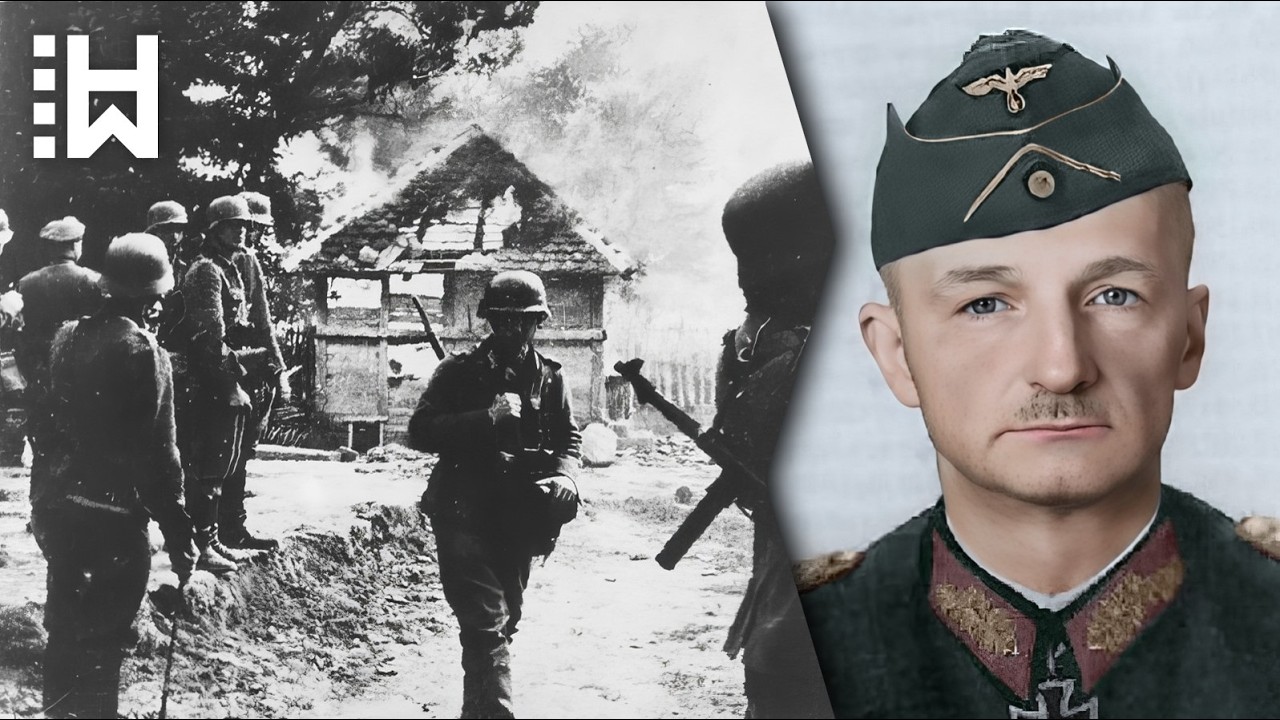
At first, victory seemed certain. Soviet defenses collapsed, entire armies surrendered, and the Wehrmacht advanced hundreds of kilometers in a matter of weeks. Beneath the triumph, however, lay a moral abyss of burning villages, starving prisoners, and civilians shot on the spot.
Among the officers serving in this campaign was Hinrich Vanna Bernhard von Erdmannsdorff, a disciplined professional shaped by the traditions of the old German army. He was born on July 26, 1891, in the town of Bautzen in the Kingdom of Saxony, then part of the German Empire.
He grew up in a traditional officers' family. His father was a noble royal Saxon administrator and former cavalry captain, while his mother came from an old Saxon noble family. The household valued duty, discipline, and loyalty to the monarchy.
On October 1, 1910, Erdmannsdorff entered a Saxon light infantry unit of the German army. His diligence earned him steady promotion, and by August 1912 he had become an officer.
When the First World War broke out in 1914, he was serving as a company officer. His battalion fought on the Western Front, where he was wounded on September 23, 1914.
After recovering, he returned to the front and served on both the western and eastern fronts over the next four years. His wartime service earned him several German and Austro-Hungarian decorations, including the Knight's Cross of the Military Order of St. Henry in 1917 and both classes of the Iron Cross.
Like millions of Germans, he returned home at the end of the war to a nation in chaos. Kaiser Wilhelm II had abdicated in the autumn of 1918, the monarchy was gone, and revolution swept the country.
The army that emerged from the ruins of the empire was small, limited by the Treaty of Versailles to 100,000 men, but it retained its traditions of professionalism and hierarchy. During the Weimar Republic, Erdmannsdorff stayed in the army and attended staff courses that broadened his military and intellectual horizons.
In 1919, he married Helena Anna Ilonka von Burgsdorff, who like him came from an old aristocratic family. Throughout the 1920s, he moved between infantry and cavalry assignments, rising through the ranks and teaching tactics at the infantry school in Dresden.
He belonged to a generation of officers who saw themselves as custodians of a professional military tradition untouched by politics, a belief that would later prove impossible to uphold under the Nazi regime.
By the early 1930s, Germany was changing. The economy was collapsing and radical movements were gaining ground. When Adolf Hitler and the Nazi Party took power in 1933, many professional officers, including Erdmannsdorff, greeted the new government with cautious optimism.
They were not Nazis, but they welcomed the regime's promise to rebuild the army and restore national pride. The personal oath to Hitler introduced in 1934 bound them not just to the state but to the Führer himself, a moral trap that would define their future.
As rearmament accelerated, Erdmannsdorff continued to rise. The old small army was abolished, and in 1935 the new German army, the Wehrmacht, was created in open violation of the Treaty of Versailles. By November 1938, Erdmannsdorff commanded his own regiment.

When the Second World War began on September 1, 1939, he led his regiment during the invasion of Poland. His troops fought in the rapid campaign that crushed the Polish army in a matter of weeks.
After the Polish campaign, he served on the Western Front in 1940 and later in the Soviet Union after the launch of Operation Barbarossa. On the eastern front, he commanded an entire division and took part in the great encirclement battles at Białystok, Minsk, and Smolensk, where hundreds of thousands of Soviet soldiers were captured.
Conditions for these prisoners were brutal. Tens of thousands died from hunger, exposure, and neglect. In German prisoner of war camps, often just fenced-off fields without shelter, starving men sometimes resorted to cannibalism to survive.
Erdmannsdorff's division pushed toward Leningrad, enduring heavy fighting in the forests and marshes of the north. The campaign was savage: villages burned, civilians were starved or shot on sight, and entire regions were devastated.
For his leadership in holding positions during the winter of 1941 to 1942 against Soviet counterattacks, Erdmannsdorff was awarded the German Cross in Gold, followed a few months later by the Knight's Cross of the Iron Cross. His official citation praised his leadership during the defense at Dyukin and the withdrawal of his division across the Volkhov.
Behind this heroism lay the grim reality of a war of annihilation. The German army in the east was not merely fighting soldiers; it was waging an ideological war dictated by Hitler's racial policies. Erdmannsdorff, like many professional officers, continued to serve despite these inhuman realities, focused on duty and blind to the crimes committed around him.
In early 1943, he was promoted to Generalleutnant, equivalent to major general. His experience and reliability made him a typical product of the Wehrmacht's command system: efficient, loyal, and obedient.
But the war was turning. Stalingrad fell to the Soviets in February 1943, and the myth of German invincibility was shattered. Erdmannsdorff spent the following months in staff and reserve roles, including as a military inspector in Dresden.
By 1944, with Germany under pressure from all sides, he was briefly assigned to command army corps in Norway and was later sent to Yugoslavia. The Balkans were a nightmare for the German occupation forces, with partisan warfare, reprisals from all sides, and chaos.
At the end of January 1945, Erdmannsdorff was appointed commanding general of the German corps stationed in Yugoslavia. One of the units under his command was the 7th SS Volunteer Mountain Division Prinz Eugen, notorious for its murderous behavior toward civilians.
Victims were shot, slaughtered, tortured, or burned to death in burning houses. Infants with their mothers, pregnant women, and frail old people were also murdered. In one case in the settlement of Velika Reka, a nine-year-old boy was skinned alive by two men.
This was no exception in the region. Almost all units under Erdmannsdorff's command took part in brutal reprisals against civilians as part of the anti-partisan campaign.
His final campaign came in March 1945 during the Lake Balaton offensive in Hungary, one of Hitler's last desperate attempts to halt the Soviet Red Army. The operation failed disastrously, and the remnants of Erdmannsdorff's corps retreated westward hoping to surrender to the Western Allies.
When Nazi Germany capitulated in May 1945, Erdmannsdorff was captured by the British. Like many officers of the defeated Wehrmacht, he expected internment or interrogation. Instead, on June 4, 1945, he was handed over to the Yugoslav authorities, who accused him of responsibility for atrocities committed by German forces in the Balkans.
The Yugoslav partisans led by Josip Broz Tito were carrying out swift retribution against occupying forces and collaborators. Erdmannsdorff was taken to Ljubljana in Slovenia along with three other German generals: Gustav Fehn, Friedrich Stephan, and Heinz Kuttner.
There was no formal trial. The four men were executed by firing squad on June 5, 1945. Erdmannsdorff was 53 years old. His wife did not learn of his death for several years.