In the high desert of the American Southwest, a rock rises roughly 1,500 feet straight out of flat, empty ground. There are no mountains around it and it belongs to no range. It is a single jagged black peak standing alone on the plain, visible from 40 miles in every direction.
The people who arrived later looked at it and saw a sailing ship. They called it Shiprock, the name printed on every map today. But the people who were already there had a different name for it. They had used it for longer than anyone can count.
They did not call it a ship. They called it the Rock With Wings.
The stories they told about it were not about sailing anywhere. They were about things that came down from the sky, landed on that summit, and made it their home. This is what the Navajo said about the winged ones at Shiprock.
Long before there were roads, maps, or the name Shiprock, this land belonged to the Diné, the people now called the Navajo. Their homeland had a name too. They called it Dinétah, and its borders were not lines on paper.
Four sacred mountains, one standing in each direction, marked the edges of the world given to them by the Holy People. To the east, White Shell Mountain. To the south, Blue Turquoise Mountain. To the west, Yellow Abalone Mountain. To the north, Black Jet Mountain.
Everything between those four peaks was home, and every part of it pulsed with meaning. Rivers, canyons, and mesas all carried a story. Nothing in this land was mere scenery. Everything was a reminder of something.
In the center of that land, on a vast and lonely plain in the region we now call the Four Corners, where Arizona, New Mexico, Utah, and Colorado meet at a single point, one shape dominated the horizon. You can see that peak long before you reach it.
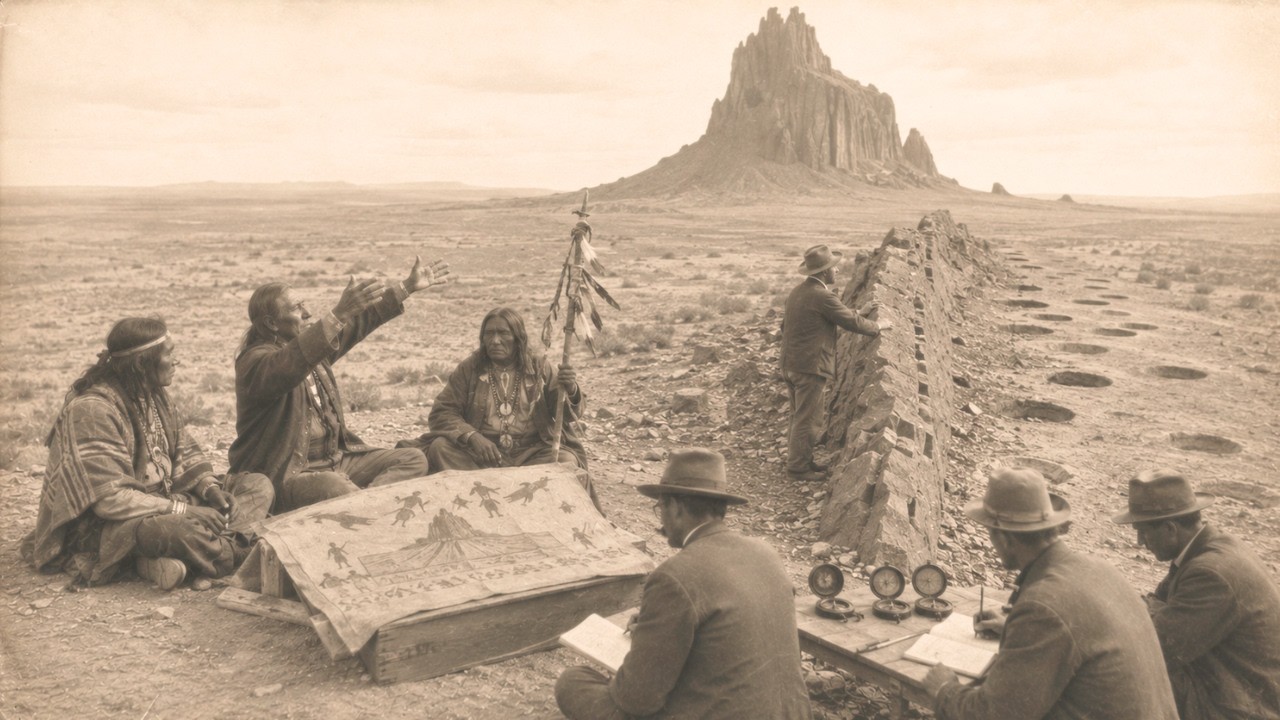
It juts from the flat ground like something that does not belong, taller than anything around it, black against the pale desert light, with long, low rock walls stretching from its base across the plain. On a still day it seems to watch. On a windy day, when dust moves across the desert floor around it, it seems as though it might move.
The Diné word for it is Tsé Bitʼaʼí. Said slowly, it means almost exactly the Rock With Wings. Not the rock that looks like a bird, not the rock shaped like a wing, but the rock that has wings. As if the wings were a fixed fact about the thing, not a poet's comparison.
That difference matters more than it seems. Consider the other name for a moment. The settlers who arrived in the 19th century saw the same rock and summoned the most impressive thing they knew: a great sailing ship under full sail crossing the ocean.
That was their frame of reference. Ships meant trade, wealth, power, and the reach of empire across the seas. So they looked at a rock in a desert a thousand miles from any ocean and saw a ship, because ships were what filled their imagination.
But the Diné name was already ancient when those settlers arrived. It did not come from watching ships, because they were not a seafaring people and this was not a sea. It came from something else. It came from stories, and the stories are far stranger and far older than any ship that ever sailed.
There is a gentler version of the tale, and it is worth knowing before the darker one. In that account, the Diné were in imminent danger. Enemies surrounded them on every side and there was nowhere left to flee.
The people gathered and prayed for help, and the earth itself answered. The ground trembled beneath their feet, rose up, and revealed an enormous bird, a creature vast enough to carry an entire people on its back. It lifted them high into the air.
It carried them across the sky, over the desert, over rivers and canyons, away from the enemies who pursued them. When it brought them to safety in a new land, the great bird settled on the plain, folded its wings, and turned to stone. That stone is Shiprock.
In that version, the rock is a savior, a guardian frozen forever in the moment of rescue, wings folded over the people it saved, watching over them for all time. It is a beautiful story. If that were the whole story, the Rock With Wings would be simply a monument to survival.
But it is not the whole story. And it is not the version that makes elders lower their voices when they look at that summit. Because beneath it lies an older layer, a darker one. To reach it, you have to go back to the beginning of the Diné world, to a time the stories describe as the dawn of everything, when the earth was new and nothing was safe.
In the oldest traditions, the first world was not a quiet garden. It was a world teeming with monsters. When the first humans appeared in this world, they found it crowded with terrifying beings. The Naayééʼ, a word meaning strangers, destroyers, monsters.
These were not ordinary predators. They were enormous, unnatural creatures that fed on humans and hunted them across the land. They multiplied until humans could barely survive. There was a giant whose footsteps shook the earth, called Yéʼiitsoh, the Big Giant, who drank whole lakes and devoured anyone he found.
There was a horned monster that charged across the plains. There was a monster that kicked travelers off cliffs to the creatures waiting below. There were rolling monsters, tracking monsters, and countless others.
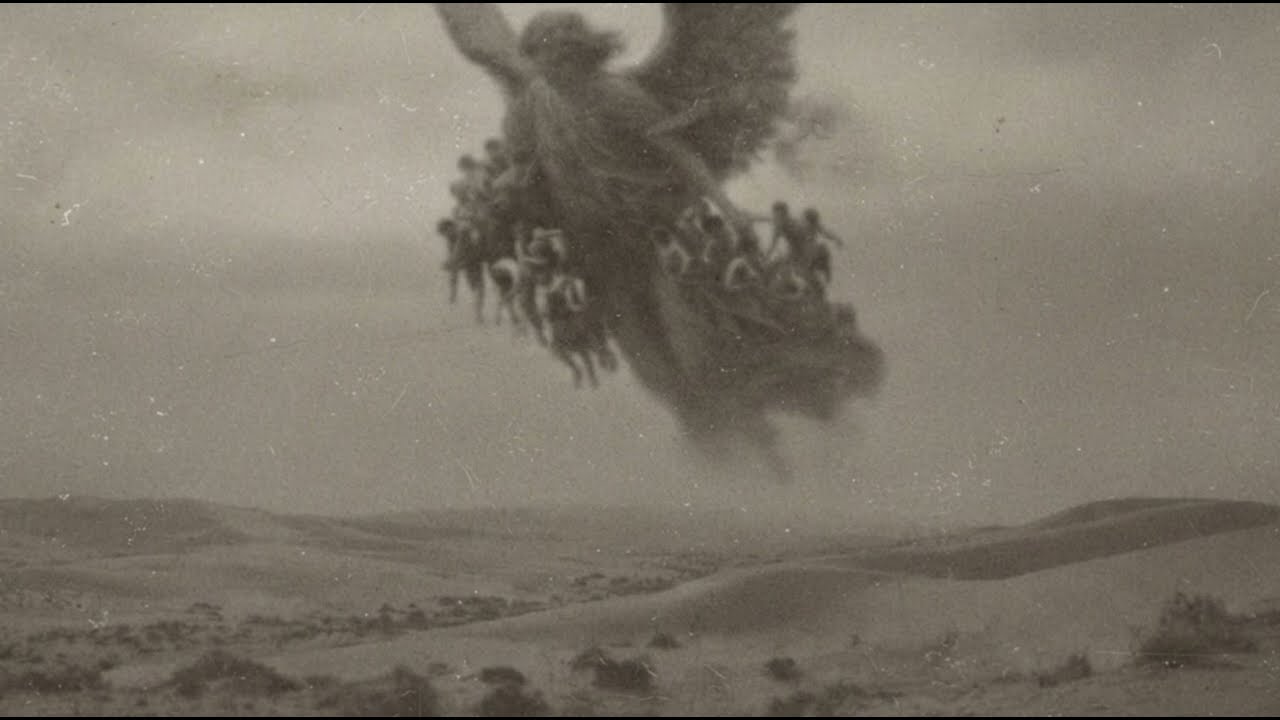
Something with a wingspan wider than a house, talons that could close around a grown man, and the strength to lift that man off the ground and carry him straight into the sky. In the traditions, these creatures were large enough to abduct an adult human as easily as an eagle takes a rabbit from a field.
And they were not alone in the sky by chance. They had a home, a place they returned to again and again, generation after generation. A nest atop a great rock spire that rose alone from the desert floor. You already know which peak.
Imagine it the way the old stories ask you to. Two monstrous birds, a mated pair, male and female, riding the updrafts from the hot desert plain. Their wings spread wider than anything alive on earth today. They circle high above the ground, so high they are barely visible, and they watch.
Below, a single person moves across the open plain. Perhaps a hunter. Perhaps someone traveling between camps. Someone alone and exposed, with nowhere to hide on that flat, open land. The birds see him. They fold their wings and drop.
This is the moment. This is the strike. They fall out of the empty sky like a stone, faster than anything that size should move, talons first, before the person on the ground can even understand what the accelerating shadow is. The talons close, and the earth leaves his feet.
Now he is rising, carried higher and higher. The desert shrinks below, the black tower grows closer, and the bird climbs toward the summit, toward ledges no human foot has ever touched, where the young are waiting. This is what the winged creatures at Shiprock did.
They landed there again and again since a time no one remembers. It was their home. And the people who lived in the shadow of that rock lived with a particular kind of fear: fear of the open sky. You cannot hide from something that hunts from above. You cannot outrun a shadow.
You never know, when you walk out onto the plain, whether the sky will stay empty or open up and drop something enormous on you. But it gets worse. The monstrous birds did not hunt only to feed themselves. They were feeding their young.
Above the summit, in a nest wedged into ledges no one could reach, two chicks waited, growing, always hungry, and the parents brought them food. Human food. In the stories, the creatures carried the captured person high into the air above the tower's peak.
Then, at the height of the climb, they simply let him go. The victim fell the entire length of the rock, all 1,500 feet, struck the rocks at the base, and the young birds came down to feed on what remained. It was a cycle with a horrifying rhythm.
Hunt, seize, carry, climb, drop, feed, then return to the sky to begin again. There was nothing the people could do about it. How do you fight something that attacks from the sky and lives atop a tower no human can climb?
For a long time, that was simply the shape of the world. The monstrous birds ruled the air above the plain. The chicks grew fat on the dead, and the people endured, buried what remained of the taken, and prayed for the day it would end.
Here the story turns. Because in the Diné traditions, the monsters of the old world were not meant to last forever. The Holy People did not abandon humans to be eaten. Help was coming. But to know who ended the reign of the winged ones, you have to know where he came from.
On the sacred mountains, there was a woman. She was called Changing Woman, one of the most beloved and important of the Holy People, who embodies the earth itself and the turning seasons. She grows old with every winter and young again with every spring.
Changing Woman gave birth to twin sons. In the stories, their father was the Sun. The twins grew with astonishing speed, and even as boys they understood that the world they were born into was broken. Monsters were devouring people. Something had to be done.
So the elder twin, who would become the great warrior, set out on a journey no one had survived before. He went to find his father, the Sun, and to ask for the weapons that could kill monsters. It was a journey across the entire sky.
The road to the Sun's house was guarded by perils that destroyed anyone who tried to pass: crushing rocks, cutting reeds, and boiling sands. But spirit beings helped the twins along the way, most famously the little Spider Woman, who gave them a charm to protect them.
They passed every obstacle and finally reached the turquoise house of the Sun at the edge of the sky. There the Sun tested them to be sure they were truly his sons, and they passed every test. When he was certain, he gave them what they had come for.
He gave them armor of hard flint. He gave them weapons made of lightning, the arrows of the storm itself, the only things in all existence that could pierce a monster's skin. The elder twin returned to earth carrying the lightning.
He had a new name now, a name that told the world exactly what he had become: Naayééʼ Neizghání, the Monster Slayer, who destroys the alien monsters. One by one, he tracked them and hunted them. He began with the greatest of them, the giant Yéʼiitsoh.
After a battle that shook the earth, he brought the giant down with lightning his father had given him. Then he turned to the others: the horned monster, the kicking monster, the tracking monster. One by one, the horrors of the old world fell before the Monster Slayer.
Slowly, the earth began to become safe for the humans who would inherit it. In the end, he came to the broad, desolate plain beneath the Rock With Wings. He had come for the birds. But here he faced a problem lightning alone could not solve.
How do you kill something that lives on the summit of a tower no one can climb? The Monster Slayer could not simply scale the rock. Even if the walls could be climbed, the creatures would see him from miles away the moment he stepped onto the open ground, and they would take him long before he reached the top.
So he did not try to climb. He did something far more dangerous. He made himself bait. He walked out onto the plain alone, in the open, in the exact place and the exact way the monstrous birds could not resist. And he waited.
He stood there on the flat, empty ground, a lone figure under the vast sky, and let them see him. It did not take long. High above, something moved. One of the great birds had spotted him. It folded its wings and dropped.
It plunged out of the sky in that terrible dive, faster and faster, talons forward, and the Monster Slayer did not run. He held his ground until the last moment, and then the talons closed around him, and the earth fell away beneath him.
Now the hunter was the one being carried. Now the greatest warrior of the Diné was rising to the full height of the tower, held in the grip of the monster, climbing toward the nest at the summit, toward the place no living human had ever reached.
The bird carried him higher and higher, past the ledges, above the very top of the rock, and then, just as it had done with countless victims before him, it let him fall. He fell. But the Monster Slayer was not an ordinary man thrown to his death.
He was the son of the Sun, wearing armor of flint and carrying the protection of the Holy People. As he hurtled toward the rocks that had shattered so many before him, he was shielded, and in some accounts a small feather given to him by his helping spirits slowed his fall.

Instead of breaking on the rocks, he landed on a ledge beside the nest, alive and unharmed. Now he stood where no living being had ever stood. He was on top of the Rock With Wings. And he was not alone.
The two young monsters were right in front of him in the nest, staring at the thing that was supposed to be their meal. The parents were still circling over the plain, hunting, with no idea. The reign of the winged ones was about to end.
The sky above the rock became empty and clean for the first time in a long age. Nothing would rise from that summit again to hunt the people below. But then the Monster Slayer turned to the two young birds, and here the story does something you may not expect.
He did not kill them. The chicks were still in the nest, utterly helpless, the children of the monsters he had just destroyed. Instead of finishing them, the Monster Slayer transformed them. He reached for the first chick, lifted it up, and spoke to it, telling it what it would become.
He said: from today, you will no longer prey on people. You will become the eagle. You will fly high and purely above the earth, and you will give people your feathers, and those feathers will carry their prayers to the Holy People.
The creature in his hands changed and became the eagle, the great bird the Diné still honor above all others, whose feathers are still used today in the most important prayers and ceremonies. Then he took the second chick and transformed it as well.
He told it: as for you, you will become the owl. You will fly at night, and you will give people signs, warnings, and guidance in the darkness. It changed and became the owl, the bird whose call the Diné still listen for carefully in the dark, believing it carries a message.
This is not just a story locked in the distant past. The eagle and the owl still live at the center of Diné life in ways that are hard to overstate. Eagle feathers remain among the most sacred and protective things a person can possess.
They are carried in ceremonies, used for blessing, and treated with care that approaches reverence, so much so that possessing them is protected by a special law. And the owl still silences a conversation the moment its call is heard.
To this day, when an owl calls near a home at night, many people stop and listen closely, because in the tradition that sound may be a warning or a sign that something is coming. The children of the monsters never left the world.
They merged into daily life, into prayer, and into prophecy, hiding in plain sight above the heads of the very people their parents once hunted. Consider that for a moment, because it is the heart of the whole matter.
The monsters that inhabited the Rock With Wings were not simply erased from existence. They were transformed into two of the most spiritually significant birds of the Diné: the eagle, whose feathers lift human prayers toward the heavens, and the owl, whose nighttime voice carries deep meaning.
Both, according to tradition, descend from those man-eating monsters that once landed on the summit of Shiprock and threw humans to their deaths on the rocks below. The horror was not erased. It was changed. It became something people could live with, and even honor.
The same feathers that now carry Diné prayers toward the sky came from the descendants of the creatures that once carried the Diné to their deaths. Nothing in these stories goes to waste. Even monsters become sacred.
Then the Monster Slayer faced one last problem, one that is almost funny when you think about it. He was standing on top of the peak with the monsters dead below him, having solved the impossible problem of getting up there.
But he had gotten there the only way anyone ever had, in the talons of a creature that was now a lifeless body at the base of the rock. There was no way down. The greatest warrior of the Diné was stranded atop the Rock With Wings with no means of returning to the earth.
In the stories, it took the help of another spirit being, sometimes said to be a bat, sometimes the same Spider Woman who had helped the twins before, to bring him safely back down. And he finally returned to his people.
The monsters were gone, and the rock stood alone in the desert, carrying within it the memory of everything that had happened above its summit. Now consider what all of this means.
The Navajo did not look at that stone tower and see a ship. They looked at it and saw the site of one of the most decisive battles in their entire world. A place where winged monsters made their nest and hunted humans from it.
A place where the greatest hero of the people himself offered himself to a monster's talons, was carried into the sky, and was thrown from the top of the world to survive by a miracle. A place where the last great terror of the old world was defeated, and its offspring became the eagle and the owl.
The name Tsé Bitʼaʼí, the Rock With Wings, is not a description of the rock's shape. It is a memory of what came down from the sky and landed there. And here, precisely, two worldviews collide.
When the settlers arrived, they knew none of this. They could not have. They saw a majestic rock and called it a ship. The name stuck because they were the ones drawing the maps, writing the surveys, and printing the guidebooks.
The older name and the ancient story behind it were pushed to the margins of the historical record. In the official account of history, Shiprock became a landmark, a geological wonder, a famous volcanic formation of the American Southwest.
Here is the strange part. Geologically, that official account is not wrong. Scientists will tell you the tower is the neck of an ancient volcano, a hardened heart of magma that cooled deep underground and was exposed after the softer surrounding rock eroded away over millions of years.
Those long, low walls stretching from the base across the desert are volcanic dikes, sheets of solidified magma that remained standing like the spokes of a broken wheel. It is in fact a textbook example of what geologists call a volcanic neck.
All of that is real and provable. But here is the question the old story leaves you with. The Navajo had a name for this rock and a detailed story attached to it long before any geologist explained how the formation was made.
And the name they chose was not about volcanoes and not about ships. It was about wings, about enormous winged beings that came down from the sky, landed on the summit, and hunted people below. Of all the images available to them, of all the ways a people could describe a strange black peak in the desert, why did those who lived in its shadow settle on the idea of wings?
Why monsters on the summit? Why a nest and prey carried upward and dropped and served as food for the young? And there is something else worth noting, something that makes the question harder rather than easier.
The Diné were not the only people on this continent who remembered enormous winged beings that dominated the heights and abducted humans as prey. Across Native North America, from the plains to the Great Lakes to the peoples of the Pacific Northwest coast, the same shape repeats under different names.
Giant birds, thunderbirds, beings large enough to lift a person off the ground, repeatedly associated with storms, high peaks, and the open sky itself. A single story told in one place might be one people's imagination.
But a story that appears again and again among cultures separated by thousands of miles and thousands of years, with no means of transmitting it to one another, begins to look less like an invention and more like an echo of a memory many peoples were trying to hold onto at once.
Some hear this and file it neatly under myth. A symbolic tale about courage, about a hero facing an impossible enemy, about horror transformed into something sacred. It is in fact all of those things.
A story can be symbolic and still serve another function at the same time. Because the oldest stories of a people are often the way they preserved real memories. A real experience, real events, real fears, encoded in a form powerful and vivid enough to survive being told and retold for thousands of years, long after its details were forgotten.
The story is a vessel, and the memory placed inside that vessel is very specific. The memory of a place where the sky itself was dangerous. Where something large and winged and hungry held the heights on that isolated summit and hunted people on the plain below.
Where it took a miracle and a hero willing to be carried in a monster's talons to make the open ground safe to walk again. That memory mattered enough to bind permanently to the rock in the one place it could never be erased from: the name itself.
We tend to assume the official account of any place is the true one without really questioning it. The name printed on the map. The plaque bolted to the overlook railing. The tidy paragraph in the tourist guide.
But the official name of this rock is barely two centuries old. It means ship because a stranger passing through thought it looked like something from his faraway world. There is a pattern here that goes far beyond one rock in one desert.
All across the map, the names we use every day are only a recent layer, painted over older names that carried older meanings. A place is named and renamed, and each arriving group writes its word over what came before, until the first meaning sinks so deep that almost no one suspects it is there.
Shiprock is one of the clearest examples you could find. Two names for the same stone, layered one over the other. One is recent, came from outside, and describes only a passing resemblance to something from a distant world of oceans and sailing ships.
The other is ancient, came from within, and describes a memory of what happened on that land. Only one of them made it onto the map. The other remains real whether the map records it or not.
The name Tsé Bitʼaʼí is far older and carries something no passing stranger could have invented from the outside. It carries a memory. The people who actually lived on this land, who knew it in every season and every light, who buried their dead and raised their children in the shadow of that tower, did not see a ship.
They saw wings, and they remembered what those wings once did. Today, Shiprock is sacred ground for the Navajo Nation, and it is closed. Since 1970, climbing the summit has been prohibited.
Part of that decision came after the deaths of climbers on its dangerous, crumbling walls. But part of it is far simpler and far older than any accident report. This is not a rock to be conquered for a photograph.
In the deepest layers of the tradition, humans were never meant to stand on that summit at all. In the entire story, only two kinds of beings ever did. The monsters that nested there. And the one hero who allowed himself to be carried in their talons to destroy them.
To climb it for sport, or for the view, or to plant a flag on top is an uninvited entry into the middle of a story that was never yours, on ground that was never meant for ordinary feet. And so the peak stands there today, just as it has stood for millions of years, closed and silent, wrapped in a story most travelers who slow down to photograph it will never hear.
They see a ship. They take the picture. They drive on. And the Rock With Wings keeps its silence, holding the memory of the winged ones who came down from the empty sky, folded their wings, landed on that summit, and ruled the air above the plain until a hero let himself be lifted in their talons to meet them face to face at the top of the world.
Names can be erased. Maps can be redrawn. But a story carried by a people in their own language, tied to a single rock that dominates their entire horizon, is a kind of record that does not soften. It needs no plaque, and it needs no one's permission to remain.
It simply waits, generation after generation, until someone finally asks the right question and hears the answer that was in plain sight all along. This is what the Navajo said about the winged ones at Shiprock: not a ship sailing a sea that never existed, but a nest at the top of the world, and the beings that landed on it.
So the next time you see that black tower rising alone from the desert, remember the name that came first. Remember that the people who knew this land better than anyone did not see a ship of wood and canvas passing through. They saw wings.
And in that one old word, they preserved the memory of what those wings once carried into the sky and what they once dropped onto the rock that still bears their name today. The ship was never real. The wings always were.