On the afternoon of October 20, 1968, on a small island in the Ionian Sea, a Greek Orthodox priest prepared a candlelit chapel for a wedding. The most photographed woman in the world had told almost no one she would be there.
The chapel was called Panagitsa, the little church of the Holy Virgin. Rain fell on the island of Skorpios that day. Outside the courtyard, about 50 journalists who had come by boat from a neighboring island waited in the downpour for a glimpse of the bride.
The ceremony began at four in the afternoon. Two children carried the candles, a boy of seven and a girl of ten, and they were the children of an assassinated American president. The bride was Jacqueline Bouvier Kennedy, then 39 years old, and arguably the most admired woman in the world.
This is the story of Aristotle Socrates Onassis, the shipping magnate from Smyrna who built the largest privately owned fleet on earth, ran his appetites the way corporations run acquisitions, married the world's most admired woman after the Kennedy assassination removed the only man capable of stopping it, kept a mistress in Paris two streets from his marital apartment, and died in 1975 while his lawyers were still preparing divorce papers meant to humiliate his wife.
Onassis was born in January 1906 in the Karatas district of Smyrna, then part of the Ottoman Empire. The exact day cannot be fixed because the records that would prove it burned with most of the city in 1922. The accepted date is January 20.
The destruction of the records left room for dispute, to the point that one historian placed his birth in 1903, suggesting Onassis later shaved three years off his age to evade Turkish conscription. The Argentine passport he later carried showed a different year and an entirely different city of birth.
A man whose birth date became negotiable is useful to remember when assessing everything that followed, because the habit of arranging the facts of his life to suit the moment began at the very beginning.
His father, Socrates Onassis, was a tobacco merchant and banker counted among the city's wealthy, and the boy grew up in a comfort that made what followed crueler by contrast. The Karatas district in the early 20th century was one of the prosperous Greek quarters of a city whose Greek population on the Aegean coast dated to antiquity.
The Onassis family was Greek Orthodox, commercially established, and safely positioned inside a Greek community whose presence in Smyrna had seemed permanent by every measure. That appearance evaporated in a single September.
He was 16 in September 1922 when the Turkish army entered Smyrna and the fire began. From the deck of a ship in the harbor, he watched his birthplace burn. The family fortune was destroyed. Three of his uncles and an aunt were among the dead. His father was imprisoned and sentenced to death.
What the boy did to free him became the story Onassis told decades later to journalist Peter Evans, who was summoned personally to write his biography. According to that account, the teenager entered into a sexual relationship with an older Turkish lieutenant, and that relationship secured his father's release and the recovery of some confiscated family property.
The story cannot be independently confirmed. It rests on what Onassis himself chose to disclose to one historian. Evans, who spent nine months in intensive conversations with him, would later describe Onassis as a monster.
What matters is not whether every detail of that disclosure is true. What matters is what the man believed the episode taught him: that intimacy was something you spend as merchandise to buy an exit from a place that is burning. The lesson he carried out of Smyrna would govern the rest of his dealings with the world.
The man who entered the Panagia church in 1968 had been spending people for nearly half a century by then. He had simply become rich enough that the currency no longer ran out.
He had converted the boy from Karatas into a working theory of human relations, and he never revised it. Every later relationship in his life would be measured against the lesson he learned at 16 on a ship's deck. He had watched his city burn from the deck of a ship arranged for him in exchange for what he proved willing to do for an older Turkish lieutenant. Humans could be spent.
That premise simplified everything that followed in the life of Aristotle Onassis.
In August 1923, Aristotle Onassis sailed to Argentina on a Nansen passport, a document issued to stateless refugees, with between 60 and 250 dollars in his pocket, depending on which account you trust. He worked nights as a switchboard operator in Buenos Aires. He ran a tobacco import business by day, drawing on connections that had survived his father's old trade.
Within six years of arriving, he obtained Argentine citizenship. Shortly after, he held his first million dollars in capital, the first of many milestones he would treat as ordinary business markers.
In 1932, as the Great Depression drove ship prices to a fraction of their value, he bought his first six cargo ships. From freighters he moved to oil tankers, building bigger and bigger vessels, until in 1954 alone he contracted for 17 supertankers at once. Roughly two decades after stepping off the boat in Buenos Aires, he owned the largest private shipping fleet on earth.
The fleet was compared by several writers to a national navy. The methods by which it was built did not stay clean, and the United States government eventually made that a matter of public record.
The investigation that produced a settlement began in 1950, when CIA agents determined from photographic evidence that Greek shipping magnates based in New York were carrying cargo on American-built ships not only for the United States and its allies but also for North Korea and China. The Korean War was at its bloodiest stage. Intelligence opened an inquiry.
The charge that resulted was narrower and more technical: conspiracy to defraud the United States in the illegal acquisition of 23 surplus American ships under a 1946 law barring non-citizen control of vessels flying the American flag.
In December 1955, Onassis agreed to pay 7 million dollars in fines. Criminal fines of 160,000 dollars were imposed on six of his companies, all of which pleaded guilty. Onassis himself emerged without a conviction in his personal name, as the corporate entities he controlled absorbed the official stigma.
That distinction mattered to him and to no one else. It became the model he would follow for the rest of his life, placing liability on the structure and keeping the man clean.
The corporate instruments he used were registered in half a dozen jurisdictions: Panama, Liberia, Argentina, Greece, each chosen to exploit a particular tax or regulatory exemption. The man who existed in his Argentine passport, in his Greek shipping records, and in his Liberian flag-of-convenience filings was, depending on which document you read, three different versions of the same person.
The 7 million dollar fine, enormous at the time, was to him what a parking ticket is to an ordinary man. He had learned in Smyrna that the world could be bought off. The Department of Justice had just confirmed that lesson at scale.
The man who emerged from the 1955 settlement was richer than the man who entered it. The 7 million dollar fine did not slow the fleet. The tanker contracts were not cancelled. The nations he carried oil for continued to deal with him.
What he needed now was a stage worthy of the man he believed himself to be. He named his yacht Christina O after his daughter and turned it into a 500-foot advertisement for what unlimited money can buy when restraint is no longer a consideration.
The ship was originally HMCS Stormont, a Canadian frigate that escorted Atlantic convoys during World War II for the Royal Canadian Navy. Onassis acquired it in the early 1950s at a bargain price close to scrap value. The rebuild took four years and millions of dollars.
This was at a time when most yacht owners measured their vessels in tens of meters. Christina O was about 150 meters long. It carried a crew of more than 50, making it operationally less a yacht than a small ship operating under a private flag. The crew lived aboard year-round when the owner traveled, which he did relentlessly.
The guests who passed through it were the names of the age, and those names became the trophies just as the trophies in his father's tobacco shop had once been products.
The interior took years and a small fortune to finish. There was a swimming pool whose mosaic floor rose through hydraulic systems to become a dance floor. There were taps that pumped salt water and fresh water. There was a surgical operating room. There was a bar called the Ari's Bar where the footrests were made from the teeth of sperm whales.
The bar stools were upholstered in tanned leather from whale foreskins. The interior was decorated by a team of European designers, but the most distinctive details were Onassis's own contributions. The bar stools were one of those contributions.
Some of those whales came from his own whaling operations, which the Peruvian navy intercepted in November 1954 for whaling inside waters Peru claimed. A Peruvian maritime court fined him 3 million dollars on the 30th of that month.
The whaling fleet operated on the same logic as everything else he did: sail into waters another nation claims, take what you want until a navy stops you. The Peruvian fine, like the American settlement after it, was simply a cost of doing business the way he chose to do it.
He hunted the whales. He skinned them. He upholstered his furniture with the most private parts of their anatomy. Then he built a running joke around making his guests sit on it.
The bar stools produced the line for which the yacht is best remembered. He would seat a female guest, such as Greta Garbo or Grace Kelly, and tell her she was sitting on the biggest penis in the world. No contemporary book or interview has ever been found that records those words for the first time.
The line migrated into yacht-travel journalism the way these things do, repeated until repetition became evidence. It survives because it is exactly the kind of thing that makes the documented facts about this man seem plausible. The joke of a man who had decided that other people existed primarily for his amusement.
The yacht functioned as a stage, and everyone who came aboard became a mere element in a continuous performance about Aristotle Onassis. The yacht was where Aristotle Onassis was most fully himself, surrounded by guests whose presence depended on his hospitality. Tolerance of his behavior was purchased by that same fact.
A man can show you what he truly values if you give him an unlimited budget and an audience with no power to object. Onassis showed it.
The Christina O soon hosted the cruise that ended two marriages in a single Mediterranean summer. On December 28, 1946, Onassis married Athina Livanos, known as Tina, the 17-year-old daughter of shipping magnate Stavros Livanos. The groom was in his forties.
The marriage was, by every account, a shipping alliance. A union arranged by two Greek shipping families for the same reason royal families once arranged theirs. The couple had two children, Alexander in 1948 and Christina in 1950. For a decade, the marriage held the shape the alliance required.
Then on September 3, 1957, at a party given in her honor in Venice by American hostess Elsa Maxwell, Onassis met soprano Maria Callas, the most famous opera singer of her generation. Callas was then married to Italian industrialist Giovanni Battista Meneghini.
He later pointed to the natural curiosity that arose between them, as the two most famous living Greeks in the world. Within two years, that curiosity was the central fact in the lives of four people.
In the summer of 1959, Onassis organized a Mediterranean cruise aboard Christina O. On July 22, guests gathered in Monaco. Among them were Sir Winston Churchill, Maria Callas, her husband Meneghini, and Onassis's wife Tina.
The cruise, by every contemporary account, was where the affair began. The Times obituary later recorded that voyage with unusual precision. By the time the cruise began, gossip columns had already begun linking Onassis and Callas, and by the time it ended, it was clear that both the Onassis marriage and the Meneghini marriage would end as well.
Within weeks, Callas separated from Meneghini. The following June, Tina filed for divorce in New York, citing adultery with a woman identified only as JR to avoid putting Callas's name in the public record. The divorce was finalized in June 1960.
What Callas gave up to be near Onassis was more than a husband. She had been, before Onassis, the most disciplined artist in opera, a woman whose voice was the product of relentless work. The years she spent with him saw that voice decline, as her life reorganized itself around a man who functioned as a means of comfort rather than a professional purpose.
The relationship never took her toward what she aspired to, marriage and a child. It took her steadily away from the stage that had made her a star. The discipline that produced that voice required the life Callas had lived before Onassis: the rehearsals, the isolation, a schedule built around performance dates.
Life with Onassis was nightclubs in Monte Carlo, dinners aboard Christina O, and travel arranged around his calendar rather than hers. By the early 1960s, the voice that had defined opera for a decade was audibly weaker. The decline was not steady. It was an erosion that became obvious in one performance and then receded, returning again, in the unstable course of a singer whose instrument depended on conditions she no longer controlled.
Critics who had once called her the greatest singer of her generation began writing about a decline whose causes they could only speculate about. The most likely cause was sitting in the front row at most of her remaining performances. Onassis had pulled her out of the rehearsal schedule her voice required, and the voice responded to the change in her circumstances by losing the qualities her audience had paid to hear.
She would remain close to him, two streets from his deathbed, 16 years after the cruise that started everything. The first Mrs. Onassis died in Paris in 1974 of a barbiturate overdose. She was the first woman in this story destroyed by proximity to him.
Before Jackie, there was her sister. During the early 1960s, while Jacqueline Kennedy was First Lady of the United States, Onassis was involved with her younger sister, Caroline Lee Bouvier. She was then Princess Lee Radziwill, a prominent social figure married to a Polish prince.
The relationship is documented in Peter Evans's reporting and confirmed through multiple accounts. It placed Onassis inside the Kennedy family orbit through the First Lady's own sister, a situation the President's brother found intolerable.
According to Evans, Robert Kennedy, then Attorney General, was so furious about Onassis's proximity to the White House and to the Bouvier sisters that he instructed Jackie to tell her Greek friend he would not return until Jack's re-election, which was a very long time away, or perhaps never.
This account rests entirely on what Evans wrote in his 2004 book "Nemesis" and has never been confirmed by any independent document, witness, or recording. It is consistent with the documented hostility between the two men, but its only source is a single secondary source and must be treated on that basis.
On November 22, 1963, President Kennedy was assassinated in Dallas. The official funeral was held three days later. Onassis was in Washington that night.
The more recent and detailed account, offered by biographer J. Randy Taraborrelli, holds that Onassis called Jackie to tell her he was in the city and staying at a hotel, leaving her feeling she had no choice but to invite him to the White House, where he stayed in an empty staff residence. A more widely circulated version suggests Lee extended the invitation on Jackie's behalf, because it would not have been proper for Jackie to appear to invite him herself.
In either case, Onassis was among a small number of people hosted at the White House during the funeral period. He was not invited to Arlington. He did not attend the ceremony. He remained in the nearly empty house while the nation buried its president, and was afterward invited into the widow's private quarters.
In the years after Dallas, there was also money moving to Jackie, though the evidence must be scrutinized rather than accepted outright. Peter Evans reports in "Nemesis" that Jackie, under financial pressure as a widow, received cash from Onassis in envelopes, up to 100,000 dollars a year, a specific mechanism that rests on Evans alone and has no documentary support.
The facts surrounding the matter are more solid: the congressional widow's pension and income from her late husband's estate were real but limited. The costs of the life Jackie was expected to maintain were not. Historians who have studied the period acknowledge that access to generous allowances from Onassis was welcome by 1968.
The picture with which the chapter closes is that of a man positioning himself at the heart of national mourning by virtue of his usefulness rather than his welcome. He had been the sister's lover and was tolerated as the widow's guest. He was present in the house on the night of the funeral, not because anyone wanted him there, but because he had made himself, as he always did, the person who possessed the resources a grieving woman needed.
That arrangement was, in its own way, the Smyrna lesson applied on the widest possible scale. The Smyrna lesson had held. He had spent money to get into that room. He had spent money to get out of every other room since 1922, and the lesson had outlived the city that taught it to him.
The most sensational claim associated with those years is that Jackie and Robert Kennedy became lovers. This claim must be handled with the care the evidence requires, because its principal source is a writer whose entire body of work has been discredited.
David Heymann, in his 2009 book "Bobby and Jackie: A Love Story," alleged a four-year relationship that began in late 1963 and continued until Bobby entered the presidential race in 1968. He cited well-known figures including Pierre Salinger, Gore Vidal, Truman Capote, and Arthur Schlesinger Jr., but Heymann's credibility collapsed under examination.
A 2014 Newsweek investigation by writer David K. Johnston concluded that his biography was riddled with errors and fabrications. NPR issued a public correction in 2015 after relying on one of his books. The writer John Dean stated plainly that Heymann was a fraud. Any claim resting on Heymann alone cannot be presented as fact.
And many of the most dramatic details in this part of the story rest on Heymann alone. One scene illustrates the problem precisely. On May 27, 1964, two days before what would have been the late President's 47th birthday, the family and some friends gathered for a dinner cruise aboard the presidential yacht Sequoia.
Arthur Schlesinger was among them, a detail confirmed by his own records and a later account by one guest. Heymann's book claims that Bobby and Jackie disappeared below deck while Ethel remained above, and quotes Schlesinger describing them on their return as looking intimate and relaxed as Cheshire cats.

The cruise is real. The quote attributed to Schlesinger does not appear in the published authorized edition of his journals, edited by his sons from an archive of 6,000 pages. There is no way to verify the original manuscript without the access Heymann claimed to have.
The same applies to an Onassis remark that Heymann relays, that he could "bury that bastard," though he would lose Jackie in the process. Its source is an unnamed informant in a book lacking credibility.
The same pattern repeats in the sensational claims. A well-known and credible figure is invoked. A vivid scene is constructed. Then verification becomes impossible because the only route to it runs through this writer. The journalistic record has destroyed that claim.
What can responsibly be said is more limited and therefore more useful. British biographer Sarah Bradford independently alleged an unusual relationship between Bobby and Jackie in her 2000 book "America's Queen," drawing on her own unnamed sources, giving the general thesis a weight Heymann's book does not provide.
Members of the Kennedy family denied it, and Robert Kennedy Jr. described the claims as complete exaggeration. The honest verdict is that closeness between them is plausible, but individual scenes remain unproven. A story of this importance deserves to be told without a claim to certainty it has not earned.
The honest conclusion from the evidence is that Bobby and Jackie shared a deep relationship of some kind, that the romantic claims rest largely on a book by a fabricating author, and that the true version cannot be reconstructed from available sources.
What the available evidence does confirm is that Onassis hated the closeness, that the Kennedy family hated his proximity, and that the loathing between Onassis and Robert Kennedy was real enough to leave traces in the public record from both sides.
What can be said with certainty is what happened next. Whatever the truth of the relationship between Jackie and Robert Kennedy, the man said to have sworn that her marriage to Onassis would happen only over his dead body was about to walk into a hotel kitchen in Los Angeles.
On June 5, 1968, in the kitchen corridor of the Ambassador Hotel in Los Angeles, moments after a victory speech in the California Democratic primary, Sirhan Sirhan shot Robert Kennedy. He died the next day. He was 42 years old.
Whatever the truth of his relationship with Jackie, his death removed the only Kennedy still standing between her and Aristotle Onassis. Four and a half months later, on October 20, 1968, she married him on the island of Skorpios.
That interval is the core of the argument, and those around Jackie understood it that way. Jackie made the decision in such total secrecy that she told no one, not even her sister. Lee learned of the engagement not from Jackie but from Onassis himself, who called her while she was vacationing in Tunisia.
The call was made to extend a personal invitation and, according to several accounts, to beg Lee to attend. Lee had been his mistress earlier. Now Onassis was asking her to stand at her sister's wedding to that man.
The distraught Lee called Truman Capote to tell him what she considered an unimaginable betrayal. Yet she came. She arrived in time to be part of the wedding on Aristotle's invitation, not her sister's.
The speed of it unsettled even those closest to Jackie. Capote, to whom Lee carried her grief, would become the keeper of the sister's wounds. The rupture between Jackie and Lee that began that autumn never fully healed. The woman who stood as bridesmaid at a wedding she learned about from the groom himself remained aggrieved for the rest of her life.
There is a conflicting account claiming Lee did not attend the wedding at all and merely sent a telegram. The photographic record of Lee and her daughter arriving in Athens en route to Skorpios on the wedding day, along with confirmations by major biographers, settles the matter in favor of her attendance. She was there in the small rain-soaked chapel, witnessing her sister's marriage to the man who had been her own lover.
Onassis had personally begged her to come, while her sister had told her nothing at all. The accounts of that betrayal were settled decades later, and very coldly. When Jackie died in 1994, her will contained a single line regarding the sister who had been her bridesmaid, stating that she had made no provision for her because she had already done so during her lifetime, a sentence that left Lee nothing while establishing trust funds for Lee's children.
The bride who told no one arranged her affairs herself around who would be informed and who would be excluded, both in the engagement and in the will, and the symmetry between the two silences reflects a precise life managed deliberately.
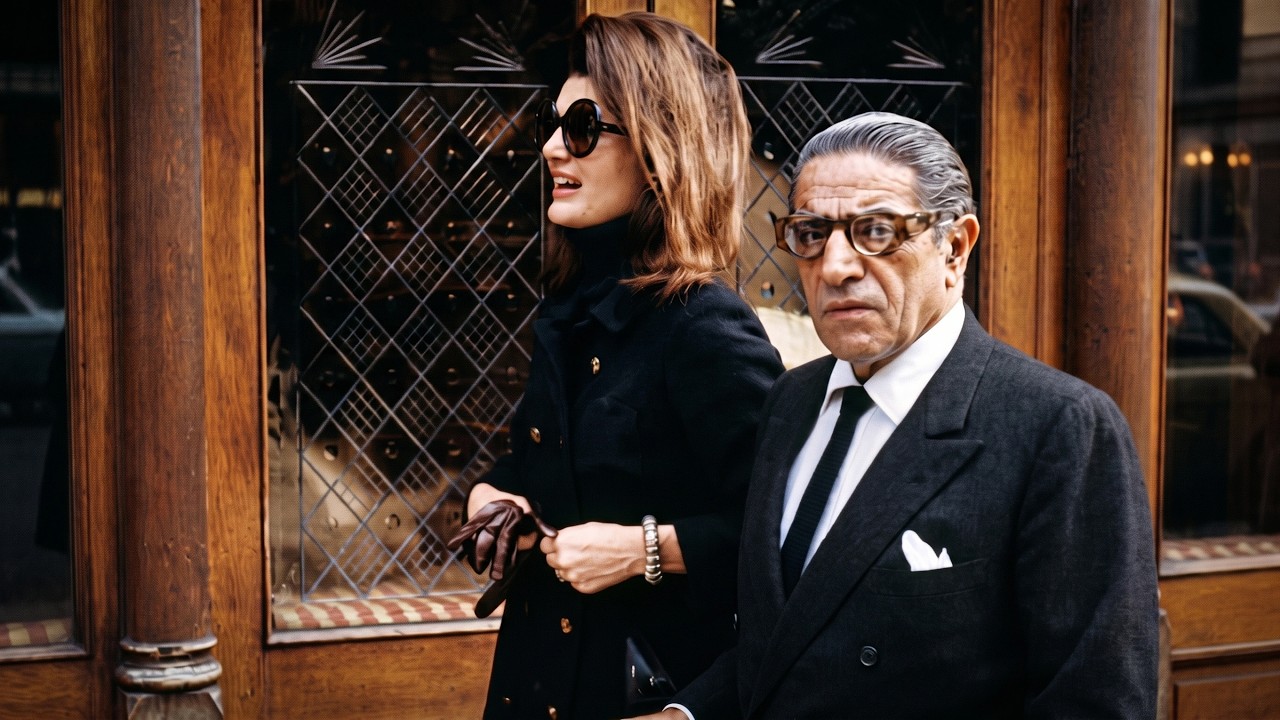
The Skorpios wedding itself was small and intimate, staged almost entirely for the people who were not invited. The journalists who had traveled through the rain to stand outside the courtyard were the audience the ceremony was designed to keep at a distance. The silence surrounding the wedding carried its own message.
The most famous American widow had made her choice, and that choice was hers alone. What Jackie was undertaking at Skorpios was a contract her own brother-in-law helped negotiate.
The number everyone remembers, 170 clauses, comes from a single named witness with an interest in the matter. Christian Cafarakis was the former chief steward aboard Christina O, and he sold what he disclosed to a London newspaper in 1971. Jackie's office rushed to deny Cafarakis, with her assistant Nancy Tuckerman calling the contract entirely fabricated and ridiculous.
The number itself cannot be confirmed. Later accounts inflated it to 173 or nearly 200. What can be confirmed is that an official marriage document did exist. The notarized settlement document later sold at auction, signed by Jackie and Christina Onassis, refers directly to the original agreement made at the time of the marriage. The document was real, even if the details of its contents remain a matter of conflicting claims.
So the clauses everyone quotes are just a steward's account. The existence of the agreement is established in the records. The negotiations behind it were handled by professionals on both sides.
Ted Kennedy, Jackie's brother-in-law, opened the negotiations on her behalf and was prepared to accept about 1.5 million dollars. Hugh Auchincloss, Jackie's stepfather, urged asking for more, and the matter moved to Andre Meyer, the Lazard Freres banker the Kennedy family trusted. Meyer was appalled by the opening number and pushed it higher, reportedly floating 20 million before Onassis warned him that his client might take herself off the market.
The notarized document confirms a payment of 2 million dollars at the marriage, not the 3 million some biographers cite. The steward's accounts describe the remaining details precisely: monthly cash sums for personal expenses, separate bedrooms in each of the couple's six residences, trust funds for her two children with the annual interest paid to her, and annual allowances for what Cafarakis called her safety and well-being, which included a budget for round-the-clock bodyguards.
The divorce clause was set at about 17 million dollars if Onassis ended the marriage. The number that explains this deal is the number Greek law would automatically have imposed. Under Greek forced-heirship rules in 1968, a widow was entitled to a fixed share of her husband's estate, the price of the estate, from a fortune later estimated at about 500 million dollars. That share would have come to roughly 62 million at his death.
By signing the contract, Jackie traded the larger automatic inheritance for guaranteed cash in the present and a fixed number in the future. She was buying security at a discount, swapping an uncertain widow's fortune for a certain monthly income. The trade made sense for a woman who had already watched from the passenger seat in Dallas how quickly wealth turns into widowhood. She did it with the cold efficiency of a woman who had already watched a fortune vanish in Dallas.
The conflicting financial figures in different accounts are worth noting, because they show how a disputed document acquires false precision through retelling. Reports of first-year spending ranged between 580,000 dollars and 1.5 million dollars. Journalist Fred Sparks put the couple's total spending at an average of more than 380,000 dollars a week. That is the basis for the title of his book, "The 20 Million Dollar Honeymoon."
None of these numbers can be matched precisely because the underlying contract was never published in full. What remains instead is a cloud of figures orbiting a document whose existence the parties confirmed and refused to disclose. The pattern of disputed numbers is the story itself. A document of this magnitude, signed by parties of this fame, exists in popular memory as a list of clauses rather than as a legal document anyone has actually read.
What the contract did not buy her was the one thing the marriage marketed itself as providing. The contract gave Jackie a title and a material income. But it did not buy her the man's attention, because that attention had belonged to someone else since 1959.
Onassis kept his apartment at 88 Rue de Faubourg in the 16th arrondissement of Paris. Maria Callas kept hers a short distance away at 36 Rue Georges Mandel. According to his personal secretary, Kiki Moutsatsos, the two never stopped seeing each other after their relationship began because they could not live without each other.
Moutsatsos described this open secret within the household in an interview published by People magazine in December 2024. When she called staff in Athens or Paris each morning, they would tell her jokingly that Mr. Onassis was very, very tired. When she asked why, they would say Maria had visited him during the night. Everyone in the house knew. Jackie knew too.
Jackie complained to Onassis's sister, Artemis, who advised her not to fight and to ignore it. Moutsatsos said Jackie behaved like a cat, very cleverly and cunningly, waiting for the right moment to confront him about his behavior.
The cruelty inside the household was not limited to infidelity. The more serious claims concern the medical staff Onassis retained. Biographer Arianna Stassinopoulos, in her 1981 book on Callas's life, drawing on more than 2,000 letters from the singer to her godfather and extensive interviews, stated that Callas underwent an abortion in 1966 at Onassis's insistence.
He told her he would end their relationship if she kept the child, as he had already resolved to marry Mrs. Kennedy as the grand prize in his pursuit of status. Major American newspapers published the claim in February and March of that year. Academic consensus has rejected another account by writer Nicholas Gage alleging a live birth in 1960, on the grounds that it rests on forged hospital records.

More disturbingly, Lindsay Spence's 2021 biography "Cast a Diva," built on previously unseen archives at Stanford, alleges that Onassis kept an abortion doctor on his personal staff. According to Spence, the doctor was used not only with Callas but with his first wife, Tina, and with his daughter Christina when she became pregnant at 19.
The geography of this arrangement was a quiet cruelty in itself. The two apartments sat in the same upscale arrondissement, close enough that a man could leave one in the evening and reach the other on foot. According to Moutsatsos, that is exactly what Onassis did on the nights when staff reported he was too tired to take calls.
Jackie occupied the residence with the title and the contract clauses. Callas occupied the apartment where the man actually lived, in an arrangement the staff in both residences understood from the first week of the marriage. The wife who had stipulated separate bedrooms in her marriage contract found that the clause she insisted on was superfluous, because the bedroom that mattered to her was in an entirely different building.
The advice she received from her husband's sister was to pay the whole thing no attention. She did so publicly. She complained only privately, and only to a few trusted intimates who could be counted on to keep quiet about what she said. The public Jackie remained as she was throughout the marriage, just as the cameras caught her at the wedding chapel: a woman enduring her circumstances with total control of her expression.
What she could not prevent was her humiliation being turned into material for public consumption in the one place she thought was entirely private. In the summer of the early 1970s, a team of 10 photographers carried out a covert operation against Jackie on the island of Skorpios.
The scale of the operation deserves to be stated plainly. According to American press reports in late November 1972, the magazine that published the photographs claimed the photographers had been pursuing Jackie since January 1971, in a campaign lasting roughly a year and a half. They worked from speedboats, wore scuba gear, and carried underwater cameras so they could surface near a shore she believed no lens could reach.
They treated her body as a commodity to be harvested in the one spot on earth she thought was entirely private. Photographs of Jackie sunbathing and walking nude were first published across nine pages in the men's magazine Playmen in Rome in November 1972. The page count was reported at the time by the New York Times and was not inflated in later accounts.
Three years later, American publisher Larry Flynt bought the U.S. rights for 18,000 dollars and published some of them, four of them full-page, in the August 1975 issue of Hustler. He ordered a far larger print run than usual, and his gamble paid off completely. The issue sold out within days, with sales jumping from a few thousand copies to more than two million. The photos launched Flynt's publishing empire, and he would later describe the purchase as the smartest investment of his life.
What turns this violation into something darker is the identity of the person who, according to one account, arranged it. Christopher Andersen's 2014 biography "The Good Son" names Onassis himself as the source who unleashed the photographers. Andersen writes that in November 1972, 10 photographers put on diving suits and infiltrated the waters off Skorpios, and that detailed maps of the island and the dates, times, and expected locations of Jackie's presence were all provided by Ari.
According to Andersen's literal account, Onassis had grown weary of funding the privacy lawsuits his wife kept filing, and devised a plan to embarrass Jackie so thoroughly that the press would have nothing left to do to hurt her, while wounding the woman he always mocked as "the widow." The photographers, using the maps and schedule provided, captured dozens of color images of her.
Andersen's claim is disputed. The daughter of one photographer opposed it, insisting her father acted alone. The photographer, Settimio Garritano, admitted only that an Olympic Airways employee had directed him, and never confirmed that Onassis gave the order.
What Jackie did in response embodies how powerless her position was. She had previously filed privacy lawsuits, the very suits Andersen says her husband refused to keep funding. But faced with photographs already printed and sold in two countries, no court could recover those images. The most photographed woman of her century absorbed the exposure in public silence.
If we strip away the vocabulary of the era, the scandal magazines, what remains is the non-consensual publication of intimate images of a woman who had no means to prevent it, sold for profit and, if Andersen is right, arranged by her own husband to break her. The financial reward for the photographers and agents who brokered the sale of the images was, in its own way, the final invoice of the operation. The photographs functioned as a financial transaction at every stage, and the woman in them received nothing from any party that profited from her exposure.
The campaign to break her would continue until grief broke her husband first. On January 22, 1973, Alexander Onassis, his only son and the heir for whom everything had been built, was aboard a small amphibious plane that crashed on takeoff at Athens's Hellinikon airport. He died of his injuries the next day at the age of 24.
The loss broke something in Onassis that no fortune could repair. He poured his grief onto his wife. He began privately calling Jackie "the witch." He told his closest aides that she carried a curse, justifying it with the dark superstitions of a shattered man.
The first important man in her life had died, then the second, and now his son had died while she was Mrs. Onassis. His daughter Christina, who had called Jackie a gold digger from the start, fed the belief as well. Her brother, whom she had lost, summed it up plainly: "My father loved titles, and Jackie loved money."
The following year, Onassis set about ending the marriage with deliberate cruelty. He engaged attorney Roy Cohn in 1974 to begin drafting divorce proceedings, a fact Cohn confirmed to the New York Times in 1981, making it one of the few claims in this entire story directly supported by the person involved.
Stassinopoulos reported that Onassis hired a private investigator to track Jackie and obtain evidence of infidelity, and that he decided to divorce her, but only after making it as humiliating for her as possible, a phrase United Press International quoted directly from the book.
The groundwork for the cruelty campaign had been laid years earlier, in February 1970, when four personal letters from Jackie to Roswell Gilpatric surfaced in a Manhattan autograph shop and were reported by Time magazine. The embarrassment occurred during her marriage, and her husband was not about to let her forget it.
The circle around Onassis was also emptying of people, and each loss seemed to confirm the curse he had attached to his wife. His first wife, Tina, mother of the son he had just buried, died in Paris in October 1974 of a barbiturate overdose, a year and nine months after Alexander's plane crash.
Christina, who had loathed Jackie since the wedding and called her a gold digger and worse, became the chief prosecutor of the curse theory. She told her father that the American woman had brought the family bad luck. The conviction grief had already formed in Onassis's mind was reinforced by the daughter most eager to see the wife gone.
Onassis had spent decades drawing people into his orbit, and that orbit was now visibly collapsing inward on the man at its center. Instead of examining the appetites that had drawn them all to him, he looked for a single cursed figure to blame, and found her in the bedroom at the end of the hall that the contract had guaranteed would remain separate from his.
His body was collapsing as quickly as his marriage. He suffered from myasthenia gravis, an autoimmune disease that strips muscles of their ability to respond. In his final months, he appeared in public with his eyelids taped open because he could no longer lift them himself. A man who had spent his life arranging how others appeared had lost control of his own face.
Cohn's engagement was concrete enough that papers existed, and those papers would later end up in the hands of Constantine Gratsos, Onassis's closest aide. He spent that terrible final year trying to engineer one last humiliation for the wife he had bought and then come to hate.
Onassis died on March 15, 1975, at the American Hospital in Paris of acute pneumonia brought on by myasthenia gravis. He died before the divorce he had initiated could be recorded, and so Jackie remained technically his widow.
His will was the final instrument of the campaign he did not live to complete. He left 55 percent of his fortune to his daughter Christina and 45 percent to the foundation named for his dead son. He reduced his widow's share to the smallest amount a Greek widow could receive, which those familiar with the matter estimated at about 3 million dollars.
Christina, who had wanted Jackie gone since the wedding, seized the opportunity, and the two women fought through lawyers for two years. The settlement gave Jackie about 26 million dollars in exchange for waiving any further claim. The number was less a victory than a withdrawal, the price at which she agreed to stop being an Onassis in everything but the name she would keep.
The money passed to Maurice Tempelsman, the Belgian-born American diamond dealer who would become her companion in her final years. Over the following decade, Tempelsman multiplied the sum four times over.
There was someone in the apartment on Rue Georges Mandel. Maria Callas reached Onassis in his hospital room, according to one account, by a service elevator while he was in a coma. She kept her red Hermes blanket near him in his final moments. Two and a half years after his death, on September 16, 1977, Callas died of a heart attack in that apartment at the age of 53. She spent her last years in isolation, dependent on the sedatives her biographers describe, and in a loneliness everyone confirmed.
According to Stassinopoulos, citing Onassis's closest aide Constantine Gratsos, who held the unrecorded divorce papers, Onassis said in his final months that Maria had been the real love of his life. He said his marriage to Jackie was the greatest betrayal of his life toward her. He said he was preparing to leave Jackie and return to Maria at the moment his body failed him.
Set against all of that, Jackie's public statement on his death reads like a document drafted by a lawyer. She said Aristotle Onassis had rescued her at a moment when her life was drowning in shadows, that they had shared many beautiful experiences together, and that she would be grateful to him forever. Not a word about love, no mention of grief, not a single syllable that could be used against her by anyone reading the statement carefully.
The widow gave the public a document crafted with the same care her late husband had once given their marriage contract. The verbs are verbs of rescue and treatment, expressing gratitude, not loss. And the woman who chose them had chosen every word she presented to the public for 30 years.
The same composed widow who stood in the rain at the Panagia church walked out of the funeral home in 1975 to negotiate a settlement, decide on a reconciliation with her sister, and begin a second chapter of her life that lasted 30 years. Jackie lived with Tempelsman, who moved into her Fifth Avenue apartment in 1988, though he never divorced the wife he had separated from years earlier.
She was diagnosed with non-Hodgkin's lymphoma in the winter of 1993 and died on May 19, 1994. In her final months, she burned her letters and private photographs with her own hands. A friend once said Jackie had lived three lives: a public life, a private life, and a secret life. The burning was the final act of liberation by a woman who had spent her life deciding what others were permitted to know.
She made sure that after her departure only the first life remained, and that the discreet erasure she carried out in her final months matched the secrecy that had accompanied her for decades as a public figure. The man who spent his life arranging what people were allowed to see was, in the end, outdone by a woman whose discretion equaled his voracity.