On December 19, 1944, in Verdun, France, the map told a story of disaster. A massive German bulge was tearing through Belgium, Bastogne was surrounded, and the northern front was collapsing.
General Dwight D. Eisenhower looked at George S. Patton. He needed the Third Army to turn north, stop the offensive in the Saar, and relieve Bastogne.
Patton's army of 250,000 men and hundreds of tanks was aimed east at Germany's heart. Eisenhower was asking him to pivot 90 degrees in winter across frozen roads.
"How soon can you start?" Eisenhower asked. Every officer in the room knew the answer. A week, maybe 10 days.
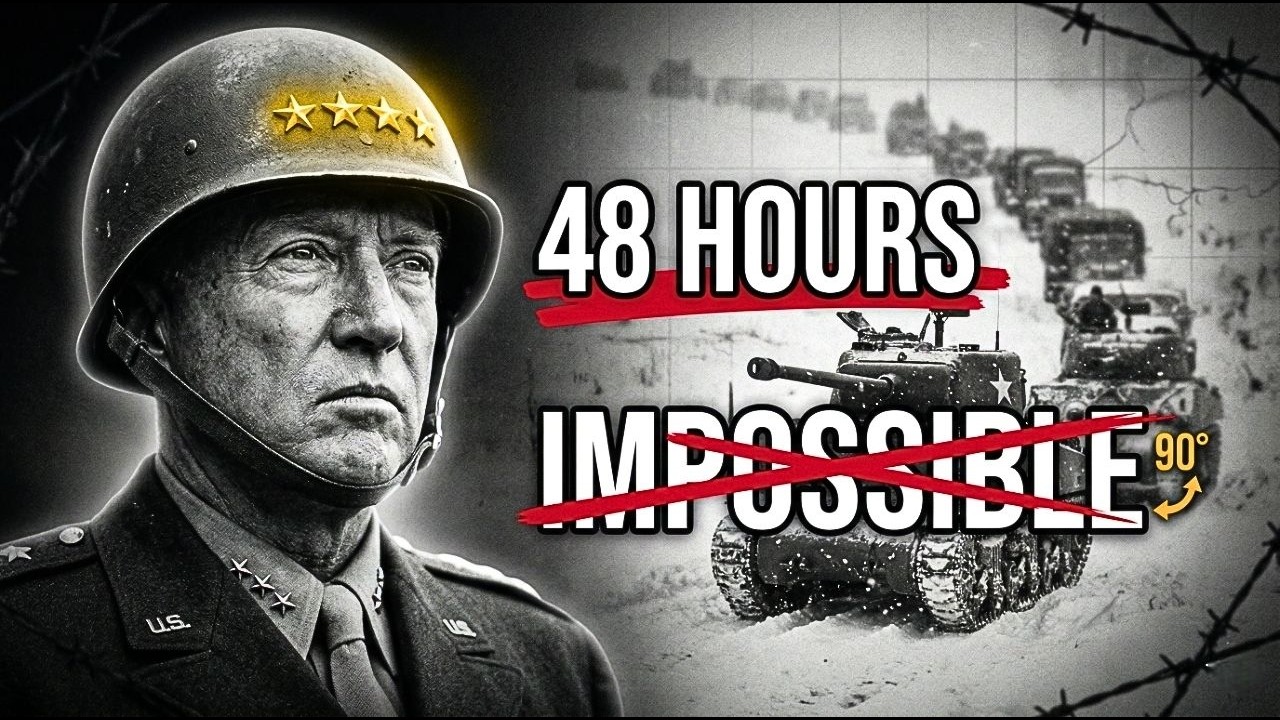
Patton smiled. "48 hours, three divisions."
The room went silent. Bradley thought he was joking. The logistics officer stared. It was impossible. But Patton had been planning this move in secret for three weeks.
To understand what Patton did, you first need to understand where he was and what he was doing when the Germans attacked.
On December 16, 1944, three days before that meeting in Verdun, Patton was deep in eastern France near the German border. His Third Army was locked in brutal combat around the Saar River.
The fighting was slow and bloody. The Germans were dug into concrete bunkers. Every mile cost lives, but Patton was winning, slowly and painfully.
He was grinding forward toward the Rhine River, toward the heart of Germany itself. His entire operation was pointed east.
The fuel dumps were positioned for an eastern advance. The supply convoys were running east. The artillery was aimed east. The maps on every commander's desk had arrows pointing east.
This wasn't just a direction, it was momentum. The Third Army was a freight train barreling toward Germany at full speed. And Eisenhower was about to ask Patton to yank the emergency brake and steer it 90 degrees north.
Then the Ardennes exploded.
On the morning of December 16, Hitler launched his last great gamble. It was like a sledgehammer smashing through glass.
Three German armies, over 200,000 men, smashed into the lightly defended American lines in the Ardennes forest of Belgium. The Americans weren't ready.
The forest was supposed to be quiet, a rest area. The Germans weren't supposed to attack there, but they did.
Within hours, the American front was shattered. Entire units were surrounded. Roads were cut. Communications went dead. German tanks were racing west toward the Meuse River.
If they reached it, they could drive all the way to Antwerp, splitting the Allied armies in half.
And right in the path of the German advance was a small Belgian town called Bastogne.
Bastogne didn't look important. It was just a town. But it sat at a crossroads. Seven roads met there. It was the knot holding the entire front together.
If the Germans wanted to keep driving west, they needed those roads, and the Americans knew it.
The 101st Airborne Division was rushed to Bastogne with orders to hold at all costs. By December 19, Bastogne was surrounded.
The paratroopers were cut off, low on ammunition, low on food. The weather was terrible. Thick fog and snow kept Allied planes grounded. No air support, no resupply.
The Germans were closing in. Eisenhower knew the situation was desperate. That's why he called the emergency meeting in Verdun. He needed solutions, fast.
The room in Verdun was cold. The mood was colder. Eisenhower stood at the head of the table.
Around him sat the most powerful American commanders in Europe. Omar Bradley, commander of the 12th Army Group. Courtney Hodges, commander of the First Army. Jacob Devers and Patton.
Eisenhower didn't waste time. He pointed at the map. The red bulge representing the German advance was growing.
He needed someone to counterattack, to hit the Germans from the south and relieve Bastogne. He turned to Patton.
Patton was already looking at the map. His eyes were moving, calculating. He had been expecting this call, not hoping for it, expecting it.
You see, Patton had a secret. For three weeks, while he was fighting in the Saar, his intelligence officer, Colonel Oscar Koch, had been warning him.
Koch was good, one of the best intelligence officers in the army. And Koch had been seeing signs. German units disappearing from the front, radio silence, troop movements.
Something was building. Koch told Patton the Germans were planning something big.
Most commanders ignored reports like that. The Germans were losing. Everyone knew it. Why would they attack?
But Patton didn't ignore it. He listened. And while everyone else was playing checkers, Patton was playing chess.
He told his staff to prepare contingency plans, three of them. Plans for what the Third Army would do if the Germans attacked in the north.
Plans that assumed Eisenhower would call and ask Patton to turn his army and drive north into Belgium. Nobody else knew about these plans. Not Bradley, not Eisenhower.
Patton kept them quiet. He didn't want to look like he was second-guessing the high command, but he wanted to be ready.
So when Eisenhower asked how soon Patton could attack, Patton already had the answer. 48 hours.
Bradley's jaw dropped. You could hear the disbelief in the room. 48 hours? To disengage from a battle, turn an entire army 90 degrees, move it over 100 miles north on icy roads in the middle of winter, and attack an enemy that outnumbered you?
Eisenhower stared at Patton. He thought Patton was being reckless. Patton had a reputation, aggressive, sometimes too aggressive.
Eisenhower used the word fatuous. He worried Patton would rush north with a half-ready force and get destroyed.
But Patton wasn't guessing. He pulled out a notebook. He showed Eisenhower the plans.
Three divisions, the Fourth Armored Division, the 26th Infantry Division, the 80th Infantry Division. He had routes mapped. He had already alerted his commanders. His staff was ready to execute.
Eisenhower looked at the plans. He looked at Patton, and he made the call. "Do it."
Patton left the meeting and drove straight back to his headquarters in Nancy, France. He arrived after midnight. His staff was waiting. They had been waiting for days, quietly preparing.
Now it was real. Patton's chief of staff, General Hobart Gay, gathered the officers. Patton stood in front of the map and laid it out.
The Third Army would execute a 90-degree pivot. Three entire divisions, tens of thousands of men, hundreds of tanks, thousands of trucks would stop fighting east, turn north, and drive into Belgium.
The Fourth Armored Division would lead. They were Patton's best, fast, aggressive. Their commander, Major General Hugh Gaffey, was a tank officer who understood speed.
The 26th Infantry and the 80th Infantry would follow, providing support and holding ground.
The orders went out immediately. Radios crackled across the front. Commanders were pulled out of battle and told to prepare to move north, Bastogne, 48 hours.
Now came the hardest part, logistics. Moving an army isn't like moving a football team. You can't just turn around and run the other direction.
An army is a massive, complex machine. Fuel, ammunition, food, medical supplies, spare parts, everything has to move, and it all has to arrive at the right place at the right time, or the whole operation collapses.
Patton's Third Army was consuming thousands of gallons of fuel every hour. The fuel was stored in dumps positioned for an eastern advance. Now those dumps had to be moved, or new ones established in the north, fast.
The roads were a nightmare. December in Belgium is cold, snow, ice. The roads weren't built for heavy tanks. A single broken-down truck could block an entire convoy. And Patton needed those convoys moving 24 hours a day.
His logistics officers worked through the night. They mapped routes. They positioned fuel trucks at intervals along the roads. They coordinated with supply depots. They made sure every unit knew where to go and when.
And the men? The men were exhausted. They had been fighting for weeks in the Saar, cold, wet, tired. Now they were being told to stop, pack up, and march 100 miles north to fight again.
But they did it.
On December 20, the movement began. The Fourth Armored Division pulled out of the line near the Saar and turned north. Behind them, the 26th and 80th Divisions followed.
Convoys stretched for miles. Tanks, trucks, artillery, all moving north through the snow.
The weather was brutal. Temperatures dropped below freezing. The roads turned to ice. Vehicles slid off into ditches. Engines froze. Soldiers marched with their coats pulled tight, their breath visible in the freezing air.
And Patton? Patton was everywhere. He drove up and down the columns in his jeep, checking progress, shouting encouragement, cursing at traffic jams.
He wanted speed. Every hour mattered. The men in Bastogne were running out of time.
By the evening of December 21, the lead elements of the Fourth Armored Division were in position south of Bastogne. Patton had done it. 48 hours, exactly as promised.
On the morning of December 22, Patton launched his attack. The Fourth Armored Division smashed into the German southern flank.
The fighting was immediate and brutal. The Germans weren't expecting an attack from the south. They had been focused on Bastogne, on squeezing the Americans inside the pocket.
Now they had a new problem, Patton.
The Fourth Armored drove north like a spear through flesh. Villages fell. Roads opened. The Germans tried to stop them, throwing Panzers and infantry into the fight, but Patton's tanks kept moving.
The 26th and 80th divisions spread out, protecting the flanks, widening the corridor. Inside Bastogne, the paratroopers heard the artillery, American artillery, from the south. Relief was coming.
On December 26, four days after Patton launched his attack, the lead tanks of the 4th Armored Division broke through the German lines and reached Bastogne. The siege was over.
The Americans inside Bastogne were exhausted, battered, low on everything, but they had held, and Patton had reached them.
The Battle of the Bulge would continue for weeks. The fighting was savage, but Patton's counterattack had stopped the German advance. The momentum shifted. The Allies were back on the offensive.
Eisenhower later called it one of the most brilliant operations of the war. Patton had taken an army locked in combat, turned it 90 degrees, moved it over 100 miles in winter, and launched a successful attack in 48 hours. Military analysts still study it today.
But here's the question nobody asks. Was Patton lucky? Or was he prepared?
Some historians say Patton got lucky. The Germans were overstretched. Their fuel was running out. The weather cleared just enough for air support. Bastogne held longer than anyone expected. Maybe Patton's gamble worked because of factors beyond his control.
But others say Patton created his own luck. He listened to his intelligence officer when others didn't. He planned for the unexpected. He kept his plan secret so he wouldn't be overruled. And when the moment came, he was ready.
There's a lesson in that. In war, in business, in life, preparation looks like luck when it works.
Everyone thought the 48 hours was impossible. The Germans thought they had won. Bradley thought Patton was reckless. Eisenhower thought it was a gamble. They were all wrong.
Patton didn't wait for permission to plan. He didn't wait for certainty. He prepared for what might happen, not just what was happening. And when Eisenhower asked the impossible, Patton had an answer.
Today, if you visit Bastogne, you can see the monuments to the 101st Airborne, the Screaming Eagles who held the town. You can walk the streets where the battle was fought.
And just outside the town, there's a memorial to the 4th Armored Division, Patton's tankers who broke the siege.
Patton himself is buried in Luxembourg at the American Cemetery, alongside thousands of men who died in the Battle of the Bulge. He's the only four-star general buried there. His grave faces the men he led.
The 48-hour maneuver that saved Bastogne wasn't just about speed. It was about preparation, leadership, and the willingness to take a risk when everyone else said it was impossible.
Was Patton right to promise 48 hours? Or was he reckless, gambling with the lives of his men and the fate of the battle?