Mordecai Granger, a 47-year-old logger living alone on the edge of the remote Appalachian settlement of Ashenvale, spent the autumn of 1887 watching his neighbors gather around an abandoned town well in the dark, moving in perfect, silent synchronization as they struck the ground with tools—even though the earth never showed a mark. The well had not been used for decades. In July 1861, a woman named Sophronia Weatherall drew up water clouded with something dark and found a piece of paper floating in it. Whatever she read made her lock herself in the church for three days, leave the settlement within the week, and the townspeople never drew from the well again, preferring the longer walk to the creek.
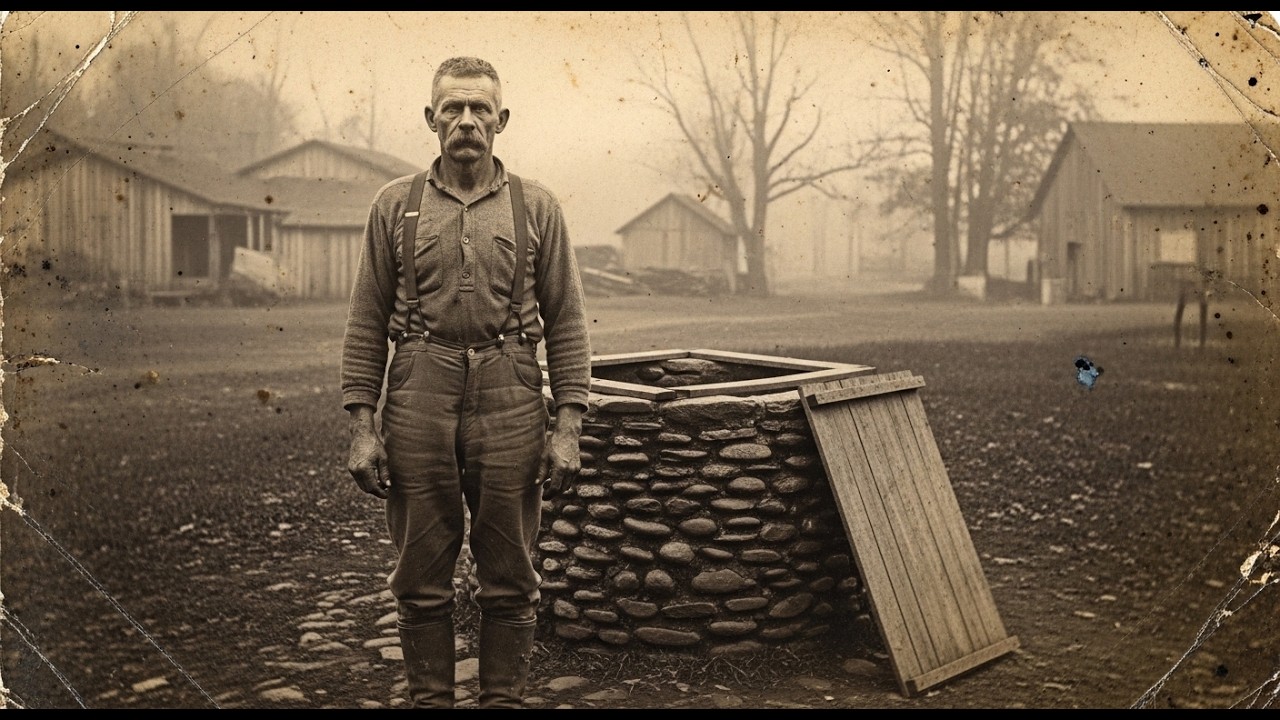
The well was older than the settlement itself, its stones worn smooth by something that left them slick even in August. Mordecai first witnessed the strange gatherings late one October evening while returning from a job six miles south. Roughly 15 of the settlement’s 40 residents were gathered in the square, attacking the ground around the well’s base with picks and shovels. No one spoke.
No one reacted when he called out. When he put his hand on the shoulder of Nehemiah Fletcher, the storekeeper, the man turned and smiled in a way that Mordecai later described as belonging on a face that had forgotten how the expression worked. Instead of words, the sound that came out was hollow, echoing water dripping on stone. The next morning, the ground was undisturbed and everyone he asked denied having been in the square.
The gatherings continued irregularly for months, drawing more participants each time, always leaving no trace. In late December, Mordecai lowered a lantern into the well to examine it. At roughly 40 feet, he found the bottom—dry, with no water. Instead, it was filled with paper.
Hundreds of pieces, densely written, stacked like sediment, some fresh and others yellowed with age. As he watched, new pieces of paper materialized out of the air and drifted down to join the pile. That night he dreamed he was standing at the bottom of the well as papers rained down around him. One phrase repeated on every sheet, always in the same handwriting: “The debts must be counted.
”
Weeks later, he woke to find the gathering outside his own cabin. This time, around 30 people surrounded the structure, all facing his home, digging and sawing not into the ground but into the air, as if striking something solid only they could see. When they dispersed, his porch was covered in dozens of papers covered in the same dense handwriting. They were fragments: “The well remembers every secret,” “Sophronia knew, but couldn’t speak,” “Every secret written is a contract signed.
”
Mordecai pieced together an understanding. The well was not for water. It was a place where people had dropped written confessions, the secrets they could no longer carry. The gatherings, he concluded, were installments on a debt—nights of labor in payment for generations of discarded guilt.
He also remembered that he had used the well himself. Three times over two years in his younger days, he had written down mistakes he could not live with and dropped them into the darkness. He decided to climb down into the well himself. At the bottom, he found not a narrow shaft but a chamber, the walls of paper stretching in rows and stacks.
He read confession after confession: Permelia Whitlock admitting she had given her baby away and told her husband it died; Nehemiah explaining he had stolen from the church collection for nine years; Hiram Jessup confessing he had driven his brother’s wife’s family away from town after she rejected him. He found his own papers, small betrayals—money never returned, a courtship that had broken another engagement, testimony that had cost a man his standing and driven him from the settlement in disgrace. As he read, the papers began to move. They lifted off the piles and swirled around him, a vortex pressing in from all directions.
He could not breathe, could not move, and through it all he heard the phrase repeated: “The debts must be counted. ”
He woke in his bed in the morning, his rope coiled neatly on the floor, no dirt under his nails. But his hands were covered in writing that would not wash off. It was a ledger.
Names, and amounts. Not money, but nights. Nehemiah owed 214. Permelia owed 198.
Hiram owed 307. Sophronia Weatherall was marked “paid in full through departure. ” Mordecai owed 89. The gathering was payment; each night of synchronized labor deducted one night from the total.
But the work was not happening in the physical world. It was happening elsewhere, clearing accumulated guilt from a reality adjacent to their own. Rather than accept the accounting, Mordecai chose to destroy it. He gathered kerosene, rags, and kindling, and in the afternoon when the square was empty, he dropped burning material into the well.
The papers caught fire immediately. The well burned for three days, smoke rising in a column that did not bend with the wind. When the fire died, he climbed down again. The papers were gone.
In their place was a smooth black surface like glass or obsidian, fused to the stone floor. In that reflection, he could see faces—everyone who had ever written a secret and dropped it into the darkness, caught between relief and terror. The gatherings stopped. But the dreams began.
Every night, without fail, at 3:00 in the morning, each person who had participated relived their secrets from the perspective of those they had harmed, feeling the full weight of their choices. Mordecai had his 89 nights of dreams. He felt the consequences of his actions rippling through the other lives: the money that had been needed for medicine, the woman whose reputation was ruined after he courted her while she was promised to another, the man he had driven from the settlement who died two years later without his community. On the 90th morning, the writing on his hands was gone.
The dreams stopped. But the understanding remained. The settlement of Ashenvale was eventually abandoned. The church collapsed in a storm in 1932, the general store burned down ten years later, and the houses were reclaimed by the forest.
But the well remains, uncovered. A surveyor vanished near it in 1923, his equipment stacked beside the opening and his journal ending mid-sentence. College students who visited in 1957 all reported recurring dreams of standing in a well while papers rained down. A photographer in 1971 found that his images of the well showed faces in the stone at the bottom—faces from census records of residents long dead.
The Forest Service erected barriers in 1983 and again in 1991. Both were torn down within months. The well remained open, and those who stumbled upon it reported the strong urge to write something down, to confess, to release a burden into the darkness. Mordecai lived another 18 years, never leaving Ashenvale.
He watched the well, made sure no one new used it, and became its keeper. When he died in the winter of 1905, he was buried with no epitaph beyond his name and years. On quiet nights, travelers passing through the ruins of the settlement would swear they saw him standing by the well, looking down into that dark opening, still counting the debts accumulated over centuries of silence.