Lucrezia Borgia has gone down in history as one of the most infamous women of the Italian Renaissance, surrounded by accusations of incest, poisoning, and political manipulation. Born on April 18, 1480, in Subiaco near Rome, she was the daughter of Rodrigo Borgia, a Spanish cardinal who would later become Pope Alexander VI, and Vannozza de’ Catanei, his longtime mistress. Lucrezia received an exceptional humanist education and grew up close to her brother Cesare, a bond that would later fuel dark rumors. Her father used her marriages as diplomatic tools.
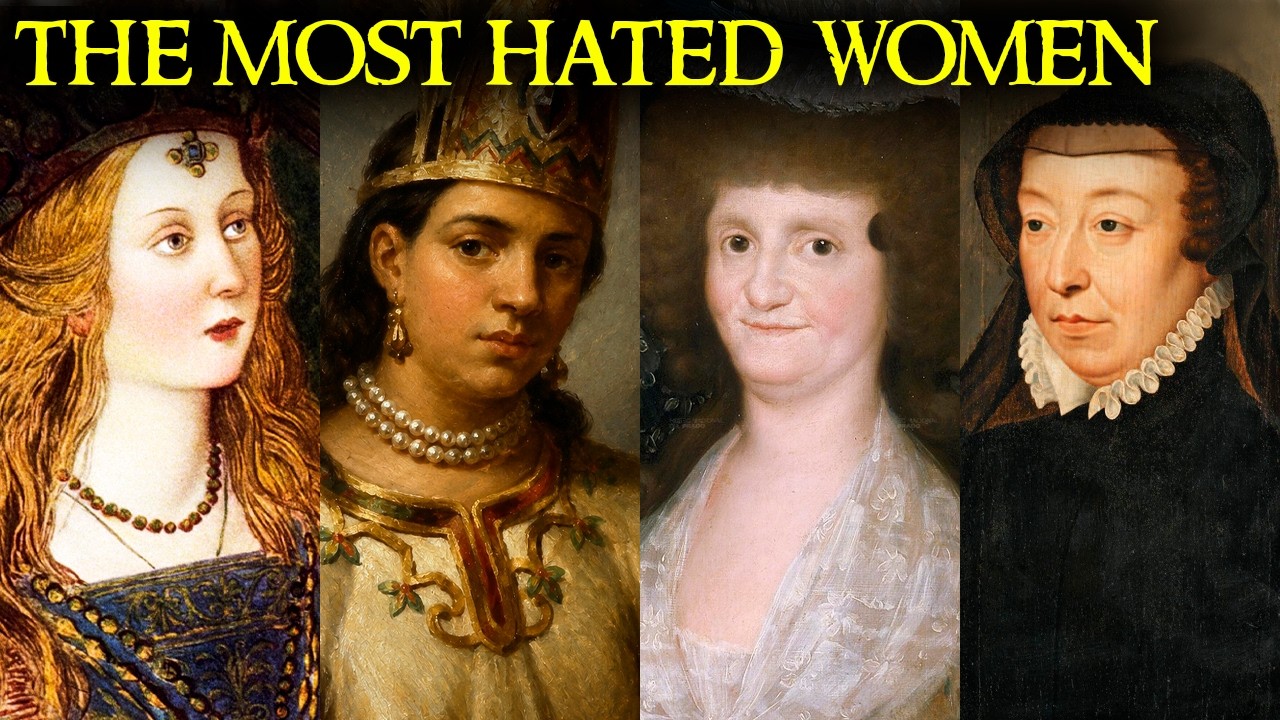
Her first marriage, to Giovanni Sforza in 1493, was annulled in 1497 after the pope decided the alliance no longer served his interests. Sforza signed a humiliating document claiming he was sexually impotent, and afterward, he reportedly spread rumors that Lucrezia had engaged in incest with her father and brothers. Around the same time, a servant named Pedro Calderón was found dead in the Tiber River, fueling speculation that he had been killed after an affair with Lucrezia. Her second marriage, to Alfonso of Aragon in 1498, ended even more violently.
The union had produced a son, but when the Borgias shifted their diplomatic allegiance to France in 1500, Alfonso was murdered in Rome. Many believed Cesare ordered the killing, though it was likely a political decision tied to the papacy’s changing alliances rather than personal jealousy. Lucrezia’s third and final marriage, to Alfonso d’Este of Ferrara in 1502, proved lasting. She became duchess of Ferrara in 1505 and remained there for the rest of her life.
Despite the stability of this marriage, she engaged in several affairs, including relationships with Francesco Gonzaga and the poet Pietro Bembo. During her lifetime, rumors circulated that she wore a hollow ring for pouring poison into drinks and that she participated in the infamous “Banquet of Chestnuts” in 1501, an alleged orgy involving her father and brother. Only one account of that banquet exists, and modern historians increasingly believe it was fabricated to defame the Borgia family. The death of Pope Alexander VI in 1503 marked the beginning of the Borgia decline.
Cesare lost control of his territories, was imprisoned in Spain, and eventually died in battle in 1507. Lucrezia, once the daughter of one of Italy’s most powerful families, was left as an isolated figure from a fallen dynasty. She endured numerous difficult pregnancies and miscarriages over two decades, giving birth to at least eight children, some of questionable paternity. After delivering a daughter named Isabella on June 14, 1519, she fell ill and died ten days later at the age of 39.
Catherine de’ Medici, born in Florence on April 13, 1519, became one of the most vilified queens in French history. As a member of the powerful Medici banking family, she was married at age 14 to Henry of Orléans, the second son of King Francis I of France. The marriage was difficult initially: Henry showed little interest in his bride, preferring his mistress Diane de Poitiers, who was 20 years his senior. For the first ten years, the couple remained childless, which made Catherine, already viewed as a foreigner, deeply unpopular.
She resorted to various strange remedies to conceive, and when she finally succeeded, whispers of witchcraft began to circulate. The couple eventually had ten children over fourteen years, seven of whom survived to adulthood. When Henry became King Henry II in 1547, Catherine became queen, but he allowed her no real political power. That changed dramatically in 1559 when Henry died in a jousting accident.
Catherine found herself as regent for her young son Francis II, and she would remain a central figure in French politics for the next three decades. The religious situation in France was explosive. Protestant Huguenots, concentrated heavily in the south, were demanding freedom of worship, while the Catholic Guise family dominated the government of the young King Charles IX. Catherine tried to navigate a middle path between the warring factions, prioritizing political stability over religious purity.
She negotiated marriage alliances, including the betrothal of her daughter Margaret to Henry of Bourbon, the Protestant prince of Navarre, in 1572. That wedding triggered one of the bloodiest events in French history. Thousands of Huguenots had flooded into Catholic Paris for the ceremony, and tensions were running dangerously high. On the night of August 23, 1572, violence erupted, and by the morning of August 24, Saint Bartholomew’s Day, Catholic mobs had begun massacring Huguenots across the city.
The killing spread beyond Paris, and by the time it ended, between 5,000 and 20,000 Protestants were dead. Catherine was quickly blamed as the mastermind behind the massacre, earning her the nickname “the Black Queen. ” The accusation stuck, but historians now believe it was largely undeserved. The assassination attempt on Huguenot leader Gaspard de Coligny, which triggered the massacre, was likely orchestrated by the Guise family.
Catherine had actually called the royal council together on August 23 in an attempt to restore order. Her son Charles IX, a weak and ineffective ruler, allegedly told his advisors to “kill them all,” but the failure to stop the violence was his, not hers. Catherine remained politically active into the 1580s, acting as an advisor to her son Henry III. She continued to be blamed for whatever went wrong in France, with accusations ranging from poisoning her enemies to keeping a poison cabinet.
She died on January 5, 1589, at age 69. Just nine months later, her son Henry III was assassinated by a Catholic fanatic, and the throne passed to Henry of Navarre, the very man whose wedding to Catherine’s daughter had preceded the Saint Bartholomew’s Day Massacre. As Henry IV, he converted to Catholicism and ended the French Wars of Religion with the Edict of Nantes in 1598. Wallis Simpson, the American socialite whose marriage to King Edward VIII triggered a constitutional crisis, was born Bessie Wallis Warfield on June 19, 1896, in Pennsylvania.
Her father died of tuberculosis when she was just months old, and she and her mother depended on her uncle’s charity during her childhood in Baltimore. Her first marriage, to naval aviator Winfield Spencer Jr. , was unhappy. He was an alcoholic who once crashed his plane into the sea, and the couple separated in the late 1920s.
She then married Ernest Aldridge Simpson, a shipping executive, and moved to London. Wallis met Edward, Prince of Wales, in January 1931. Their relationship became intimate around 1934, while Wallis was still married. By the time Edward became King Edward VIII in January 1936, he was determined to marry her.
The British government, led by Prime Minister Stanley Baldwin, made clear that British society would not accept a twice-divorced American as queen. Edward abdicated on December 11, 1936, after less than eleven months on the throne, and his brother Albert became King George VI. Edward and Wallis were given the titles Duke and Duchess of Windsor and a substantial income to live comfortably in exile. They married in France on June 3, 1937.
Instead of retreating from controversy, the couple accepted an invitation to visit Nazi Germany in October 1937. During their two-week stay, they were hosted by top Nazi officials including Joseph Goebbels, Hermann Göring, and Joachim von Ribbentrop, and they met Adolf Hitler personally at his mountain retreat. When World War II broke out, the Windsors fled Paris ahead of the German advance in 1940, escaping through Spain to Lisbon. There, the Nazis plotted to lure them back to Spain to use them as leverage against Britain.
British intelligence suspected that Edward, through his host, a banker with Nazi connections, may have been planning to return to the throne if Germany won the war. The evidence was never conclusive, but the suspicions followed them for the rest of their lives. The British government arranged for Edward to become governor of the Bahamas for the duration of the war, effectively keeping the couple away from Europe. After the war, the Windsors returned to Paris and lived as exiled royalty, maintaining a certain celebrity status despite the ongoing suspicion about their wartime activities.
Edward died in May 1972 at age 77. Wallis, who had been diagnosed with dementia and lost the ability to speak by 1980, died on April 24, 1986, at age 89. Malinalli, better known as La Malinche, was born around 1500 among the Nahuatl people in the Yucatán Peninsula. Enslaved as a child, possibly sold by her family or kidnapped during a raid, she ended up among the Maya and became bilingual, speaking both Nahuatl and Yucatec Maya.
This linguistic ability would change her fate. In 1519, when Hernán Cortés arrived in Maya territory, local leaders gave him 20 enslaved women as gifts, and Malinalli was among them. When it was discovered that she could speak the language of the Aztecs, Cortés took her from the Spanish nobleman to whom she had been given and made her his interpreter. Her role proved crucial.
The Spanish were outnumbered and desperately needed allies among the Nahuatl-speaking peoples who resented Aztec domination. Using Malinalli as interpreter, Cortés secured alliances with the Tlaxcalans and Texcocans against the Aztec Empire. She became so important that the Spanish called her “Doña Marina,” and indigenous peoples treated her as a noblewoman. When the Spanish reached Tenochtitlan in November 1519, Malinalli translated between Cortés and the Aztec emperor Montezuma.
Accounts of the emperor’s reaction vary. According to one legend, Montezuma may have believed Cortés was the god Quetzalcoatl, who was prophesied to return in the year 1519. The Spanish stayed in the city as guests for over six months, but tensions grew. On the night of June 30, 1520, the Aztecs attacked, and the Spanish were forced to fight their way out of the city, suffering heavy losses.
Malinalli reportedly warned Cortés of the impending attack. After the “sad night,” Cortés regrouped with his indigenous allies and returned the following year. By then, a smallpox epidemic had devastated Tenochtitlan, as the Aztecs had no immunity to European diseases. In the summer of 1521, the city fell, and the Aztec Empire was destroyed.
Cortés once claimed that, after God, no one was more important to his success than Malinalli. After the conquest, she bore Cortés a son named Martín in 1522, though she never married him. When his wife arrived in Mexico, Malinalli was married off to one of his officers. She died of smallpox in 1529 at age 29.
In Mexico, her name became synonymous with betrayal, giving rise to the term “malinchista” for someone who betrays their own country. Yet those who defend her point out that she was a slave who was likely coerced into her role as interpreter. She was helping a foreign power against the society that had enslaved her in the first place. María Luisa de Parma, born December 9, 1751, in the Italian city of Parma, became queen consort of Spain in 1788 when her husband became King Charles IV.
Her marriage to Charles, a weak-willed man more interested in hunting than governing, allowed her to become the real power behind the throne. In an era when women were expected to remain in the background, this made her deeply unpopular. Rumors swirled constantly. The most persistent accusation was that she had a long affair with Manuel Godoy, a young man who rose rapidly to become prime minister of Spain under her patronage.
Some even claimed Godoy was the biological father of several of her children. There were also accusations that she poisoned her rivals, including the Duchess of Alba, who died suddenly in 1802. Modern historians agree the duchess died of tuberculosis, and the poisoning claims were false, but the rumors nevertheless damaged María Luisa’s reputation. The queen had suffered through 24 pregnancies, ten of which ended in miscarriage, and seven of her fourteen children died in infancy or childhood.
These losses, combined with her dominant personality, made her a target for gossip. In foreign policy, Spain initially joined the coalition against revolutionary France but reversed course in 1794 and became France’s first ally among European powers. This alliance with Napoleon proved disastrous. In 1808, Napoleon decided to dispense with the Spanish royal family entirely.
After Charles abdicated and his son Ferdinand was briefly deposed, Napoleon’s brother Joseph was imposed as king of Spain. María Luisa, Charles, and Godoy fled to France, where they lived as near-prisoners. Eventually allowed to move to Rome, they spent their remaining years there under papal protection. Ferdinand, restored to the throne after Napoleon’s fall, prohibited his parents from returning to Madrid.
María Luisa died in Rome on January 2, 1819, at age 67. Her husband died just two weeks later.