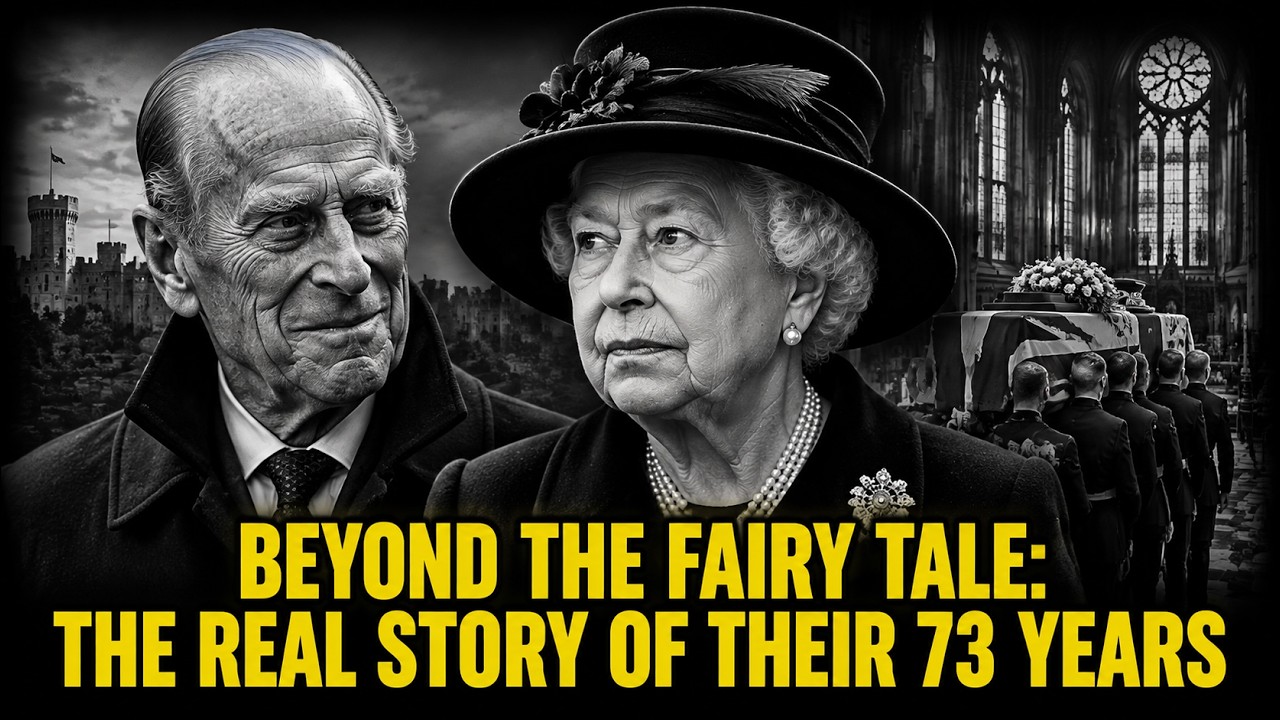
On April 17, 2021, a 94-year-old woman sat alone in a wooden pew in St. George's Chapel at Windsor Castle and waited for her husband's coffin to pass.
She wore black and a face mask. There were 30 mourners in a chapel built for 800, and pandemic rules placed a two-metre gap between her and every other person in the building.
The coffin arrived on the back of a dark green Land Rover Defender. Philip had helped design the modifications himself, arguing with the manufacturer about the colour over a period of 16 years.
He had specified the vehicle for exactly this purpose because he thought a hearse was a waste of a good chassis. It was, in its way, the last practical joke of a man who had spent seven decades being told what he could not do.
The photograph of the Queen in that pew went around the world within the hour and became the single most reproduced image of that year. Millions of people looked at it and felt something break slightly.
What they believed they were seeing was the end of the greatest love story in the modern history of the British monarchy. Seventy-three years, from 1947 to 2021.
It was longer than any marriage in the recorded history of the family, longer than any consort had ever served, and longer than most of the people watching had been alive.
That reading of the photograph was not wrong. It was also not the whole of it, and the distance between those two statements is where the real story sits.
The photograph did not show that for the last four years of his life, Philip had not lived with his wife.
He had moved out of Windsor and Buckingham Palace and gone to a five-bedroom farmhouse called Wood Farm on the edge of the Sandringham estate in Norfolk, a building of no distinction with a kitchen, a wood burner and a view of flat fields.
He read there and painted watercolours. He wrote letters in his own hand and answered his own post. The Queen came up by train at weekends when the diary allowed it, which was not every weekend.
Hugo Vickers, in his book Queen Elizabeth II: A Personal History, describes the arrangement without decoration. In a sense, he writes, they separated.
The photograph also did not show that the woman most frequently at Wood Farm during those years was not the Queen. Her name was Penny Knatchbull, and she was 32 years younger than Philip.
She was in that chapel on April 17, and the palace briefing notes given to the press that morning explained her presence by saying her husband was unwell and she was attending in his place.
Royal correspondents who had watched the two of them together for 30 years found that explanation baffling. One described it publicly as slightly demeaning to Penny, given that she was closer to the Duke than her husband had ever been.
She had turned 68 the day before the funeral. Palace aides told reporters she arrived heartbroken and that she had lost her best friend.
The photograph did not show that the marriage began in a deficit and never entirely climbed out of it.
Philip walked into that family in 1947 as a man with no money, no country, no property, no settled nationality, and four sisters he could not invite to his own wedding because three had married German princes and one of those princes had held rank in the SS.
The court that received him had a private nickname for him. Sir Alan Lascelles, Jock Colville, David Bowes-Lyon and the whole permanent professional class around the throne looked at his file and saw not a survivor but a risk.
It did not show the amoeba. That word matters, and it is the first thing to hold on to, because everything that follows sits underneath it.
In 1952, weeks after his wife became Queen, a fight broke out inside the family about what the royal house would now be called.
Philip's uncle, Lord Louis Mountbatten, had reportedly announced at a dinner party that the House of Mountbatten now reigned over Britain. Queen Mary heard about it, and the newly widowed Queen Elizabeth, the woman the country would come to know as the Queen Mother, heard about it too.
They went to Winston Churchill. Churchill took it to cabinet, and in April 1952 the cabinet ruled that the royal house would remain the House of Windsor.
Philip's surname would not pass to his own children. His friend and equerry Mike Parker recorded what Philip said when the decision came down.
"I am nothing but a bloody amoeba," he said. "I am the only man in the country not allowed to give his own name to his own children."
He was 30 years old. He had just lost the naval career he had earned on merit and loved without qualification. He had lost the command of his own ship, and now he had been told by the government of the United Kingdom that his name was not wanted.
He would spend the next 65 years walking a fixed number of paces behind his wife in public and holding her handbag when she needed both hands free. That is the man in the coffin, and that is what the 73 years were built on top of.
Both things have to be held in the mind at once, because that is the whole trick of this story and almost nobody manages it.
In 1946, before the engagement was public, Philip wrote to Elizabeth's mother that Elizabeth was the only thing in this world which was absolutely real to him.
He wrote to Elizabeth herself that falling in love with her completely and unreservedly had made all his past struggles and even the troubles of the world seem small and petty.
Those are not the sentences of a man executing a career move. They are the sentences of a 25-year-old who had spent his childhood being handed between relatives with one battered suitcase and had finally found a fixed point.
At their golden wedding in 1997, standing at the Guildhall, the Queen said the thing she is now most quoted for saying.
"He is someone who does not take easily to compliments," she said. "But he has quite simply been my strength and stay all these years. And I and his whole family, and this and many other countries, owe him a debt greater than he would ever claim or we shall ever know."
She said it again at the Diamond Jubilee in 2012, calling him her constant strength and guide.
Both of those things are true. The love was real, documented and lasting. And the marriage was also an arrangement with accommodations built into it that the public was never asked to know about, and that the palace worked very hard for a very long time to keep out of view.
The popular version of this story is lazy, and the true version is much stranger and much sadder.
The lazy version says Philip was a serial adulterer, that the Queen knew and swallowed it, that the marriage was a performance, and that behind the balcony waves there was nothing but a cold woman and a cruel man in separate bedrooms.
The problem with that version is that nobody has ever produced a single piece of hard evidence that Philip slept with anyone other than his wife. Not one photograph, not one letter, not one credible first-person account from any of the women named.
Pat Kirkwood denied it for the rest of her life and was furious about it until she died on Christmas Day 2007.
Sasha Abercorn, the Duchess of Abercorn, told the biographer Sally Bedell Smith flatly that she did not go to bed with him and that what they shared was a passion for the work of Carl Jung.
Helen Cordet's son Max gave a specific and on-the-record denial and never varied from it.
Giles Brandreth, whose 2004 book Philip and Elizabeth: Portrait of a Marriage was written with more direct access to the couple than any other account, acknowledges the lifelong pattern of close friendships with younger women and then declines deliberately to call any of them affairs.
So the salacious version collapses the moment you push on it. And yet there is Eileen Parker, the wife of Philip's closest friend and private secretary, who filed for divorce in 1958 and named the Duke of Edinburgh's household as the environment that destroyed her marriage.
The Thursday Club that Philip belonged to in Soho, at Wheeler's in Old Compton Street, was a drinking society of photographers, actors and journalists that no palace press officer has ever been comfortable describing in detail.
And in 1957, while Philip was four months into a solo voyage around the South Pacific aboard the royal yacht Britannia, an American newspaper printed a story alleging a rift in the royal marriage, and Buckingham Palace did something it almost never does.
It issued a direct denial. "It is quite untrue," the statement said, "that there is any rift between the Queen and the Duke."
That denial has been studied for 70 years for one reason. The palace does not comment. When the palace comments, the story has reached a temperature that silence will not lower.
The Queen flew to Lisbon in February 1957 to meet Britannia and be photographed rejoining her husband. When Philip came aboard, every man on the reception party had grown a beard, and the Queen came out to meet them wearing a false ginger beard of her own.
The episode has been retold for decades as evidence of a marriage in perfect working order. Read it the other way and it is a piece of theatre staged by two professionals in a foreign port because the story had got out of the palace's hands.
In 1991, a five-year-old girl named Leonora Knatchbull died of kidney cancer after 14 months of treatment. Philip, who was 70 at the time, attached himself to her mother in a way that lasted the rest of his life and ended with him living in a farmhouse in Norfolk with that woman as his most constant companion, while his wife of seven decades ran the country from Windsor.
None of those things prove adultery. All of them describe a marriage that was not what the public was told it was. That is the honest position, and it is harder to hold than either of the easy ones.
The story begins with a boy born on a dining room table in a rented villa on Corfu in June 1921, whose family was carried off the island by a British warship 18 months later after soldiers arrested his father and came close to shooting him.
By the age of 10, that boy had a mother committed against her will to a Swiss sanatorium with a diagnosis of paranoid schizophrenia, a father living in Monte Carlo with a mistress on money he did not have, and four sisters married off into German nobility and gone.
Kurt Hahn built a school at Gordonstoun on the Moray coast around cold showers and long runs before dawn, and a boy with nothing left to lean on took to it completely.
Then there is a girl born 10 miles away from all of that in every sense, in a house on Bruton Street in Mayfair, third in line to a throne nobody expected her to occupy, whose entire life was rearranged on December 11, 1936.
Her uncle gave up the crown for a twice-divorced American, and her stammering father was handed a job that killed him at 56. She was 10 and understood immediately what had happened to her.
Her governess, Marion Crawford, watched her write out her name on a piece of paper that week and stop halfway through, because the name she had been writing for 10 years was no longer the right one.
On July 22, 1939, at the Royal Naval College at Dartmouth, a 13-year-old princess was introduced to an 18-year-old cadet who had been given the job of keeping the visiting children entertained and who chose to do it by jumping over the tennis nets.
Crawford wrote afterwards that Elizabeth never took her eyes off him. Everything in this story runs out of that afternoon.
The court spent the next eight years trying to slow it down, not stop it. The evidence does not support a blocking campaign, whatever the tabloids have said for 50 years.
What the record shows is a king and queen asking their daughter to wait until she was certain, a long tour of South Africa in 1947 arranged partly to test whether distance would loosen the attachment, and a private nickname used by her mother that biographers can actually pin to her.
The nickname was the Battenburg. It was not shouted. It was filed. It reminded every person in earshot which family he had really come from and how recently that family had needed to change its name to hide the German sound of it.
There is what he gave up to marry her. The Greek and Danish titles were renounced, the Greek Orthodox faith was abandoned, and he converted out of it. He was granted British nationality by naturalisation on February 28, 1947, nine months before the wedding, at which point he took the surname Mountbatten because he had no other surname to take.
Malta gets a chapter of its own, and this part is important because Malta is the control experiment.
Between 1949 and 1951, Philip was stationed there as a serving officer of the Royal Navy, and Elizabeth came out to join him at a rented villa at Guardamangia. There was no full household and no red boxes.
She drove her own car. She went to the hairdresser. She danced at parties, went to the beach, paid her own bills at the shop, and was for the only extended stretch of her adult life a naval officer's wife with a title she was not required to use every hour of the day.
Everyone who saw the two of them in Malta said the same thing afterwards. That was the happiest they ever were.
Then came February 6, 1952, at a game lodge in Kenya called Treetops, and the man who had to walk his wife out into the gardens to tell her that her father was dead and that everything they had built was over.
Mike Parker said later that Philip looked as if half the world had dropped on him. The naval career ended that morning without a decision or a ceremony. He had reached the rank of commander and had his own ship, the frigate HMS Magpie, and he never served again.
The name war is the wound the rest of his life grew around. Then came the coronation, and what it meant that Philip chaired the commission that put television cameras inside Westminster Abbey against the wishes of Churchill, the Archbishop and most of the old guard, and won.
That put 27 million British people in front of a screen on June 2, 1953. That argument was the entire argument of his life in miniature. A monarchy that let people in would survive. One that hid would not.
He also knelt in front of his own wife that day, in front of the cameras he had fought for, put his hands between hers, and swore to become her liege man of life and limb.
Then came the 1950s, the Thursday Club, Mike Parker, Eileen Parker's petition, the Baltimore Sun, Britannia, Lisbon and the beards.
The question of the bedrooms is one everyone asks and almost nobody explains properly. Separate bedrooms in that class, in that generation, in that architecture were standard and mean nothing on their own.
What is worth looking at is not the arrangement but the pattern of who was in the house and who was not over 69 years, and what changed after 2017.
The women have all been named, with the evidence for and against, and with the biographers who knew Philip personally disagreeing with each other on the record.
Ingrid Seward frames it one way. Brandreth frames it another. Sally Bedell Smith has Pamela Hicks, the Queen's own lady-in-waiting and lifelong friend, saying that Elizabeth was very aware that Philip liked to flirt and did not mind, because she understood him very well and recognised the friendships for what they were.
The children get the sharpest edge of the phrase "broken in private," because whatever was or was not happening between the husband and the wife, something was demonstrably wrong between the father and the eldest son.
Philip sent Charles to Cheam and then to Gordonstoun, the school that had made him, and it did not make Charles. Charles wrote home from Scotland describing it in terms that later became famous through his biographer, Jonathan Dimbleby.
The relationship between those two men never fully recovered. Philip's letters to Diana in the 1990s, which Diana's own friends confirmed were kind, sit very strangely next to it.
On August 27, 1979, a fishing boat called Shadow V in the harbour at Mullaghmore in County Sligo took the only person who had ever functioned in Philip's life as a parent.
Then came 1992, the year the Queen herself called an annus horribilis, and 1997, and the week in September when the two of them stood in a corridor at Balmoral trying to work out how to make a 15-year-old boy walk behind his mother's coffin.
Philip said to William: "If you do not walk, I think you will regret it later. If I walk, will you walk with me?"
The last four years were Wood Farm, the Land Rover crash on the A149 near Sandringham in January 2019 when a 97-year-old man pulled out into the low winter sun and rolled his car and walked away from it, and the question of who the Queen asked to persuade him to surrender his licence.
Not a doctor, not a private secretary. She asked Penny. And Penny did it.
Then came the last year of all, when a pandemic did something no institution had managed in 73 years. It put the two of them alone in the same building with nothing to do and nobody to perform for.
They spent the spring and summer of 2020 at Windsor with a skeleton staff, and the household called it HMS Bubble. By every account that has come out since, those months were among the best either of them had.
He died on April 9, 2021, at Windsor, two months short of his 100th birthday. She died 17 months later.
On September 19, 2022, his coffin was moved out of the royal vault and placed beside hers in the King George VI Memorial Chapel, alongside her father, her mother and her sister. The arrangement she had run for seven decades went into the ground exactly as she had organised it.
Between November 20, 1947, and April 9, 2021, those two people appeared together in public on something in the order of thousands of occasions, across every continent, in front of every kind of camera, through 11 of her prime ministers and 13 American presidents.
In all of that time, across 73 years, neither of them ever once in public said anything unkind about the other. Not once. There is no recording, no witness scene, not a single photograph of a row.
Compare that to what happened to every other marriage in that family. Margaret and Snowdon ended in 1978 in the first royal divorce since Henry VIII.
Charles and Diana separated in 1992 and divorced in 1996, with taped phone calls, rival television interviews and two people running competing press operations against each other from inside the same institution.
Andrew and Sarah separated in the same year, with photographs of her taken in the south of France that ended any possibility of repair. Anne and Mark Phillips divorced in 1992.
Four marriages in that generation, four failures, and in the middle of it, the two people at the top holding a line that nobody else in the building could hold.
That did not happen by accident, and it did not happen because they were happier than the others. It happened because both of them, for entirely different reasons, had decided very early that the performance was the job.
She had decided it at 10, watching her father take on work that frightened him because his brother would not.
He had decided it somewhere between a Swiss sanatorium and a headmaster's study at Gordonstoun, where he was told his sister and her husband and their two small sons had gone into a factory chimney in fog near Ostend.
His own account of his childhood is four sentences long, and it is the most revealing thing he ever said about himself.
"The family broke up," he told a biographer. "My mother was ill, my sisters were married, my father was in the south of France. I just had to get on with it. You do, one does."
That is not a man describing resilience. That is a man describing a decision to stop expecting anything, made at an age when most people are still expecting everything, and then carried without amendment for 80 more years.
Put those two together and you get a marriage that could survive anything and could not discuss any of it.
"Broken in private" does not mean what the thumbnails want it to mean. There was no secret second family. There was no hidden bitterness that biographers have unearthed.
What there was, and what the record supports in detail, is something much more ordinary and much harder to look at.
Two people who loved each other and could not spend time together, because one of them had a job that consumed every hour of every day for 70 years and the other had no job at all and was forbidden by the constitution from having one.
A man who was told at 30 that his career was finished, his name was refused, his opinions were unwelcome, and his function was to walk behind, and who then spent the next six decades building a life out of committees and speeches and the Duke of Edinburgh's Award and the World Wildlife Fund and carriage driving, because the alternative was to sit still.
And a woman who understood all of it, watched him go looking for company she could not give him because she was in a room with a red box, and made a decision somewhere in the 1950s that the marriage was more important than the accounting.
That is the accommodation. That is what the palace managed, what she accepted, and what the public was never asked to know about.
The version they gave you was true. The matching outfits, the shared laughter at the racecourse, the silver and the gold and the diamond and the platinum. Two people at the centre of British life for so long that most of their subjects had grown up and grown old alongside them.
It was true. It was just not complete.
Mon Repos, the rented villa on Corfu in the summer of 1921, was not a palace. It was a shabby Regency villa on a wooded slope south of Corfu town, built by a British Lord High Commissioner in the 1820s and handed on to the Greek royal family when the Ionian islands were handed on with it.
It had no electricity and no hot water. The plumbing did not work. Prince Andrew of Greece and Denmark and his wife Alice took it as a summer house because it was free, and because by 1921 there was not a great deal of money in that branch of the family and there was about to be a great deal less.
Philip was born there on June 10, 1921, on the dining room table, according to the account the family told and never bothered to correct. He was the fifth child and the only son.
His four sisters, Margarita, Theodora, Cecilia and Sophie, were 16, 15, nine and seven years older than him in that order, which means that by the time he was old enough to form a memory of any of them, three of the four were already being fitted for someone else's household.
His father was a lieutenant general in the Greek army. That is the fact that ended everything.
Greece in 1921 was in the middle of a war with Turkey that it was about to lose catastrophically. In August 1922, the Greek army in Asia Minor collapsed, Smyrna burned, and something in the order of a million and a half people were driven out of a country their families had lived in for 3,000 years.
A nation that loses a war on that scale goes looking for someone to blame, and it does not usually look upward at the strategy. It looks sideways at the officer corps.
In September, a group of colonels seized power. In October, they began arresting the men they held responsible. Six of them, including a former prime minister and the commander-in-chief, were tried in Athens in November and shot the same afternoon on a field outside the city.
Prince Andrew was arrested and brought before the same revolutionary committee. He had commanded the second army corps. He had at one point in the campaign refused an order he considered suicidal, and that refusal was now being written up as the reason the front had broken.
He expected to be shot. His wife expected it too.
What saved him was diplomacy of a very direct kind. King George V, who had already watched his cousin the Tsar and the Tsar's entire family murdered in a cellar at Yekaterinburg four years earlier and had privately blocked the offer of asylum that might have prevented it, was not prepared to sit through a second one.
A British naval officer named Gerald Talbot was sent into Athens, negotiated with the head of the revolutionary committee, and got the sentence commuted from death to banishment for life. HMS Calypso was waiting off Phaleron.
The family left Greece in December 1922. Philip was 18 months old.
Every retelling of his life includes the detail that he was carried aboard in a cot improvised out of an orange box or a fruit crate, and biographers have been repeating it for a hundred years while noting each time that nobody ever confirmed it. Take it as a story the family liked rather than a fact.
What is not in doubt is the rest of the sentence. The future husband of the Queen of England left the country of his birth as a refugee on a British warship at 18 months old and never lived in Greece again.
They went to Paris, or rather to Saint-Cloud on the western edge of it, into a small house lent to them by Andrew's sister-in-law, Princess George of Greece, who had married into the Bonaparte money and could afford to be generous.
There was no income. Andrew had no profession. Alice had no fortune of her own. They lived on what relatives sent, and the relatives were Mountbattens and Milford Havens in England, who had money and opinions in roughly equal measure.
Philip went to an American-run school in Saint-Cloud called the Elms, where he learned English properly and acquired the accent that would later confuse people who assumed he was Greek.
He was, by every account of those years, a cheerful and physically fearless small boy in a house that was slowly coming apart around him.
His mother was going deaf and had been since birth. She lip-read in four languages, which is a feat of concentration most people cannot imagine sustaining for an hour, let alone a lifetime. By the late 1920s, the concentration was failing.
Alice had always been devout. In 1928, she was received into the Greek Orthodox Church, and the devotion accelerated into something else. She began to describe divine messages. She told people she was in direct communication with Christ and with Buddha.
She developed what her family described as an obsession that made her presence in the house impossible to manage. In 1930, they took her.
Alice was removed from her home against her will by force, on the authority of a family decision backed by medical opinion, and driven to Dr Ludwig Binswanger's sanatorium at Kreuzlingen in Switzerland.
Binswanger was a serious clinician and Kreuzlingen was a serious institution. Sigmund Freud was consulted on her case and offered a view of it that has aged extremely badly. The diagnosis recorded was paranoid schizophrenia.
She was kept for roughly two years and was moved between clinics for some time after that. Philip was eight when she was taken. He was told very little. Nobody explained it to him at the time, and nobody explained it to him for years afterwards.
Within the same two-year window, the rest of it went as well.
Andrew took the collapse of his wife as a release rather than a grief. He moved to the south of France, settled in Monte Carlo, took up with a woman named Andrée de La Bigne, and lived on other people's hospitality and a small allowance for the next 14 years.
He was charming, idle and effectively finished. He died in a Monte Carlo hotel room in December 1944, aged 62, and what he left his only son was a signet ring, a set of ivory-backed clothes brushes and a trunk. Philip wore the ring for the rest of his life. He was wearing it at his wedding. He was wearing it when he died.
The sisters married, all four of them, between 1930 and 1931, into German princely houses. Margarita to Gottfried of Hohenlohe-Langenburg. Theodora to Berthold, Margrave of Baden. Cecilia to Georg Donatus, Hereditary Grand Duke of Hesse. Sophie, at 16, to Prince Christoph of Hesse.
They moved to Germany. They had their own households and their own children. And the nine-year-old brother who had spent his early childhood being looked after by them was now a boy with no mother, no father in any functional sense, and no sisters within 500 miles.
He was passed to England. His grandmother Victoria, Marchioness of Milford Haven, took him in at Kensington Palace, and his uncles took over the management of his future.
George Milford Haven first, and after George died of cancer in 1938, the younger one, Louis "Dickie" Mountbatten, who would spend the next four decades treating his nephew's life as a project to be managed, and who is either the hero or the villain of this story depending entirely on which biographer you are reading that day.
Cheam came first, a prep school in Berkshire where the fees were paid by relatives, then two terms at Schule Schloss Salem in Germany, run by the family of his brother-in-law Berthold of Baden.
The educationalist behind Salem was a German Jew named Kurt Hahn, and by 1933 Hahn had been arrested by the new regime, released after international pressure, and pushed out of the country. He went to Scotland and founded a new school on the Moray coast at Gordonstoun.
Philip followed him there in 1934. Gordonstoun has been so heavily mythologised in both directions that it is worth saying what it actually was.
Hahn's theory was that the modern middle-class boy was being ruined by comfort and needed to be given genuine responsibility and genuine physical hardship early, so that character would form under load.
The practice was cold showers before dawn, runs in all weathers, seamanship on the Moray, a fire service and a coastguard watch staffed by the boys themselves, and a school motto taken from Plato about there being more in you than you think.
For Charles, 30 years later, it would be an institution he described in terms his own biographer later put in print, and it damaged him.
For Philip, it was the first place in his life that gave him a structure he could rely on and did not take it away again. He became head boy. He captained the cricket and the hockey.
Hahn's own report on him used the phrase that everything he does, he does with tremendous power. His housemaster described him as a boy who could be relied on absolutely in an emergency and was frequently a nuisance the rest of the time.
Then on November 16, 1937, the school sent for him.
His sister Cecilia, her husband Georg Donatus, their two small sons aged six and four, and Georg's mother had boarded a Sabena aircraft at Frankfurt bound for London. Cecilia was eight months pregnant. They were flying over for a family wedding.
In heavy fog near Ostend, the pilot came down too low, clipped a factory chimney, and the aircraft went into the ground and burned. Everyone aboard died. In the wreckage, they found a newborn infant beside Cecilia's body, apparently delivered by the impact.
Philip was 16. He was called into his headmaster's study to be told, and he described that moment decades later as one of the worst of his life.
He wrote of the profound shock with which he heard the news of the crash and the death of his sister and her family. He travelled to Darmstadt for the funeral.
And here we arrive at the photograph, because there is a photograph and it has followed him for 80 years.
It shows a 16-year-old boy in a dark overcoat walking behind the coffins through the streets of Darmstadt. On either side of him in step are men in Nazi uniform.
His brother-in-law Christoph of Hesse, Sophie's husband, held the rank of Oberführer in the SS and ran a signals intelligence operation under Hermann Göring. Berthold of Baden had served on the German side. The crowd along the route is giving the salute.
That photograph is real. It is not a forgery and it is not out of context and it does not require explanation away. What it requires is accuracy about who is in it and what they were.
Philip was a schoolboy at a Scottish school founded by a Jewish refugee from that regime, attending his sister's funeral. His brothers-in-law were adults who had made their own choices.
Two years later, he would be at sea in a British warship, and Christoph of Hesse would be dead in an air crash in Italy in 1943 while serving the other side. But the British court did not hold that distinction very carefully in 1946, and that is the point. The photograph existed. Everyone who mattered knew it existed.
In May 1939, Philip entered the Royal Naval College at Dartmouth. He came out the following year as the best cadet of his term with the King's Dirk, and went to sea in a war.
His war was not decorative, and it is worth stating in some detail, because a great deal of what came later only makes sense if you understand that this was a man who had been genuinely professionally excellent at something before anybody handed him anything.
He served on the battleship Valiant in the Mediterranean. At the Battle of Cape Matapan in March 1941 off the southern Peloponnese, he was a 19-year-old midshipman in charge of the searchlight control, and it was his searchlights that found and held the Italian cruisers in the dark and allowed the British battle line to destroy them inside about four minutes.
He was mentioned in dispatches and given the Greek War Cross of Valour. At 21, he was first lieutenant of the destroyer HMS Wallace, which made him one of the youngest men holding that post in the entire Royal Navy.
During the invasion of Sicily in July 1943, with Wallace under sustained night attack from the air and no room to run, Philip proposed and executed a plan to launch a raft loaded with smoke floats and wood, set it alight, and turn hard away in the dark. The bomber went for the burning raft. The ship survived the night. The crew were fairly clear afterwards about who had saved them.
He was in Tokyo Bay in September 1945 for the Japanese surrender aboard the destroyer Whelp, and he watched the ceremony from the deck.
That is the man at 24, with a war record that stands entirely on its own, a rank earned rather than granted, and no home, no money, no country, and no name that any government would accept.
While all of that was happening, a girl 10 years his junior was having her entire life rearranged by an event that had nothing to do with her.
Princess Elizabeth of York was born on April 21, 1926, at 17 Bruton Street in Mayfair, at her maternal grandparents' London house, by caesarean section. The home secretary was in the building, because the home secretary was in the building for royal births in those days.
She was third in line to the throne behind her uncle David and her father Bertie. Everyone concerned assumed that number would go up rather than down, because her uncle was 31, extremely popular, and expected to marry and produce children of his own.
The household she grew up in has been described as happy so often that the description has stopped meaning anything, which is a shame, because in this case it appears to have been accurate.
The Duke and Duchess of York, Bertie and Elizabeth, were a close and affectionate couple in a family not otherwise noted for it. Margaret arrived in 1930.
They lived at 145 Piccadilly, which was a large London townhouse and not a palace, and they referred to themselves, in a phrase the girls used for the rest of their lives, as "us four."
In 1932, a 22-year-old Scottish teacher named Marion Crawford was hired as governess. Crawford stayed 17 years, and because she later broke the silence in a way that got her erased from the family, we have an account of that childhood from inside it that we have for almost no other royal childhood.
What that account shows is a serious, orderly, slightly anxious child. Elizabeth arranged her shoes in a line under her bed at night and sometimes got up to check that they were straight. She kept a stable of toy horses on the landing and unsaddled every one of them before bed.
Her grandfather, George V, a man who terrified most of his own children into permanent stammering nervousness, adored her without qualification and let her lead him around the room by the beard.
Winston Churchill, meeting her at Balmoral when she was two, wrote to his wife that she had an air of authority and reflectiveness astonishing in an infant.
She was 10 years old on December 11, 1936. Her uncle Edward VIII had been king for less than a year. He wanted to marry Wallis Simpson, an American with two living former husbands, and the government of Stanley Baldwin, the Church of England and the Dominions all told him he could not do that and keep the crown.
On December 10, he signed the instrument of abdication. On the 11th, he broadcast to the nation and left the country. Her father became King George VI. She became heir presumptive to the throne of the United Kingdom at 10 years old.
Crawford recorded the moment. Elizabeth had been in the middle of writing something and had headed the page with her name. When the news came through, she looked at what she had written and stopped, because Princess Elizabeth of York was not who she was anymore.
Margaret asked her sister whether this meant she would have to be the next queen. Elizabeth said, "Yes, someday." Margaret said, "Poor you."
The family moved into Buckingham Palace, which none of them wanted. Bertie was a shy man with a stammer who had been trained for nothing and had spent his life expecting to be a minor royal duke. He took the job because his brother would not, and it aged him visibly year on year until it killed him at 56.
That is the lesson Elizabeth learned at 10 and never unlearned. Duty is not a feeling. Duty is a thing you do instead of the thing you want, and the person who does not do it destroys the people around him.
The war made the rest of her. The girls went to Windsor Castle in 1940 and stayed there for five years, sleeping in the dungeons during raids. In October 1940, she made her first broadcast, aged 14, addressed to the evacuated children of Britain.
In 1945, she badgered her father into letting her join the Auxiliary Territorial Service, where she was number 230873, Second Subaltern, Windsor, and learned to strip and service an engine and drive a lorry. It is the only formal qualification she ever obtained, and she was pleased with it for 80 years.
On the night of VE Day in May 1945, she and Margaret were let out of the palace with a small group of young officers, went into the crowd in the Mall, and stood outside their own front door shouting for the king to come out onto the balcony. She called it later one of the most memorable nights of her life.
Go back six years to July 22, 1939, because that is where the two lines cross.
The king and queen took the royal yacht Victoria and Albert down to Dartmouth to visit the Royal Naval College. The two princesses came along. There was an outbreak of mumps and chickenpox among the cadets, so the girls were parked out of the way in the house of the officer in charge, and a cadet was detailed to keep them entertained.
The cadet was 18, blonde, extremely good-looking, and related to them by blood several times over, since his grandfather's sister had been Tsarina and his mother's grandmother had been Queen Victoria. He was also at that point functionally an orphan on a scholarship, which nobody at the tea table mentioned.
Crawford was there and wrote it down. They played with a clockwork railway on the nursery floor, and then went out to the tennis courts, and Philip jumped the nets.
Elizabeth kept saying how high he could jump. He ate several plates of shrimps and a banana split. He asked her what she did and appeared to find her answers uninteresting.
Crawford's judgment on the afternoon has been quoted so often it has worn smooth, but it is still the best sentence anyone has produced about it. She never took her eyes off him.
The following morning, when Victoria and Albert sailed and a flotilla of small boats came out to escort her down the Dart, most of the cadets turned back at the mouth. One did not. Philip kept rowing on his own, well out past the point where it was sensible, until the king became irritated and ordered him signalled to turn around. Elizabeth watched him through a pair of binoculars until he was a dot.
She was 13. Take that seriously rather than romantically, because the evidence is that she did.
Over the next eight years, she wrote to him, kept his photograph on her mantelpiece where the household could see it, and when a lady-in-waiting suggested it might be prudent to move the photograph somewhere less conspicuous, she replaced it with a different one of him in a beard, on the grounds that this way nobody would recognise him. She was making a joke, and she was not moving the photograph.
In December 1943, Philip, home on leave, came to Windsor and sat in the front row of the Christmas pantomime the girls put on every year. Elizabeth was 17 and was playing the principal boy. Crawford noticed that she performed the entire thing at him.
Philip's own private letters from that period are affectionate and slightly bemused. He was on a destroyer in a war and she was a schoolgirl in a castle, and he does not appear to have taken it entirely seriously until about 1946, and then he took it very seriously indeed.
That is where the court woke up, because from the perspective of the men who ran the monarchy as an institution, and they did run it, the heir presumptive to the throne of the United Kingdom had formed an attachment to a stateless Greek naval officer with no money.
A mother in a religious order who had been in an asylum. A father who had died broke in a hotel in Monaco with a mistress in attendance. Three sisters married to Germans, and one brother-in-law who had worn SS uniform.
Harold Nicolson recorded the settled view of the court in the mid-1940s in a single line. Rough, ill-mannered, uneducated, and would probably not be faithful.
The nickname the Queen liked has been misreported for 70 years, and it is worth getting right because it tells you more than the misreport does.
Popular history and at least one very successful television drama will tell you she called him "the Hun." The archival evidence puts that phrase and the phrase "the German boy" in circulation inside her wider circle, and traces them most clearly to her brother David Bowes-Lyon, a man with a sharp tongue and a snob's instincts, and to courtiers writing in their private diaries.
What biographers can actually pin to Elizabeth Bowes-Lyon herself is quieter and colder. She called him the Battenburg.
That is not a wartime insult. It is a filing system. Battenburg was the family's name before they anglicised it to Mountbatten in 1917 to bury the German sound of it, at the precise moment German bombs were falling on London.
Calling him the Battenburg reminded every person within earshot exactly which family he had come from, exactly how recently that family had needed to change its name, and exactly how far below a daughter of the Strathmores he sat.
None of that adds up to hatred. It adds up to snobbery, which in the insular British upper class of the 1940s was less a private feeling than a competitive sport played in public for points.
Did the king and queen try to stop it? The tabloid version has the Queen running a covert campaign to steer her daughter toward a succession of safe English dukes' sons, and there is no solid primary evidence for any organised blocking operation at all.
What the record does support is duller and more effective. They asked her to wait until she was sure, and in February 1947 they took her out of the country.
The South Africa tour was three and a half months long. The whole family went aboard HMS Vanguard, and the private hope on the parental side was that 4,000 miles and a 15-week separation would do what argument had not. It did not.
On April 21, 1947, in Cape Town, on her 21st birthday, Elizabeth broadcast to the Commonwealth the sentence that would define the next 75 years of her life.
"I declare before you all that my whole life, whether it be long or short, shall be devoted to your service, and the service of our great imperial family to which we all belong."
She had already made the other declaration privately, and it was of the same kind. She had decided at 13, and she was not going to change her mind to make a dinner table more comfortable.
Her parents read the situation correctly, gave way, and the engagement was announced on July 9, 1947. The Queen Mother lost that round. She would remember losing it.
And her son-in-law entered the family already knowing every cold little name that had been used behind his back, which is not a promising way to walk into a house you are going to live in for the next 55 years.
Before he could marry her, he had to be dismantled and rebuilt.
On March 18, 1947, his application for naturalisation was gazetted, and on February 28 that year he had already been received as a British subject. He renounced his Greek and Danish royal titles.
He was no longer Prince Philip of Greece and Denmark. He was Lieutenant Philip Mountbatten of the Royal Navy, and he had taken that surname because he did not possess one of his own.
The house he descended from was Schleswig-Holstein-Sonderburg-Glücksburg, which nobody in Britain in 1947 was going to print on a marriage certificate.
He was received into the Church of England in October, having been baptised Greek Orthodox. He did it without complaint and without much visible conviction. His mother, who had by then founded her own Orthodox nursing order in Athens, did not make an issue of it either.
Consider what that adds up to. In the space of eight months, a man surrendered his religion, his titles, his nationality and his name in order to marry a woman. And at the end of the process, the British court still regarded him as a foreigner, and would go on regarding him as one for another 30 years.
The wedding was on November 20, 1947, at Westminster Abbey. Two thousand guests.
Britain at that moment was three years out of a war it had won and could not pay for. Still on ration books, still clearing bomb sites, in the middle of a fuel crisis and a currency crisis. There was a genuine argument in the newspapers about whether the country could afford a royal wedding at all.
Elizabeth's dress, designed by Norman Hartnell, was paid for partly with clothing coupons, and the government issued her 200 extra. Women all over the country posted their own coupons to the palace so that the princess could have a proper dress. Every one of them was sent back, because it was illegal to transfer them.
Look at the pews and count who is missing.
Philip's mother was there in the grey habit of the nursing order she had founded, sitting on the groom's side of an English abbey in a costume that made her look like something out of a different century entirely. She was the only member of his immediate family present.
His father was three years dead in Monaco. His sister Cecilia was 10 years dead near Ostend. And Margarita, Theodora and Sophie, the three women who were still alive and who had helped raise him, stayed in Germany and read about their brother's wedding in the newspapers.
Each had married a German prince, and several of those husbands carried documented service to the regime that had bombed London, and inviting them in the autumn of 1947 was politically impossible.
That is the first sentence of the marriage, and it is worth sitting with. The bride was surrounded by every relative she possessed. The groom had one, and she was dressed as a nun.
His best man was his cousin David Milford Haven. The Duke of Windsor, the uncle whose abdication had produced the entire situation, was not invited either, and would not be invited to anything for the rest of his life.
On the morning of the wedding, the king created him Duke of Edinburgh, Earl of Merioneth and Baron Greenwich, and made him a Knight of the Garter. He was not made a prince of the United Kingdom.
That detail sits there quietly for 10 years, and we will come back to it, because the day it was finally corrected tells you a great deal about what had happened in between.
They honeymooned at Broadlands in Hampshire, Mountbatten's house, and then at Birkhall on the Balmoral estate. Elizabeth took her nanny with her. That is not a joke and it is not a metaphor.
Bobo MacDonald, who had dressed her since she was a small child and would remain in her service until 1993, travelled on the honeymoon.
For the next four years, they had something close to a life. Charles was born on November 14, 1948, at Buckingham Palace. Philip was playing squash with Mike Parker when the news came. Anne followed on August 15, 1950.
They set up at Clarence House, which they were allowed to renovate to their own taste, and Philip took to that with the enthusiasm of a man who had never owned a house or chosen a curtain in his life.
Then Malta. In October 1949, Philip was posted to the Mediterranean fleet as first lieutenant of the destroyer Chequers, and Elizabeth went out to join him.
They took a villa at Guardamangia called the Villa Guardamangia, rented from the Mountbattens, a plain limestone house on a steep street in a working town outside Valletta, for roughly two years in stretches.
The heir to the British throne lived as an ordinary naval officer's wife. She drove her own car. She went to the hairdresser in Sliema and sat under the dryer with everyone else. She went to the market. She swam and picnicked and danced at the Phoenicia Hotel and went to the polo at Marsa to watch her husband play badly and with total commitment.
She paid in shops. She carried a handbag containing money that she personally intended to spend.
The children were not there. Charles and Anne stayed in England with their grandparents for long stretches, which is a fact that later generations have found harder to forgive than the people involved ever did.
It belongs in this story because it is the first appearance of a pattern that recurs. When the institution and the family pulled against each other, the institution won, and the children absorbed the difference.
In September 1950, Philip got his own command, HMS Magpie, a frigate, and he drove that ship and that crew extremely hard and won every fleet competition he could enter. Men who served under him remembered a demanding officer who was fair and who knew the job.
He said later that those were the best days of his life, and it is the only time he ever said that about anything.
Everyone who saw the two of them in Malta describes a woman visibly happier than at any other point in her recorded life. It lasted until July 1951.
George VI had been ill for years and was now dying, though he was not told so directly. He had a lung removed in September 1951. The public was given a softened version.
Elizabeth and Philip came home to take on his engagements, and Philip's naval career did not end with a decision or a ceremony or a farewell dinner. It stopped. He went on indefinite leave and never returned to active service. He was 30 years old, and he had been at sea for 11 years.
In October, the two of them did a five-week tour of Canada and the United States in the king's place. Elizabeth travelled with a sealed envelope in her luggage containing the draft accession documents, because the household had worked out what was likely to happen and had prepared for it without telling her in so many words.
On January 31, 1952, the king came to London Airport to see them off on a tour of Kenya, Australia and New Zealand. He stood on the tarmac in a bitter wind without a hat, thin and grey, and watched the aircraft go.
Every photographer there took the picture. It is one of the most quietly terrible images in the family's archive, because everyone in it except possibly his daughter understood what it was.
He died in his sleep at Sandringham in the early hours of February 6, 1952. Lung cancer, arteriosclerosis, decades of cigarettes, and 15 years of a job he had never wanted.
They were at Treetops, a small lodge built into a fig tree above a water hole in the Aberdare forest in Kenya, and they had spent the night watching elephant and rhino come down to drink.
The hunter Jim Corbett wrote in the visitors' book afterwards that for the first time in the history of the world, a young girl climbed into a tree one day a princess, and climbed down the next day a queen.
The news reached the party at Sagana Lodge some hours later through a local journalist and a reporter's telephone call. It was Mike Parker who was told first, and Parker who told Philip.
Parker described what happened to Philip's face. He said he looked as if half the world had dropped on him.
Then Philip took his wife out into the garden and walked her up and down for about half an hour, and he told her there alone, and nobody has ever recorded what either of them said.
When they came back inside she was pale and composed, and she began immediately to send the telegrams. Somebody asked her by what name she wished to reign. "My own name, of course," she said. "What else?"
She was 25, he was 30. The marriage they had built in Malta was over that morning, and the thing that replaced it lasted 69 years.
Within weeks of the accession, Lord Louis Mountbatten was reportedly at a dinner party at Broadlands, and reportedly announced to the room that the House of Mountbatten now reigned over Britain.
He should not have said it. Whether he said it in exactly those words is disputed, and it hardly matters, because the version that travelled was the damaging one, and it travelled within days.
It reached two women who found it intolerable.
The first was Queen Mary, the old queen, widow of George V, then 84 and with perhaps a year to live. She had personally lived through the moment in 1917 when her husband scrubbed the name Saxe-Coburg-Gotha off the family and invented the House of Windsor, at the exact moment German bombs were falling on London. To Queen Mary, Windsor was not a label. It was an act of survival performed by her own husband.
The second was the new widow at Sandringham, Elizabeth Bowes-Lyon, 51 years old, who had just lost her husband, her home, her role, her standing as first lady of the kingdom, and the partnership that had carried her through a war, all in a single night.
She was in Scotland, largely withdrawn, and there was genuine talk that she might never come back to public life. She came back for this.
The two of them went to Winston Churchill. Churchill required no persuading whatsoever, since he had distrusted Mountbatten for years and regarded him as a self-promoter who had given away India.
Churchill took it to the cabinet, and in April 1952 the cabinet of the United Kingdom formally advised the sovereign that the royal house would remain the House of Windsor.
Read that sequence again, because there is something in it people skip. A mother-in-law and a grandmother-in-law reached into Downing Street and had the prime minister and the cabinet settle a family argument against a 30-year-old man who had no standing to answer them.
Philip did not lose an argument. He lost a vote he was not allowed to attend.
"I am nothing but a bloody amoeba," he said. "I am the only man in the country not allowed to give his own name to his own children."
Historians who have gone through the papers point out a useful footnote, which is that he pressed the complaint hardest around 1960, during the negotiations that finally produced a compromise.
In February 1960, with Queen Mary long dead and Churchill out of office and the Queen pregnant with Andrew, an Order in Council established that descendants of the marriage who did not hold royal styles would carry the surname Mountbatten-Windsor.
It took eight years and the removal of both objectors to get a hyphen. The wound opened in 1952, and the people who had poured salt into it remained perfectly identifiable to him for the rest of his life. One of them sat in the cabinet. One of them came to Christmas.
The humiliations of that first year came in a series, and none of them were accidental.
He was told he could not live at Clarence House, the home he had just finished renovating, and that they would move into Buckingham Palace, which both of them disliked and which Elizabeth had never wanted to occupy. He lost that argument too.
He was told he could not sit beside his wife in the coronation coach. He was told where he ranked in the order of precedence, which was behind his own children.
At the coronation on June 2, 1953, in front of the cameras, he knelt in front of his wife, placed his hands between hers, and swore to become her liege man of life and limb and of earthly worship, and to live and die against all manner of folks.
Then he stood, touched the crown, kissed her cheek, and stepped backward down the steps. There is film of it. Watch his face on the way down.
And here is the part that is genuinely his, and it was a victory. Philip chaired the coronation commission, and the great fight of that commission was whether to allow television cameras inside Westminster Abbey.
Churchill was against it. The Archbishop of Canterbury was against it. The whole apparatus of the old court was against it, on the reasonable ground that a sacrament is not a broadcast and that the mystery was the point.
Philip pushed hard the other way and won, with the Queen's backing. On the day, something in the region of 27 million people in Britain watched their monarch crowned, a very large number of them on television sets bought or rented specially for the occasion, crowded into the front rooms of neighbours who had one.
It was the event that put television into British life. It was also, in one afternoon, the whole of Philip's argument about the monarchy demonstrated in public. An institution that lets people in survives. One that hides does not.
The Queen Mother never fought the broadcast openly, but the instinct behind the resistance, the conviction that mystery was the armour, was hers to the bone. The argument between those two positions ran under the surface of the family for the next 50 years.
Yes, they had separate bedrooms. They had separate bedrooms in the Belgian Suite at Buckingham Palace and separate rooms everywhere else, connected by a shared door and an interconnecting arrangement with a page and a dresser and a bell system attached to each.
This is presented in a certain kind of documentary as a revelation, and it is nothing of the kind. Every couple in that class and that generation with that much house did the same.
It has to do with staff, with hours, with a wife who was woken at 7.30 with a pot of Earl Grey by a woman who had known her since she was six, and a husband who came in at two in the morning from a dinner in the City and got up at six to fly himself somewhere in a light aircraft.
The interesting question is not the arrangement. It is what the arrangement was used for over 73 years, and the answer changes completely depending on which decade you are looking at.

In the 1950s, it was two extremely busy people sleeping badly on opposite schedules. By 2017, it was two houses in two counties. That is the distance this story is actually measuring.
In between those two points sits a man who woke up in 1953 at the age of 32 with no career, no name, no rank he had earned, a wife who worked 14 hours a day at something he could not help with and was not permitted to see, and roughly 65 years of life left to fill.
What he did with that is more impressive than the gossip, and almost nobody tells it.
He built a job out of nothing, and he built it fast. By 1953, he was president or patron of something in the order of hundreds of organisations. Unlike most royal patronages, these were not letterhead appointments.
He turned up, he read the papers, he asked questions that made the boards uncomfortable, which is precisely why some of them wanted him and precisely why others regretted asking.
In 1956, working with Kurt Hahn, the man who had taught him at Gordonstoun, and with the mountaineer John Hunt, who had led the Everest expedition, he launched the Duke of Edinburgh's Award.
The idea was Hahn's philosophy pushed out of a private school and into the general population. Give an ordinary teenager a physical challenge, a skill, a period of service to somebody else, and an expedition they have to plan and survive, and something happens to them that no classroom produces.
It has now been running for 70 years in 140 countries, and something over eight million young people in the United Kingdom alone have completed one of its levels. Whatever else is true about Philip, that is the single largest thing any member of that family has built in the modern era.
He built it in his 30s out of frustration and Hahn's theory and his own certainty that comfort ruins people.
In 1961, he became the first president of the British branch of the World Wildlife Fund and later international president. The obvious objection is that he shot things, and he did. He shot a tiger in India in 1961 and was photographed standing over it, and the photograph followed him for decades.
He never pretended otherwise, and his defence, made repeatedly and with some force, was that a man who has killed animals understands populations and habitat better than a man who has only ever been moved by them.
He was serious about science and about engineering in a way no member of that family had been since Prince Albert, and the comparison was made so often that it irritated him.
He read technical papers. He was an early and public advocate for computers in British industry, for design education, for cleaner air. He gave a lecture on the coming impact of automation on employment in 1961 that reads today like something written 30 years later.
He learned to fly and took his RAF wings in 1953, and his helicopter licence after that, and logged something in the order of 5,900 hours as a pilot. The household hated it, and the Queen said very little about it in public.
He was throughout a genuinely difficult man. The temper is not a tabloid invention. It is attested by everyone who worked in those houses in every decade, and the pattern of it is consistent.
It went up fast. It came down fast. It was aimed at incompetence and at people who wasted his time, and he did not apologise and did not remember it 10 minutes later, while the person on the receiving end remembered it for 30 years.
Ingrid Seward, who knew him and wrote Prince Philip Revealed in 2020, put it in a sentence that does not flatter and does not condemn. He can be rude, she wrote. He walks away from conversations midway. He does not listen to stupid people.
The remarks are their own genre. He asked a group of British students in China how long they had been there and told them that if they stayed much longer they would go slitty. He asked an Aboriginal Australian whether his people still threw spears at each other. He told a driving instructor in Scotland that he had never known a woman capable of concentrating for that long. He told a factory owner that a fuse box looked as though it had been put in by an Indian.
He knew exactly what he was doing. He coined a joke word for it and used it about himself. Dontopedalogy, he said, is the science of opening your mouth and putting your foot in it, a science which I have practised for a good many years.
That is a man who has decided that the only freedom available to him is the freedom to say the thing, and has priced the consequences and is willing to pay.
In 1956, the plan was reasonable on paper. Philip would open the Melbourne Olympic Games in November 1956 on the Queen's behalf. Rather than fly there and back, he would take the new royal yacht Britannia on a long circuit of the Commonwealth, hitting the places nobody ever visited.
He was away for four months. He crossed the Antarctic Circle, which no member of the royal family had done. He was, by every account, happier than he had been since Malta, because he was back on a ship with a wardroom and a purpose and no courtiers.
While he was away, three separate things happened in London that collided.
The first was Suez. In October and November 1956, while Britannia was steaming south, Britain, France and Israel invaded Egypt over the canal. The United States refused to support it. The pound came under attack, and Anthony Eden's government collapsed in humiliation. The country was in the worst political crisis since the war.
The second was the Thursday Club. For years, Philip had belonged to a lunch club that met on Thursdays at Wheeler's Oyster Bar in Old Compton Street in Soho, and the membership was actors, photographers, journalists and naval officers.
Baron Nahum, the society photographer, was the centre of it. Peter Ostrinov went. James Robertson Justice went. It was loud, it drank heavily, the humour was filthy, and the appeal to Philip is completely obvious. It was the only room in London where he was not the Duke of Edinburgh.
It was also, from the palace's point of view, a room full of men who talked to newspapers for a living.
The third was Mike Parker. Michael Parker was Australian, had served with Philip in the war, had been his equerry and then his private secretary since 1947, and was his closest friend. He was also on Britannia for the whole four months.
In February 1957, while the yacht was in the Mediterranean, his wife Eileen filed for divorce in London.
The petition itself was ordinary enough by the standards of the time. What was not ordinary was that the wife of the Duke of Edinburgh's private secretary was going to court while the Duke of Edinburgh's private secretary was on the Duke of Edinburgh's yacht at the far end of a four-month absence from his own wife.
Eileen Parker's own account, published much later, described a household so completely consumed by the Duke's service that her marriage had no oxygen left. She did not accuse the Duke of anything. She did not have to. The papers did the arithmetic themselves.
Parker resigned immediately, met the yacht, and left. Philip did not want the resignation and accepted it because the alternative was worse. The friendship survived privately.
On February 6, 1957, the Baltimore Sun printed a story alleging a rift in the royal marriage. Giles Brandreth attributes it to that paper in Portrait of a Marriage. It was picked up everywhere within 24 hours.
The shape of it was simple. The Duke had been away for four months. His private secretary was being divorced. The Duke had been seen with an actress. The marriage was in trouble.
Buckingham Palace then did the thing it does not do. On February 11, 1957, the press secretary, Commander Richard Colville, issued a statement. "It is quite untrue," it said, "that there is any rift between the Queen and the Duke."
A denial is not evidence of the thing denied. Palaces deny things that are false. But the palace of that era under Colville, whose entire operating principle was that the press should be told nothing at all, did not comment on rumour as a matter of doctrine. Colville was nicknamed the Abominable No-Man for it.
For that office in that year to put out a sentence on that subject means the temperature had gone somewhere silence could not fix.
Then came Lisbon. On February 16, 1957, the Queen flew to Portugal for a state visit, and Britannia came in to meet her. Philip and the reception party came aboard the aircraft to greet her, and every man of them had grown a beard during the voyage.
When they came into the cabin, the Queen was sitting there wearing a false ginger beard of her own.
It is a wonderful story, and it has been told for nearly 70 years as the perfect proof that the rumours were nonsense, because look how well they get on.
Read it once more with the dates in front of you. The denial was on the 11th. The beards were on the 16th. Two professionals who had been performing in public since childhood staged a piece of warm domestic comedy in a foreign capital in front of the world's press, five days after their press office had been forced to deny that their marriage was failing.
Both readings can be true simultaneously. The affection was almost certainly genuine. It was also deployed.
Six days after that, on February 22, 1957, the Queen issued letters patent granting her husband the style and dignity of a Prince of the United Kingdom. He had been Duke of Edinburgh for nine years, and he had never been a prince of this country.
In the exact week the newspapers were printing that his marriage had collapsed, he was made one. The palace explanation was that it corrected a long-standing anomaly and that the timing was coincidental.
The alternative reading is that the Queen, having been forced to watch her husband humiliated by the press and by her own court for a decade, chose that particular fortnight to put her hand on the scale in public. Brandreth, generally the most cautious of the biographers, does not treat that reading as unreasonable.
Pat Kirkwood was a stage star described in the press of the day as Britain's most glamorous performer with the best legs in London.
In 1948, Philip, then 27 and with a pregnant wife at home, went to her dressing room at the London Hippodrome with Baron the photographer, took her to dinner at Les Ambassadeurs, on to the Milroy nightclub where they danced, and then back to Baron's flat for scrambled eggs at dawn.
Kirkwood denied for 59 years that anything happened. She denied it in print, in interviews and in her memoir. She was still angry about it when she died on Christmas Day 2007.
Philip wrote to her at one point calling the allegations the mythology of the press, and she was not satisfied by that. What she said afterwards is the coldest and best sentence anyone has produced on this whole subject.
"A lady," she said, "is not normally expected to defend her own honour. It is the gentleman who should do that. I would have had a happier and easier life if Prince Philip, instead of coming uninvited to my dressing room, had gone home to his pregnant wife on the night in question."
She is not saying he slept with her. She is saying he behaved carelessly with her reputation and then let her carry the cost alone for six decades. That is a different charge, and on the evidence a fair one.
Helen Cordet was born Helen Foufounis in Marseilles in 1917, four years older than Philip, from a Greek family in Paris that had helped his own family during the exile years. She knew him from childhood.
He walked her down the aisle at her first wedding when he was about 16. He was godfather to both her children, Max and Louise. He paid Max's fees at Gordonstoun directly. Both children grew up calling him Uncle Philip.
She became a television personality in Britain, hosting Cafe Continental for the BBC. The rumour that Philip fathered her children surfaced as early as 1948 and has never gone away.
Cordet wrote a memoir called Born Bewildered, addressed the question of her children's paternity, and declined to answer it, which is the single most effective thing she could have done if she wanted the question to survive her.
Her son Max gave a specific denial on the record. "I have heard these rumours all my life," he said, "but they are ridiculous. My father, my real father, lives in Paris, and it is silly to say otherwise. All this goes back to their childhood friendship, and there is nothing more to it than that."
He died on September 7, 2011, having built a serious career as a professor of strategic management in Barcelona. His sister Louise is still alive. Neither ever changed position.
The documented father on the record was Marcel Boussac, a Free French Air Force officer who became Cordet's second husband.
So on the paternity question, there is no evidence. Two on-the-record denials from the people most concerned, and a mother's silence that fed the story for 50 years.
What is documented is the rest of it, and the rest of it is odd. The godfather role for both children, the school fees paid personally by a young man who had no money of his own, and the sustained closeness through exactly the years when the understanding with Elizabeth was private and not yet announced.
Suggestions are not evidence, but the specific combination of facts has a pull to it that the denials never entirely dispersed. The honest position is that we do not know, and that the most likely explanation is the least dramatic one: two Greek children of the Paris exile who had nothing and nobody, who stayed loyal to each other for life.
Sasha Abercorn, Duchess of Abercorn, was a close friend of Philip's for decades and the one who addressed it most directly. She told Sally Bedell Smith on the record that she did not go to bed with him. "It was a strong attraction," she said, "but they shared a passion for the work of Carl Jung."
The Countess of Westmorland was another of the long friendships Brandreth lists. Same pattern: younger, clever, no evidence.
Penny Knatchbull is the largest of them, and she belongs to a later chapter.
Philip's own answers are worth hearing, because he gave them rarely and bluntly. To one journalist who put it to him directly: "Good God, woman, have you ever stopped to think that for years I have never moved anywhere without a policeman accompanying me? So how the hell could I get away with anything like that?"
On another occasion, more generally: "Every time I talk to a woman, they say I have been to bed with her. It is absolutely cuckoo."
The policeman point is stronger than it sounds. Philip was under close protection from 1947 until he died. He was one of the most photographed men on Earth for 70 years, in an era when Fleet Street would have paid a fortune for a single frame.
The tabloids of the 1980s and 1990s destroyed the private lives of almost every other member of that family with taped phone calls, long lenses and paid servants. They never produced a single photograph, letter or first-hand account about him.
Set against that, he was a physically restless, charming, funny man in his 30s and 40s, who spent enormous amounts of time away from his wife, in the company of people who were not his wife, and who chose repeatedly to place himself in rooms where a careful man would not have gone.
The biographers who actually knew him do not agree with each other, and pretending otherwise would be dishonest. Seward frames the pattern most directly and uses the word playmate. Brandreth, whose access was greater and who is the more careful writer, lists the same friendships and specifically declines to call them affairs.
The last word on it should probably go to the woman who was closest to the actual marriage and had nothing to sell.
Pamela Hicks was Mountbatten's daughter, a bridesmaid at the wedding, a lady-in-waiting on the Commonwealth tours, and one of the Queen's oldest friends. She told Sally Bedell Smith this.
"She was very aware that Prince Philip liked to flirt and she did not mind. I think because she understood him very well and she recognised the friendships for what they were, that they were based on some element like carriage driving or a fondness for the work of Carl Jung, and that they were not affairs."
She knew it was absolutely nothing. Not naivety, not a woman looking away. Understanding from a person who had decided at 13 who this was going to be, and who then organised the following 74 years around that decision with precisely the same discipline she applied to everything else she was responsible for.
That is the accommodation. It was not weakness and it was not blindness. It was a policy, and she made it early and never revisited it.
There is a test case for that policy, and it happened in the same decade. Group Captain Peter Townsend had been an equerry to George VI, a Battle of Britain pilot, and by 1953 he was controller of the Queen Mother's household, and divorced.
Princess Margaret wanted to marry him. On coronation day outside Westminster Abbey, in front of the press of the world, Margaret picked a piece of lint off his uniform, and every journalist present understood immediately what they had just seen.
What followed took two and a half years and destroyed her. Townsend was posted to Brussels. The Royal Marriages Act meant Margaret needed the sovereign's consent before she was 25. After 25 she needed only to give notice and wait a year, but by then the cabinet had made clear that a marriage would require her to give up her royal status, her income, and quite possibly her residence in the country.
The Archbishop of Canterbury was against it. Tommy Lascelles was against it. The Queen Mother would not fight for it, and her sister, who by then was Queen, did not overrule any of them.
On October 31, 1955, Margaret issued a statement saying she had decided not to marry Peter Townsend, mindful of the Church's teaching that Christian marriage is indissoluble, and conscious of her duty to the Commonwealth.
Everybody in this story was in that room in some form. The institution had just demonstrated in public, at close range inside the immediate family, exactly what it would do to a member of it who put a personal attachment ahead of the arrangement.
Elizabeth watched her younger sister destroyed by that rule at 25 and never afterwards showed the slightest inclination to test it herself. Whatever she decided about her own husband's friendships, she decided it in the same years she was watching Margaret come apart, and it would be strange if the two things were unconnected.
There is also the small awkward irony that Anthony Eden, the prime minister who advised on the Townsend question, was himself a divorced and remarried man, and that 50 years later the Church of England found a way for the heir to the throne to marry a divorced woman whose former husband was still living.
The rule was never a rule. It was a judgment about what the country would tolerate in a given year, made by men who were guessing.
The other thing that decade did to the marriage was simply to take them out of the country for months at a time.
The Commonwealth Tour of 1953 and 1954 was the longest journey any British monarch had made. They left in November 1953 and came back in May 1954. Six months.
Bermuda, Jamaica, Panama, Fiji, Tonga, New Zealand, Australia, Ceylon, Aden, Uganda, Malta, Gibraltar. She was the first reigning monarch to visit Australia and New Zealand, and something like three-quarters of the entire Australian population came out to see her, which is a figure that sounds invented and is not.
Charles was five and Anne was three, and they stayed at home. The children were flown out to Malta at the end to join Britannia for the last leg, and there is newsreel of the reunion at Tobruk, and the mother shakes her son's hand.
That handshake has been used against her for 70 years, and it deserves context rather than a verdict. She was in public in front of cameras on a quayside in 1954, in a class and a generation in which physical affection was not performed in front of strangers. It is also true that she had not seen her children for half a year and she shook her son's hand.
Both things are true and neither cancels the other. What it tells you about the marriage is that by 1954, two years in, the job had already established its priority over everything else in the house, including the children, and neither parent seriously contested that. Philip did not push back on it. He was on the same tour.
The 1950s are usually written as the decade the marriage nearly broke. They are better read as the decade in which two people worked out what the terms actually were, accepted them, and stopped negotiating.
One part of Philip almost nobody covers is the part that explains the friendships better than any amount of speculation about dressing rooms. From about his 40s onward, he was seriously and privately preoccupied with religion.
That is not the received picture. The received picture is a bluff naval officer with no interior life, and it is wrong, and the evidence is substantial.
In 1966, he founded St George's House in the precincts of Windsor Castle with Robin Woods, the Dean of Windsor, as a place where clergy, scientists, businessmen and civil servants would come for several days at a time to argue about the ethical problems nobody else in British life had a venue to argue about. It is still running.
He attended the consultations himself, and he did not sit at the back. He read theology. He read Jung seriously, which is where the Duchess of Abercorn friendship actually came from, and both of them said so.
He corresponded with Michael Mann, a later Dean of Windsor, for years, and the two of them published a book together in 1989, an exchange of letters called Survival or Extinction about the relationship between religion and the environmental crisis. He edited and contributed to several other collections on the same theme.
He argued in print that conservation without a religious dimension was a technical exercise that would fail, because it gave people nothing to be answerable to.
He also quietly became interested in Orthodoxy again in later life, his mother's faith, the one he had given up in 1947 in order to be permitted to marry.
In 1994, at the age of 73, he went to Jerusalem for the first time to attend a ceremony at Yad Vashem, where his mother Alice was honoured as Righteous Among the Nations for having hidden a Jewish family, the Cohens, in her apartment in Athens through the German occupation.
She had done it using the one asset she still possessed, which was that as the sister-in-law of a German prince, nobody searched her flat. She had never mentioned it to anyone.
Philip said, standing there, that he suspected it had never occurred to her that her action was in any way special. "She was a person," he said, "with a deep religious faith, and she would have considered it to be a perfectly natural human reaction to fellow beings in distress."
Alice had died in 1969 at Buckingham Palace, where she had spent her last two years living with her son and daughter-in-law after the Colonels' coup drove her out of Greece for the second time in her life.
She had asked to be buried in Jerusalem on the Mount of Olives, near her aunt. In 1988, her remains were finally taken there. When somebody objected that it was a long way from anywhere and nobody would visit, she is said to have replied that there was a perfectly good bus service.
The woman who was taken from him by force when he was eight, whom the family had written off as mad and inconvenient, turned out to have quietly done one of the bravest things anybody in that entire family has ever done, and told nobody, and was buried on a hillside in Jerusalem. And her son went there at 73 to say so out loud.
He was not a simple man and he never was. The idea that he was a rude sailor who chased women is a caricature that survived because it is easier to broadcast than the alternative, which is a stateless orphan with a serious mind, a violent temper, a genuine religious life, an engineering brain, no outlet for any of it, and 69 years of walking two paces behind.
The friendships make far more sense in that light. Sasha Abercorn on Jung. Penny Knatchbull on grief and horses. The correspondence with a succession of Deans of Windsor. These were the conversations he could not have with his wife.
The reason he could not have them with his wife is not that she was stupid, because she was not, and it is not that she did not care. It is that she was working. She was reading boxes. She was seeing a prime minister. She had 16 countries and a Commonwealth and a diary made up two years in advance.
She had made a promise on the radio in Cape Town at 21 that she was going to keep for the next 75 years without a single day off, and she kept it.
He married a woman and got an institution, and he spent the rest of his life looking for people to talk to in the hours when the institution had her.
If the marriage held, the family did not, and the place where it visibly failed was between the father and the eldest son.
Charles was born in 1948 into a household that had four more years of ordinary life left in it. Then his mother became Queen when he was three, and his grandfather died, and everything reorganised around a job.
He was a soft, watchful, easily wounded child, physically timid, close to his grandmother, happiest with adults, and by every account he adored his father and was frightened of him at the same time.
Philip looked at that child and saw a boy who was going to be eaten alive by the life ahead of him unless somebody toughened him up. It was not cruelty. It was the exact philosophy that had saved Philip's own life at 15, applied to a completely different child by a man who had no template for what a father was, because he had never had one.
Cheam first, the same prep school Philip had gone to, where Charles was miserable. Then in 1962, Gordonstoun.
Philip's own memory of Gordonstoun was of the first structure that had ever held him. Charles arrived as the heir to the throne in a school full of boys who could win status by bullying him, at a place whose entire method was to strip away comfort.
He was beaten and he was isolated, and he described it in letters home in terms that his authorised biographer Jonathan Dimbleby printed in 1994. Charles called it, in the phrase that has followed it ever since, absolute hell.
The Queen, according to multiple accounts, was aware her son was unhappy and did not intervene. Philip's position was that Charles would thank him later. Charles did not thank him later.
In the Dimbleby book, which Charles cooperated with, the portrait of his childhood is of a father who was harsh and mocking and a mother who was physically and emotionally remote, and it was published while both of them were alive and reigning. Philip was reportedly wounded by it in a way he did not show.
Their relationship in later decades was affectionate, functional, and permanently short of something, and the two men never had the conversation.
The middle child got the opposite treatment and thrived on it. Anne, born 1950, was direct, physically fearless, funny in exactly her father's register, and completely uninterested in being managed. Philip taught her to sail and to drive carriages, and she rode at the Olympics in Montreal in 1976.
Everyone in the household understood, without it being said, that Anne was the one he found easiest, and that Charles knew it.
Then there is the second family. Andrew came in 1960, Edward in 1964, 10 and 16 years after Anne. The Queen was by then a settled monarch in her 30s rather than a terrified 25-year-old, and she was by every insider account a warmer and more available mother. The second time, Andrew in particular was indulged.
That fact sits in the record for 30 years doing nothing much, and then in the 21st century it does a great deal.
In 1969, Philip put the entire family on television. The Royal Family documentary was his project, made with the BBC and ITV, following the Windsors for a year at Balmoral, Sandringham and Buckingham Palace, showing them barbecuing sausages, buying ice cream, decorating a Christmas tree, talking to each other over lunch.
Forty million people in Britain watched it. It was sold around the world. It was again his argument in visible form. Let them in.
It was also, in the judgment of a great many people, including eventually the Queen herself, the single worst institutional mistake of the reign. Once you have shown people a family, you cannot go back to showing them an institution, and every intrusion that followed for the next 50 years rested on the precedent of that film.
It was withdrawn from circulation and has essentially never been shown since. Philip never accepted that it had been a mistake.
The 1970s gave the marriage its first sustained public criticism, and it arrived over money.
In 1969, on an American television programme, Philip said that the royal family would go into the red the following year and that they might have to move into smaller premises. It was meant as a joke and it landed in a Britain of strikes and inflation as something else entirely.
The Labour MP Willie Hamilton went after the civil list for years with a genuine talent for publicity. Philip, who had spent two decades trying to make the institution look less expensive and more useful, had handed the other side a line.
On March 20, 1974, a man stopped Princess Anne's car in the Mall and attempted to kidnap her at gunpoint, shooting four men in the process. Anne, asked to get out of the car, replied, "Not bloody likely," and stayed where she was.
Her father's reaction, when told, was reportedly to observe that if the gunman had succeeded in taking her, he would have had a very difficult time indeed. That is not indifference. That is precisely how that man expressed relief.
The Silver Jubilee in 1977 was the high watermark of the public marriage. Street parties in every town in the country, the two of them at the centre of it, walking through crowds 25 years in, and the affection for them was uncomplicated and enormous.
Two years later, he lost the only parent he had.
On August 27, 1979, an IRA bomb hidden aboard a fishing boat called Shadow V was detonated by remote control in the harbour at Mullaghmore in County Sligo. Lord Mountbatten was killed.
So were his 14-year-old grandson Nicholas Knatchbull, the Dowager Lady Brabourne, and a 15-year-old local boy named Paul Maxwell, who had taken a summer job on the boat. On the same day at Warrenpoint, the IRA killed 18 British soldiers in a double ambush.
Philip was 58. Mountbatten had been the fixed adult presence in his life since he was a small boy in Paris. He had managed the naturalisation, the schooling, the introduction, arguably the marriage itself, and had been the one person Philip could speak to without calculation for 40 years.
He said almost nothing about it publicly then or ever.
Norton Knatchbull, Mountbatten's grandson and Philip's godson, survived the explosion. Two months later, on October 20, 1979, Norton married Penelope Eastwood at Romsey Abbey, and Prince Charles was best man, and the whole family came to a wedding held eight weeks after a funeral.
Penny Eastwood was 26. Her father was a butcher who had founded the Angus Steakhouse chain, which put her a considerable distance outside the circle by birth. She had been educated in Switzerland and had a degree from the London School of Economics.
Everyone who met her used the same words: outgoing, well-read, a loud and slightly filthy sense of humour, which was precisely and exactly Philip's register.
They had met around 1974 at a polo match while she was going out with Norton. The Queen liked her. Philip liked her. She entered that world through the front door with the family's full approval, married Mountbatten's heir, and moved into Broadlands, the house where Philip and Elizabeth had spent part of their honeymoon in 1947.
For 12 years, she was simply a young member of the extended family. Then in 1990, her youngest child was diagnosed with kidney cancer.

Leonora Knatchbull was four years old. The treatment lasted 14 months. She died in a London hospital on October 22, 1991, aged five.
And Philip, who was 70, did the thing that he had never once done for any member of his own immediate family, so far as the record shows. He went to her.
Ingrid Seward records it plainly. Philip befriended her when her life began to fall apart following the death of her five-year-old daughter. He suggested carriage driving, which he had taken up himself in his 50s when his wrists gave out for polo, as something that would occupy her hands and her attention four days a week.
He sent his own head groom, Mickey Flynn, to teach her. By 1994, he was teaching her himself, and she became genuinely good at it and competed internationally.
Everyone around Penny in 1991 was sympathetic and most of them were useless, because most of them had not buried anybody. Philip had watched his mother taken away by force when he was eight. He had been called into a headmaster's study at 16 and told his pregnant sister and her two small sons had burned in a field in Belgium. He had lost his father, his career, his name, and then Mountbatten and Nicholas in a single morning off Sligo.
He was not offering her comfort. He had nothing comforting to say, and he never pretended otherwise. What he was offering was the only thing that had ever worked for him, which was a demanding physical task with a timetable attached, performed in company, for years.
Palace staff gave it a name within a few years, because they gave everything a name. When Philip drew up a guest list for a shooting weekend or a dinner or a regatta, it ended the same way every time. And also Penny. The household said it as one word.
Over the next 30 years she was at Sandringham, at Balmoral, at the Royal Windsor Horse Show, at Cowes Week, on the balcony at Buckingham Palace for Trooping the Colour. Charles gave away her surviving daughter Alexandra at her wedding in 2016, which is a family-level act and not a courtesy.
Seward saw the two of them at the Royal Yacht Squadron ball during Cowes and wrote what she saw. "When I saw Philip and Penny gliding around the dance floor, neither of them gave a damn who saw them or what anyone might say. Philip, an excellent dancer, was completely in rhythm with the beautiful Penny."
The nature of it has never been established, and the people best placed to know disagree in print. Seward calls her his most recent playmate. Brandreth places her in the same category as Abercorn and Westmorland and refuses to go further.
Neither has produced evidence of anything physical, and Penny herself has never given an interview about him in her life, before his death or since.
What is not in dispute at all is the Queen's position, and it was not tolerance. Seward records that the Queen and Philip both admired Penny for her spirit and made sure she was included in their lives as much as possible.
When Norton left Penny in 2010 and went to the Caribbean with a fashion designer, the Queen and Philip by multiple accounts could not forgive him for it. Norton came back to Broadlands in 2014 and did not move back into the main house. He moved into a converted barn on the grounds.
The husband left, the wife stayed, the estate kept running, and the royal family sided with her against Mountbatten's own heir.
While all of that was building quietly in Hampshire and Norfolk, the rest of the family was coming apart in public, and the 1990s are where the phrase "perfect in public" stops being about Philip and Elizabeth at all and starts being about what they had to hold together.
1992. Andrew and Sarah separated in March. Anne and Mark Phillips divorced in April. Photographs of the Duchess of York in the south of France appeared in August.
Andrew Morton's book, written with Diana's covert cooperation, was serialised in June and told the country that the Princess of Wales was bulimic, suicidal and trapped. In November, Windsor Castle caught fire and burned for 15 hours. In December, the Prime Minister announced the separation of the Prince and Princess of Wales to the House of Commons.
On November 24, 1992, at Guildhall, the Queen made the speech everybody remembers, with a bad cold and a flat voice.
"1992," she said, "is not a year on which I shall look back with undiluted pleasure. In the words of one of my more sympathetic correspondents, it has turned out to be an annus horribilis."
Philip's part in that period is the single most misrepresented thing in the whole story, and it deserves correcting. The popular version has him as Diana's chief persecutor. The documentary evidence is close to the opposite.
Between June and December 1992, Philip wrote Diana a series of long letters in his own hand, trying to mediate. Extracts were read into the record at the inquest into her death in 2007, and Diana's own friends confirmed both their existence and their tone.
He signed them "Pa." He told her he and the Queen had done their best to treat her as a daughter. He was extremely critical of his own son, writing that he could not imagine anyone leaving Diana for Camilla and that such a prospect was unreasonable.
He also, being who he was, told her plainly where he thought she was making things worse. Diana kept them. Her friend Rosa Monckton and others said she was moved by them.
The relationship was not warm afterwards, and the letters do not make him a saint. They do make the cartoon impossible to sustain.
The divorce came through in August 1996. Diana died in Paris in the early hours of August 31, 1997. The family were at Balmoral. William was 15 and Harry was 12.
What followed was the worst week the monarchy has had in living memory, with the flag argument at Buckingham Palace, the silence, the crowds in the Mall turning, and the Queen coming south on the Friday to make a broadcast that saved the situation.
Inside the castle, the argument that mattered was about whether two boys should walk behind their mother's coffin through central London in front of a million people and a global television audience.
Charles wanted them to. Earl Spencer, Diana's brother, was against it and said so with some force. William did not want to do it.
And Philip, who was 76, said the thing that settled it. "If you do not walk," he told his grandson, "I think you will regret it later. If I walk, will you walk with me?"
He was not obliged to be there. He was the boy's grandfather by marriage to the reigning monarch, and the procession was a Spencer and Wales matter. He walked anyway on September 6, 1997, between the two boys for a mile and three-quarters through silent crowds.
That is the man. He could not say a warm thing to his eldest son across 50 years, and he could find the exact sentence that got a frightened 15-year-old through the worst hour of his life.
Two months later, on November 20, 1997, they marked 50 years of marriage, and both of them said in public what they almost never said.
The Queen at Guildhall: "He has quite simply been my strength and stay all these years. And I and his whole family, and this and many other countries, owe him a debt greater than he would ever claim or we shall ever know."
And Philip, in the same room, gave the only public account of his own marriage he ever gave, and it is four sentences.
"I think the main lesson we have learned," he said, "is that tolerance is the one essential ingredient in any happy marriage. It may not be quite so important when things are going well, but it is absolutely vital when things get difficult. You can take it from me, the Queen has the quality of tolerance in abundance."
He said that in front of an audience, on the record, at their golden wedding, about his own wife.
Tolerance is not what you need when you love somebody. Tolerance is what you need when there is something to tolerate. He is standing in Guildhall in 1997 publicly thanking his wife for putting up with him, and he is not specifying what for, and he is doing it in front of the world's press with the prime minister in the room.
That is the closest either of them ever came to describing the arrangement out loud.
The new century took the rest of her family away in a single winter. Princess Margaret died on February 9, 2002, aged 71, after years of strokes. Seven weeks later, on March 30, the Queen Mother died at Royal Lodge, aged 101, with her surviving daughter beside her.
That death closed a circuit that had been open since 1947. The woman who had filed Philip away as the Battenburg, who had reached into Downing Street in 1952 and taken his name off his own children, outlived her husband by 50 years and died with the penniless boy from the fruit box still standing exactly where she had never quite wanted him, at the centre of the House of Windsor, the name she had gone to war with the cabinet to protect.
He was 81 at her funeral, and he had outlasted every single one of them. Lascelles, Colville, Bowes-Lyon, Queen Mary, Churchill, the entire apparatus that had looked at his file in 1946 and decided he was a risk. All dead, all gone. And the risk was still there, still turning up, still asking why things were done that way.
He had also, somewhere in the preceding two decades, stopped being controversial and started being loved, which is the standard fate of anyone who lasts long enough in British public life.
The Golden Jubilee came in 2002, three months after the two funerals, and a million people came into the Mall. The diamond wedding anniversary came in 2007, and they went back to Malta, to Marsa, to Guardamangia, to the street where she had once bought her own groceries.
The Diamond Jubilee in 2012 was where the machinery finally showed its age. On June 3, the two of them stood on the deck of the royal barge for the Thames pageant for four hours in continuous cold rain, both in their 80s, both refusing to sit. Philip was 90 and he stood the entire time.
Two days later, he was admitted to hospital with a bladder infection and missed the rest of his wife's jubilee. She carried out the remaining engagements alone, and people noticed how she looked doing it.
That was the pattern of the last decade. He kept doing it because stopping was not in his vocabulary, and the machine kept sending him out. In 2017, he carried out more than 200 solo engagements at the age of 95.
In May 2017 at Buckingham Palace, he told a room he was standing down. Asked about it by a well-wisher, he said he was discovering what it was like to be a piece of furniture that had been in the same place too long.
At his last official engagement on August 2, 2017, at Buckingham Palace in the rain, reviewing Royal Marines, somebody asked him something and he replied that he was the world's most experienced plaque unveiler.
He had done 22,219 solo engagements since 1952. Spelled out, that is a number so large that it does not communicate anything. Try it a different way. He performed a public duty on his own, without his wife, on average about 340 times a year, every year, for 65 years.
Then he went to Norfolk.
Wood Farm sits on the eastern edge of the Sandringham estate near the village of Wolferton, a five-bedroom farmhouse with brick walls and no grandeur whatsoever. Philip had used it as a bolt hole for decades. From 2017, it was where he lived.
He kept two members of staff, and by some accounts three. He cooked. He answered his own correspondence in his own hand, which was substantial, because people wrote to him constantly. He read history and science. He returned to watercolours. He had the racing on. He entertained in small numbers around a kitchen table, and he told people repeatedly that he was having the best time he had had in 70 years.
The Queen stayed at Windsor and Buckingham Palace and worked, because she was 91 years old and still doing the job full-time and would go on doing it for another five years. She came up to Norfolk at weekends when the diary allowed. It did not always allow.
Hugo Vickers, in Queen Elizabeth II: A Personal History, wrote the sentence quoted at the start of this story. In a sense, they separated.
Penny Romsey, the new Countess Mountbatten, often stayed with him there, often at Wood Farm, when Philip was 96, 97, 98, 99.
It does not mean the marriage ended. They spoke on the telephone constantly. She came when she could. Every account of the period describes two people entirely at ease with each other and entirely certain of each other.
What it means is that when Philip was finally given at 96 the first free choice about how to spend his days that he had been permitted since February 1952, he chose a farmhouse in Norfolk with a woman 32 years younger than him for company. And his wife of 70 years chose to keep working.
Neither of them treated that as a crisis, because by then they had been running exactly this arrangement in miniature for about 60 years and had simply stopped disguising it.
"Perfect in public, broken in private" is the wrong phrase for that. "Separated in private" is the right one, and it is sadder, because nobody did anything wrong.
In January 2019, he was still driving. On the 17th, at the age of 97, he pulled out of a side road onto the A149 near Sandringham, was blinded by the low winter sun, and hit a car containing two women and a nine-month-old baby.
His Land Rover rolled. One woman broke her wrist. Philip climbed out of an overturned vehicle unhurt and was photographed two days later driving a replacement without a seat belt.
Somebody had to take his licence off him. The Queen did not send a doctor and did not send a private secretary and did not do it herself. She asked Penny. Penny went to Wood Farm and did it. Three weeks after the crash, it was announced that the Duke of Edinburgh had voluntarily surrendered his driving licence.
There is more in that one decision than in any amount of speculation about bedrooms. The Queen of the United Kingdom, needing to persuade her husband of 71 years to do something he did not want to do, understood exactly who had the best chance of getting it done, and it was not her, and she was not remotely troubled by that.
Then the world stopped and gave them something back.
In March 2020, the pandemic closed Britain, and the Queen, then 93, and Philip, then 98, were moved to Windsor Castle with a skeleton staff of about 20 people who lived on site in rotation for months. The household called it HMS Bubble.
For the first time since Malta, 70 years earlier, there was no diary, no state visits, no garden parties, no investitures, no travel, nobody to receive. Two people in a castle with nothing to perform and nowhere to be.
Every account that has emerged since describes those months as unexpectedly happy. They ate together. They walked in the grounds. They watched television. In April 2020, she made the broadcast about the pandemic that ended with the line about meeting again, and he was in the building while she recorded it.
In June, they marked 73 years of marriage. In November, for their anniversary, they were photographed opening a card made by their great-grandchildren, sitting side by side on a sofa, and they look in that photograph like nothing more or less than two very old people who like each other.
He had a good winter and then a bad February. On February 16, 2021, he went into the King Edward VII's Hospital, was transferred to St Bartholomew's for a heart procedure, and came back to King Edward VII's on March 16.
After a month, he was discharged and driven back to Windsor. It was the longest hospital stay of his life, and he had hated every hour of it, and the only thing he had wanted was to go home. He got 24 days.
Prince Philip, Duke of Edinburgh, died at Windsor Castle on the morning of April 9, 2021, two months short of his 100th birthday. He died in his own bed in his own house, which for a man who had spent his first 10 years being moved between other people's houses is not a small thing.
The Queen was in the castle. Accounts differ on whether she was in the room.
The funeral was on the 17th. He had planned a great deal of it himself over many years, and had spent 16 of those years arguing with Land Rover about the specification of the Defender that would carry his coffin, including the exact shade of dark bronze green.
He had wanted no fuss, no lying in state, no eulogy. The service ran about 50 minutes. There were 30 mourners, because the law permitted 30 out of an original plan for 800, and the Queen went without the rest of the country's ordinary comforts that day for exactly the same reason every other bereaved person in Britain had gone without them that year.
The Royal Marines buglers played Action Stations, which is sounded aboard a warship to send men to battle positions, and which he had requested, because he had been at Matapan and off Sicily and in Tokyo Bay, and he was a naval officer before he was anything else, and he was still a naval officer at the end.
She sat alone in a wooden pew in black, in a mask, and the photograph went around the world. Penny Knatchbull was 11 rows away, described in the palace's own briefing notes as attending on behalf of her husband, who was unwell.
She has never said a word about him in public. Not before he died, and not in the years since. No interview, no memoir, no anonymous quotes to a Sunday newspaper, in a family and an era where almost everybody eventually talks. That silence has now lasted 30 years, and it is the most eloquent thing about her.
The Queen carried on for 17 more months. She was visibly diminished from that spring. She used a stick. She cancelled things. She told people more than once that she was lost without him, which from that particular woman is an extraordinary sentence.
At the Platinum Jubilee in June 2022, she appeared on the balcony twice and did very little else, and the country understood.
She died at Balmoral on September 8, 2022, aged 96. On September 19, after the state funeral at Westminster Abbey and the committal at Windsor, Philip's coffin was brought up out of the royal vault where it had been resting for 17 months and placed beside hers in the King George VI Memorial Chapel, a small side chapel off the North Choir aisle of St George's, along with her father, her mother and her sister's ashes.
Us four, plus him. The arrangement she had been organising since 1952 went into the ground exactly as she had designed it, with everybody in the right place.
Three things get left out of every version of this story, and all three change the shape of it.
The first is what the marriage actually looked like on an ordinary Tuesday, because 73 years is not made of jubilees. It is made of Tuesdays.
The year had a fixed shape and it did not vary. Christmas and the New Year at Sandringham until early February. Then Buckingham Palace and Windsor through the spring, with Easter Court at Windsor, Royal Ascot in June, the garden parties, Holyrood House in Edinburgh for a week in July, Cowes in August on the Isle of Wight, and then Balmoral from August until early October.
The same houses, the same weeks, for seven decades. So precisely that a person could tell you where the Queen of England was standing on any given date 30 years in advance.
Inside that, the working day was hers, and it was relentless. The red boxes came every day of the year except Christmas Day and Easter Day, wherever she was, containing cabinet papers, Foreign Office telegrams, briefings and documents requiring signature. She read them, and she did not skip them, and prime ministers who tried to test whether she had read them stopped trying after about the second attempt.
Tuesday evening was the audience with the prime minister, alone, no minutes taken, no third person in the room, which over the course of the reign meant something in the region of 15 prime ministers and several thousand private conversations that nobody will ever read.
Philip was in none of that. He was constitutionally excluded from it. He never saw the boxes. He was not present at the audiences. His wife spent several hours of every single day of their married life doing work she was forbidden to discuss with him in a room he did not enter.
What he had instead was the estates. She handed him Sandringham and Balmoral to run in 1952, and those are real working agricultural businesses with tenants, staff, budgets and decades of accumulated comfortable inefficiency.
He went at them like a naval officer taking over a badly run ship. He cut staff. He modernised the farms. He introduced new systems and new crops. And he asked the question that no royal household had been asked in living memory, which was: why do we do it this way?
Some of the older members of the family, and one in particular at Clarence House, regarded that question as a form of vandalism. To that way of thinking, the answer to why do we do it this way was that we have always done it this way, and the doing of it precisely that way, with the footmen and the ceremony and the deliberate excess, was the entire point of the exercise.
Then there was Balmoral, which is where they were most themselves. Philip cooked, actually cooked, at a barbecue he had designed and built himself on a trailer he had also designed, with a set of compartments for the implements. He did the meat and the Queen did the washing up in a plastic bowl.
There is film of it and photographs of it, and every guest who ever went describes the same scene. A man in his 80s in a kilt burning sausages on a hillside in Aberdeenshire while the sovereign of 16 countries dried the plates.
That is a marriage. It is not the marriage anybody was sold, and it is a better one.
The second thing is that he eventually won the argument, and almost nobody gives him the credit.
From 1952 onward, Philip's position was consistent and unpopular. The monarchy had to be visibly useful, visibly less expensive, visibly less hidden, and visibly smaller, or it would not survive the century.
He said it in speeches from the 1950s. He made the coronation broadcast happen. He made the 1969 film happen. He pushed for the walkabout, which began on the New Zealand tour in 1970 and simply meant that the two of them got out of the car and talked to people in the street, and which is now so normal that it is difficult to explain how radical it was.
For 40 years the household resisted most of it, and the older generation resisted all of it.
Then Windsor Castle burned down on November 20, 1992, which happened to be their 45th wedding anniversary, and the heritage secretary announced that the government would pay for the restoration, and the country reacted with an anger that genuinely shocked the palace.
Britain was in recession. People were losing houses. The proposition that the taxpayer should find £60 million to repair one of the Queen's castles was not received well, and the newspapers, which had spent the year publishing transcripts of the family's private telephone calls, went for it.
Within days, it was announced that the Queen would begin paying income tax, that Buckingham Palace would open to the public to fund the repairs, and that the civil list would be reduced to cover only the sovereign and a handful of working members.
Those were not new ideas. They were Philip's ideas, some of them 30 years old, and they had been blocked for 30 years, and they went through in a fortnight because a fire and a recession did the arguing for him.
The Way Ahead Group, which was set up the following year and met twice yearly with the senior family and the senior officials in the same room, was the formal version of the same thing. Out of it came the slimmed-down monarchy, the review of the succession rules, the reform of the household finances.
Every single structural change the institution made in the second half of the 20th century runs back to a position Philip had been arguing since he was 30 and being ignored for. He was right, and he was 30 years early, which in that family is functionally the same as being wrong.
The third thing is the comparison, and it is the one that tells you what he actually achieved.
The job of consort to a reigning queen is one of the worst jobs ever invented, because it has no defined content, no salary attached to a function, no possibility of promotion and no exit. The person doing it is required to be permanently visible and permanently subordinate in a culture that has never had a comfortable script for a man in that position.
Prince Albert had the same job a century earlier and was miserable in it for years before Victoria eventually let him take on real work, and he was dead at 42.
Prince Henrik of Denmark, consort to Queen Margrethe II, spent 50 years complaining publicly about not being made king, refused in 2017 to be buried beside his wife, and was not.
Prince Claus of the Netherlands, an intelligent and decent man, had a long documented battle with depression inside the same role.
Philip did that job for 69 years, which is longer than anyone in British history has ever done it, and did it without once in public complaining about his wife or his position in a way that damaged her. He complained about a great many other things, loudly and often, to the press, and it never once touched her.
That is the achievement. Not the award scheme, not the estates, not the 800 patronages. The achievement is 69 years of standing two paces behind somebody without ever making it her problem in public.
And then right at the end of it, the family produced a problem that no amount of that discipline could contain, and it belongs in this story because of who it landed on.
Prince Andrew, born 1960, was the indulged one, the second family, the child the Queen had time for in a way she had not had time for Charles. He was also, from the mid-2000s, a source of institutional damage that escalated year on year, through his business dealings as trade envoy, through his friendship with Jeffrey Epstein, and into the allegations made by Virginia Giuffre, which Andrew has consistently and categorically denied.
In November 2019, he gave an interview to Newsnight that is now taught as an example of what not to do, and within days he had withdrawn from public duties. In January 2022, weeks before Philip's memorial service, he was stripped of his military affiliations and his royal patronages. In February, he settled the civil case in the United States without any admission of liability.
Philip was 98 when the interview went out, and he had six months of a pandemic and 18 months of life left. There is no reliable public account of what he said about it, and inventing one is what a great many people have done.
What can be said is that the interview took place at Buckingham Palace, that the decision to grant it went ahead against the advice of the palace communications staff, and that a family whose entire operating principle for 70 years had been that you never explain and you never complain watched a member of it do both on television for nearly an hour.
The Queen was 93. Her husband was in Norfolk. And the arrangement the two of them had held together through Suez, through 1992, through 1997, was now being tested by their own son at the point where neither of them had any capacity left to absorb it.
She stripped him of everything anyway. In January 2022, a mother in her 96th year removed her favourite child's military ranks and patronages by public announcement and let him keep nothing but the private courtesy of the family.
That is the same woman who had watched her uncle put his own wishes ahead of the institution in 1936 and had decided at the age of 10 never to do that. She was still applying the rule 86 years later to her own son. She had applied it to herself for a lifetime. She was not going to make an exception at the end.
The households of that family have produced a considerable amount of paid testimony over the decades. Most of it from the Wales and York sides, most of it sold to newspapers, and almost none of it about the two people at the top.
The staff who served the Queen and Philip directly have been, with a very small number of exceptions, silent. And the silence is not because there was nothing to say. It is because of who those two were to work for.
The picture that does emerge from the handful of authorised accounts and from the memoirs of people who left on good terms is consistent and a little surprising.
He shouted. She did not. He was demanding, impatient and completely without side, and he knew every member of staff by name and knew what their father did and asked about their children. She was courteous to the point of opacity and almost never raised her voice, and the household's chief difficulty with her was that she disliked confrontation so profoundly that unpleasant decisions could sit unmade for years.
The two of them together in private, in front of staff, were funny. That is the detail that comes up over and over and never makes it into the dramas. They teased each other. He called her by names nobody else would have dared use. She laughed at him, and the laugh was the loud, unguarded one, not the public one. People who heard it remembered it decades later, because it was the only time she sounded like a private person.
So what was it?
Here is the case that the marriage was broken. He never wanted the life and said so for 70 years. He lost his career at 30 and never got another one that was truly his. He lost his name and complained about it publicly for decades. He was refused a title in his adopted country for nine years and given it in the exact week the press said his marriage had failed.
He was outranked by his own children and had to kneel to his own wife on television. He spent enormous stretches of the marriage away from her, some of it necessary, a great deal of it chosen. Four months on a yacht in 1956 and 1957 while the papers ran the story that ended in a palace denial.
His closest friend's marriage disintegrated inside his own household, and the wife who filed for divorce blamed the household. He belonged to a drinking club full of men who sold stories for a living. He went to actresses' dressing rooms, and he did it while his wife was pregnant, and he let those women carry the reputational cost while he said nothing publicly for 59 years.
He was, on the evidence of his own eldest son's authorised biography, a father who damaged the child who most needed him to be gentle. And in the end he moved out. He lived four years in another county with another woman for company, and the palace put a briefing note in front of the press at his funeral to explain her presence in terms nobody who knew them believed.
That is not nothing, and anyone who waves it away is not being straight with you.
Here is the case that the marriage held 73 years. Not one public unkind word by either about the other, ever, in an era in which every other marriage in that family detonated in public with taped telephone calls and rival television interviews and paid servants selling diaries. Four marriages in that generation ended. Theirs did not.
There has never been one photograph, one letter, one credible first-hand account of adultery in 70 years of the most aggressive tabloid press in the world working on the most photographed family alive, with unlimited money and every incentive. Every woman named denied it. The two people best placed to know about Cordet's children denied it on the record. The biographer with the most access refuses to call any of it an affair.
The letters he wrote her in 1946 survive, and they are the letters of a man who has found the only fixed point he has ever had. He gave up his religion, his titles, his nationality and his name to marry her, and the man who did that has been characterised as a schemer, which is a strange kind of scheme.
She said in public twice, at 50 years and at 60 years, that he was her strength and stay. He said in public once, at 50 years, that the essential ingredient was tolerance and that she had it in abundance.
And there is one more thing, and it settles it. At the very end, when there was finally no institution and no diary and no press and nothing whatsoever required of either of them, in the strange empty year of the pandemic, they chose to be together, and everyone who saw them says they were happy. You do not do that with somebody you have been enduring.
So what was it? It was two people who married for love and then had the terms of the marriage rewritten by an event neither of them controlled, on February 6, 1952, in a game lodge in Kenya, when a man who had never been ill in his life took his wife into a garden and told her that her father was dead.
Everything after that morning was improvised.
She was given a job that consumed her, and she did it for 70 years, and she was extremely good at it, and it left her almost no capacity for anything else.
He was given no job at all and forbidden by the constitution from having one, and he built one anyway, out of committees and speeches and eight million teenagers on Welsh hillsides. And it was not enough, because it was never going to be enough for a man who had commanded a warship at 29.
In the gap between those two facts, he went looking for company, and she let him. And neither of them ever discussed it with anybody, including, one suspects, each other.
That is the accommodation. It cost him a career, and it cost her a husband who was there, and it cost their eldest son a father who could talk to him, and it bought the institution 70 years of absolute stability at a time when every comparable monarchy in Europe had already fallen over.
Perfect in public was not a lie. It was a decision made separately by two people who had both learned young what happens when somebody in that family puts their own feelings first, and who had both watched the wreckage that Edward VIII left behind.
Broken in private is not right either, in the way the phrase is usually meant. Nothing was broken. Something was separated deliberately and managed for a very long time by people who were extremely good at managing things and who had no other option available to them.
Whether that was strength or surrender is genuinely open. What is not open is what the last photograph shows. A woman of 94 sitting alone in a pew with a two-metre gap on every side of her, in a chapel that would have held 800, waiting for a coffin on the back of a Land Rover he had designed himself.
Seventy-three years, the longest in the history of that family, and she still had 17 months of it left to do on her own.