On August 1, 1944, the Polish capital of Warsaw rose against Nazi occupation. Barricades appeared in the streets, red and white flags flew above ruined buildings, and young men and women of the Polish Home Army took up arms. For a brief moment, hope returned to the city.
The German response was swift and merciless. Orders were issued that Warsaw must be destroyed and its population annihilated as an example to all of Europe. Into the working-class district of Wola marched men drawn not from a disciplined army, but from prisons and concentration camps.
These were criminals given weapons and freedom in exchange for obedience. What followed was not a battle but a massacre of men, women, and children, carried out with a brutality that shocked even hardened German officers. The unit responsible was the Dirlewanger Brigade.
The Second World War began on September 1, 1939. Six months later, in March 1940, as the Nazis prepared for another phase of the war, the idea for a special unit emerged. Heinrich Himmler, leader of the paramilitary SS, proposed forming it, and Adolf Hitler gave his approval.
The first recruits were convicted poachers. Himmler believed that men skilled in tracking and shooting in forests would be effective in hunting partisans. Prisoners from across Germany were gathered and promised suspension of their sentences and possible amnesty if they served well against partisans in occupied Europe.
On June 14, 1940, the first group was organized as the Wilddiebkommando Oranienburg, meaning the Oranienburg Poachers Unit. Its commander was Oskar Dirlewanger, a decorated veteran of the First World War, but also a convicted pedophile, rapist, and criminal.
In 1934, Dirlewanger had been sentenced to prison for the rape of a 13-year-old girl and for the sexual abuse of other minors. He lost his military rank and his academic title. Only through the intervention of his friend Gottlob Berger, a high official in the SS, was he released and later admitted into the Waffen SS, the armed branch of the SS.
In September 1940, the unit was sent to the General Government, the German colonial administration in occupied Poland. Instead of fighting armed resistance, the men guarded labor camps and supervised Jewish workers in places such as Stary Dzików and in the Lublin district, under the authority of Odilo Globocnik, the SS and police officer responsible for mass deportations.
There, the brutality of the unit quickly became visible. Jewish prisoners were beaten for the slightest delay. Dirlewanger also arrested Jews on the charge of ritual murder and then demanded ransoms of up to 15,000 złotys, or the prisoners would be shot.
Women were selected and brought to Dirlewanger's quarters, where he raped them and then ordered them shot so they could not testify against him. There were even rumors that Jewish women were cut up and boiled with horse meat to make soap.
Theft and corruption by members of the unit were common. Food and valuables stolen from prisoners were traded on the black market. Even within the SS, complaints about the Dirlewanger unit arose.
The SS judge Georg Konrad Morgen investigated corruption and murder in several camps and later stated that Dirlewanger had committed random killings and the severe abuse of prisoners. There were discussions about dissolving the unit and prosecuting its commander for so-called race defilement because of sexual relations with Jewish women.
Yet the proceedings were blocked. Gottlob Berger and other powerful protectors shielded Dirlewanger, and instead of punishment, the unit was transferred farther east. In February 1942, it was sent to occupied Belarus.
In Belarus, their operations followed a pattern. At dawn, villagers were surrounded, and in many cases the population of a village was herded into barns or large wooden buildings. The doors were barred and the structures set on fire.
As flames rose and smoke filled the interior, those inside screamed and tried to break through the walls. Anyone who managed to escape was shot by machine guns positioned outside.
Dirlewanger also had another tactic to determine which village would be targeted next. He would fly a light reconnaissance plane over any village suspected of shielding partisans. If the plane was hit by gunfire, he would mark the village's location on the map. Later, he would return on the ground and lead an attack, setting the targeted village on fire and killing all its inhabitants.
In these operations, entire settlements were wiped out. Houses were looted for food, livestock, and clothing before being burned. But Dirlewanger's unit also used more sadistic approaches in anti-partisan warfare.
An anonymous witness reported that Dirlewanger's men roasted captured partisans alive and then threw their bodies to a herd of hungry pigs. Women were raped and held as sexual slaves, traded among the men for two bottles of vodka. Not only Dirlewanger but many of his men committed acts of sexual violence against civilians, including the rape and torture of children.

During Aktion Cottbus in 1943, one of the largest German anti-partisan operations in Belarus, Dirlewanger's unit alone reported enemy losses of about 14,000 dead. Since the Germans lost only around 60 soldiers in the whole operation, it is evident that the vast majority of the dead had been unarmed civilians killed in another part of the German racial war in Eastern Europe.
Civilians were also used by the Dirlewanger unit to clear minefields. Local men, women, and even children were forced to walk ahead of German troops over roads suspected of containing mines. Explosions tore bodies apart, and those who survived were driven forward again.
In July 1944, the unit was expanded and redesignated as the SS Sturmbrigade Dirlewanger, more commonly known as the Dirlewanger Brigade. The following month, it was sent to German-occupied Warsaw.
On August 1, 1944, the Warsaw Uprising began when the Polish Home Army attempted to liberate the Polish capital. Adolf Hitler and Heinrich Himmler ordered that the city be destroyed and its population annihilated to serve as a warning.
The Dirlewanger unit entered the city on August 4, 1944. During the uprising, it took part in the Wola Massacre, during which more than 40,000 Poles were murdered in the Wola district. The massacre was ordered by Adolf Hitler himself, who requested that anything that moved be killed in order to stop the Warsaw Uprising.
Dirlewanger's unit used women and children as living shields when attacking enemy positions. They burned three hospitals with patients inside. Nurses were whipped, gang-raped, and hanged naked together with doctors.
Dirlewanger and his men showed no mercy even to children. They were raped, burned alive, or thrown alive to starving dogs. When Oskar Dirlewanger and his men found a daycare with 500 children inside, he ordered his men to kill every one of them, but because he wanted them to save ammunition, they beat and stabbed the defenseless children to death with rifle butts and bayonets.
Later, they drank, raped, and murdered their way through Warsaw's Old Town, slaughtering civilians and fighters alike without distinction of age or sex. In the Old Town, about 30,000 civilians were killed, and several thousand wounded in field hospitals overrun by the Germans were shot and set on fire with flamethrowers.
The Germans eventually crushed the uprising and razed the center of the city to the ground in October 1944. At that time, Dirlewanger and his men played a crucial role in another brutal suppression. This time it was the Slovak National Uprising, which lasted two months, from August 29 to October 28, 1944.
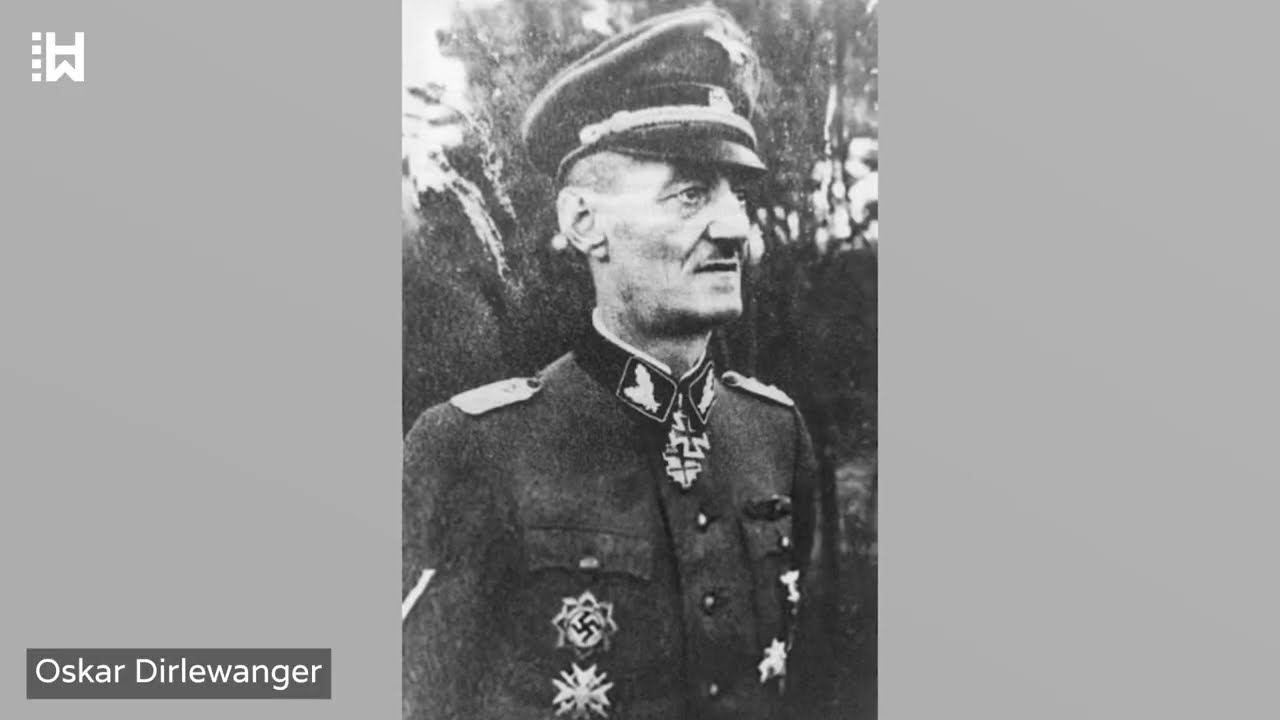
On October 30, 1944, Jozef Tiso, the Slovak president and Catholic priest, personally decorated German soldiers who had fought against the insurgents. The ceremony took place in Banská Bystrica, in Slovakia, and one of the decorated was Oskar Dirlewanger.
By the autumn of 1944, as the military situation of the Third Reich deteriorated rapidly, the Dirlewanger unit was deployed to Hungary to fight the advancing Red Army. Recruitment had by then become increasingly desperate.
Political prisoners from concentration camps were given what was presented as a chance to serve in the unit. In reality, their options were severely limited. Refusal in many cases meant immediate execution or a return to camp conditions that offered little hope of survival.
Faced with this choice, a number of prisoners entered the ranks of the unit, not out of conviction, but as a temporary strategy for survival. Yet their loyalty was fragile from the outset. Many of these men were waiting for the first possible opportunity to escape.
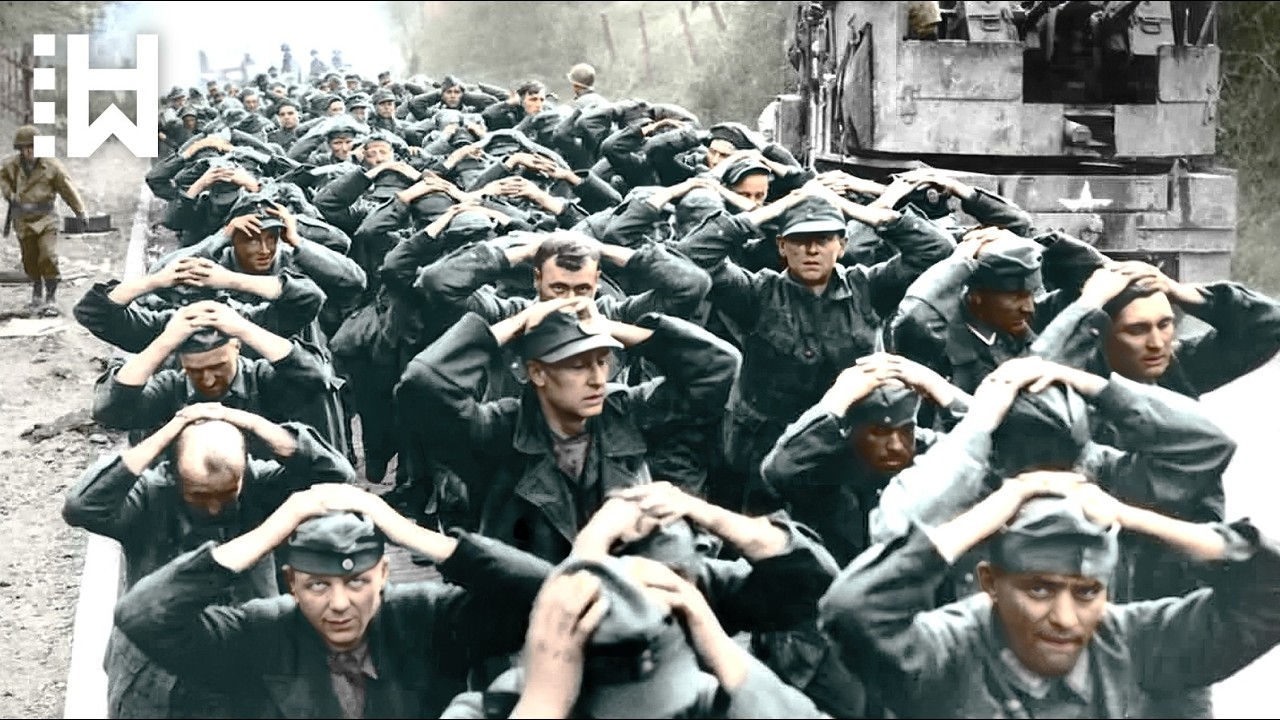
As the front collapsed in late 1944, desertion became more frequent. In December alone, hundreds crossed over the Soviet lines seeking captivity rather than continued service in a formation notorious for its brutality. Others who attempted to defect were caught and executed.
By the final months of the war, the unit disintegrated, discipline eroded, and its structure began to collapse alongside the crumbling German war effort. After the collapse of Nazi Germany in May 1945, several leading figures connected to the Dirlewanger formation faced violent or judicial ends.
Oskar Dirlewanger himself was arrested on June 1, 1945, in southern Germany, recognized despite using a false name, and imprisoned. On June 7, 1945, he died in custody after being severely beaten by guards.
His immediate superior in Belarus, SS-Gruppenführer Curt von Gottberg, who had issued orders to turn entire regions into so-called dead zones, was captured by British forces and committed suicide on May 31, 1945.
SS-Obergruppenführer Erich von dem Bach-Zelewski, the higher SS and police leader responsible for anti-partisan warfare and for crushing the Warsaw Uprising, was captured by the Americans. Although he avoided execution for his wartime crimes by testifying at the Nuremberg trials, he was later sentenced in West Germany to life imprisonment for earlier murders committed in the 1930s and died in prison in 1972.
The Nazi regime that created this infamous and psychopathic unit promised a thousand-year empire. It lasted 12 years. But the crimes committed in its name left scars that endure far longer than the men who carried them out. The Dirlewanger Commando was more than a willing instrument in these crimes.