On November 6, 1895, an 18-year-old girl was led down the aisle of St. Thomas Church in New York with red rims around her eyes. She had been locked in a room for weeks, her mother had threatened murder to break her will, and she had wept so long that the carriage was held outside the church for 20 minutes while her face composed itself. The man waiting at the altar had been told he was permitted to marry her only because she came with $2,500,000.
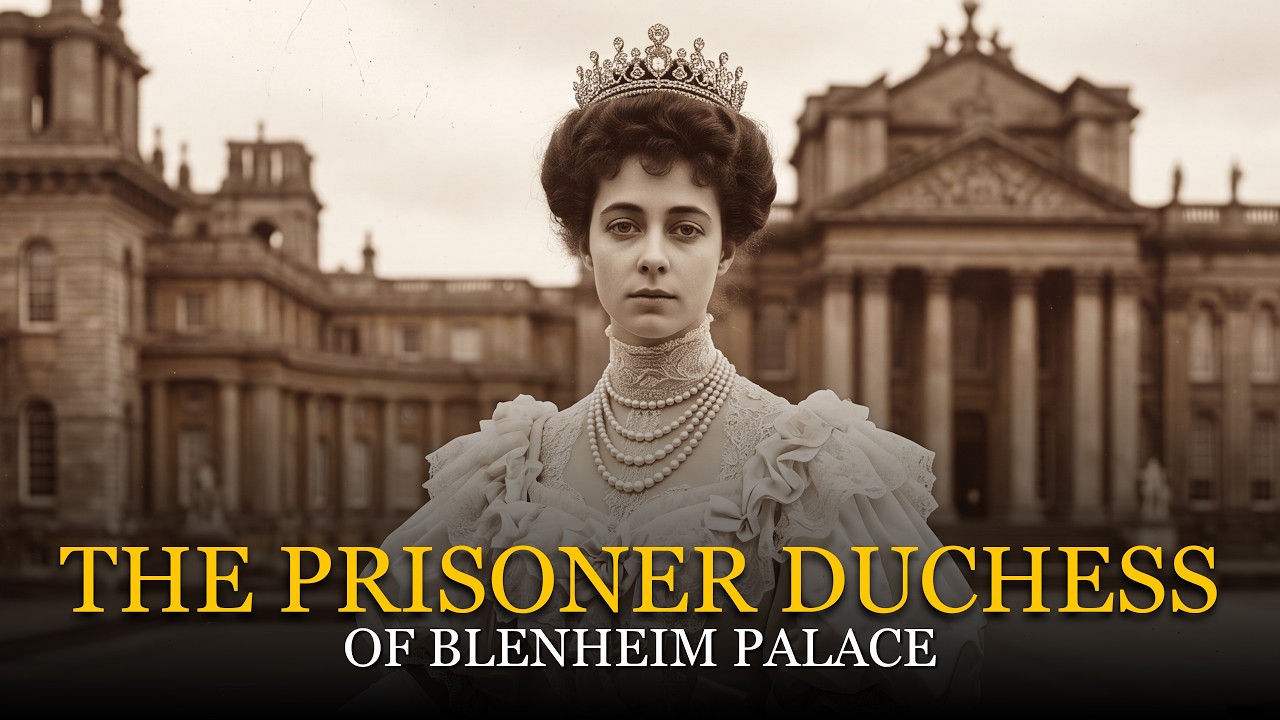
The bride was Consuelo Vanderbilt. The marriage would become one of the most famous and bitterly recounted arrangements of the Gilded Age. Consuelo was born in March 1877 in the Vanderbilt mansion at 659 Fifth Avenue. Her father, William Kissam Vanderbilt, was one of the four richest men in America.
Her mother, Alva Erskine Smith Vanderbilt, was a social climber of formidable ambition. The family fortune, built by her great-grandfather Cornelius Vanderbilt, had grown to nearly $200 million across the cousins. By age three, Consuelo spoke two languages; by age six, four. She grew to six feet tall, and her mother decided her posture required correction: for two hours a day, Consuelo wore a steel rod harness with a leather circle holding her chin upright and her hands tied to a belt at her waist.
Alva’s plan for her daughter was an old strategy dressed in new money. The Vanderbilts had built railroads, but New York society, ruled by the Astors, refused to invite them to dine. Alva had tried for a decade to break through with lavish houses and parties. When society closed its doors again, she turned her ambitions above it.
By the spring of 1894, she had the Almanach de Gotha open on her desk, underlining the names of dukedoms. She was looking for a title old enough to silence her critics and a family poor enough to need her daughter’s fortune. Consuelo, meanwhile, was in love. Winthrop Rutherford was a tall, quiet lawyer of 30 from an old Hudson Valley family.
They had met in 1893, ridden together in Central Park, and by the summer of 1894 had an understanding: they were not formally engaged, but they understood they would be. That understanding ended on a morning in 1895 when Alva opened her daughter’s writing desk and read what she found there. She told her husband they would take Consuelo to Europe, where she would be presented at court. There would be a marriage, and Alva had already chosen the man.
The man was Charles Richard John Spencer-Churchill, the 9th Duke of Marlborough. He was 24 years old, lived in Blenheim Palace, and could not afford to keep it open. His mother, an American heiress herself, had told him precisely what to look for in a wife: an American fortune. The estate was bankrupt.
The annual income from the lands had fallen below £30,000, while the palace cost around £40,000 a year to maintain. His father had spent 20 years selling the contents of the building to keep the roof on. The Duke, known as Sunny, had been told since age 14 that his marriage was not a matter for him but for the estate. He was in love with another woman, most credibly identified as Muriel Wilson, an English girl whose £200,000 fortune was not enough to save the palace.
A transatlantic transfusion was required. In May 1895, a letter reached him from Alva Vanderbilt. It mentioned her daughter Consuelo, a dowry of $2. 5 million, and a willingness to discuss the matter in London.
The Duke replied within the week and sailed for New York in June. He had seen only a photograph of Consuelo and remarked that she had a long neck. When Consuelo refused the marriage, her mother turned the key and waited. At Marble House in Newport, Rhode Island—Alva’s $11 million summer cottage, built largely of marble—Consuelo was told in early August that she was to marry the Duke.
The settlement was being drawn up, the wedding gown ordered from Paris, and the Duke would arrive in September. Consuelo said she was engaged to Winthrop Rutherford and would marry no one else, running away if necessary. Alva locked the door of the upstairs sitting room from the inside and put the key in her pocket. She told her daughter there would be no running away.
If Consuelo refused the marriage, Alva said she had a pistol and would shoot Mr. Rutherford, arranging it so no one would know. Consuelo, 18 years old and isolated, believed her. She had seen her mother destroy lesser obstacles.
For four weeks of August and September, Consuelo was kept under guard at Marble House. Her letters were read before leaving the house, her visitors screened, her brothers sent away, and her father kept in New York. Rutherford’s letters were intercepted and burned. She was forced to write him a letter, dictated by Alva sentence by sentence, ending their engagement.
In late September, Alva opened the door. The dressmaker measured Consuelo for her wedding gown. Consuelo wept during every fitting. The wedding took place at St.
Thomas Church on November 6, 1895. The bishop of Long Island officiated, a choir of 50 boys was brought in, and 25,000 people stood outside in the rain. The carriage arrived at 20 minutes to noon but did not stop; it went slowly around the block while the bride cried. For 20 minutes, the carriage moved at walking pace.
When it finally stopped, Alva pressed her face to the window and said something no one recorded. Consuelo stepped down, her veil covering her face. The evening after the wedding, on a special train given as a gift by her father, the new Duchess of Marlborough sat alone in a green velvet compartment and prayed for the train to crash. On the third night of the honeymoon, the Duke spoke to her without ceremony.
He told her he had given up the woman he loved in order to take her—an English woman of impeccable family. He told her he had married her because the palace required $2,500,000, that he had done what was necessary, and he expected her to do the same. Consuelo did not weep. She looked out at the dark forests of France and said nothing.
They arrived at Blenheim Palace in January 1896 at dusk in the rain. The household of 40 indoor servants stood on the steps, with 200 outdoor servants ranged on the lawn. The entire village of Woodstock waited on the road. The palace had 187 named rooms.
The Duke’s apartments lay on the south front, separated from the Duchess’s by long corridors and four doors. There was no connecting door. In a small diary kept that year, Consuelo wrote a single line that the world would not see for 57 years: that there were nights at Blenheim in those first months in which she prayed to die. Life inside the palace was rigid and cold.
The Duke rose at 7, breakfasted at 9, met his agent at 10, and dined at 8. The Duchess’s day was constructed around his. At dinner, they sat at opposite ends of a 40-foot table, unable to speak without raising their voices in the hearing of the footmen. The Duke read a book.
The Duchess looked at the wall. The corridors were stone-flagged and unheated, and in January the temperature sat below 45 degrees Fahrenheit. Consuelo wore three layers of wool indoors. She counted 40 rooms that were closed and shuttered, their furniture under dust sheets.
Between her bedroom and her husband’s, she counted 47 doors. After the first month, she did not enter his apartments; after three, he did not enter hers. They met for meals, for Sunday chapel, and for public functions. Nothing more.
Her daily ritual of motherhood was four minutes each morning in the breakfast room, where the head nurse handed the children to her, she kissed them on the forehead, and the nurse took them back. The children belonged to the nurses, then tutors, then school. Consuelo refused to behave as the system required. She went up to the nursery in the afternoons, read to her sons, and held them.
The Duke summoned her and told her this behavior was beneath her position. She timed her visits instead so the head nurse was elsewhere. The first son, known as Bert, was born in September 1897; the second, Ivor, in October 1898. With an heir and a spare, the entire purpose of the marriage had been fulfilled.
The Duke withdrew from the marriage entirely. In the winter of 1901, Consuelo fell ill with pneumonia and nearly died. The Duke, informed by telegram in London, did not come. He sent letters of inquiry and arrived 10 days after the crisis had passed.
By 1902, the Duke had begun an affair with Gladys Deacon, a striking and brilliant American woman Consuelo had taken as a friend. Consuelo learned of it and quietly withdrew her hospitality. The Duke insisted on Gladys’s presence at every house party. At the palace’s bicentenary celebrations in August 1904, with King Edward VII and Queen Alexandra present, Gladys Deacon sat seven places down from the Duke.
Consuelo presided at her end of the table, performing her role without faltering. The bicentenary was the moment Consuelo decided to leave. She wrote to a London solicitor, and the separation took two years to arrange. A deed of separation was signed in October 1906.
She would live at Sunderland House in London, built for her by her father as a wedding gift. The boys would remain with their father during school terms and with her during vacations. She was 30 years old, had been inside the palace for 11 years, and left behind 187 rooms. At Sunderland House, Consuelo built a different life.
Her charity work became her vocation. She established the Sunderland House Hostel for working women near Charing Cross, which held 120 beds and was always full. She funded clinics in the East End. She visited tenements.
She gave away over £200,000 of her own money between 1907 and 1914. She met Mrs. Pankhurst in 1909 and donated £1,000 to the suffragette cause. Her mother, meanwhile, had transformed.
Alva remarried, was widowed, and became a leading suffragette in America. In 1912, she sent her daughter a letter. It said, in writing for the first time, that she was sorry—that she had been wrong, that she had broken her daughter, and that she would attempt to make amends. The relationship that slowly rebuilt was, by Consuelo’s own account, the great surprise of her later life.
When the First World War came in August 1914, Consuelo converted Sunderland House into a hospital for wounded officers within a fortnight. She lived in a flat at the back. Over four years, the house treated over 3,000 wounded men. She raised a fund that supplied free milk to over 2,000 children a day in the East End.
In 1917, she stood for election to the London County Council and won, becoming one of the first women elected. She served on committees and did not miss a meeting for three years. In May 1921, her divorce from the Duke was granted on grounds of his adultery. The following year, in Paris, she married Jacques Balsan, a French aviation pioneer who had loved her silently since 1906.
Her sons sent their good wishes; the Vanderbilts did not attend. In 1926, the Catholic Church declared that the 1895 marriage had never validly existed. The Duke, who had converted to Catholicism, had applied for an annulment on the grounds of duress. Consuelo provided nine pages of testimony describing the confinement, the intercepted letters, her mother’s pistol, the carriage outside the church, and the conversation on the train.
Alva, then 73, provided eleven pages in which she confessed everything: locking her daughter in a room, threatening to kill Winthrop Rutherford, dictating the letter of dismissal, and pressing her face to the carriage window on the wedding day to repeat the threat. She asked the tribunal to give her daughter the freedom she had taken away 31 years before. The annulment was granted. The Duke married Gladys Deacon in January 1927.
The marriage was no happier than his first; he barred her from the palace in 1933, and she ended her life in a psychiatric hospital in 1977. Consuelo’s elder son, who had become the 10th Duke, did not speak to his mother for six years, unable to forgive the testimony that had called his parents’ marriage a sham. The reconciliation came after Alva’s funeral in 1933. Alva died in Paris in January 1933, aged 80, with Consuelo at her bedside.
Her last word was her daughter’s name. The years between 1921 and 1940 were, by Consuelo’s own account, the happiest of her life. She and Jacques Balsan lived in a ten-room house in the south of France called Lou Sueil, a second home in Normandy, and an apartment in Paris that looked out to the Eiffel Tower. Edith Wharton and Cole Porter visited.
Winston Churchill, her cousin once removed by marriage, came to dine. In May 1940, with the German army breaking through French lines, they loaded a single car, drove to Bordeaux, and left France from Lisbon. They arrived in New York in July, having lost two houses and a library of 4,000 books. Jacques Balsan died in Florida in November 1956 at 88.
He had been her husband for 35 years and her friend for 50. In 1952, Consuelo published her memoir, The Glitter and the Gold. It described the locked room, the wedding, the train, the palace, the escape, and the reconciliation with her mother. It was an immediate success and has remained in print for over 70 years.
Consuelo Vanderbilt died at her house in Southampton, New York, on December 6, 1964, at 87. She left instructions that her body be flown to England and buried in the churchyard at Bladon, on the edge of the Blenheim estate, beside the grave of her elder son. The grave is a simple slab of Cotswold stone. The inscription gives her name, her dates, and the words “wife and mother.
” It does not give the title of Duchess. Blenheim Palace today is open to the public and receives around 850,000 visitors a year. The Italian garden and the water terraces paid for by the Vanderbilt dowry are still there. In the red drawing room hangs the portrait of Consuelo and her sons painted in 1905.
Marble House in Newport survives as a museum. Visitors can stand before the door of the room at the end of the second-floor corridor—the original door, with the original lock. The Preservation Society has not changed them. The palace remains.
The dukedom continues. Consuelo Vanderbilt walked out of it at 30, freed other women, gave milk to other people’s children, loved a kind man for 35 years, and told her story in her own words, in her own time. The buildings outlive us all. But they cannot speak, and they cannot remember.
The voice that carries is the human one that lifts itself in the long evening of a long life to set the record straight. Consuelo Vanderbilt lifted hers.