A Royal Navy recruiting advertisement shown repeatedly in cinemas across Britain presents a glossy image of warships and submarines gathering at sea, with slogans promising adventure and career transformation. But the reality behind that advertisement, according to a detailed analysis of current naval figures, paints a dramatically different picture of the service in 2026. The Royal Navy is currently facing what military observers describe as a severe recruitment and retention crisis, one that has forced the service into a cycle of decommissioning vessels it cannot crew while struggling to bring new warships into service. The gap between the advertisement’s portrayal and the service’s actual condition has become increasingly difficult to ignore.
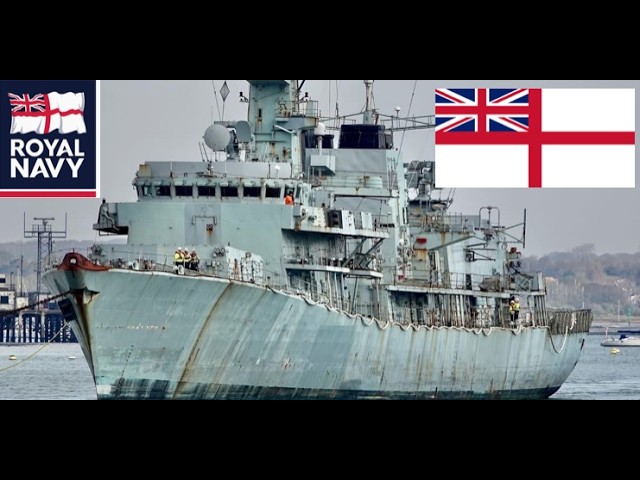
The most pressing issue is the state of the frigate fleet, long considered the workhorse of the Navy. Britain has not commissioned a single new frigate in nearly a quarter of a century, while simultaneously retiring those already in service. The Navy currently operates just five active Type 23 frigates, a number set to drop further when HMS Richmond is decommissioned shortly. That will leave the service with more frigates awaiting scrapping than actually in service.
One of the most striking examples of waste involves HMS Iron Duke. The frigate received a full refit between 2019 and 2023 at a cost of 103 million pounds to the taxpayer. After returning to sea and monitoring Russian warships in the English Channel, the vessel managed only 16 months of operational service before being quietly withdrawn due to personnel shortages and mechanical problems. She has now been stripped of her weapons and systems and will likely join her sister ships at Fareham Creek in Portsmouth, where vessels await disposal.
Several of these decommissioned frigates have found new homes abroad. In a striking statistic, there are now more former British frigates serving in foreign navies than in the Royal Navy itself. Chile operates four former Type 22 and Type 23 vessels, Romania operates two, and Brazil operates two more, having also purchased the helicopter carrier HMS Ocean at what has been described as a knockdown price. The submarine fleet has suffered a similarly dramatic decline, shrinking from 22 vessels in 1997 to just nine today.
Of those nine, four are dedicated solely to carrying the nuclear deterrent and do not serve as hunter submarines. Britain’s amphibious warfare capability has also eroded to the point where experts argue the Navy could not mount an operation on the scale of the Falklands conflict. The replacement program for the frigate fleet is itself facing uncertainty. Britain is building 13 new frigates in two classes, the Type 26 and the Type 31.
The first Type 26, HMS Glasgow, is fitting out and expected to begin sea trials later this year, with entry into service planned for 2027. However, rumors suggest the government may sell one of the Type 26 vessels, possibly to Norway. There are also concerns that the Type 31 program could suffer the same fate as the Type 45 destroyer program, which was cut from 12 vessels to six. The destroyer fleet is in its own precarious position, with only one Type 45, HMS Dragon, currently operational while the rest undergo refits.
The Navy’s rule of three, which requires one ship deployed, one in training, and one in maintenance for each operational role, has become impossible to fulfill with such limited numbers. The root cause of this decline is a profound manpower shortage. Since 2012, Navy personnel numbers have dropped by 16 percent. In the last recorded 12-month period, 220 trained personnel left the service, the equivalent of the crew for two new Type 31 frigates.
Recruitment for 2023 to 24 fell 40 percent short of targets. The Ministry of Defense reports the Navy is approximately 1,000 trained personnel under strength. This shortage has created what experts describe as a death spiral. Too few sailors remain to crew vessels properly, so the Navy decommissions ships without replacement.
It cannot hope to crew new warships being built, which leads to further cuts and makes the service a less attractive career prospect, fueling further recruitment failures and more departures. The remaining sailors face serious overwork and over-deployment, which feeds low morale and poor retention rates. Commentators note that while the British Army has offset some recruitment problems by expanding the Brigade of Gurkhas, who now make up 8 percent of the entire Army, and by recruiting Fijian soldiers, no similar solution exists for the Navy’s highly technical roles. Critics argue that the current situation can only be the result of deliberate policy decisions made by successive Labour and Conservative governments over the past 30 years.
They point to the decisions to retire vessels without replacement, sell warships to foreign nations, and repeatedly cut orders for new classes of ships as evidence of a consistent pattern of neglect. Some observers question whether the doom loop can be arrested at this point, noting that the government has shown little evidence of wanting to make the deep changes required to make the service fully functional again. Predictions suggest that many of the 13 new frigates being built will likely be cancelled before completion or sold to foreign nations to recoup costs, and there is speculation that one of the Navy’s two aircraft carriers may be permanently docked to redirect its manpower to other priorities. The central contradiction remains troubling for those concerned with Britain’s naval defenses.
The recruiting advertisement promises young people a rewarding career at sea, but the figures suggest that joining the Navy today, with its overstretched personnel and uncertain future, may not be the attractive option the advertisement implies.