In November 1861, the Cincinnati Chronicle ran a headline declaring General William T. Sherman insane. Just months into the Civil War, one of the Union’s most promising commanders was being sent home to Ohio in disgrace. His peers called him paranoid, his staff whispered that he had lost his mind, and Sherman himself questioned his own sanity, wondering aloud who could truly say who was sane and who was insane in such times.
Sherman’s path to that moment had already been marked by failure. He was a West Point graduate who had resigned his commission, watched a banking career collapse in San Francisco, and failed as a lawyer in Kansas. When Louisiana seceded in 1861, he quit his post as superintendent of a military academy, warning Southerners they did not know what they were doing. He understood that war would be catastrophic, and the weight of that knowledge broke him.
By the fall of 1861, Sherman was a brigadier general tasked with defending Kentucky, a state torn between North and South. He was consumed by dread. He paced the halls of Louisville’s Galt House Hotel with his coat unbuttoned, his hands trembling so violently that whiskey sloshed from his glass. At night, he stalked the corridors muttering about phantom Confederate armies.
He insisted that 200,000 men were needed to hold the line, a prediction that alarmed the Secretary of War and made the press brand him “Crazy Sherman. ”
By November, he was relieved of command. His wife, Ellen, traveled south to bring him home. She found a man who had not slept or eaten properly for weeks, his uniform hanging loose on his frame, his feverish eyes darting at shadows.
He confessed that he stayed up all night, felt like he was riding a whirlwind, and admitted he might truly be going mad. Ellen recognized the darkness. She had seen it before when his bank collapsed and in the eyes of his melancholic uncle. Doctors at the time called it melancholia, a condition that would later be understood as bipolar disorder.
She took him home to Ohio, where there were no doctors or medicines, just silence, Shakespeare, and sleep. She read him King Lear as a reflection of his unraveling. For three weeks, she anchored him. By December, a flicker of the old Sherman returned, and he reported to Missouri for a desk job organizing supplies.
There he met Ulysses S. Grant, a man battling his own demons, with whispers of drunkenness following him. Grant saw past Sherman’s reputation and assigned him to support the Tennessee campaign. At the Battle of Shiloh in April 1862, Sherman’s division was blindsided by a Confederate surge.
A Minié ball tore through his hand, leaving bone visible in the wound, and another grazed his shoulder, soaking his uniform in blood. Instead of crumbling, he rallied his men under fire, shouting to hold the line. Grant later said Sherman saved the day. What had changed was not Sherman’s inner turmoil but its direction.
He began to see the Civil War not as a conventional contest but as a psychological siege. He came to believe that the crueler war became, the sooner it would end. His manic energy now had a purpose: to break the South’s will to fight. In 1864, Sherman took Atlanta.
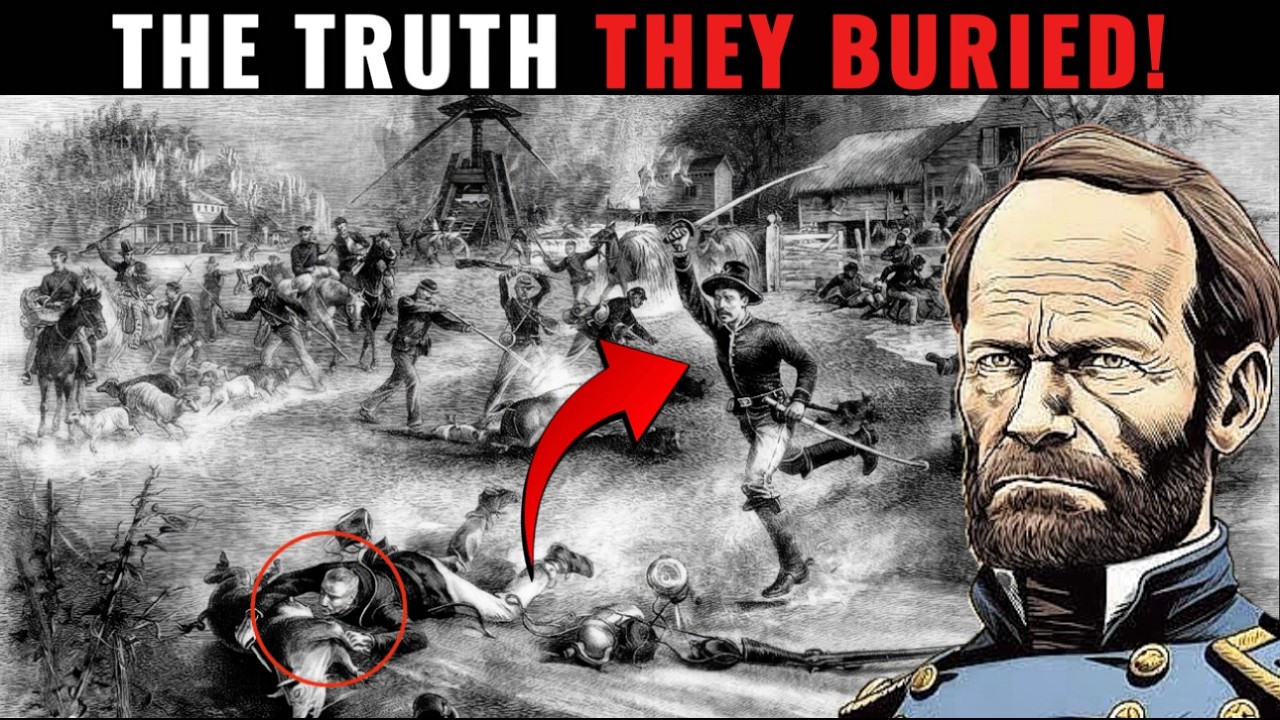
Then he made a decision that stunned observers. He cut his supply lines and led 60,000 men into the Georgia wilderness with just 20 days of rations. His orders were to live off the land and destroy everything else. Rails were heated and twisted into what became known as Sherman’s neckties.
Barns and cotton gins were burned. One farmer’s diary recorded that the soldiers left only chimneys weeping smoke. Georgians whispered that the devil was coming. An encounter during the march captured his chilling logic.
When a sobbing woman confronted him about burning her home, Sherman replied that they had to make the land a barren waste until the Southern sons stopped fighting. Behind them, soldiers threw family portraits onto bonfires. After the fall of Savannah, Sherman telegraphed President Lincoln, offering the city as a Christmas gift. But the ghosts of the war lingered.
After Columbia, South Carolina burned in 1865, Sherman wrote that he was tired and sick of war, and that its glory was all moonshine. For decades afterward, he reportedly woke gasping from dreams of burning children. Psychiatrists who later studied Sherman saw his breakdown as central to his effectiveness. Depression gave him a realistic view of the war, while his manic energy drove him relentlessly.
He survived the war and the whispers, but his march never truly ended. It remained etched in the scarred earth of Georgia, in the chimneys that once wept smoke, and in the twisted rails buried beneath the landscape. The question of whether he was a monster, a prophet, or something more human continues to follow his legacy.