The hospital bracelet was still around my wrist when my husband pressed a folded $20 bill and a few quarters into my palm and told me to take the bus home. Six days after a C-section, with the incision still burning at every step, I stood in the cold outside the hospital doors and watched him. The discharge nurse had asked if someone was coming to get me. I must have said yes.
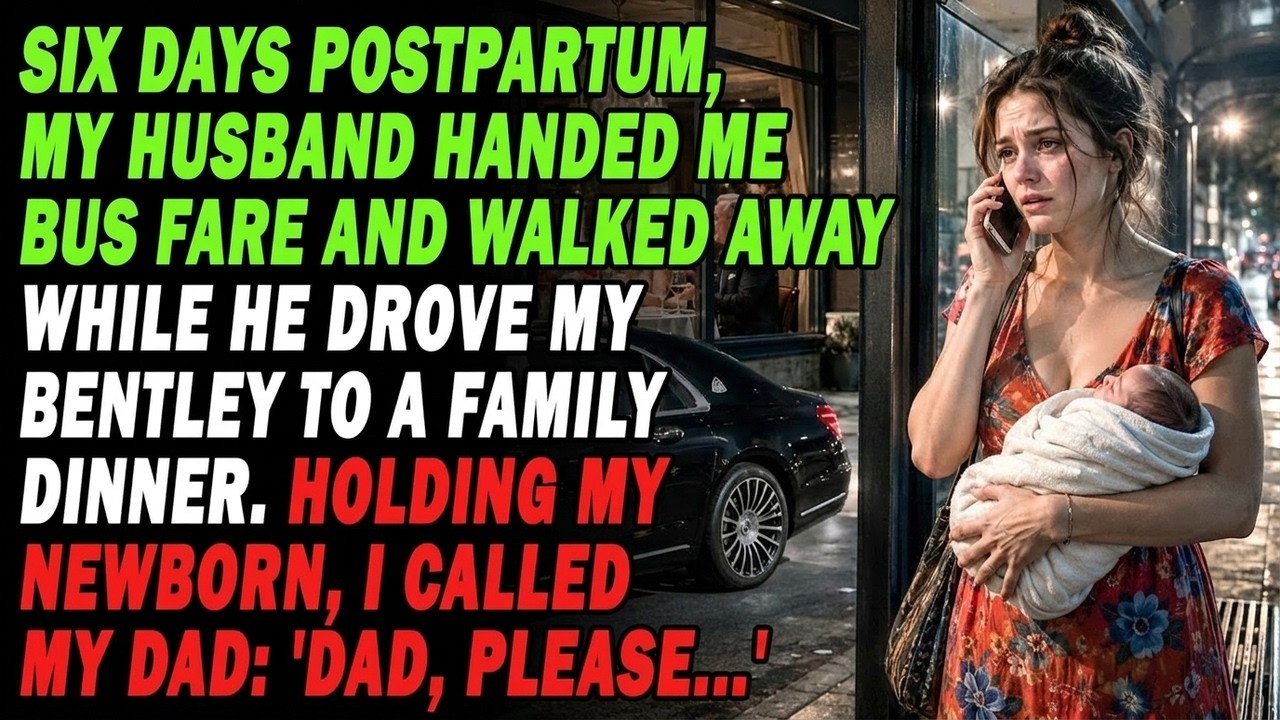
I don’t remember what I assumed would happen, only that I expected something. That he would hold the car door, take the hospital bag, say anything at all that sounded like he understood what the last six days had cost me. What happened was that Grayson handed me transit money the way you’d tip a coat check attendant and told me his parents and his sister Kristen were already on their way into the city and he couldn’t keep them waiting. That car, the slate gray Bentley with the flawless leather interior and the faint new car smell, had been a gift from my father on my twenty-fifth birthday.
After we married, Grayson took over the keys with the casual ease of a man who believed everything in his orbit naturally belonged to him. I let it go because I loved him then, or thought I did. I asked him if he was serious. He told me not to make a scene.
I looked past his shoulder and saw the car idling by the curb, warm and bright inside, his mother in a fur trimmed coat in the front seat, Kristen already on her phone in the back. They didn’t even look at me. Grayson gave me a small impatient nod and walked to the driver’s side, and then the Bentley pulled away and disappeared into Michigan Avenue traffic. I stood there for a long moment with the $20 and the quarters in my hand.
Then I found the bus shelter and sat down on the cold bench with our newborn son Nico in my arms and I waited. The 151 came eventually and I rode it north with a baby who weighed eight pounds and a body that was still trying to figure out what had happened to it. The other passengers didn’t look at me. The bus was warm and loud and it smelled like wet wool and exhaust, and I pressed my face against the window and watched the city slide by, apartment buildings and storefronts and the lake turning gray and white in the February light.
I asked myself what an Ashby was doing on a city bus. But I already knew. I had spent the last two years doing everything I could to stop being an Ashby, or at least to stop letting it count for anything. When I met Grayson I was living in a one bedroom walk up in Lincoln Park and driving an old sedan with a cracked taillight, and I told him my father was an orchard owner in central Illinois.
He never questioned it. He never even looked too hard. Both of us trying to stay warm. He never once asked why a Chicago girl had grown up around apple trees, or what my family actually did for a living, or why my own savings account could carry our deposit on the two bedroom without blinking.
He assumed I had some modest trust fund, maybe enough for a down payment one day, and he didn’t ask past that because he didn’t need to. The point was that I loved him. The point was that I was real. I made that decision on purpose.
I chose a smaller life because I wanted to be loved for the right reasons. I wanted a man who wanted me, not Ashby Capital, not the twenty seven floors of my father’s firm, not the floor with my family’s name on it at Kellogg. And it had not protected me from anything. It had only given Grayson room to become something worse inside the space I left him.
When I called my father and told him I wanted to come home, he picked up before the second ring. I told him my life had fallen apart and that I needed a place to stay, just for a little while. He didn’t ask what happened. He didn’t ask if I was sure.
He simply said, “Then you are never taking a bus again. Not today. Not ever. Stay where you are.
” I told him I was already on the bus and he said, “Then get off at the next stop. ”
I told him I was holding the baby. I told him I was fine. He said he was sending someone.
I told him not to come himself, and he said, “I’m not coming myself. Stay where you are. ” And then he hung up. I got off at the next stop and stood inside a heated bus shelter with our diaper bag and our son and the $20 still folded in my hand.
Twenty minutes later a black Escalade pulled up and a woman in her sixties in a wool coat got out and came around to my side and said, “I’m Margaret. Mr. Ashby sent me. ” She buckled Nico into a properly installed infant seat before I even had a chance to sit down.
She took the hospital bag from me and the dirty overnight bag and told me to sit in the back and rest. I had forgotten what it felt like to have someone simply take care of things. Not to negotiate with me, not to make me feel like I was being difficult, just to handle it. Margaret got on the highway and drove north toward Lake Forest and I watched the city give way to suburbs and the suburbs give way to longer driveways and wider lots.
Home was my mother’s family house, forty-two acres and a mansion built in 1902, a private drive lined with oaks older than anything Grayson had ever owned, an iron gate that swung open when the car approached. My father came out onto the porch before the engine cut. He is a man who has been on the cover of Forbes three times, who has testified before the Senate Finance Committee twice, who has a floor named after him at Kellogg. He is not a man who shows emotion easily.
He held his grandson for a long time without speaking. Then he said, “Let’s get you inside. ”
That night I told him everything, all of it. I told him about the hospital bracelet and the bus money and the slate gray Bentley.
I told him about the lunch Kristen had made me sit through when they finally came to the city looking for me, how she had told me I was being selfish, that whatever had happened at the hospital was a misunderstanding, that Grayson was overwhelmed with the River North project falling through and I needed to be supportive instead of dramatic. My mother, who had never once said “I told you so” about Grayson, sat in the corner and said nothing, but I could feel all the concern she had swallowed for two years radiating off her quietly. When Kristen finished, I told her I was happy to discuss an apology for her son’s behavior, but that I had no interest whatsoever in returning to Lincoln Park. She left looking like she had swallowed glass.
My mother never said a single word of judgment. She simply wrapped a shawl around my shoulders and pulled the baby’s blanket up and said, “You’re home now. That’s all that matters. ”
My father sat through all of it without interrupting.
Then he stood and went to his desk and made three phone calls. I only heard pieces of the first two. The third one I heard clearly because his voice dropped into the register he uses when there is absolutely no room for negotiation. He said, “Don’t send a letter.
Send a courier, and call Hartwell at First Midwest. ” And then he said, “The man put my daughter on a city bus six days after a C-section. He drove her car to a steakhouse while she held their newborn in the cold. I want him to understand that there are consequences for that.
”
I sat very still in the wing chair by the fireplace and listened to my father dismantle Grayson Dunore’s life. I did not call Grayson back. He called me. Over and over and over.
He left voicemails that started with anger and moved through confusion and ended somewhere around pleading. He used the word “inconsiderate. ” He said he was willing to take me back if we could move forward. He said I was being childish.
I set the phone face down on the nightstand and went to sleep in my childhood bedroom for the first time in two years. The room smelled like cedar and old radiator and whatever specific combination of things had meant home my entire life. Over the following days, the machinery my father had set in motion moved with the quiet, annihilating efficiency of a glacier. First Midwest froze Grayson’s credit line for a routine review he apparently couldn’t explain.
His company’s largest passive investor, a Chicago hedge fund that had stayed in the room precisely because Ashby Capital was also in the room, sent a politely worded exit notice. Every investor who had abandoned him, every credit line that had gone dark, every partnership that had quietly dissolved, all of it traced back to something I had done. Grayson did not know that yet. He still thought my father was an orchard owner in central Illinois.
He had believed that for the entirety of our marriage because I had let him believe it, the same way I had driven used cars and ordered from the regular menu and never once mentioned the floor with my name on it at Kellogg. When his life started collapsing, he assumed I had made a permanent mistake. He thought he could fix it by calling the family farm of an old orchard man. The day everything changed, he finally got through to me.
I had just come back from a walk with Nico and I was holding him on my hip when my mother handed me the phone with a look that said he was on the line and that it was my choice. I took it. He was talking into the intercom at the front gate while I listened. His voice was pitched low and urgent, and he was saying, “I know she’s there.
Just tell her I need to talk to her. Tell her I’m not leaving until she comes down. ”
The call went through. I held the phone to my ear and he said, “Eleanor, I know you’re there.
I know you can hear me. We need to talk about this. ”
I waited. Then I said, “Grayson, do you know what Ashby Capital is?
”
There was a long silence on the other end of the line. Ashby Capital had its headquarters in the Loop, same as it always had. My father, Alistair Ashby, was the founder and chairman. The man Grayson assumed was an apple farmer had a portfolio worth more than every dollar Grayson’s family had ever seen combined and fifty dollars more.
Grayson had spent two years married to the daughter of one of the richest men in the city and had never once asked the right question because he had never once looked past what I let him see. I heard him at the gate, heard him cough in the cold, heard him say, “What are you talking about? ”
I told him to come to the door of the gate house and I would explain. He came.
I met him in the small booth where the security guard sat in the winter. I was wearing a black blazer and fresh lipstick and I had handed Nico to my mother before I walked out. The night air was cold and quick and it felt good on my face. Grayson looked smaller than I remembered.
His hair was disheveled and he hadn’t shaved and his overcoat hung open. He looked like a man who had not slept in days, who had watched his life dismantled piece by piece and had no idea who was holding the hammer. He sat across from me in the gate house and spent the first part of the conversation going back and forth between pleading and blame the way men do when they realize too late that the rules have changed. He wanted to know if I had made a mistake.
He wanted to know if I was coming home. Then he said the thing I had been waiting to hear. He said, “My father must have some business contacts who could help get the River North deal back on track. ”
He still thought my father ran an apple farm.
I looked at him for a long moment. Then I said, “Grayson, my father is Alistair Ashby. He owns the building where you held your last company event. He underwrote the merger that put your partner in a position to know your name at all.
The deal fell through because I asked him to let it fail. ”
The color left his face in a way I had never seen before. He sat back in the chair and stared at me like I was a stranger. His mouth opened and closed a few times before he managed to say, “You’re lying.
”
“I called every bank,” I said. “Every investor. Every vendor who had a forwarding address for you. I told them about the bus.
I told them about the steakhouse. I told them how you treated me for two years and how you treated our son for six days. ”
He didn’t speak for a very long time. Then he said, “You’re a monster.
”
I stood up. I looked at him, this man who had handed me transit money while I held his newborn, and I said, “You gave me twenty dollars and a bus pass and you called it help. ”
I did not look back. My heels made a clean, even sound on the gate house floor with each step, and then I was outside in the cold February air and the night was very quiet.
The lake somewhere beyond the tree line was doing what it always did, moving and moving and moving without caring about any of us at all. Grayson’s voice followed me, rising, cracking, saying my name over and over. The gate buzzed and then it clanged shut behind me. There was nothing to divide because everything Grayson had built had been built on access and reputation that had never actually belonged to him.
A damages settlement his lawyer negotiated down from what my father’s team initially demanded, and it still managed to be a number that would follow him for a very long time. Ten days after the lawsuit was settled, I went back to the Lincoln Park condo with a team of movers and my father’s lawyer. Grayson stood in the foyer with his arms crossed and watched me pack the things I wanted. There wasn’t much.
A cardigan, some pregnancy books, a jar of face cream, a few photographs. The furniture was his, the art was his, all of it was his and none of it had ever been mine. I filled a single box and a duffel bag and I walked out the door. Grayson did not try to stop me.
He had learned, by then, that there was nothing he could say. He just watched me go with a look on his face that was hard and empty and a little bit confused, like a man who had walked into a building and discovered the floor had given way behind him. I carried the box down the stairs and out to the street where my father’s driver waited with the door open. The divorce was finalized nine months later.
Grayson tried to claim half the value of the condo, but it was mine, registered in my name, bought with my father’s money as a birthday gift and never touched by a single one of Grayson’s accounts. He fought it for a while and then he stopped, because there wasn’t anything else he could do. Word travels in this city. My father gave my number to a woman who ran a small foundation that helped connect postpartum mothers with resources, and we had a long conversation that turned into a lunch that turned into a meeting about what I actually wanted to do next.
And then over several months of museum visits and long dinners and one genuinely memorable argument about affordable housing policy, something became something else entirely. He has never once made me feel like I owe him anything. He has never asked me to be smaller. He has never asked me to pretend I don’t know what I am capable of.
He has never once looked at me and seen a problem to be managed. He just shows up. He just stays. He has been reliably, genuinely there, and that’s the part I didn’t know how to look for before.
I spent two years falling in love with someone’s surface, someone’s confidence, someone’s beautifully constructed image, and it never occurred to me to find out whether the man underneath would be there when it mattered. He was. When I gave birth again, he held my hand through the whole thing. When I told him I wanted to start a foundation of my own, he said, “What do you need?
” Not “Is that a good idea? ” Just “What do you need. ”
Our intake coordinator is a woman who spent her own first week postpartum in a shelter. She came to work with us because she wanted to answer the phone when the call came in from a mother who had nowhere else to go.
I understand that call. I understand it better than I wish I did. He stood in the back of the room while I gave a short speech at the foundation’s first fundraising dinner. He didn’t clap loudly.
He didn’t make a scene. He just stood there with his arms crossed and watched me the way he always does, steady and sure. My father was there too, in the front row, and when I looked at him he nodded once. Every phone call, every quiet guarantee made good on, every single thing he never said out loud when he simply put his arm around me in that elevator and let me be his daughter.
That’s how he shows love. Not in words. In action. Nico is almost two now.
He calls me something that sounds approximately like mama. He has strong specific opinions about which foods are acceptable and which are absolutely not, and he throws a dramatic fit if the crust is still on his toast. He looks like Grayson, which is a strange and complicated thing, but he has my father’s eyes, and he is the only thing that makes any of that worth carrying. The man I love now has never once flinched when I tell the story.
He tells people, “She took a city bus home with a newborn and then she took apart a man who had it coming. ”
I don’t phrase it like that. I don’t have to. I still think about that afternoon a lot.
Not with anger anymore, not with sadness. I feel something I don’t have an exact word for, a kind of gratitude for the specific clarity of that moment. Because it was only that moment, that one unambiguous February afternoon, that finally made me stop pretending. I had spent two years in a smaller life than I deserved because I was afraid my real life would make real love impossible.
I thought the only way to be loved properly was to make myself small. I thought that if I admitted who I was, I would be nothing but money to someone. I thought the bus would protect me. And it had not protected me from anything.
It had only given a man room to become something worse inside the space I left him. I do not make myself small anymore. The other day, I drove my own car down the drive and through the iron gate. I was alone in a black Escalade, not the Bentley, not anything I was handed, a car I bought with my own money from a company I started myself.
Nico was in the back, asleep in his car seat. The radio was on and the road was long and straight and the light was golden through the bare oak trees. I don’t know why I drove past that corner. But I did.
I looked at the fence, at the empty parking lot, at the bench where I had sat on a cold Tuesday afternoon with my newborn and my hospital bracelet and twenty dollars in my hand. I did not slow down. I did not look away. I just kept driving, with my hand on the wheel and my son asleep behind me, and for the first time in a very long time, I was not running from anything.
I was moving toward everything. Look what I can do.