In 1929, Joseph Stalin consolidated his control over the Soviet Union and launched an aggressive campaign to transform the agrarian country into an industrial power. Farmers were forced into state-controlled collective farms, and those who resisted were branded enemies of the socialist system, stripped of their property, and sent to the Gulag labor camps. Grain was seized from farms to supply Moscow’s quotas and feed growing cities. The consequences were most devastating in Soviet Ukraine, one of the country’s richest agricultural regions.
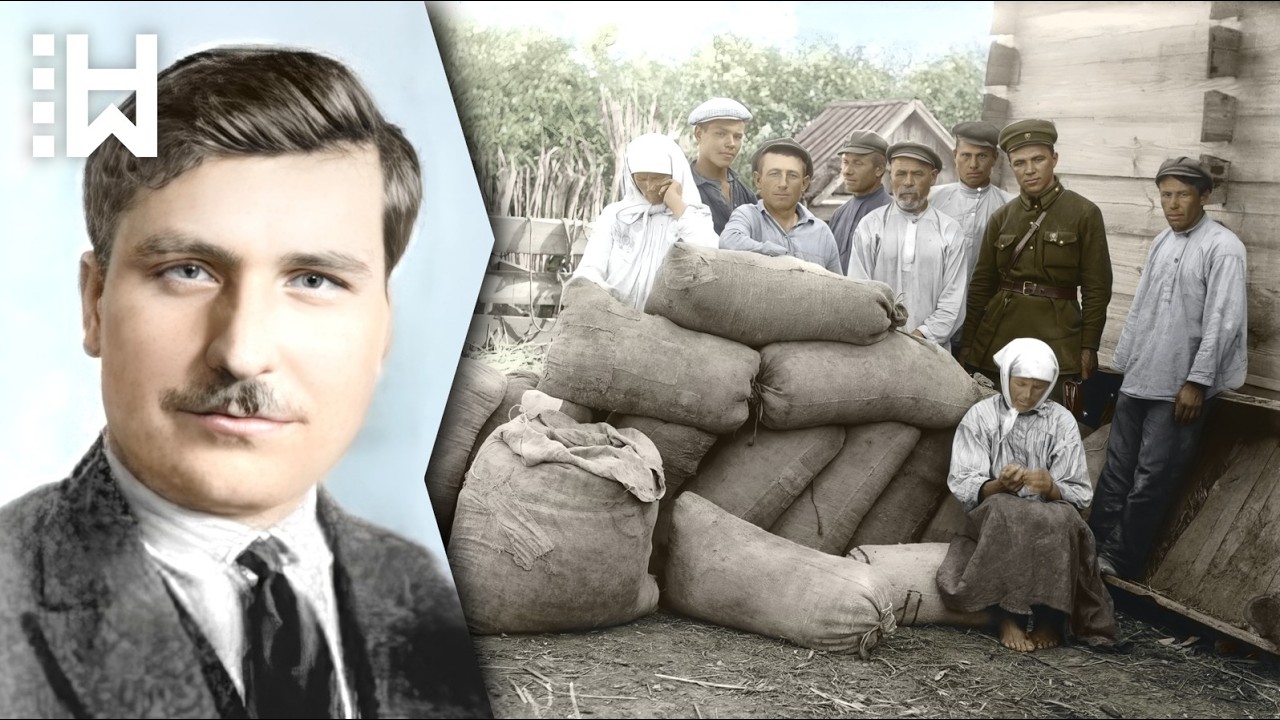
Impossible grain quotas, food confiscation, travel restrictions, and collective punishment of entire villages turned a severe agricultural crisis into the Holodomor, a man-made famine in 1932 and 1933 that killed millions of Ukrainians. Stalin ordered the policies, but they were enforced by officials in Ukraine, including Vlas Chubar, the head of the Soviet Ukrainian government. Chubar was born on February 22, 1891, in the village of Fedorivka, then part of the Russian Empire and now in southern Ukraine. He came from an ethnic Ukrainian peasant family and joined the Bolshevik wing of the Russian Social Democratic Labor Party in 1907.
After leaving school, he worked in factories in Kramatorsk, Mariupol, and Moscow, gaining the authentic working-class credentials the party valued. In May 1915, during World War I, he was mobilized into the Russian Imperial Army but, as a skilled worker, was assigned to a military plant in Petrograd. The revolutions of 1917 pulled him from the workshop. After the October Revolution, he was appointed commissar of the main artillery administration in Petrograd and rose quickly through the Bolshevik state’s economic apparatus.
By July 1923, Chubar had reached the top of the Ukrainian government as chairman of the Council of People’s Commissars of the Ukrainian Soviet Socialist Republic, effectively making him prime minister of Soviet Ukraine. He held that position for more than a decade while also serving as deputy chairman of the Soviet Council of People’s Commissars in Moscow. In November 1926, Chubar became a candidate member of the Politburo, the party’s highest executive body. He was the first ethnic Ukrainian to reach that level.
In the mid-1920s, he led the so-called Ukrainization commission, a policy aimed at promoting Ukrainian language and culture within the republic’s institutions, and pushed for greater Ukrainian control over all-Union enterprises on its territory. To many, he appeared to embody a distinctive Ukrainian Bolshevism, loyal to Moscow but attentive to the republic he governed. That loyalty to Moscow ultimately proved the stronger force. When Stalin set out to break the peasantry through forced collectivization, Chubar supported him.
He backed Stalin against Leon Trotsky and, in November 1929, joined the attacks on Nikolai Bukharin and other opponents of forced collectivization. In March 1930, he noted with apparent satisfaction that 63 percent of Ukrainian peasant households had already been pushed into collective farms. On February 1, 1932, despite evidence that the policy was causing a catastrophic decline in agricultural output and mass famine, Chubar and Stanislav Kosior, the party leader in Ukraine, jointly signed an order titled “On Seeds,” which instructed party committees to deny collective farms in Ukraine any seed assistance. Their signatures appeared repeatedly on documents that turned forced collectivization into a machine of death.
Chubar was not unaware of what the policy was doing. He traveled to the countryside and saw the results firsthand. On June 10, 1932, he wrote directly to Stalin and Vyacheslav Molotov, then chairman of the Council of People’s Commissars, warning that tens of thousands of malnourished, swollen-bodied people were dying of famine in every village. Days later, supported by the Ukrainian Politburo, he sent a telegram to Moscow pleading for grain to feed Ukraine.
Stalin’s reply was contemptuous. He wrote that Chubar was wrong, that Ukraine had already received more than it should, and that there was no reason to give more grain and nowhere to take it from. Ukraine’s appeals angered the Kremlin rather than moving it. On July 2, 1932, Stalin ordered Lazar Kaganovich and Molotov to deal with what he called Chubar’s corruption and opportunism.
At the Third Ukrainian Party Congress in Kharkiv in early July 1932, Chubar publicly argued that the pace and methods of collectivization were unrealistic and that the grain collection plan was too ambitious. It was as close to opposition as a member of the Ukrainian Communist leadership could come, and it changed nothing. The quota imposed on Ukraine for 1932 was nearly six million tons, a figure beyond any realistic estimate of the harvest, and Moscow insisted it be met. After registering his objections and being rejected, Chubar enforced the very policy he had warned would end in catastrophe, signing a decree on grain purchase quotas that set an entirely unrealistic target for collective farms.
The deadly measures escalated through the autumn and winter of 1932. On November 11, Chubar jointly signed instructions authorizing full confiscation of crops, seizure of land, deportation of peasants who failed to deliver, and the notorious “blacklist” system that placed entire villages under blockade and cut them off from all trade, effectively sentencing those villages to death by starvation. In December, Chubar clashed with Lazar Kaganovich, the former first secretary of the Ukrainian Communist Party, whom Stalin had sent back to Ukraine over complaints that fines were not being collected from peasants who failed to deliver grain. Chubar argued weakly that the peasants were too poor to have anything left to confiscate.
After his view was rejected again, he arranged in December 1932 for decrees from the Ukrainian Council of People’s Commissars banning the sale of potatoes, meat, and livestock in the Chernihiv, Kyiv, and Vinnytsia regions, which had been accused of failing to meet their quotas. The ban removed one of the last remaining food sources and, in the words of a later court, amounted to killing by starvation. This is the persistent contradiction at the core of Chubar’s record during the Holodomor. He looked at the starving countryside, described it accurately in private sessions, and begged for it to be fed.
Then he signed the orders that sealed its fate. Chubar, who expressed certainty that Moscow’s policies would lead to disaster, nonetheless implemented them voluntarily. He was not the architect of the famine, which was decided in the Kremlin, nor an unconscious observer, but an instrument that fully understood what it was doing and carried it out anyway. According to estimates, his decisions took the lives of at least 3.
5 million Ukrainians. In 1934, as the famine in Ukraine finally receded, Chubar was transferred to Moscow. The move was presented as a promotion but was actually a sign of Stalin’s dwindling trust. He became deputy chairman of the Soviet Council of People’s Commissars and of the Council of Labor and Defense.
In February 1935, he was promoted to full membership in the Politburo, and from 1937 he also served as the Soviet finance commissar. To an outside observer, he stood at the top of the Soviet state. In reality, he had entered the first stage of his own destruction. The terror Stalin was building soon consumed nearly the entire old Bolshevik elite, and Chubar was among the first to fall.
In January 1938, he was removed from the finance commissariat, and in June of that year he was sent to the Urals to head a construction project in Solikamsk. Shortly after his arrival on July 4, 1938, he was arrested. The charges were the usual fabrications of that era: anti-Soviet activity, terrorism, and sabotage. There was no meaningful defense, and none was permitted.
On February 26, 1939, the 48-year-old Chubar was sentenced to death and executed by firing squad later that same day. The Ukrainian politician who had imposed starvation on his own republic was destroyed by the state he served, convicted not for the real crime of famine but for imaginary conspiracies invented by his comrades. On August 24, 1955, during the first wave of de-Stalinization, Soviet authorities quietly rehabilitated Chubar and cleared him of the charges for which he had been executed, as part of Khrushchev-era efforts to restore the reputations of purged Bolsheviks. The rehabilitation applied only to the fabricated crimes of 1938.
No mention was made of the famine, and the reckoning for that came much more slowly. That reckoning finally arrived in January 2010, when the Kyiv Court of Appeal, in a criminal case brought by the Security Service of Ukraine, ruled that the Holodomor was an act of genocide against the Ukrainian people and named those responsible. Alongside Stalin, Molotov, Kaganovich, Pavel Postyshev, Kosior, and Hryhoriy Khateyevich, the court named Vlas Chubar. The ruling relied in part on the very decrees he had signed, which the court found were calculated to bring about the physical destruction of part of the Ukrainian nation.
None of the accused could hear the verdict. They had all been dead for decades, and Chubar himself had been executed 71 years before the ruling was handed down.