On May 5, 1945, one of the most unlikely battles of the Second World War unfolded on the rocky slopes beneath Castle Itter in the Austrian Alps. An American captain, a Wehrmacht major, and a former SS officer fought side by side, firing at attacking Waffen-SS troops along the same castle walls. They were defending 14 of France’s most prominent political prisoners, men the SS had orders to kill. It was one of only two confirmed instances in the war where American and German soldiers fought on the same side, and it happened because of a desperate gamble taken during the final days of the Third Reich.
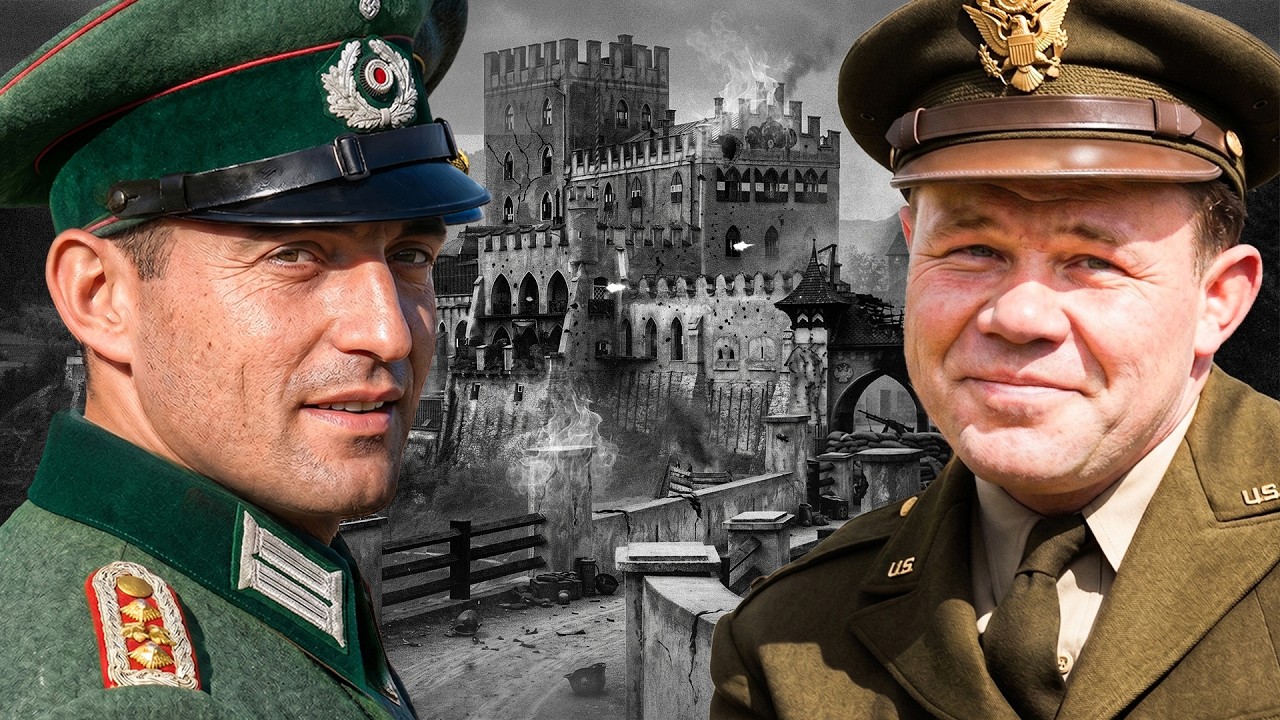
Castle Itter sat on a wooded hill in Austria’s Brixental Valley, overlooking the village of Itter below. It had served as a fortress and later a hotel before being converted into a prison under the administration of the Dachau concentration camp system. The facility was designed for high-value French prisoners, and by April 1945, it held some of the most important hostages in German hands. Among the captives were Édouard Daladier, the French prime minister who had signed the 1938 Munich Agreement with Hitler, and Paul Reynaud, the leader who had tried to keep France fighting before his government collapsed in 1940.
Also imprisoned were General Maxime Weygand, who had commanded the French Army during the German invasion, and General Maurice Gamelin, the commander who had presided over France’s rapid military defeat. The political contingent included trade union leader Léon Jouhaux, right-wing politician François de La Rocque, and Michel Clemenceau, son of the World War I premier Georges Clemenceau. The most unlikely captive was Jean Borotra, a Grand Slam tennis champion who had been arrested after trying to flee Vichy France to join the Allies. These men shared one thing beyond their French nationality.
They were all worth more to the Reich alive than dead, and all of them knew that status could change overnight. The man in charge of last-resort German resistance in the region was Major Josef Gangl, a decorated Wehrmacht officer. Gangl had served in the Austrian army and had seen enough of the war to break with the Nazi cause. By the end of April, he had secretly sided with the Austrian resistance, determined to surrender his depleted forces to the advancing Americans rather than fight on.
When Gangl learned of a suicide mission by SS troops preparing to storm the castle and execute the prisoners, he made a risky decision. He drove to American lines outside Kufstein and requested help from Captain John Lee, commander of a unit attached to the 409th Infantry Regiment of the 12th Armored Division. Lee agreed to the rescue, but he had only a fraction of his former command after the divisional headquarters ordered his tanks toward Kitzbühel. He refused to refuse the mission.
On May 3rd, Lee and a small convoy of American soldiers approached the castle under a flag of truce and found it still under the control of the castellan, Major Wehrmacht officer Siegfried Seidling, who chose to surrender without a fight. The French prisoners were now technically free, but they were far from safe. Waffen-SS units still roamed the hills, and the nearest Allied forces were days away. Lee immediately understood the danger.
He sent a radio message to his command asking for reinforcements and spent the night inside the castle with the prisoners and the handful of soldiers who had come with him. When morning came on May 4th, a relief force was still assembling, but the threat of an SS assault was growing by the hour. Czech cook Andreas Krobot, a former prisoner who had been moved to the castle as a handyman, volunteered for a desperate mission. He left the castle with a message from Lee and Gangl, traveling on foot toward Innsbruck to reach the American 103rd Infantry Division.
Krobot moved through territory still crawling with German troops, at one point narrowly avoiding SS patrols, but by nightfall on May 3rd, he had reached the American lines and delivered the message. A rescue column rolled out at dawn the next morning, but it was recalled before reaching the castle. Colonel John Lynch, commanding the 103rd’s 409th Infantry Regiment, had been ordered to advance along a different axis, and the direct relief of Itter was cancelled. Krobot’s 64-kilometer gamble had succeeded, and then been undone by a line on a map.
On the morning of May 4th, with American officers debating whether the mission could still be carried out, a second volunteer stepped forward. The 28-year-old Sergeant Tschuikowitsch, a Czech-American soldier under Lee’s command, offered to try a different route through the mountains. Lee agreed, and Tschuikowitsch set out on foot with orders to reach the 103rd and bring back any available forces. Inside the castle, the situation was deteriorating.
The SS had been moving into position around the valley, and the French prisoners were running out of patience. The former prime minister Daladier complained about the conditions, and the tennis star Borotra paced the halls, offering to fight with any weapon he could find. Lee had to order them to remain indoors while he and Gangl prepared the defenses. On May 5th, around 1 a.
m. , the SS attack began. Between 100 and 150 Waffen-SS troops from the 17th Panzergrenadier Division, commanded by SS-Oberführer Georg Bochmann, launched an assault from the wooded slopes surrounding the castle. Their artillery and machine guns opened fire, and the small garrison inside the walls returned fire as best they could.
The defenders consisted of Lee and his handful of American soldiers, Gangl and his small group of Wehrmacht artillerymen, and the former SS officer Kurt Schrader, who had been wounded in France and sent to the castle to recover. Schrader had broken with the SS after seeing the treatment of prisoners and had moved his wife and family into the castle alongside the men he was supposed to be guarding. When the SS attacked, he took up a position in the tower with a machine gun and fired on his former comrades. The French prisoners refused to be passive onlookers.
Lee had ordered them to stay inside, but they would not hide while others fought for them. Several of them, including Daladier, Reynaud, and Borotra, defied the order and took up rifles at the windows. Borotra, a 46-year-old former Wimbledon champion, accounted for at least one of the attackers before the fighting intensified. The early exchanges went well for the defenders, but the SS quickly adapted.
They moved artillery into the wooded hills and lobbed shells onto the castle. The heaviest German piece, a 20mm anti-aircraft gun, was emplaced on the slopes just north of the walls and began scoring direct hits. Sergeant Tschuikowitsch was among those firing from a tower when a shell struck near his position, killing him instantly. He was the only defender shot dead that day.
By late morning, the situation was critical. The SS had captured the castle gatehouse and were attempting to bring a panzerfaust into position to blast through the inner courtyard. Lee and Gangl were running low on ammunition, and the defenses were being reduced position by position. Lee called for a volunteer to break out and bring help from the 142nd Infantry Regiment, which was known to be fighting east of Wörgl.
The prisoners refused to let their liberators die without a fight. At midday, the tennis champion Jean Borotra volunteered for a desperate mission. Armed with a pistol and a submachine gun, he climbed the castle wall and dropped into the open, sprinting through the valley below. SS troops spotted him and opened fire, but Borotra moved through the terrain using the trees and hills for cover.
In the early afternoon, he reached the 142nd Infantry Regiment and reported the situation. But the American commander there was under orders to push toward Kufstein, and the rescue force was redirected. The castle was left to the defenders, who were now on the verge of being overrun. Inside, the last defenders were down to a few rounds per man.
The SS had pushed close enough to the castle that they could bring a panzerfaust into position near the gatehouse. Lee ordered his men to fall back into the keep, preparing for a last stand. Then a sound reached them from the south: the rumble of heavy armored engines. Sergeant Tschuikowitsch had made it through the lines after all.
He had reached the 103rd Infantry Division and managed to raise a relief force, including tanks from the 12th Armored Division. Around 4 p. m. , the American tanks rolled into the valley and opened fire on the SS positions.
Machine gun fire swept the slopes, and the SS troops scattered into the forest, pursued by the fresh American infantry. The battle of Castle Itter was over. The prisoners had survived, and the SS assault had failed. The defenders had paid a heavy price.
Major Gangl, the Wehrmacht officer who had betrayed the SS to save the French hostages, was killed by a shell fragment during the final hours of the fighting. He had been the only defender shot and killed that day. The 14 French prisoners were evacuated the same evening and flown from Innsbruck to France, reaching Paris by May 10th. Daladier and Reynaud both returned to political life in the postwar republic.
Borotra resumed his tennis career and died in 1994 at the age of 95. Lee received the Distinguished Service Cross for his leadership during the siege. After the war, he returned to civilian life in the United States and died in 1973 at the age of 55. The SS officer Kurt Schrader, who had fought alongside the Americans, was arrested after the battle and sentenced to two years for his former party membership, a term later shortened in recognition of his actions at the castle.
Only two confirmed instances in the Second World War saw American and German soldiers fighting on the same side, and the battle of Castle Itter was one of them.