In the Tennessee hill country of Rutherford County, a piece of land passed through four different owners between 1884 and 1903. Every deed filed at the county courthouse carried the same strange handwritten clause, reproduced word for word from one sale to the next: “The cabin at the eastern edge of the property is to remain secured. No inquiry shall be made of its contents. No entry is to be attempted.
” Four owners, four different lawyers, and none of them questioned why. For 19 years, the cabin sat with its door bolted from the outside and its single window sealed behind planks. The neighbors knew it was there, and the children who played in the surrounding fields knew it was there. Everyone had been raised to understand that some things are better left undisturbed.
But in the autumn of 1903, a family arrived from Cincinnati who had never been taught that lesson. When they asked about the cabin, the silence they met was so total that even they felt it. They opened it anyway, and what they found inside would not be understood for another decade. When it finally was, the people who had lived their entire lives in that county refused to speak of it.
The property had been known since the 1830s as the Tatum Place. Elias Tatum cleared the land himself in 1831, working alongside eight enslaved people he had brought from Georgia. His land covered roughly 240 acres near the Stones River, where the soil was dark and generous. The eight enslaved workers lived in three cabins set behind the main house.
The easternmost cabin, the smallest, had been built in 1833 and built differently. Its walls were thicker, its window was smaller and placed high, and its door hinges were mounted on the outside so it could be locked from without. Elias Tatum died in 1849, leaving the property to his eldest son, Cornelius. By 1855, Cornelius was working the land with nine enslaved people and had married a woman named Darinda Pruit, the daughter of a preacher from Smyrna.
Darinda kept journals, and it is those journals, discovered in 1914 in a trunk at the Murfreesboro Public Library, that give the most detailed picture of daily life on the Tatum property. She wrote about her garden, her children, and the weather. And occasionally she wrote about the eastern cabin. In March of 1857, she wrote: “Cornelius has moved Amos to the east cabin alone.
He says it is necessary for the management of the others. I did not ask further. ” In July of that year, she noted the cabin was kept locked at night and that Cornelius carried the key himself. She had not seen Amos at communal meals in weeks.
Then, in January of 1859, her handwriting grew erratic. She wrote only: “I understand now why the window was placed where it is. I understand now what the lock is for. God forgive this house.
” The subject then disappeared from her journals for 18 months. Darinda was not ignorant. She was educated and capable of moral reflection. But she had married into a system, and the cost of truly seeing it was a cost she appears to have decided she could not pay.
So she looked away, and the east cabin stayed locked, and Amos vanished entirely from the written record of the Tatum household. The Civil War arrived in Rutherford County with force. The Battle of Stones River, fought at the end of December 1862 and into the first days of January 1863, was one of the bloodiest engagements of the conflict. Cornelius Tatum was not a soldier.
He sent his family to Smyrna and stayed behind to protect his property. What happened on the Tatum land during those weeks is reconstructed from three sources: a deposition by a Union soldier named Corporal Frederick Austerhaus, a letter Cornelius wrote on January 9th, and an account recorded in 1871 by a freedman named Solomon Gentry. The corporal noted his unit camped near the Tatum property on the night of January 4th. He observed a small cabin with a bolted door and heard from inside it a sound he described as a voice, though not speaking in any way he could make out.
They did not open the cabin. Cornelius’s letter to his wife makes no mention of Union soldiers. Near the end, he wrote: “The situation with Amos has resolved itself. There is no need to discuss it further when you return.
”
Solomon Gentry’s account, recorded eight years later, contains a single passage that may refer to these events. He wrote that in the first week of January 1863, a man came out of the wood on the eastern side of the Tatum Place and walked through three fields before anyone saw him. He could not say his own name. He had been in the small cabin with the thick walls since before the cold came.
When asked questions, his answers did not match the questions, like a man keeping time in a way that does not align with the clock everyone else is using. Gentry does not name this man, and the account moves on to other matters. Cornelius Tatum survived the war, but his property survived it less well. Several of the people enslaved on the property left immediately.
A few stayed on for wages Cornelius could not consistently pay. Darinda returned in the spring of 1863 and resumed her journals. She never mentioned Amos or the east cabin by name again. But in September of 1863, she wrote that Cornelius had begun using the cabin for storage and had changed the door hardware.
She wrote: “I do not know why I find this significant. Perhaps because I have spent six years not looking at that door, and now every time I cross the yard, I look at it without meaning to. ”
The property limped through Reconstruction, losing acreage as debts came due. Cornelius died in 1877.
Darinda sold the remaining property the following year and moved to Murfreesboro. The property passed to a man named Warren Gillespie, who had come from Virginia after the war. He leased the fields and had no living memory of the Tatum household. But he still did not open the cabin.
The family that purchased the property from Gillespie’s estate in 1889, a couple named Hull, also did not open it. The deed both times contained the same handwritten addendum. The fact that each successive owner accepted the clause without documented curiosity suggests the explanation they were given was sufficient. Whoever told them about the cabin told them enough to make them understand that opening it was not worth whatever they might find.
The family arriving from Cincinnati in October of 1903 was named Peyton. Arthur Peyton was 34, a bookkeeper who had decided he wanted to try farming. His wife Catherine was 31 and had grown up on a farm in Indiana. They had two children, Edmund, age nine, and Vera, age six.
They had purchased the property nearly sight unseen through a Nashville land agent. When they arrived, Edmund ran toward the tree line and found the cabin first. He reported a little building with boards over its window and a very big old lock on the door. Arthur examined the lock, noted the thickness of the walls, and went back to unloading the wagon.
A week later, he asked around in town. The responses were polite and vague. The hardware store owner said he wasn’t sure who might have a key. The postmaster said he didn’t know much about the property’s history.
A woman at the dry goods counter said some things on old properties are best left to settle themselves. Arthur attributed the vagueness to rural reticence. He did not hear the agreement underneath it. He went back to the property and cut the lock with a cold chisel and hammer.
When the door opened, the smell that came out was the smell of long habitation in a small space. Not decay, but the smell of a place where someone had lived. Inside, the cabin was about 12 by 14 feet with a packed earth floor. High on the eastern wall was the boarded window.
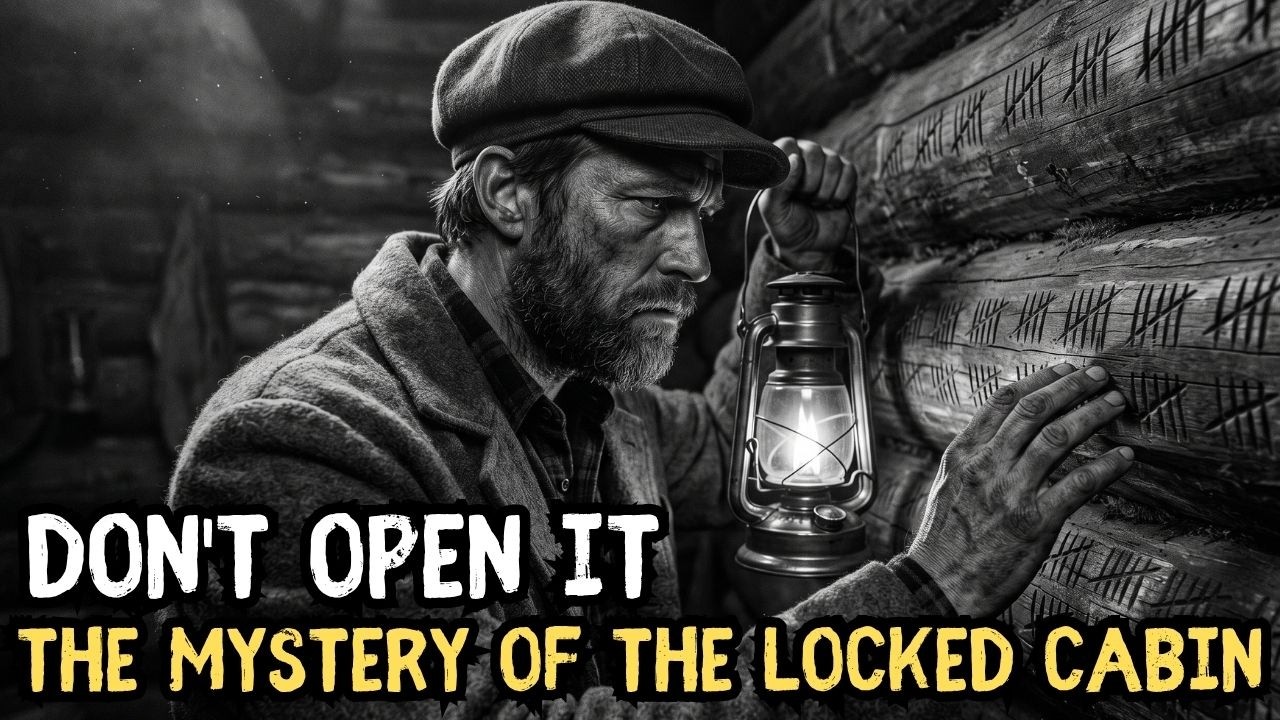
Along the south wall was a plank shelf with a rusted tin cup, a piece of rag, and a small hand-carved wooden implement. And beside the shelf, scratched into the log wall, were a series of marks arranged in a counting pattern, the kind a person makes when keeping track of days. Arthur counted the marks. There were somewhere between 480 and 520 days’ worth, approximately 16 to 17 months.
He came out and told Catherine it used to be where someone lived. She asked who. He said he didn’t know yet, but he was going to find out. Arthur was systematic.
At the Rutherford County Courthouse, he found the succession of property sales, each with the clause. He found the pre-war assessment records listing enslaved people by first name only. In the records, among the names, was Amos, listed as male, approximately 30 years of age in 1840, valued at $650. Amos appeared again in the 1850 and 1855 assessments.
But in the 1860 assessment, the last one before emancipation, Amos was not listed. Arthur found no record of a sale and no death record. He went back to the cabin and examined the marks more carefully. Near the end of the sequence, the counting marks became irregular, and then stopped being groups at all, becoming shapes and angles that might have been attempts at letters.
He could not read them. Catherine asked him what he thought the marks meant. He said someone had been in the cabin without the ability to leave for between a year and a half and two years. She asked whether he thought it was the man from the assessment records.
He said it was likely. She asked what happened to him when he came out. Arthur had no answer. In January 1904, Arthur went to Nashville and spent four days in the records offices, working through Freedmen’s Bureau documentation and labor records, looking for an Amos, formerly enslaved, from Rutherford County.
He did not find him. But he found a claim from a woman named Hester Gaines, who identified herself as formerly enslaved on a property in Rutherford County. At the bottom of her claim for wages owed by the estate of Cornelius Tatum, she had written a single sentence: “There is a man who was on that property who was not freed with the others, and I do not know if he is alive. His name is Amos Jbird.
Someone should look for him. ”
Amos Jbird. A surname, the kind of name enslaved people sometimes carried as a form of identity that existed outside the records kept by the people who owned them. Hester Gaines’ 1866 notation suggested that a year after the war ended, someone was still asking about Amos Jbird.
Whether anyone had looked, Arthur could not determine. There was no follow-up document, no resolution. The key to what happened came not from Nashville, but from the basement of the Murfreesboro Methodist Church. A deacon named Cyrus Ledbetter had preserved a collection of correspondence belonging to several local families.
He received Arthur in the spring of 1904 and brought out a bundle of documents tied with a faded blue ribbon. They included letters involving Cornelius Tatum. Amos Jbird had, according to a letter Cornelius received in 1856, been involved in what the writer described as communications of a dangerous nature with a free colored population in Nashville. It appeared Amos had been writing or sending word to a network of correspondence and mutual assistance that enslaved and free Black people maintained as a form of resistance.
Cornelius Tatum’s response was measured. He wrote that he understood the concern, that he would manage the matter privately, and that there was no need to involve the county’s formal structures. Handling it privately meant the east cabin, with its thick walls and high window and lock on the outside. It meant removing Amos Jbird from the visibility of the other enslaved people on the property, from neighbors and travelers and county assessors, and placing him in a state of enforced invisibility.
Arthur knew it was not an unusual calculation for its time and place. It was a form of control that existed within the broad tolerance of a social system. Cornelius Tatum did not lock Amos Jbird in that cabin because he was uniquely cruel. He did it because the system made it possible and the community made it acceptable.
What happened inside the cabin over the 16 to 18 months the counting marks suggest, the documents do not say. Hester Gaines’ claim suggests Amos was alive when the war ended, or at least that she did not know he was dead. The disoriented figure in Solomon Gentry’s account may or may not have been Amos. If it was, then the chaos of the Battle of Stones River had provided the only opening the locked door could not withstand: not force, but the temporary collapse of the system that maintained it.
Arthur found one more document in Ledbetter’s bundle: a half page of notes in Cornelius Tatum’s handwriting from 1863. Several lines were crossed out. What remained legible was this: “The cabin is to remain as it is. Nothing moved.
Nothing changed. The door is to stay locked. If anyone asks, the cabin is for storage. If the property is sold, the arrangement is to continue.
This is not negotiable. ” It ended: “The man is gone. Where he went is not known and should not be inquired after. ”
Cornelius had accepted not knowing as the resolution.
He had closed the door and locked it, and the community had honored the agreement for 40 years, through four property sales and a war that was supposed to have changed everything. It had held until a bookkeeper from Cincinnati with no history in that county arrived with a cold chisel and too many questions. Arthur Peyton did not publish what he found. He was a bookkeeper who had stumbled into a record of something his country had decided to bury.
He wrote up his findings in a careful 23-page document, organized with sources noted and gaps clearly marked, and sent copies to three places: the Freedmen’s Bureau records office in Nashville, the Howard University Library, and a Black-owned newspaper in Nashville. He received one brief acknowledgement. Whether anything was published, he never confirmed. Arthur and Catherine stayed on the property for six more years.
He wrote to his brother in 1907 that what he felt was not fear, but a kind of grief. “The worst thing I found in that cabin was not the marks. The worst thing was how easy it was. Nobody had to force anyone to keep quiet.
They just did generation after generation because keeping quiet was easier than not keeping quiet. ”
The property was sold in 1910. Arthur removed the clause about the east cabin from the deed, and he removed the boards from the window before they left so the light could come through. What became of Amos Jbird is not known.
There is no death record, no Freedmen’s record. There is Hester Gaines’ 1866 notation, “someone should look for him,” and then silence. It is possible he survived and built a life somewhere outside the reach of Rutherford County’s records. It is also possible it went the other way.
The documents say clearly that a community of ordinary people maintained a silence for 40 years that made one man’s suffering nobody’s business. When the silence was finally broken, it was broken by an outsider wielding nothing more dramatic than a cold chisel and the assumption that questions deserve answers. The east cabin stood until at least 1923, when county records show it was demolished. The land is farmland today.
The marks are gone. The only record of them is in Arthur Peyton’s 23-page document, which sits in the Howard University Library, cataloged under “property records and personal accounts, Middle Tennessee, 1900 to 1910,” where it has been waiting for over a century for someone to look.