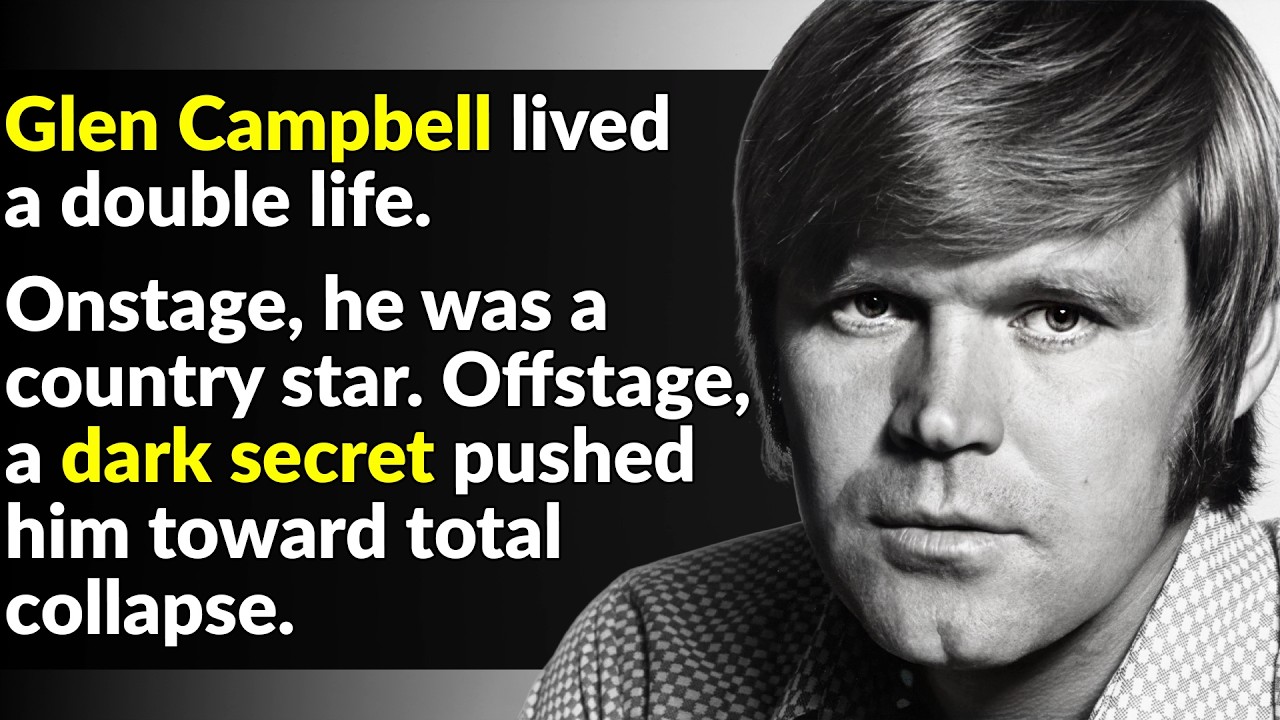
Glen Campbell lived two very different lives. On stage, he was country music’s golden boy, a guitar virtuoso who played with Frank Sinatra, the Beach Boys, and Elvis Presley. Behind the scenes, a string of failed marriages, turbulent romances, and substance abuse drove him toward collapse. Born Glen Travis Campbell in a small Arkansas town, he grew up on a farm where his family picked potatoes, corn, cotton, and watermelon.
Money was so scarce that they sometimes ate squirrel to survive. The household had no electricity, but his father managed to scrape together five dollars to buy guitars from Sears. Campbell was just four years old. By age six, Campbell was playing on local radio stations, teaching himself by listening to the radio because he had no formal instruction.
At fourteen, he left school in the tenth grade and moved to Houston to join his brothers, working odd jobs like installing insulation. But he kept playing guitar around town. At seventeen, Campbell traveled to Albuquerque, New Mexico, where his uncle led his own band. A television appearance on a KOB children’s show led to far more than a paycheck.
There, he met Diane Marie Kirk. The pair married in court when Campbell was eighteen and Kirk was sixteen and pregnant. The teenage marriage began in tragedy. Their son, Glen Travis Campbell Jr.
, was born two months premature on July 25, 1955, and lived only a few days. A daughter, Deborah Kay, arrived the following year, but Campbell did not let fatherhood slow his musical ambitions. In 1960, Campbell moved to Los Angeles and became a session musician. He joined the rock band the Champs, famous for the Latin-flavored hit “Tequila.
” From there, he became part of the Wrecking Crew, a group of elite session players whose guitar work can be heard on recordings by the Beach Boys, Frank Sinatra, Doris Day, and Sammy Davis Jr. A shared background forged a bond with Elvis Presley. When Campbell worked on the soundtrack for “Viva Las Vegas,” the two became friends, united by their simple rural upbringings and cotton-picking days. Campbell’s personal life, however, remained complicated.
After separating from Diane Kirk in 1959, he married Billie Jean Nunley on September 20, 1959. Before their 1976 divorce, the couple had three children, bringing Campbell’s total to four. In 1961, Campbell signed with Crest Records and released “Turnaround, Look at Me. ” The album did not chart well, but it led him to form his own band called the GCs, a name that sounded similar to the Australian group the Bee Gees.
Oddly, both the GCs and the Bee Gees recorded versions of the same song without success; the Vogues’ 1968 cover became the famous one. Despite being heard on 586 recordings, Campbell never learned to read music. When he worked with a full orchestra, the musicians played the piece once so the gifted guitarist could memorize it and follow along. Campbell’s big break came from the Beach Boys.
In 1965, Brian Wilson was under enormous pressure and needed a replacement for a tour. Campbell filled in on bass and vocals. As a reward, Wilson offered him a song Wilson had co-written, “Guess I’m Dumb,” and produced it for him. The difficult track required Campbell to sing in different registers, but it failed to chart.
His first taste of success arrived in 1965 with a new version of Buffy Sainte-Marie’s “Universal Soldier. ” The song carried a strong peace message that seemed to respond to American troops heading to Vietnam. But Campbell’s personal views surprised listeners. When asked about young men who burned their draft cards, he shocked audiences by saying they should be hanged.
“Universal Soldier” was Campbell’s biggest hit up to that point, but he struggled to follow it up. Capitol Records nearly dropped him. The label gave him one final chance, pairing him with producer Al DeLory. The result was “Burning Bridges,” which became a top 20 country hit.
Campbell and DeLory continued producing hits like “Gentle on My Mind” and “By the Time I Get to Phoenix. ” At the 1967 Grammy Awards, Campbell won four trophies, two for each song. The following year, his album “By the Time I Get to Phoenix” beat the Beatles and won Album of the Year. Hollywood came calling, and the offer came from John Wayne.
According to the account, Wayne and his daughter approached Campbell backstage after a concert and asked if he wanted to appear in a film. What Campbell did not know was that the producers had originally wanted Elvis Presley for “True Grit. ” Presley’s demanding agent insisted his client receive top billing over Wayne and co-star Kim Darby. That never happened, so Campbell got the part.
With almost no acting experience, Campbell took a major risk. He clashed with director Henry Hathaway, who later described Campbell’s performance as stiff and complained about his laziness. Campbell himself was brutally honest about his work, saying his acting was so bad that it made Wayne look much better, helping the legend win his only Oscar. Campbell still received a BAFTA nomination for most promising newcomer.
Campbell’s good looks helped him land his own variety show, “The Glen Campbell Goodtime Hour,” which mixed music and comedy. Behind the scenes, aspiring writers Steve Martin and Rob Reiner cut their teeth, and guests ranged from the Beatles and Johnny Cash to John Wayne and Carol Burnett. His return to film with “Norwood” was less successful. The promotional posters highlighted the stars’ real talents, reading, “It’s time for Glen and Super Joe to do their things.
” But the film received lukewarm reviews, with one critic calling it corny but harmless. It was Campbell’s last feature film. In 1974, Campbell was in Australia when he heard a song on the radio about an aging musician reflecting on his rise to fame. He felt a strong connection to Larry Weiss’s “Rhinestone Cowboy” and pitched it to Capitol Records upon returning to the United States.
The song topped both the Billboard country singles chart and the Billboard Hot 100, successfully crossing Campbell into pop music. The song’s success led to an attempt to adapt it into a film. Campbell was offered the lead role and turned it down. The 1984 film “Rhinestone” went to Sylvester Stallone and Dolly Parton instead.
It was nominated for nine Golden Raspberry Awards, and Stallone won Worst Actor. Campbell’s own life was unraveling. He was heavily drinking, and his second marriage was ending. By 1978, his marriage to Billie Jean Nunley was over, but the wild lifestyle continued.
He later credited his third wife with introducing him to drugs. Sarah Bahr, ex-wife of singer M. Davis, had a negative influence on Campbell. He said he started using cocaine while in Las Vegas, and although he did not blame her entirely for his problems, he left her in 1980.
His next relationship proved even more volatile. Campbell began dating Tanya Tucker, then just 22 and already battling her own issues with alcohol. He threw her a $57,000 birthday party at 22, and their duet “Dream Lover” earned a Grammy nomination for best country vocal performance. But the relationship turned into a nightmare marked by loud, sometimes violent public fights.
He allegedly threw chairs, and she reportedly broke his ribs. After one quarrel at the Plaza Hotel in New York, the room was left in ruins, costing Campbell $1,200 to clean. When the relationship ended, Tucker demanded $3 million in alimony and shocked the music world by claiming Campbell had broken her front teeth. She never filed a lawsuit, but the affair ended decisively.
Campbell called the relationship poisonous and insane; Tucker described Campbell as the love of her life. In 1981, Campbell went on a blind date with Kim Wollin and married her the following year. Wollin seemed unprepared for what awaited her. She described her husband on drugs as a monster and recalled an incident when he pointed a gun at her.
She gave him an ultimatum: quit or leave. Her church offered help, and she played him an audio recording of himself drunk, rambling incoherently. Hearing himself was enough to make Campbell stop. He later said he stopped using drugs in 1989, but relapses followed.
In 2003, Campbell was driving in Phoenix, Arizona, when police pulled him over, convinced he was drunk. When asked his name, he said he was Glen Campbell, the Rhinestone Cowboy. He told officers he had only ordered a Coke at a bar, but they did not believe him. He claimed he had been given too much to drink.
The situation worsened when he tried to kick an officer in the leg. The judge handed down the maximum sentence: ten days in jail. Campbell died on August 8, 2017, at age 81. His former lover Tanya Tucker, whose relationship with him had been turbulent, wrote and performed the song “Forever Loving You” in his honor.
Campbell’s widow was furious, accusing Tucker of exploiting his death for fame. His legacy remained complicated even after death. Campbell fathered nine children, but when his will was read, not all of them inherited. The three children from his marriage to Billie Jean Nunley were left out.
They moved to contest the will but eventually abandoned the challenge for unknown reasons. Despite the turmoil, many remembered Campbell fondly. Rock singer Alice Cooper described him as a golden boy who could get along with all kinds of people.