A glass vial, a body on the floor in Lüneburg, and an autopsy report written by British military doctors. For decades, that was the final chapter in the life of Heinrich Himmler.
The man who led the SS, controlled the concentration camp system, and helped organize the Holocaust never faced a public trial. On May 23, 1945, he died of cyanide poisoning while in British custody.
Yet for decades afterward, his death remained in question. Was the body really Himmler's? Was he killed before he could talk? And what did the original medical examination actually record?
The answer is less dramatic than a secret assassination, but it is more revealing of the facts. Himmler died by his own cyanide capsule after his arrest. The controversy grew later, fed by secrecy, poor communication, and a British desire to make the remains disappear without creating a shrine.
Heinrich Himmler was not a battlefield commander in the traditional sense. He was an administrator of terror. As Reichsführer-SS, he oversaw troops, the police apparatus, and the concentration camps.
Under his authority, deportations, forced labor, and mass murder were carried out through offices, orders, and trains. By May 1945, he knew the regime had collapsed and that the men who built it might face trial.
He tried to save himself through negotiation. Himmler contacted Count Folke Bernadotte of Sweden and attempted to open channels with the Western Allies. At the same time, he remained in charge of SS forces.
Hitler discovered those contacts and stripped Himmler of his posts. The man who had demanded absolute loyalty was suddenly moving under a false identity.
On May 21, 1945, British forces stopped a group of men near Bremervörde. Himmler was posing as Heinrich Hitzinger and had altered his appearance. His papers were suspicious.
He wore a black patch over one eye and had shaved his mustache. The guards did not immediately know they had captured the head of the SS. They had detained a man trying to impersonate someone else.
He was moved through detention and interrogation centers. The British searched him repeatedly. Senior officers needed confirmation before the arrest could be announced.
Himmler was stripped and examined. A vial was found among his possessions, but the decisive capsule stayed hidden in his mouth. That detail explains why the final examination mattered so much. The danger was not only escape, but suicide before interrogation.
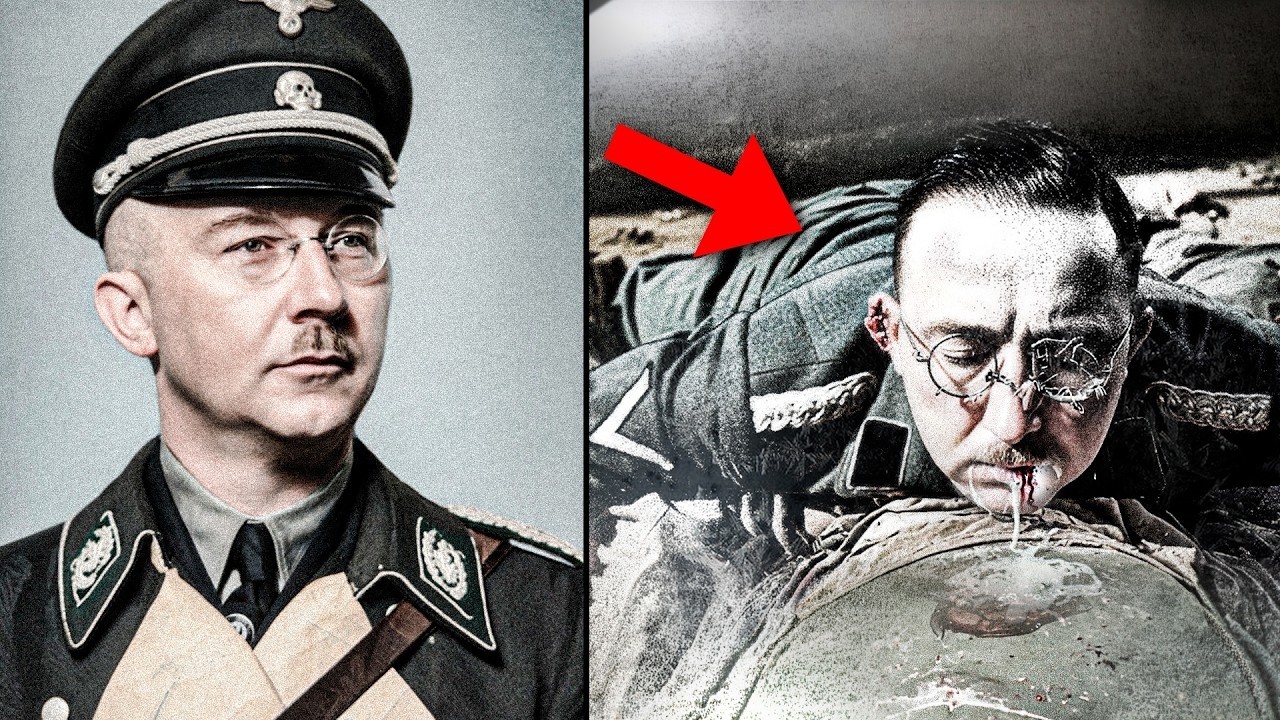
On May 23, at the British headquarters in Lüneburg, doctors carried out a more careful inspection. According to the contemporary account, a medical officer asked Himmler to open his mouth so his tongue could be checked.
Himmler clenched his jaw. The glass capsule broke. Cyanide entered his mouth. British personnel tried to restrain him and save him, but he died within minutes.
The scene was chaotic. The prisoner was naked except for a piece of clothing or a blanket. Officers tried to clean his mouth and apply medical treatment. The poison worked faster than the doctors could reverse it.
Himmler had kept his means of suicide through several searches and used it when he realized the final search might expose it. This is where the words autopsy and post-mortem must be handled carefully.
The British did conduct a post-mortem examination to establish identity and cause of death. It was not a modern forensic autopsy staged for public release. The report described the body, measured it, recorded distinguishing features, and examined physical evidence.
A death mask was made and photographs were taken. Doctors recorded that the body was that of a well-nourished adult male with distinctive physical features. They examined the head, teeth, jaw, scars, hair, and body measurements.
The purpose was not curiosity. The British had recently learned that senior Nazis might use doubles, aliases, or forged papers. They wanted an indisputable record that the prisoner who died was Heinrich Himmler.
Identification did not rest on a single detail. It relied on appearance, answers given during interrogation, comparison with photographs, and the circumstances of the arrest. Himmler himself had admitted his identity before death.
His signature and physical characteristics were checked. The medical report created a permanent record of the body. The cyanide poisoning interpretation is also supported by contemporary evidence.
The capsule was seen, the glass broke in his mouth, and he collapsed quickly. The post-mortem findings were consistent with poisoning. There is no reliable evidence of a gunshot wound, strangulation, or outside attack.
The murder theory persists because the British controlled the information, ordered secrecy, and disposed of the body in an unmarked grave. But secrecy is not proof of murder.
The British had reasons to avoid a public grave for Himmler. They did not want pilgrims, propaganda, or a future shrine for the SS. The body was buried secretly in the Lüneburg Heath area. No marked grave remains.
That decision created a perfect environment for later speculation. If no one could visit the grave, no one could independently verify what happened there.
Later conspiracy theories usually follow two lines. One claims the British killed Himmler because he knew about negotiations with the West. The other claims the prisoner was a double.
Both theories require evidence that has not appeared. The British had reasons to interrogate Himmler rather than kill him. He was one of the most important surviving Nazi leaders.
His knowledge of the camps, the intelligence apparatus, and late-war negotiations could have been valuable. The alleged kill documents cited to support the theory suffer from serious problems. Some later papers proved to be forged or unreliable.
A sensational claim about secret British orders cannot overturn contemporary medical records without strong evidence. The fact that officials signed secrecy agreements proves the death was sensitive, not that the official account was false.
The truly disturbing conclusion is not that Himmler was secretly killed. It is that he escaped the courtroom. The man responsible for the SS did not have to listen to survivors' testimony.
He did not answer questions about deportation, gas chambers, or forced labor under oath. The cyanide gave him control of the moment when the world might have confronted him.
His death also revealed a contradiction in Nazi leadership. Himmler demanded sacrifice from others and sent millions to inescapable situations. When his arrest became certain, he chose the small glass capsule.
The body preserved by British doctors belonged to a man who organized a vast system of death and then refused to submit to the law that would try him. After 64 years, the popular narrative of a new autopsy can sound as if scientists discovered a completely different cause of death.
The historical record is more precise. The important evidence was already there in 1945. The identity revealed, the cyanide capsule, the rapid death, and the post-mortem examination. Later research challenged myths, not the core conclusion.
So what did the examination reveal? It revealed that the body was Heinrich Himmler's. It revealed no reliable sign of assassination. It recorded a body that died in British custody after breaking a hidden cyanide capsule.
And it revealed something morally important. One of the chief architects of Nazi terror escaped the public trial his victims deserved.
The reason the Himmler case remained prone to myth is the gap between his capture and the announcement. Allied leaders realized they had a valuable prisoner. They also knew a public trial might expose embarrassing negotiations and failures.
Himmler had tried to contact the West while the camps were being liberated. That made him politically useful, but it also made his death sensitive. The British did not publish every detail immediately.
Officers were instructed to maintain secrecy. The body was photographed and measured. A plaster cast was made of his face. The brain was removed as part of the examination.
These actions look sinister if stripped of context, but post-mortem identification in wars often involves preserving every possible piece of evidence. The British had to prevent any later claims that Himmler had escaped.

The physical report was remarkably ordinary in tone. It described height, build, hair, eyes, nose, chin, scars, and other features. That ordinary language matters.
A document designed to identify a body does not read like a political confession. It does not describe a monster. It describes an adult male and records the features by which experts could compare him with photographs and earlier records.
The cyanide capsule was not a British invention. Poison had been distributed to or obtained by senior Nazis in anticipation of capture. Himmler already carried one vial that was discovered. The second was hidden in his mouth.
The final search succeeded only when a doctor examined the inside of his mouth. Himmler's act was deliberate. He knew what the capsule was and what would happen when it was crushed.
Some later writers argued that the cyanide did not work quickly enough or that the body showed signs of a struggle. Such arguments usually rely on photographs taken after his collapse, when officers were trying to restrain him and recover the poison.
A chaotic scene does not automatically indicate murder. The absence of a trial is a tragedy for justice, not evidence that the British killed him.
The body was buried in secret because the Allies had learned what could happen when graves become political sites. A marked grave could attract former SS members and create a shrine. The unmarked burial also protected the soldiers involved.
Himmler had commanded men who might remain armed and dangerous. The decision was practical and political, but it inevitably led to later suspicion.
The real forensic question was whether the body examined was the same man captured at Bremervörde. The answer depended on continuity. The same prisoner, the same physical measurements, the same admission of identity, the same remains.
There was no unexplained substitution. The double theory requires us to believe that a second man was captured, resembled Himmler closely enough, possessed his information, and then died with the same cyanide story. No evidence supports that conclusion.
The years after 1945 turned Himmler's death into a blank space in popular memory. The camps remained, but the commander was absent from the courtroom. Survivors had to hear his name through documents and photographs instead of direct questioning.
His suicide did not only save his life from public execution. It deprived history of a direct confrontation. That is why the forensic story of Himmler should end with responsibility, not mystery.
The autopsy did not reveal a secret poison, a hidden illness, or an assassination plot. It confirmed the identity of a man who tried to disappear and recorded that he died by his own hand before the courts could question him.
There is another reason Himmler's death attracts attention. The man who spent years controlling the identities of others suddenly had no name. The SS had created categories, numbers, and documents for prisoners. It decided who belonged, who could work, and who could disappear.
Himmler himself tried to become "Heinrich Hitzinger." The alias was not a minor detail. It was an attempt to escape the identity system he had used against millions of people.
The British arrest was not cinematic. It relied on suspicion. The papers looked too clean. The men in the group did not behave like ordinary displaced soldiers. The eye patch and shaved mustache made Himmler less like himself, but a disguise can raise suspicion when it is too deliberate.
The first soldiers did not need to know his rank. They only needed to know something was not normal. During interrogation, Himmler tried to present himself as an important figure.
He wanted to speak to senior officers. He wanted to acknowledge his political value. This was the same instinct that had shaped his career. He thought his rank and importance might protect him, but the British were no longer negotiating with the Reichsführer-SS.
They were dealing with a prisoner whose identity had to be proven before the consequences could begin. The search for poison had a practical background too. Allied forces knew that Nazi officials carried cyanide.
Hitler had died by poison. Other members of the leadership had attempted suicide. A capsule in a pocket was easy to find. One hidden in the mouth was harder.

The medical examination became a struggle between a doctor searching and a prisoner waiting for the right moment. The final moment happened quickly. Once the capsule was bitten, officers had seconds, not hours.
Cyanide interferes with the body's ability to use oxygen. There is no need to recount precise clinical details in this story, but the consequences were concrete. Himmler fell to the ground, his breathing stopped, and doctors could not treat the effect of the poison.
The British wanted him alive for interrogation. They did not have time to extract what he had swallowed. Early reports used urgent language because the death was unexpected.
Himmler had survived capture, interrogation, and multiple searches. Officers believed he would be available for questioning. Then, in a room outside Lüneburg, one of Europe's most important prisoners died.
The British had to secure the body, confirm identity, and justify their failure to keep him alive. This explains why the post-mortem report was so detailed. It was not enough to say that a prisoner named Hitzinger had died.
An official record had to prove physical identity. Doctors recorded body dimensions, head shape, and facial features. They noted the short thick neck, the jaw, the hair, the eyes, and marks that could be compared with photographs.
The report also protected the British from any future challenge to credibility. If Himmler appeared elsewhere, or if Nazis claimed the British had killed a double, the measurements could be consulted.
The death mask preserved facial features. Photographs documented the condition of the body. Physical and dental details created a chain of evidence rather than a single official sentence.
The body was not treated as a public event for viewing. The British kept the matter under control. This decision was partly driven by security.
Himmler's name remained powerful among loyal SS members. A public funeral could have become a rally. A grave could have become a shrine. The purpose of the unmarked burial was to prevent that.
But secrecy has a cost. When families cannot visit a grave and researchers cannot examine remains, the missing information becomes fuel for speculation. The same decision that prevented a neo-Nazi shrine created the idea that something had been hidden.
Historians must therefore distinguish between a secret burial and a secret killing. The first is documented, while the second is not. One later theory claimed Himmler was killed because he held information about secret negotiations with Britain.
It is true that he tried to contact the West. It is true that Allied officials had reasons to control that information, but the theory still requires evidence of an order, a method, and a motive strong enough to outweigh the value of interrogating him. None of that has been proven.
Another theory focused on physical differences in photographs of the dead man. Bodies change after death. Photographs taken from different angles distort the shape of the jaw, nose, and cheeks.
Himmler had shaved his mustache, altered his hair, and worn a disguise. Comparison based on a single image can give an impression of difference without proving a substitution.
The post-mortem report is therefore more important than a dramatic photograph. It contains a set of observations recorded by medical officers at the time. The body was linked to the prisoner captured near Bremervörde.
The prisoner admitted his identity. Physical features matched. The mechanism of suicide was observed. An alternative theory must explain all those points at once.
There is also a moral problem with the phrase "the truth discovered decades later." It suggests the original evidence was false and a later revelation saved the story. In Himmler's case, the core truth was known immediately.
The later decades produced arguments, forged documents, and sensational books. None of them changed the cause of death. What later investigations revealed was how much the public wanted a second story.
A quiet cyanide suicide seemed unsatisfying. Himmler was too powerful for his end to be an examination room. People preferred an assassination, a double, or secret negotiations. But history does not owe us a cinematic ending.
The most important truth is that Himmler died before a court could force him to describe the system he led. He escaped interrogation, but he did not escape documentation. SS files, camp records, survivor testimony, and orders remained.
His death removed one witness and one defendant. It did not remove the crimes.