Declassified testimony and archival records have 𝓮𝔁𝓹𝓸𝓼𝓮𝓭 the horrific “entertainments” that SS and Wehrmacht units pursued across occupied Soviet and Baltic territories during World War II — pastimes that began as ordinary soldierly recreation but curdled into industrial-scale sadism, mass rape, and ritualized murder that investigators say defies conventional understanding of human behavior.
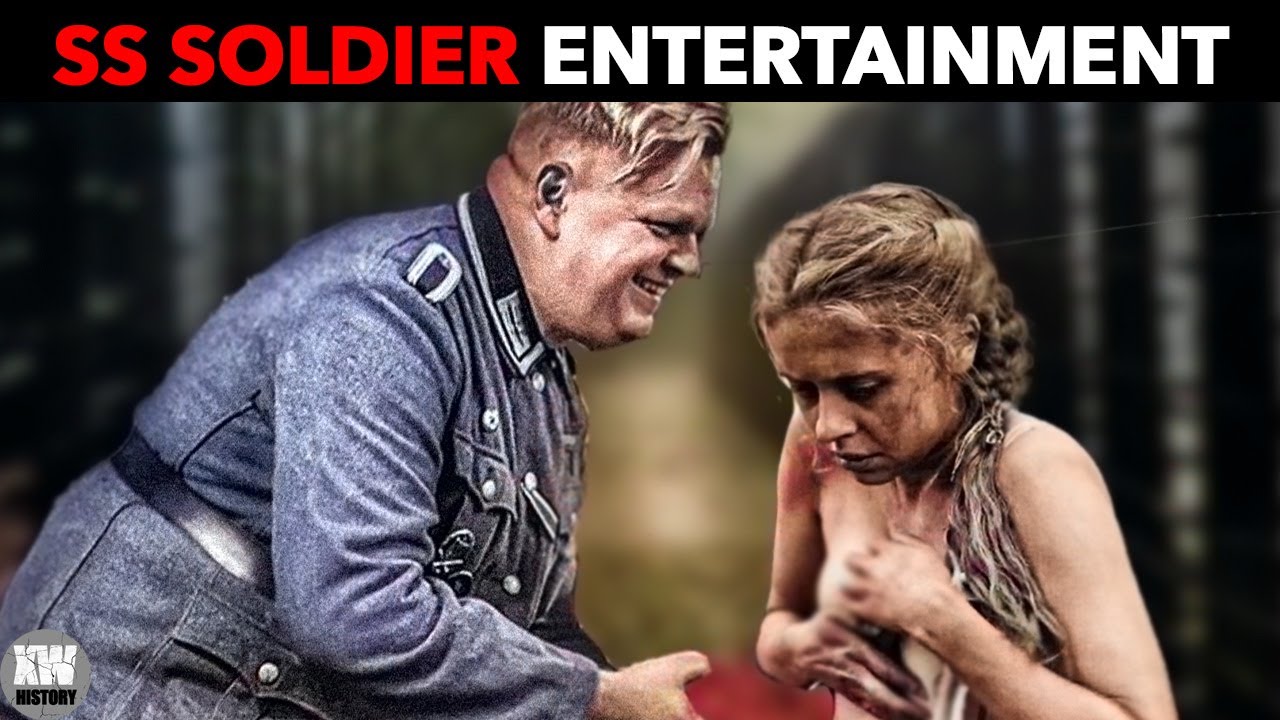
The accounts, drawn from KGB archives, survivor memoirs, and captured German orders, describe a systematic culture in which the leadership of Nazi Germany not only tolerated but explicitly demanded atrocities from its men. “You have no heart and nerves. They are not needed in war.
Destroy pity and compassion in yourself,” read one directive issued to SS troops. “Don’t stop if there’s an old man or a woman, a girl or a boy in front of you. With this you will save yourself from death, secure the future of your family and earn fame forever.”
Historians note that SS formations occupied a unique and lethal position in the Nazi war machine. They were elite combat units expected to fight Germany’s enemies directly at the front, but they were also routinely deployed for punitive operations behind the lines — hunting partisans, “maintaining order” in occupied regions, and carrying out reprisal massacres against civilians. It was in this rear-echelon role, far from the discipline of the front, that the most grotesque behavior flourished, particularly after 1941, when the German advance stalled and soldiers accustomed to easy victories began to “go wild.”
In the village of Yako, near Smalin, an SS detachment entered on a rainy autumn day and herded every resident into the square in front of the village council. The men — a term used loosely, since only the elderly and teenage boys remained — were marched outside the village and shot. In the village of Pinak, all residents, including old people, women, and children, were driven into the collective farm administration building.
The doors were propped shut from the outside with sticks, and the structure was set ablaze. Women and children screamed and rushed through the burning building while the perpetrators stood by and calmly watched.
Near Vage, an execution squad paused to rest and amuse itself. Villagers, mostly women and children, were driven from their homes onto a bridge and forced to jump into the river below. Those who tried to swim to shore were shot.
Those who did not drown quickly enough were pelted with stones. Witnesses described the killers laughing as the bodies sank.

Rape was so commonplace that it became a matter of routine logistics. In the memoirs of Peter Schuber, a soldier in a security detachment, the process is described with chilling banality: “We went to the village of Foreso near Gachina. We had a task to bring local girls for the gentlemen, our officers.
The operation was successful. We grabbed many girls from nearby houses and filled a whole truck with them. The officers had fun with the girls almost all night, and in the morning they gave them to us, the soldiers.”
In the city of Tiin, a high school student named Kadeta, already wounded by shrapnel, was taken to a hospital for German soldiers housed in a monastery. The wounded men — Wehrmacht and SS alike — did not miss the opportunity. The girl was raped by a crowd of soldiers and died of her injuries.
Robbery accompanied the violence. Intelligence reports from the city of Lban describe officers and soldiers moving through local homes in search of gramophones and sewing machines. The looting was not confined to Russian, Ukrainian, and Belarusian regions; the Baltic republics were stripped as well.
Colonel Gal, chief of staff of the First Military District, reported “very deplorable facts of robberies” carried out by soldiers of the Wehrmacht, SS, and local collaborators, with goods shipped home to Germany. Occupation authorities issued orders demanding that “suspicious elements who have not been convicted of serious crimes but who, due to their beliefs and behavior, appear dangerous must be transferred to the operational groups of the security police and SD.”
Some killers turned murder into a grotesque sport. At the Treblinka station, sixty kilometers from Warsaw — a name that today evokes the same horror as Mauthausen and Auschwitz — an SS man named Stump was nicknamed “Laughing Death” by prisoners because he laughed every time he shot or hanged someone. He and his colleagues enjoyed watching a deranged SS man named Wudowski rush after children driven into the fence perimeter, swinging a hammer and beating everyone he could reach.
On one occasion he beat fifteen children to death in a single frenzy.

Edmund Seidelman, a prisoner of the Lviv camp, recalled the Nazis forcing prisoners to carry heavy loads — bundles of bricks, stones, and logs — on the way to and from the quarry. The guards called it “taking vitamins.” If a prisoner carried bricks, he was “taking vitamin C.”
If he carried logs or boards, it was “vitamin D.” The method was designed to physically exhaust already emaciated people before they were shot.
In the village of Kitki, in the Smansk region, Nazi forces carried out a massacre before retreating, raping every young woman and girl who fell into their clutches. Even miners were not spared. The executioners did not have time to cover their tracks: after the village was liberated, fifty-nine female corpses were discovered.
Many had had their fingers, ears, and breasts cut off.
A person captured by punitive forces on suspicion of contact with partisans could be forced by police and SS men to run in front of a horse, motorcycle, or car. Those who collapsed from exhaustion were shot immediately.
One memoir, preserved in KGB archives, comes from a woman who was thirteen or fourteen years old during the war and lived in a village near Smansk. The Nazis had established a burial ground close to her home where they brought the people they killed. She remembered an SS man named Yore, apparently a local trader, who amused himself by hunting local girls as they herded cattle the Germans had not yet confiscated.
The girls would run; he would chase them, pull a gun from its holster, and pretend he was going to shoot. “It is not hard to imagine what the poor children were going through,” she wrote. The tormentor, she noted, never actually killed any of the locals — he simply enjoyed the terror.
 Decades later, in 1963, the same woman boarded a tram car and recognized the man instantly. Despite the years that had passed, she knew him at once. She tried to follow him but lost sight of him in the crowd.
Her letter, preserved in the archives, is one of the few surviving attempts to bring a perpetrator to account through the memory of a child.
The picture that emerges from these records is not one of isolated excesses by rogue soldiers but of a system that institutionalized cruelty. Nazi leadership, according to captured documents and speeches, “not only forgave any crimes committed by the Wehrmacht and SS soldiers in advance but even demanded these crimes.” Adolf Hitler declared that his regime had created “a new type of man,” a “race of masters,” and remarked that “it is natural that in the west other approaches are needed” — an implicit acknowledgment that the brutality in the east was policy, not aberration.
Even the lighter moments of occupation life were poisoned by coercion. In some areas, Nazis seeking “cultural activities” rounded up local populations and forced them to dance, sing, and play instruments — compelling civilians to perform joy for their captors. What might have been harmless recreation in any other army — letter-writing, card games, dominoes, checkers, photo sessions, picnics, sports competitions, visits by orchestras and artists — existed alongside field brothels and, in rare units, cafes and canteens where waitresses and dishwashers were expected to “intimately serve” German military personnel for a fee.
Historians caution that the full scale of these crimes remains unknown. Many villages were destroyed entirely, leaving no survivors to testify. Many perpetrators were never identified, and many who were identified were never prosecuted.
The KGB archives that preserve letters like the one from the tram car contain thousands of similar accounts, most of them never acted upon.
What the records make clear is that the “entertainments” of the SS on occupied territory were not a footnote to the war but a central feature of it — a deliberate policy of terror designed to erase resistance, dehumanize victims, and reward perpetrators. The woman who recognized her tormentor on a tram in 1963 never got justice. The fifty-nine women of Kitki never got justice.
The children driven into the fence at Treblinka never got justice. Their stories, preserved in yellowing files and survivor testimony, remain as evidence of what happens when a state not only permits atrocity but demands it — and calls it fun.