On the afternoon of August 3, 1943, inside a canvas tent on the island of Sicily, a three-star American general struck a sick soldier across the face with a leather glove, called him a coward, and ordered him thrown out of an evacuation hospital. The soldier's temperature was 102 degrees Fahrenheit. He was suffering from malaria and dysentery, and had been hiding both from his unit because he did not want to leave it. The general was George S. Patton.
What happened in the days after that slap became one of the most important stories the United States Army tried to forget. The account that follows is drawn from official medical reports, Dwight Eisenhower's letter of August 17, 1943, and the testimony of the men and women who were in those tents.
Sicily, August 1943. The island had been burning for 33 days. Operation Husky began on July 10. By the first week of August, Allied armies were cutting their way across the Sicilian coast. The British under Montgomery pushed north along the eastern shore. The Americans under Patton raced west, then north, then east in a famous and unauthorized drive toward Messina.
The terrain was volcanic rock. The roads were dust. The hills around Troina, Nicosia, and Santo Stefano were filled with German machine-gun nests, mortar pits, and tightly sown mines. The cost rose every day.
The 1st Infantry Division, the "Big Red One," had been in the line almost continuously since the landings at Gela. Its men were dirty, sleep-deprived, and dehydrated, their eyes sinking deeper. Some had been fighting for a month with a single pair of socks. Others carried shrapnel they had told no one about. The medics saw what the official reports did not.
A few miles behind them, near an olive grove outside Nicosia, the 15th Evacuation Hospital was a city of canvas. White tents stood in neat rows. Generator wires ran along the dirt. A wooden sign at the entrance carried a red cross. Inside the surgical tents, the air smelled of ether, sulfur powder, blood, and burnt coffee.
Nurses of the U.S. Army Nurse Corps worked 18-hour shifts. They were young, most in their twenties or early thirties. They wore olive-drab uniforms over their dress uniforms because skirts were impractical in Sicily. They had learned in training back home how to take a pulse, change a dressing, and hand a surgeon a clamp. Here they learned other things. How to find a vein in a sweat-soaked arm. How to hold a teenager's hand while he called for his mother. How to walk past a row of litters without slowing down. They did not talk much during their shifts. There was no time.
That was the world Private Charles Herman Kuhl entered on the afternoon of August 2. Kuhl was 27 years old. Before the war, he laid carpet in Mishawaka, Indiana, a small town where his father had once worked on the railroad and neighbors called him by his first name. He was not a natural soldier. He was a quiet, narrow-shouldered man with thinning hair and a habit of looking at the ground when officers spoke to him.
He had been in Sicily since the landings. He had not slept well in 11 nights. On August 2, his platoon medic sent him back from the front. He could not keep food in his stomach. His hands shook when he tried to load his rifle. He reached his battalion aid station first, then was moved up the chain to the 15th Evacuation Hospital. A clerk wrote three words on his medical card that would follow him for the rest of his life: psychoneurosis. Acute anxiety state, moderate.
A nurse pointed him toward a bed. He sat down. He did not say much. No one in the tent thought he was an unusual case. They had seen a thousand like him.
While Kuhl lay on his cot in Nicosia, 60 miles away in a commandeered villa serving as headquarters of the Seventh Army, Lieutenant General George S. Patton Jr. was finishing a meeting that would shape the next ten days of his life. He was 57 years old. He stood six feet tall, broad-shouldered, his face burned by the sun from the open jeep he insisted on riding. He wore a steel helmet polished like a mirror, a tailored jacket with three rows of ribbons, and two pistols on his hips with ivory grips — the Colt he had carried since the Mexican border in 1916 and a Smith & Wesson he had acquired later. He wrote in his diary every night in a private code. He believed in destiny. He believed in cavalry charges. He believed in the chain of command. And he believed deeply in the moral weakness of men who hesitated.
Across the desk from him sat Major General Clarence R. Huebner. Huebner was 54. He had just been appointed to command the 1st Infantry Division, replacing the beloved Terry de la Mesa Allen. Huebner was a strict, by-the-book officer who had inherited an exhausted and resentful division. He needed to show his new army commander that he had the situation in hand.
He told Patton what any new commander tells his boss when that boss is George Patton. He told him the front was weakening. He told him there were too many men in the hospitals. He used a hard word: malingerers.
Patton did not need much convincing. He already believed that battle fatigue, what an earlier generation called shell shock, was a myth invented by the weak to avoid duty. He had written it in private letters. He had said it in private speeches. To him, rear-echelon hospitals were not sanctuaries. They were hiding places.
After the meeting, he told his aide he intended to visit the evacuation hospitals himself. He wanted to see these malingerers with his own eyes. That visit would become the first slap.
August 3, 1943. Afternoon. The general's convoy stopped at the gate of the 15th Evacuation Hospital outside Nicosia, in a cloud of white dust. Patton stepped out first. He always stepped out first. He walked the gravel path between the tents with his aide two steps behind.
The hospital commander was summoned. Nurses stopped their work to salute. The wounded sat up where they could. Some cheered. Patton moved from bed to bed doing what he had come to do, the part he was good at. He stopped at a young infantryman with bandaged eyes and told him he was proud of him. He pinned a Purple Heart on the chest of a sergeant whose leg had been amputated below the knee. The young man cried. Patton cried. Witnesses would remember that part of the visit for the rest of their lives and would say, truthfully, that the general loved his men.
Then he reached a tent at the end of the row. He saw a soldier sitting on a bed in full uniform, hunched forward. No bandages, no visible wound. The soldier was Charles Kuhl.
Patton stopped. He asked, in the voice he used for ceremonies, "What's the matter with this man?"
Kuhl looked up at him. He gave the answer every exhausted 19-year-old has given since the Romans crossed the Rubicon. I guess I just can't take it anymore.
Six words. What happened next took less than 30 seconds, and everyone in the tent would remember it differently for the rest of their lives.
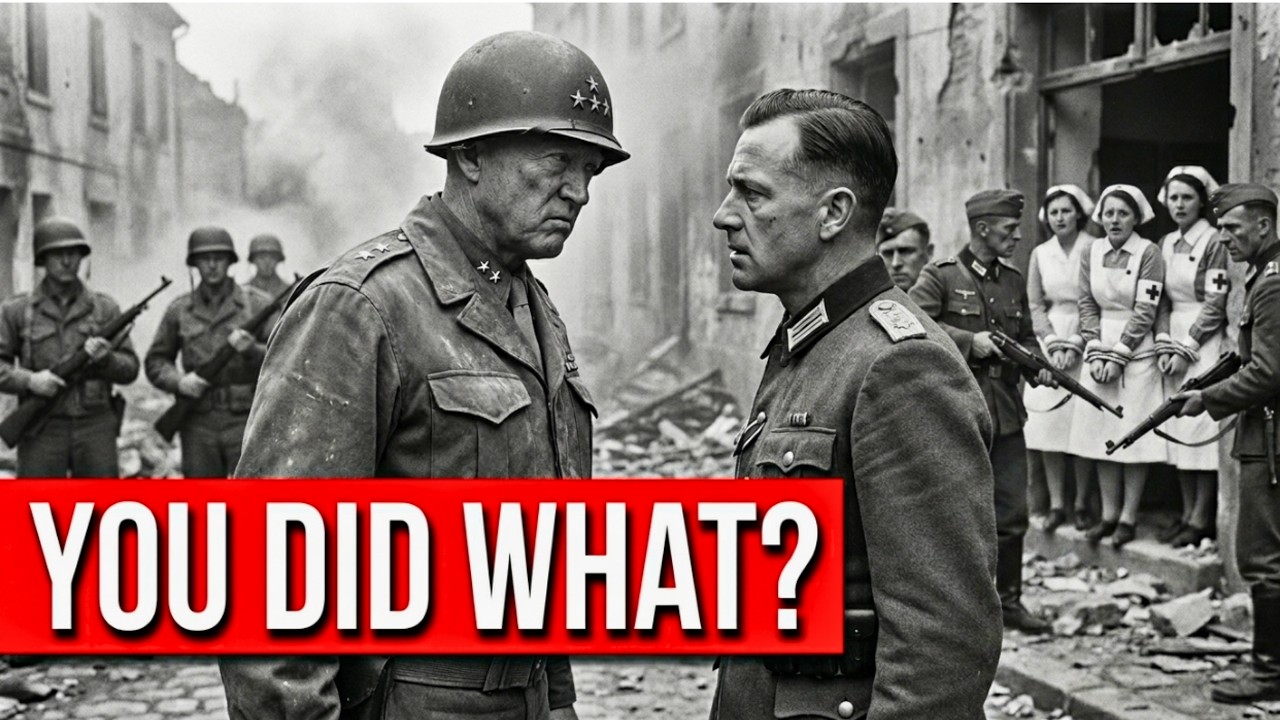
Patton's face changed. He pulled off his gloves. He slapped Kuhl across the chin once, hard, with his leather gloves balled in his fist. He grabbed the soldier by the collar of his shirt and pulled him to his feet. A bottle tipped over and fell. Patton was shouting now, his voice cutting through the canvas walls, audible in the next surgical tent. He called him a coward. He called him a yellow son of a bitch. He screamed at the officer in charge not to admit this bastard. He dragged Kuhl toward the tent flap. As the soldier stumbled out into the Sicilian sun, the general kicked him — actually kicked him — in the rear of his trousers.
Kuhl staggered a few steps and fell. A medic helped him up. Patton walked back inside the tent. He kept shouting for another full minute, ordering the man sent back to the front, threatening the staff if they admitted any more cases like him.
The nurses did not move. A surgeon in a bloodstained apron stood perfectly still in the corner. A captain, a doctor, opened his mouth and then closed it. This was a three-star general. This was the man whose name was on the front of every newspaper in America. There was no scenario for what had just happened. There was no page in the manual. There was only silence after the shouting, and the heat, and the smell of ether, and the sound of Kuhl outside vomiting into the dust.
Patton left. His jeep pulled away. The hospital staff began to move again, slowly at first, the way people move after a near-miss car accident. A nurse went to look for Kuhl. She found him on the ground beside a generator, his shirt out of his trousers, his cheek already beginning to swell where the gloves had landed. She helped him up. She said nothing. She walked him back to a litter, a different bed in a different tent, and put him on it.
That night, a thermometer was placed under his tongue. It read 102.2 degrees Fahrenheit. A blood smear taken from the crook of his elbow the next morning would come back positive for plasmodium. Malaria. A stool sample would confirm what the medics already suspected. Chronic dysentery. He had been sick for weeks. He had hidden it because he did not want to leave his unit. The man George Patton called a coward had a fever of nearly 39 degrees Celsius and parasites in his blood.
The same night, 60 miles away in his commandeered villa, Patton sat at a small writing desk by a window. He opened his diary. He wrote a page about his hospital visit. He noted the brave amputee. He noted the men's morale. And he wrote, in a steady unbroken hand, about the soldier he had met at the end of the row. He called him a weakling. He went to bed satisfied with what he had done, believing it was right. The light in his window went out shortly after eleven.
Across Sicily, in the dark, in a thousand tents and a hundred aid stations, the war went on. In a hospital 60 miles to the south, in a unit that had not yet entered this story, a medic prepared a bottle of plasma for the morning's casualties. In two days, his hospital would receive orders to move forward to a coastal town called Santo Stefano. In eight days, a soldier named Paul Bennett would be carried into its receiving tent against his will. And in two days, on the morning of August 5, Lieutenant General George S. Patton would sit at the same writing desk in the same villa and draft an order that would go out to every commander in his Seventh Army.
It would state, in his own words, that any man who went to the hospital on the pretext that he was unable to fight for psychological reasons would be considered a coward and dealt with accordingly. The order would be signed two days after a slap no one outside that tent yet knew about.
That is the part that changes everything, because what happened in that canvas tent outside Nicosia on the afternoon of August 3 was not a passing moment of anger. It became policy two days later.
August 5, 1943, morning. Seventh Army headquarters in Palermo. Patton at his desk by the window. A cup of coffee at his elbow. A notepad in front of him. His secretary waiting for dictation. He had been thinking about this since he returned from Nicosia. He believed the country was going soft. He believed the front lines were thinning because of men who chose the hospital over the trenches. He believed a general's duty was to fix what others did not dare even name.
So on the morning of August 5, he dictated a directive to every commander in his army. It was short. It was clear. It was signed in his own hand. He wrote that a very small number of soldiers were going to the hospital on the pretext that they were nervously unable to fight. He wrote that these men were cowards. He wrote that they brought disgrace on the Army and let down their comrades, who were left to face the dangers of battle while they used the hospital as a means of escape. He wrote that they would not be sent to the hospital. They would be dealt with within their units. Anyone who refused to fight would be tried by court-martial for cowardice in the face of the enemy.
He signed it. Copies went out by motorcycle messenger to every corps, every division, every regiment in the Seventh Army before the end of the day. What happened in the tent at Nicosia was no longer just a flare of temper. It was now an official order. And the order carried the general's name on it. Every captain read it. Every battalion surgeon read it. Every medic at every aid station from the western tip of Sicily to the slopes of Mount Etna read it. The directive spread faster than any of them could respond to.
Five days later, a coastal town called Santo Stefano entered the story.
Santa Agata di Militello and Santo Stefano di Camastra sit on the northern coast of Sicily, about 30 miles east of Nicosia. The land drops in slow terraces from the mountains to the Tyrrhenian Sea. The roads are narrow, the houses built of stone. The 93rd Evacuation Hospital had been ordered forward from the rear to handle casualties from the fighting at the San Fratello line. It was a crowded unit. By the morning of August 10, every bed was full.
The officer in charge was Lieutenant Colonel Donald E. Currier. He was a career medical officer, about 50 years old, soft-spoken, organized. The kind of doctor who kept a small notebook in his jacket pocket and wrote down his patients' names so he could ask after them by name on his rounds. He was not a confrontational man. He had not yet faced the worst day of his professional life. That day was August 10.
Private Paul G. Bennett was 21 years old. He was from North Carolina. He stood five feet four inches, slight, with a face that looked younger than his age. He served in Battery C of the 17th Field Artillery Regiment. He had been at the front for four months. He had watched men in his battery hit by mortar fragments. He had helped carry the wounded to the aid station. He had seen up close things a 21-year-old should not see.
He had not slept well in weeks. His hands trembled. His pulse would not settle. He could not eat. He sweated through his shirt at night, even when the air was cold. The medics saw it. They told him he was going back to the hospital. He refused. He told them his battery needed him. He told them his lieutenant was short of gunners. He told them he could hold on. He begged. That is the part history records, that he asked to stay with his unit.
They did not let him. They put him in the back of an ambulance and moved him against his will to the 93rd Evacuation Hospital, his rifle still slung across his chest because he had not let them take it. He arrived sometime in the morning of August 10. A nurse undressed him. A doctor examined him. The diagnosis was the same one Charles Kuhl had received a week earlier. Combat exhaustion. He was placed on a bed in a care tent near the surgical area. He was given a sedative. He sat propped against a pillow with his knees drawn up to his chest. He did not talk much.
Outside, on the dusty road that ran along the coast, a familiar convoy approached. Patton arrived at the 93rd Evacuation Hospital in the early afternoon. He came on what had become a familiar tour. He walked the wards. He praised the wounded. He pinned medals on men whose wounds the surgeons could show him. He wept where he was expected to weep. And men wept on their cots with him, because Patton at his best was still a man who could break your heart with his sincerity.
He reached a tent. He saw a young soldier sitting on a bed, thin, with no bandages, his cheeks wet. Bennett was crying. The general stopped. He asked the boy what was wrong with him. Bennett said quietly that his nerves had given out. He said he could not help it. He said he heard shells coming when there were no shells.
Patton's tone changed. He said, loud enough to be heard in the next three tents: "Your nerves? Hell, you're just a goddamned coward." He slapped him, not with a glove this time, but with his open hand across his already wet cheek. Bennett did not move. Patton slapped him a second time.

Then Patton did something he had not done in Nicosia. He reached across his body. He unbuttoned the flap of the holster on his hip. He drew the ivory-handled pistol he carried everywhere. He waved it in the boy's face. He said, in a voice the nurses in the tent would remember for the rest of their lives: "You ought to be lined up against a wall and shot. In fact, I ought to shoot you myself, you whimpering goddamned coward."
The pistol was six inches from the eye of a 21-year-old. The tent went completely silent. Lieutenant Colonel Currier, the hospital commander, had heard the shouting from his office and was now walking fast up the gravel path. He reached the tent entrance in time to see his army commander putting his pistol back in its holster and turning toward him. Patton ordered Currier to get this man out of the hospital. He ordered him to send him back to the front lines. He said he would not have cowards in his hospitals. Then he turned and left. His jeep pulled away. The dust hung in the air for a long time.
Inside the tent, the nurses moved first. One of them, a woman in her late twenties, said to have been a captain in the Army Nurse Corps, walked over to Bennett. She sat on the edge of the bed. She did not touch him. She just sat there. After a minute, the boy put his face in his hands and began to cry the way boys cry when they have been beaten by an adult man in front of other men. The nurse stayed with him until the sedative began to work.
Outside the tent, Lieutenant Colonel Donald Currier stood perfectly still on the gravel. He was a doctor. He had spent his career under a single guiding principle of medicine. First, do no harm. He had just watched a three-star general draw a pistol on a patient in his ward.
He went back to his office. He sat down in his chair. He did not pick up the telephone. He did not send a cable yet. He took out a sheet of paper and began to write down what had happened in precise, clear medical English, noting the time, the place, the names, and the words as he and his witnesses remembered them. This was the first sentence of a paper that would eventually nearly end George Patton's career. It did not look like such a powerful paper yet. It looked only like the right thing to write down.
Currier finished the report that evening. He had the chief nurse and the doctor closest to the bed at the moment of the slapping sign it as well. He attached separate witness statements from two other nurses and a medic. Then he did something a less brave man would not have done. He did not send it to the Seventh Army. He did not send it to Patton's chief of staff. He sent it through the medical chain of command. His report went to the II Corps surgeon. From there it would go to the surgeon of the North African Theater of Operations, and then to Eisenhower's chief surgeon at Allied Forces Headquarters in Algiers.
A separate parallel report went through the normal chain of command from II Corps headquarters to its commanding general, Lieutenant General Omar Nelson Bradley. Two reports, two roads to the top. The sender certainly did not realize, when he handed the envelope to the courier on the evening of August 10, that he had just done the thing that would make this case impossible to fold away. Whether by intention or routine medical procedure, the report traveled two paths at once, and in the days that followed, only half of that path would go as Patton's friends wished.
The report reached Omar Bradley through II Corps within 48 hours. Bradley was 50 years old. He was from rural Missouri. He had known Patton for more than 25 years, through military assignments, at Fort Benning, and across the long peacetime career that had brought them both to this island. Patton in Sicily was his direct superior. Bradley did not like him, but he understood him.
He read the report twice. He understood immediately what the paper in his hands contained. He understood it could end Patton's career, and he made his decision. He did not send it on. He folded it. He put it in an envelope. He put the envelope in a locked drawer of his field desk. He told his chief of staff he would handle the matter personally, in his own time and in his own way. He intended to bury the report.
This was not a small thing. Bradley was a cautious man, and a moral man by the standards of his profession. He was not protecting Patton out of friendship. He was protecting him out of calculations about the war, about the divisions Patton had not yet led, about what the press would do, about what Hitler would read in the New York Times if a senior American general were brought down in the middle of a campaign. He put the report aside. He locked the drawer. He went to dinner. He did not yet know that an identical report was making its way that same night through the medical chain in Algiers. He did not yet know about Demaree Bess.
Demaree Bess was 50 years old. He was a veteran war correspondent for the Saturday Evening Post. His hair was white. He wore tweed jackets even in the heat of North Africa. He had been covering Europe since before the Nazis existed. He was the kind of journalist other people turned to when they did not know what to do with a story.
In the second week of August, a doctor he knew, a doctor who had shared whiskey with him in a tent in Tunisia, sat down across from him in a mess hall in Algiers and told him what had happened at a hospital in Sicily. The doctor was frightened. He was not asking Bess to publish anything. He was asking Bess what he should do.
Bess listened for a long time. He was a careful man. He was also an experienced one. He understood what kind of story this was. He understood, as a journalist who had covered wars for 20 years, that this was not a story he could publish and move on from. He thanked the doctor. He walked across the compound to the office of the commander of Allied Forces in the Mediterranean theater. He asked to see General Eisenhower.
He was not turned away or barred from entry. What passed between Demaree Bess and Dwight Eisenhower in that office, no one outside the room heard with certainty. What we know is what happened after Eisenhower read the medical report that arrived the same week through his chief surgeon. He sat with both papers on his desk, the doctors' report and the notes of his conversation with Bess. He did not raise his voice. He did not pace. He put his elbows on the desk and his head in his hands for a long time.
He understood that the normal chain of command had gone silent. That the report through II Corps had not reached him and would not. He understood that he now had to act alone, without the cover his subordinates had tried to provide for Patton. He picked up his pen.
On August 17, 1943, a week and a day after the slapping incident at Santo Stefano, Eisenhower wrote a private letter to George Patton. The letter ran two and a half pages. It was the kind of letter of which few copies survive, because the men who write them do not want them to survive. Eisenhower wrote that he was shocked. He wrote that the conduct described was not consistent with the standards of an officer in the United States Army. He wrote that no formal investigation would be opened, and the phrase "no formal investigation will be opened" was the most important thing in the letter. Though Patton would not understand this for several months, he wrote that Patton would apologize in person, not through a memo or a press release, but himself: to Private Kuhl, to Private Bennett, to the doctors and nurses of the 15th Evacuation Hospital, to the doctors and nurses of the 93rd Evacuation Hospital, and to each division of the Seventh Army, standing in front of them with his own voice.
The letter was sealed. It was delivered by hand through a courier Eisenhower trusted to Sicily. It reached Patton's desk on the morning of August 19. He read it twice. He sat with it for a long time. He understood, in a way men in his position rarely do, that he was one signature away from the end of his career. He picked up the telephone. He began calling his division commanders. The apology tour would last nearly a month.
In the third week of August, while Patton was preparing his speeches, Dwight Eisenhower did something else. He invited three war correspondents to his office in Algiers. Demaree Bess was there. Quentin Reynolds of Collier's was there. Merrill Mueller of NBC was there. Other correspondents would be brought into this circle in the days that followed. John Charles Daly of CBS, and through him a chain of others, until roughly a dozen senior American journalists in the theater knew the story.
Eisenhower did not lie to them. He told them what had happened. He told them what he had done. He told them what Patton had been ordered to do. Then he asked them a question. He asked them not to publish. He told them Patton was the most valuable field commander the United States had on the battlefield. He told them the Italian campaign was not over, and the invasion of France still awaited them. He told them Adolf Hitler read American newspapers, that the German high command followed every American general by name, and that losing Patton, after publicly destroying him for slapping a soldier named Bennett, would cost more American lives than any of them could count. He did not order them. He asked them.
The journalists looked at one another. These were not weak men. Quentin Reynolds had been bombed in London. Merrill Mueller had covered the news from the Russian front. Demaree Bess had been on three continents in 18 months. They had seen what war does to soldiers, and they had no illusions about what George Patton had just done inside a tent in Sicily. But they also looked at the map. They saw the divisions still on the line. They saw the young men who had not yet come. One by one, they agreed to keep the story quiet.
It would stay quiet for 100 days. It would stay quiet until a Sunday in November, when a man named Drew Pearson, who had not been in that room, who had been asked nothing, who was bound by no agreement made in Algiers, sat in a radio studio in Washington and read on the air what dozens of American officers and a handful of American journalists already knew. But that would come later.

For now, in Sicily in late August, George Patton put a folder of notes and a list of units into his jeep. And he began the longest trip of his life. He moved from division to division, from hospital to hospital, from the men of the 1st Division to the men of the 2nd Armored Division to the men of the 9th Division, to stand in front of them and with his own voice say the words he did not want to say. He did not say them well. In most of his speeches, he did not actually apologize. He talked about discipline. He talked about morale. He talked about how a man must control his fear. He said more than once that he had believed the soldiers in the hospitals were malingering, and that if he was wrong, he regretted being wrong. He did not say he regretted slapping them.
The men in the crowds listened in silence. Some clapped politely. Some clapped with real loyalty. Patton was still Patton, and there were men in those formations who would follow him to the gates of hell and back. But in the back rows, in the battalions of the 1st Infantry Division that had been bleeding since Africa, there were also men who simply turned their heads away. They would not forget, and neither would the nurse who had sat on Paul Bennett's bed. Neither would Lieutenant Colonel Donald Currier, sitting at his desk on the Sicilian coast, who had just received word that his medical report had reached Algiers, and that the commander of Allied forces in the Mediterranean had read every word of it. He did not yet know what would happen. He did not yet know who Drew Pearson was. He knew only that he had written down what he saw.
And three months and ten days later, on the other side of the ocean, that paper would surface in the world again.
November 21, 1943, a Sunday in Washington, D.C. Cold weather. A radio studio, a small table, a microphone on a stand. A man in his mid-forties sat down with a stack of typed pages and put them in front of him. His name was Drew Pearson. He was 45 years old. He wrote a syndicated newspaper column called "Washington Merry-Go-Round." On Sunday nights, he read a version of it on the radio. He had more enemies in Washington than any man not currently holding elected office. Senators had called him a scoundrel, cabinet secretaries had called him a liar. He kept a file on every one of them.
Tonight, he had a story. He had not gotten it from Demaree Bess. He had not gotten it from Quentin Reynolds. He had not gotten it from a room in Algiers where a general had asked the press to do the right thing. He had gotten it from his own sources, from an officer who had been in Sicily, from a doctor who had come home, from a paper that had passed through too many hands. He had made no agreement with Eisenhower. He had not been asked to. At nine o'clock Eastern time, the red light came on on the studio wall and Drew Pearson began to read.
He told the country that General George S. Patton had struck two soldiers in evacuation hospitals in Sicily in recent months. He gave the names. He gave the dates. He said Patton had been reprimanded by General Eisenhower, but that no formal action had been taken. He paused. He thanked his listeners. The light went off. The story was public.
By Monday morning, it was on the front page of every newspaper in America. The reaction was not what Patton or Eisenhower had expected. It was worse. Telegrams poured into the White House. Mothers of soldiers in the Pacific wrote to members of Congress. The Senate chamber opened within 72 hours, and a senator from Tennessee, a senator from New Jersey, and a senator from Florida rose in turn to demand that George Patton be relieved of his command. A congressman from Pennsylvania demanded a formal investigation. Other voices rose to defend him. A senator from Ohio said the country owed Patton gratitude, not contempt. A retired general wrote an open letter saying that men who had never come near a battlefield should be careful before judging those who had.
Newspapers published editorials on both sides. Hearst papers defended Patton. The New York Times called for a review by the War Department. Radio commentators discussed it nightly for nearly three weeks. And in Algiers, Dwight Eisenhower picked up the telephone and called Washington. He defended Patton. He told the War Department that discipline had already been administered. He told them the apologies had already been made. He told them Patton was the best field commander the United States had, and that removing him from the field in the middle of a war to satisfy an article by Drew Pearson would be an act of strategic stupidity the American people would pay for in graves. He put his own career on the line to support that statement.
The War Department backed down. Patton kept his uniform, but he did not get a command. Not in November, not in December, not even in January when the plans for the invasion of France entered their final stage. Not in February, not in March, not in April, not even in May. For nearly 11 months, the most aggressive general in the American war sat in a series of headquarters offices, attending briefings he was not allowed to act on, watching other men receive the orders that should have been his.
He wrote long letters to his wife. He took long walks alone. He slowly understood that the slap inside a tent in Sicily had cost him the invasion of Europe.
Then, in the late winter of 1944, something strange happened. He was given a job. It was not a real job. It was a ghost. In January 1944, Allied intelligence officers in London began what would become the largest military deception operation in the history of warfare. It had a name. It was called Operation Fortitude. Its purpose was to make Adolf Hitler believe the coming invasion of France would land at the Pas de Calais, the narrowest point of the English Channel, when in fact it would land 200 miles to the southwest on the beaches of Normandy.
To convince Hitler of this, the deception planners needed an army. So they invented one. They called it the First United States Army Group. They gave it shoulder patches. They gave it radio operators sending fake traffic from empty fields in southeast England. They gave it inflatable rubber tanks parked in orchards. They gave it wooden landing craft moored in the Thames estuary. And they gave it a commander. The commander of this phantom army had to be a man Hitler would believe. He had to be a man the German general staff already considered the most dangerous American in uniform. He had to be a man whose name on a piece of paper would make German panzer divisions dig in deeper.
There was only one man in the United States Army who fit that description. His name was George Patton.
He received the assignment. He put his stars on his shoulders. He walked through fake parade grounds in front of fake formations. And German aerial reconnaissance photographed him every time he did it. He gave a speech at the opening of a welcome club for American soldiers in Knutsford, England, which was reported in the German press. For six months, he became the most photographed general in the European theater, and he had not led a single soldier in combat for nearly a year.
The Germans believed it. Hitler kept the German Fifteenth Army, along with substantial armored reserves, positioned at the Pas de Calais on June 6, 1944. For weeks afterward, they waited for the real invasion they were certain Patton was about to lead. It never came. The Allies landed in Normandy. The ghost of George S. Patton kept the Fifteenth Army in place until it was too late. Historians have argued ever since about how many American, British, and Canadian lives that saved. The number is not small.
There is a kind of bitter justice in it that no one in the tent at Santo Stefano could have imagined. The slap that nearly ended Patton's career placed him exactly where the Allies needed him on the most important morning of the twentieth century. The humiliation became the weapon.
In late July 1944, after the breakout at Saint-Lô, George Patton finally returned to command a real army, the Third Army, and began the drive across France he had been born for. But he was not the same man. The newspapers would not leave him alone. The country would not leave him alone. And the soldiers he led from the summer of 1944 to the spring of 1945 would cheer him and follow him and bleed for him, knowing exactly what he had done in a tent in Sicily and what the country had said about it afterward. He was great. He was also, in some way, smaller than he had been.
In December 1945, after the war ended, after Germany was defeated, and after his Third Army was settled into occupation duties in southern Bavaria, George Patton went hunting near Mannheim with a friend. Their car collided with a slow-moving truck at a road junction. Patton was thrown forward and struck his head on the steel partition behind the driver's seat. His third and fourth cervical vertebrae were broken. He was paralyzed from the neck down. He lived for 12 days in a hospital in Heidelberg, conscious and aware, joking with the nurses to the end. He died on December 21, 1945. He was 60 years old. He was buried in a military cemetery in Luxembourg, in a row with the men of his Third Army, at his own request, so that he might rest, in his words, with the soldiers who had died under his command.
Charles Kuhl went home to Mishawaka, Indiana. He went back to laying carpet. He married. He raised a family. He never sued the Army. He never gave a newspaper interview demanding an apology. When reporters called in the years after the war, he was polite and brief. He said General Patton was a great soldier. He said the slap happened a long time ago. He said he held no grudge. He died in 1971 at the age of 55. His grave is in a small cemetery a few miles from the house where he grew up.
Paul Bennett, whatever George Patton shouted at him in that tent at Santo Stefano, was never sent to fight again. The medics and noncommissioned officers who took charge of him after Patton left Sicily quietly arranged a series of assignments in rear areas that kept him away from the infantry for the rest of the war. He went home to North Carolina. He lived a private life. He gave no interviews. He outlived Patton by decades.
Lieutenant Colonel Donald Currier served out the rest of the war as a medical officer. He never wrote a memoir. He never sought credit for the report he filed on the evening of August 10, 1943. He simply went back to practicing medicine.
And what of the nurses who sat with Paul Bennett until the sedative took effect? The nurses who signed Currier's report, who did not turn their faces away in a tent in Sicily, whose names do not appear in most of the books written about Patton? They went home, like millions of other Americans, to a country that was beginning to forget what they had done. They died in their beds, in their own time. Most of them never told their grandchildren the story.
It took 37 years for the condition Paul Bennett was hospitalized for, the condition George Patton called cowardice, to be given a name the United States Army would accept. In 1980, the American Psychiatric Association published the third edition of its Diagnostic and Statistical Manual. It included, for the first time, an official diagnosis: post-traumatic stress disorder. Soldiers returning from Korea and Vietnam and every war since finally had a word for what was happening to them. The word came far too late for Charles Kuhl. It came far too late for Paul Bennett. It came far too late for the men of the 1st Infantry Division who broke down among the rocks above Troina in the summer of 1943. But it came.
And in the quiet rooms of veterans' hospitals across America over the long years since, every soldier diagnosed with that disorder, every father and every grandfather who finally had a name for the nightmares, is a descendant of a piece of paper a soft-spoken Army doctor sat down to write on the evening of August 10, 1943, on the northern coast of a small Italian island, after he watched a three-star general draw a pistol on a 21-year-old man. That doctor did not know he was changing anything. He thought he was only writing down what he saw. In the end, that is how almost everything important in history gets written. Not by the generals, but by the men and women who refuse to look away.