In 1883, two of the wealthiest families in America went to war—not with weapons, but with marble, gold leaf, and chandeliers the size of carriages. On one side stood the Astors, whose fortune came from fur pelts and Manhattan real estate, and who had ruled New York society for half a century. On the other stood the Vanderbilts, whose money came from steamships and railroads, and who possessed more wealth than the Astors ever dreamed of—but not the social acceptance they craved most. The Astors controlled who mattered in New York.
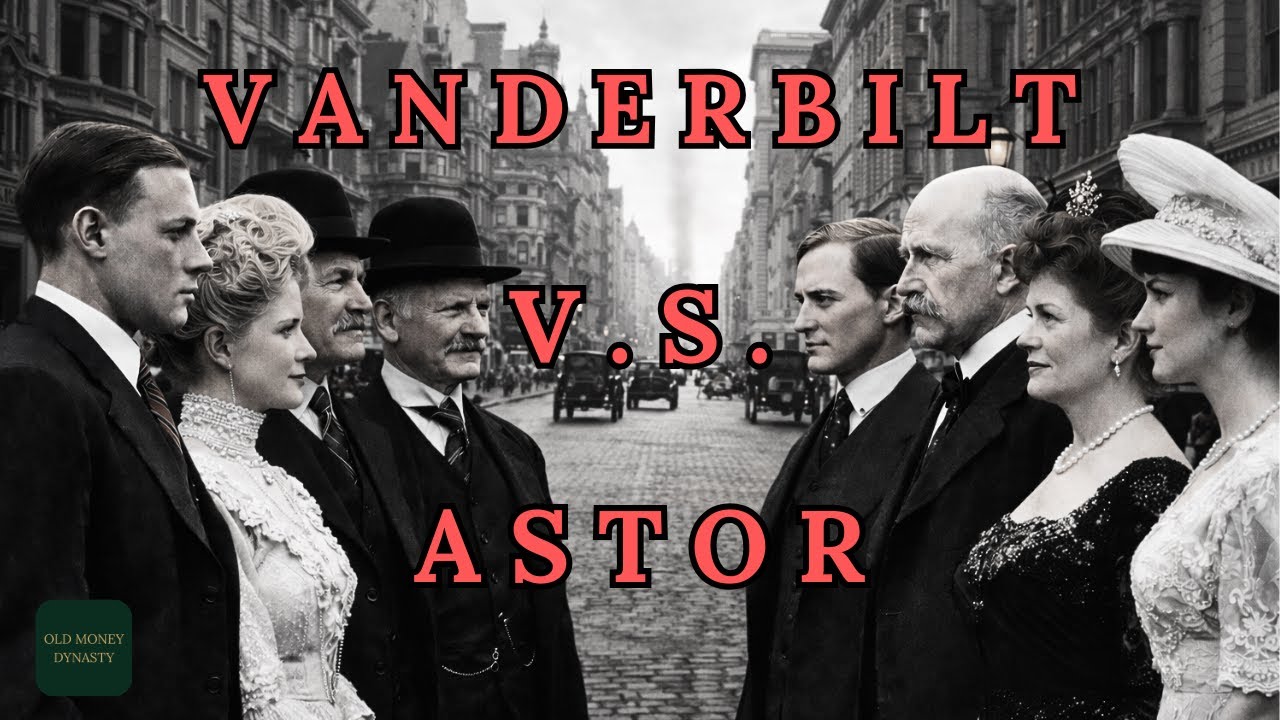
They decided who received invitations and who was ignored, dismissing the Vanderbilts as vulgar newcomers unworthy of polite company. The Vanderbilts refused to accept that verdict, and for decades, the battle played out on Fifth Avenue, in Newport, and inside the gilded boxes of rival opera houses. The mansions that rose from this conflict became the most spectacular America had ever seen—not because these families needed places to live, but because they needed to prove something. To understand the rivalry, one must start with John Jacob Astor, born in 1763 in the village of Walldorf, Germany.
The son of a butcher, he left home at 17 and worked his way down the Rhine River on a timber barge, eventually reaching London, where his brother had a musical instrument business. After four years learning English and saving money, he set his sights on America, which had just won its independence. In 1783, he boarded a ship bound for the United States, carrying only a few pounds, seven flutes to sell, and a powerful ambition. During the nearly three-month voyage, Astor met a German passenger who explained the fur trade—buying pelts cheaply from trappers and Native Americans, then selling them in London for enormous profit.
By the time the ship reached Baltimore, Astor had abandoned music for furs. He arrived in New York in 1784, anglicized his name from Johann Jacob to John Jacob, and within two years opened a small shop in lower Manhattan. Working brutal hours, he learned to grade furs by touch and built a network stretching from the Atlantic coast to the frontier. The Jay Treaty of 1794 opened new markets in Canada and the Great Lakes region, and Astor moved quickly.
By 1800, he had accumulated $250,000—nearly $500 million in today’s terms. But he understood that fur trading was unpredictable. The real money lay in the ground itself: Manhattan. As the city expanded northward, Astor bought farms, swamps, and empty lots that others considered worthless, waiting for the value to multiply as the city grew.
In 1808, he founded the American Fur Company with the blessing of President Thomas Jefferson, building a monopoly that dominated the trade from the Great Lakes to the Pacific coast. When the fur business declined as he had predicted, Astor sold most of his trading interests and concentrated on real estate. When he died in March 1848, he was the wealthiest person in the United States, with an estate valued between $20 and $30 million—historians estimate it represented nearly 1% of the entire American economy. He left $400,000 for a public library that later became part of the New York Public Library, and the rest went to his son, William Backhouse Astor.
The founder of the family fortune on the other side was Cornelius Vanderbilt, a 16-year-old from Staten Island who had quit school five years earlier and could barely read, but understood water, wind, and profit. In 1810, he reportedly borrowed $100 from his mother to buy a small sailing vessel called a periauger. Within 12 months, he had repaid her and earned $1,000 in profit. Within a decade, he dominated the waters around New York.
Born on May 27, 1794, in Port Richmond, Staten Island, Vanderbilt descended from Dutch settlers, but generations of hard labor had not lifted his family from poverty. The War of 1812 provided his first major opportunity when the federal government needed supplies delivered to forts around New York Harbor. By the time peace returned, he had accumulated $10,000 and a small fleet. Then came steam.
In 1817, he took a job captaining a steamboat for Thomas Gibbons, earning only $1,000 per year but learning everything about the new technology. He also learned how to fight monopolies, running his boat anyway despite New York State’s exclusive rights granted to Robert Fulton and Robert Livingston, until the monopoly collapsed. By 1829, Vanderbilt launched competing steamboat lines, using a ruthless strategy: enter a market, slash prices below what competitors could sustain, drive them into bankruptcy or force them to pay him to leave, then raise prices. By the end of the 1840s, only one man still carried the honorary title of Commodore: Cornelius Vanderbilt.
During the California Gold Rush, he built a transit route across Nicaragua, cutting travel time and earning over a million dollars annually. In 1863, at an age when most men retired, Vanderbilt pivoted to railroads, taking control of the New York and Harlem Railroad, then the Hudson River Railroad, and by 1867 the New York Central. In 1870, he merged these into one of the first giant corporations in American history, connecting New York City to Chicago for the first time. When he died on January 4, 1877, at 82, his fortune exceeded $100 million—a concentration of wealth no individual has matched since, adjusted for the size of the American economy.
But none of it mattered to the people who controlled New York society. To them, Vanderbilt remained what he had always been: a ferryman with too much money. In Gilded Age New York, money alone meant nothing without the right social connections. The gatekeeper was Caroline Schermerhorn Astor, born in 1830 to a family tracing its roots to the Dutch settlers who founded New Amsterdam.
Her marriage to William Backhouse Astor Jr. united fortunes and pedigrees, but the Astor name still carried the odor of commerce—only two generations separated the family from a German immigrant with seven flutes. Caroline intended to change that. Within a decade of her mother-in-law’s death in 1872, she controlled who mattered in New York.
With her partner Ward McAllister, a southern-born arbiter of taste, she built an elegant system of social exclusion based on calling cards and guest lists. In 1872, McAllister founded the Society of Patriarchs, a committee of 25 gentlemen overseeing the great balls of each season. By the 1880s, he had declared that only 400 people counted in fashionable New York—a number matching the capacity of Mrs. Astor’s ballroom.
The Vanderbilts were not among them. Alva Smith Vanderbilt was determined to change that verdict. Born in 1853 in Mobile, Alabama, to a cotton merchant whose fortune the Civil War destroyed, Alva received her education in France, learning European manners and ambition in equal measure. In 1875, at 22, she married William Kissam Vanderbilt, a grandson of the Commodore.
The Vanderbilt fortune gave her resources old New York could not match, but direct assault would fail—Mrs. Astor simply refused to acknowledge the family existed. Alva studied her enemy and concluded she would need to build something so magnificent that even the queen of society could not ignore it. In 1878, construction began on the corner of Fifth Avenue and 52nd Street on a building unlike anything New York had ever seen.
Architect Richard Morris Hunt, the first American admitted to the prestigious École des Beaux-Arts in Paris, designed a French Renaissance palace in gleaming white limestone. The mansion contained 60 rooms, a grand hall 60 feet long faced entirely in stone, furniture that had once belonged to Marie Antoinette, and a total cost of $3 million—nearly $100 million today. But a building alone would not be enough. Alva planned a costume ball on a scale New York had never witnessed, inviting over a thousand guests.
The date was set for March 26, 1883, and New York society began preparing costumes months in advance. One invitation was conspicuously absent: no card went to young Carrie Astor, the popular daughter of Mrs. Astor. The omission was deliberate.
Carrie had been rehearsing a quadrille with friends to perform at the ball, and without an invitation, she could not attend. And Alva knew exactly why: according to society rules, you could not invite someone to your home if they had never formally acknowledged your existence. Mrs. Astor had spent years pretending the Vanderbilts did not exist, and now that silence had consequences.
The morning after Carrie discovered she had not been invited, her mother’s carriage appeared on Fifth Avenue. Mrs. Astor had no choice. She sent her footmen to the door of the Vanderbilt mansion with her calling card—a surrender disguised as a social courtesy.
The invitation arrived the following day. On the evening of Monday, March 26, 1883, police officers assembled at the corner of Fifth Avenue and 52nd Street as crowds gathered on the sidewalks. Nearly 1,200 guests arrived in costumes that had taken months to prepare, decorated with real sapphires, rubies, and emeralds. Host William Kissam Vanderbilt appeared as the Duke de Guise in yellow silk tights and a black velvet cloak embroidered in gold.
Alva wore the costume of a Venetian princess with a jeweled cap featuring a peacock made of colored gems. But the costume everyone remembered belonged to Alice Vanderbilt, wife of Cornelius Vanderbilt II. She came dressed as electric light—her gown of yellow satin decorated with glass beads in a lightning bolt pattern, carrying a torch powered by hidden batteries that glowed like the Statue of Liberty. At the ball, Caroline Schermerhorn Astor, the woman who had refused to acknowledge the Vanderbilts for years, danced in their home.
The champagne alone cost $65,000; contemporary sources put the total expense at $250,000, nearly $6 million today. The dancing continued until sunrise. The newspapers praised Alva’s taste and declared it the social event of the generation. As of March 27, 1883, the Vanderbilts stood at the top of New York society.
Mrs. Astor had come to their house. She could never pretend they did not exist again. The rivalry extended to opera.
The Academy of Music had stood at 14th Street since 1854, and its 18 boxes determined who belonged in society. The Vanderbilts did not own one—William Kissam Vanderbilt reportedly offered $30,000, and the directors refused. The old families cherished the opera house precisely because it was small and inconvenient, keeping out the new people. But the new people had enough money to build their own opera house.
On October 22, 1883, the Metropolitan Opera opened its doors with Gounod’s Faust. In its boxes sat the Vanderbilts, the Morgans, the Drexels, and the Whitneys. The Academy countered by hiring the most famous soprano in the world, Adelina Patti, at $5,000 per performance, and both impressarios lost fortunes. But prestige had shifted.
By 1886, the Academy of Music canceled its opera season and never presented opera again. Caroline Astor understood what had happened and purchased a box at the Metropolitan Opera, joining the new order she could not defeat. The summer wars moved to Newport. Before the Vanderbilts arrived, wealthy families escaped the summer heat in wooden cottages that were deliberately restrained.
Old money whispered; it did not shout. In 1888, the Goelets threw down a challenge by hiring Richard Morris Hunt to design a mansion called Ochre Court that would surpass the Vanderbilts’ Petit Château. Alva responded by hiring Hunt herself and commissioning a summer cottage that would obliterate it. The mansion that emerged in 1892 was called Marble House, and the name was no exaggeration—500,000 cubic feet of marble from three continents covered the exterior and interior.
The total cost reached $11 million, of which $7 million went to marble alone, nearly $400 million today. The design included a grand salon covered in 22-karat gold leaf and a dining room with chairs modeled after those in the court of Louis XIV, weighing 75 to 100 pounds each, requiring footmen to slide them into place. William Kissum Vanderbilt presented the deed to the completed mansion as a birthday gift to his wife on her 39th birthday—a shrewd gesture, because when the marriage ended three years later, Alva already owned Marble House outright. The competition between brothers followed.
On the night of November 25, 1892, fire swept through a wooden mansion called the Breakers on Ochre Point in Newport, owned by Cornelius Vanderbilt II, the senior brother who had inherited the bulk of the family fortune. For most families, such a loss would be devastating. For Cornelius, it was an opportunity. Within six weeks, he hired Richard Morris Hunt—the architect who had just finished Marble House for his younger brother—to design something grander.
Construction began in spring 1893, with 2,000 workers laboring around the clock to complete the structure in just two years. The mansion that rose on Ochre Point dwarfed everything else in Newport: 70 rooms across five floors, a Great Hall that was a perfect cube of limestone and marble, steel trusses throughout, and boilers located in a separate underground facility connected by a tunnel. The cost reached $7 million, and in every respect except marble expenditure, the Breakers exceeded its rival. Richard Morris Hunt died in Newport during the summer of 1895, supervising the finishing touches on what would be his final commission.
Cornelius enjoyed only one summer at the Breakers in good health before suffering a stroke in July 1896; he died on September 12, 1899, at 55. His widow Alice presided over it alone for another 35 years, outliving four of her seven children, and in 1948, her daughter leased it to the Preservation Society of Newport County for $1 per year. Today, it is the largest and most visited of the Newport mansions, with 400,000 people walking through its rooms each year. The Astor family had its own intergenerational war.
In the early 1890s, Caroline Schermerhorn Astor and Mary Dahlgren Paul Astor, wife of William Waldorf Astor, both claimed the title of Mrs. Astor. William Waldorf believed his wife deserved to be known simply as Mrs. Astor, since he headed the senior branch of the family, and Caroline ignored him.
William Waldorf decided to make her pay. The Astor family owned adjacent mansions on Fifth Avenue, and William Waldorf announced he would demolish his father’s house and build a 13-story hotel that would loom over his aunt’s home, block her light, and fill her quiet neighborhood with strangers. The Waldorf Hotel opened on March 13, 1893, rising 225 feet above Fifth Avenue with 450 guest rooms. Caroline reportedly called it a glorified tavern.
For three years she endured it, then capitulated, moving uptown in 1896 to a double mansion on the northeast corner of Fifth Avenue and 65th Street, designed by Richard Morris Hunt, with a ballroom that could accommodate 1,200 guests. Her son, John Jacob Astor IV, saw an opportunity. He built another hotel on the empty site at 34th Street—the Astoria, which opened in 1897, taller and grander than its neighbor. The two hotels stood side by side, built by feuding relatives, competing for the same guests.
Someone proposed a merger; the hotels were connected by a 300-foot marble corridor that the fashionable set called Peacock Alley. The combined establishment became the Waldorf-Astoria, the largest hotel in the world, where the chef invented dishes that would outlast the building itself—Waldorf salad, eggs Benedict, Thousand Island dressing. Caroline Astor never returned to 34th Street. She died in October 1908, and according to those who attended her in her final months, she would dress in her finest gowns, descend her marble staircase, and receive guests who existed only in her memory.
Her son survived her by less than four years: in April 1912, John Jacob Astor IV boarded the Titanic with his young second wife and did not survive the sinking. In 1929, the Waldorf-Astoria buildings were sold and demolished; in their place rose the Empire State Building. The world that made both families possible was ending. In February 1913, the 16th Amendment was ratified, allowing the federal government to tax income.
Within five years, wartime rates would push the top bracket to 77%. The era of limitless accumulation was over. The Great War accelerated everything, claiming members of both families. Alfred Gwynne Vanderbilt, son of Cornelius Vanderbilt II, boarded the Lusitania on May 1, 1915, despite warnings.
On May 7, a German submarine torpedoed the ship, which sank in 18 minutes. Alfred, who could not swim, spent his final moments helping women and children into lifeboats, giving his own life vest to a young mother holding an infant. His body was never recovered. Alva Vanderbilt Belmont found a new cause.
After her divorce from William K. Vanderbilt in 1895 and the death of her second husband in 1908, she joined the suffrage movement. She funded organizations, hosted conferences at Marble House, and helped found the National Woman’s Party alongside Alice Paul in 1916. They organized the first protest ever held in front of the White House.
In August 1920, the 19th Amendment was ratified, and women could vote. Alva died in Paris on January 26, 1933. Her funeral at St. Thomas Episcopal Church in New York featured all-female pallbearers, and her casket was flanked by members of the National Woman’s Party.
She had begun her public life as a society woman determined to storm the gates of old money, and ended it as an activist determined to tear down barriers that excluded half the population from political life. The mansions came down faster than they had gone up. In 1926, wrecking balls arrived on Fifth Avenue. The Petit Château—the house where Alva had hosted the ball that conquered Mrs.
Astor—was demolished in the spring of 1926 and replaced by a 20-story commercial building. The same year, the largest private residence ever built in New York City, the Cornelius Vanderbilt II mansion stretching an entire block from 57th to 58th Street, was sold for $7 million—the price of the land, not the 130 rooms on it. A week before the wreckers arrived, Alice Vanderbilt opened the house to the public for 50 cents a person, and thousands came to see how the highest of high society had lived. Then the walls came down.
Bergdorf Goodman opened on the site in 1928. The wrought-iron gates were donated to Central Park, the carved fireplace went to the Metropolitan Museum of Art, and sculptural reliefs ended up in the Sherry-Netherland Hotel. The Astor double mansion at 65th Street was sold and demolished in 1926, replaced by Temple Emanu-El. The reasons were practical: maintaining a mansion required an army of servants who had become expensive, property taxes climbed every year, and the land beneath these houses had become worth more than the houses themselves.
By the end of the 1920s, Millionaires’ Row had become a memory. Some of the Newport cottages fared better. The Breakers still stands, preserved exactly as Alice Vanderbilt left it. Marble House survives, open to tourists, its dining room chairs still weighing 75 pounds each.
And in the mountains of North Carolina, Biltmore, the largest private home in America, remains in the Vanderbilt family—250 rooms on 8,000 acres, opened to the public in 1930 to help pay the bills. What remains is the story. Caroline Astor died believing she still ruled a society that had already moved on without her. Alva Vanderbilt Belmont died fighting for causes that would have horrified the world she had once conquered.
The fortunes were taxed, divided, and dispersed across generations until the name Vanderbilt no longer automatically meant wealth. The social hierarchy collapsed under the weight of immigration, war, and economic transformation. The Gilded Age was not a golden age—the name itself was coined by Mark Twain as criticism of an era that glittered on the surface but concealed corruption beneath. And yet the houses were beautiful, the craftsmanship extraordinary, the ambition productive of structures that still inspire awe.
The gates are open now. Anyone can walk through them.