On November 22, 1963, Harry Truman was 79 years old and living in retirement in Independence, Missouri. It was the same town where he had been born, and the same house on Delaware Street where he had lived with his wife Bess for most of their marriage.
He had been out of the White House for nearly 11 years, having left office in January 1953 when Dwight Eisenhower succeeded him. He spent his retirement writing and corresponding, taking his famous morning walks around Independence, and overseeing the Harry S. Truman Presidential Library, which had opened in 1957.
At midday on November 22, 1963, word reached him that the President of the United States had been shot in Dallas, Texas. What Truman said and did in the days and weeks that followed is a story drawn from multiple documented sources.
Those sources include contemporary television and newspaper interviews preserved in archives, records at the Harry S. Truman Presidential Library and the John F. Kennedy Presidential Library, published letters and statements, and Truman's own handwritten notes. Together they paint a picture of a former president wrestling with grief and political complications, responding personally and deeply to a tragedy that struck not just a man he knew, but the institution of the American presidency itself.
To fully understand the weight of Truman's reaction, it is first necessary to understand the complicated history between the two men. Their relationship was never simple.
During the 1960 Democratic primary campaign, Truman publicly opposed John F. Kennedy's candidacy. He felt Kennedy was too young to be entrusted with the presidency and too inexperienced. According to records preserved at the Chappell Manuscript Foundation and various biographical sources, Truman's preferred candidates were Stuart Symington of Missouri and Lyndon Johnson of Texas.
Truman also felt deep suspicion toward Kennedy's father, Joseph Kennedy, whose isolationist record and association with Senator Joseph McCarthy troubled him. In private correspondence, Truman described his reservations about the Kennedy family in blunt terms, saying in a note widely quoted by biographers that he was not afraid of the Pope, but of "the Pope" — meaning the father.
At a press conference at the Truman Library on August 20, 1960, when Kennedy visited Independence in person to show that Truman's support had been secured after the convention, a reporter asked Truman directly about his earlier criticisms that Kennedy was too young and inexperienced. Truman's reply, preserved in the transcript of that press conference in the American Presidency Project, was terse as usual. He said the Democratic National Convention had settled the matter, and that was all there was to it.
It was, in its own way, a masterpiece of Truman-style evasion. He did not retract his earlier criticisms, and he did not repeat them publicly. The convention's decision was enough. He moved on.
True to his word, Truman campaigned for Kennedy in nine states during the 1960 general election. He told reporters during that tour that he did not know whether his efforts would succeed, but that he was doing his best. Kennedy won narrowly in November, and Truman sent him a warm congratulatory letter.
In that private correspondence, preserved by the Chappell Manuscript Foundation, Truman wrote of his confidence in Kennedy as a man of integrity and honor — qualities he considered essential for any president. The day after Kennedy's inauguration in January 1961, Truman was received in the Oval Office for the first time in eight years.
According to records at the JFK Library, he was the first guest at the White House under President Kennedy, and he took the new president on an informal tour of the executive mansion. The two men maintained a relationship marked by respect throughout Kennedy's presidency. They were never close. The generational gap was enormous. Truman was born in 1884 and Kennedy in 1917, but they belonged to the same Democratic Party, and Truman respected the office Kennedy now held more than anything else in American public life.
That respect for the presidency, as it turned out after November 22, was central to how Truman dealt with what happened in Dallas. When journalists reached Truman in the immediate aftermath of the assassination, his first public comments were preserved on film and are available through the CBS News archive and YouTube recordings of newsreel footage from that era.
Speaking to reporters, Truman said: "I was shocked and deeply grieved when I heard the news." "He was a fine man, an able president, and he did a good job." "It is truly unfortunate that such things happen, especially at the hands of a worthless person who has nothing better to do than try to take our president from us."
Those words, brief and direct in the style that marked Truman throughout his public life, were his immediate public reaction to the assassination. The phrase "worthless person" reflected classic Truman. Throughout his presidency and retirement, he was known for expressing himself in plain, blunt language.
But beneath those simple words was a real and profound feeling. He was shocked and deeply wounded. It was not the language of a man delivering a diplomatic statement. It was the language of a man genuinely affected by what had happened.

Truman understood what it meant to receive news of a president's death suddenly and shockingly. He had been through that experience himself in April 1945, when he was summoned to the White House and told of Franklin Roosevelt's death. He knew firsthand the confusion of that moment.
On November 23, 1963, one day after the assassination, Truman traveled to Washington to attend the funeral services for President Kennedy. His arrival was captured on video, and the footage has been preserved in various news archives. According to reports from that period, he was interviewed upon arriving in Washington and said he would be meeting with the new president, Lyndon Johnson, that day.
Truman's meeting with Johnson in the days immediately following the assassination fits the broader pattern of what historians have called the "presidents' club" — an informal network of former presidents who maintained relationships with sitting presidents and offered counsel in times of national crisis.
Truman attended Kennedy's funeral on November 25, 1963, joining the procession of world leaders and dignitaries who came to Washington to pay their respects. Photographs and video footage from that day showed Truman among the former presidents and officials present. He was one of the most senior American political figures in attendance, representing a generation of Democratic leadership reaching back to the New Deal era.
The events in the weeks following Kennedy's assassination revealed another, more complex dimension of Truman's response. Nine days after the assassination, according to Truman Library records cited in multiple historical analyses, Truman began writing handwritten notes on a subject that had been on his mind for some time.
He had long harbored concerns about the direction the Central Intelligence Agency had taken since he established it in 1947. These concerns were not born of the assassination. According to his published writings and records documented at the Truman Library, he had come to believe over the preceding years that the agency had exceeded its original purpose as a body to gather and coordinate information for the president, and had instead become an operational arm of government with its own agenda and its own secret activities.
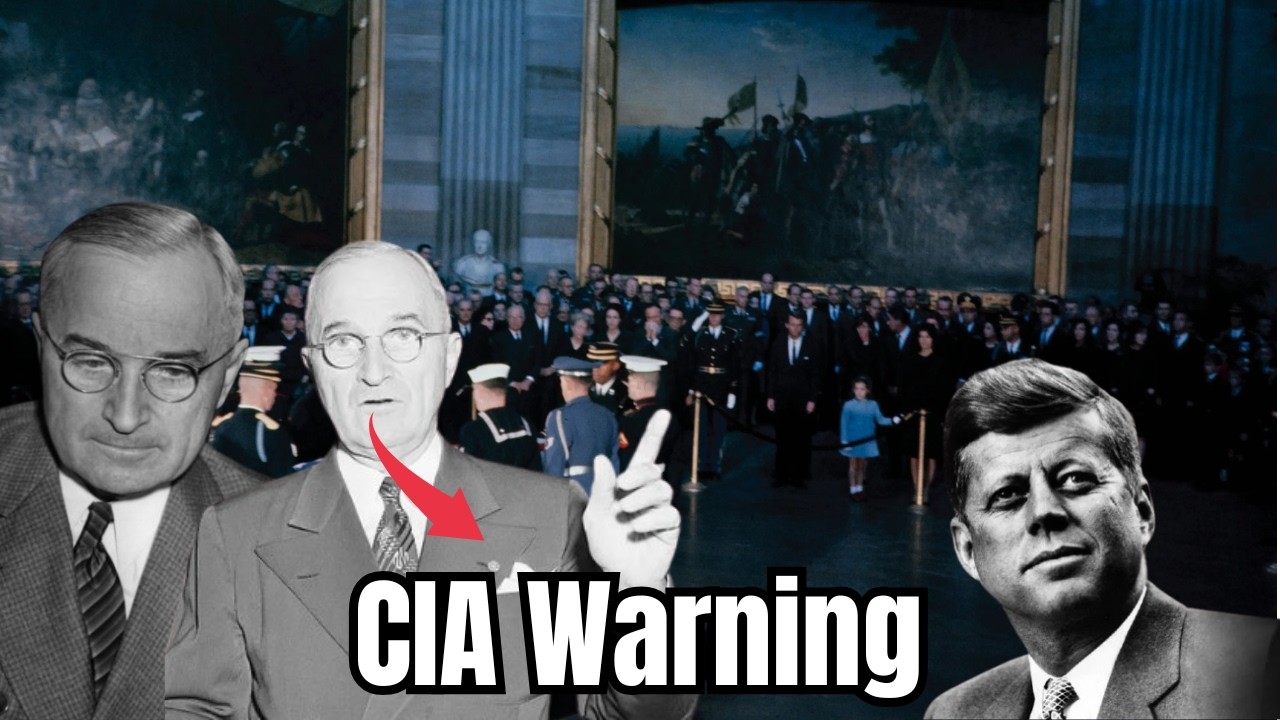
On December 22, 1963, exactly one month after Kennedy's assassination, Truman published an article in the Washington Post. The article was titled "Limit CIA Role to Intelligence." It ran on the front page (A1) of the paper's early edition.
The full text of the article has been preserved in multiple archives, including the CIA's own reading room, where a declassified version is available, as well as through research collections at the Truman Library. Truman wrote in the article: "I think it has become necessary to re-examine the purpose and operations of our Central Intelligence Agency." He continued: "For some time, I have been disturbed by the way the CIA has been diverted from its original mission."

It has become an operational and at times policy-making arm of the government. He called for returning the CIA to its original role as an intelligence arm for the president, and for ending or restructuring its operational missions. He closed with words historians have quoted ever since, writing: "There is something about the way the CIA has been functioning that is casting a shadow over our historic position, and I feel that we need to correct it."
The timing of this article has been the subject of considerable historical debate. It was published exactly one month after Kennedy's assassination. Truman had begun drafting his notes nine days after the assassination. Some historians and researchers have interpreted the timing as suggesting a connection between Kennedy's killing and Truman's concerns about the CIA, although it is essential to note clearly that Truman himself made no explicit connection in the article itself.
He did not mention Kennedy's name in the article. He did not accuse the CIA of involvement in the assassination. What is documented is the timing and content of the article, not any explicit link Truman drew between the two events. A responsible presentation of this historical moment requires keeping that distinction clear.
There is also an additional complication regarding the authorship of the article. According to a CIA internal memo declassified in 2004 and cited by numerous researchers, an agency official noted that the article was written by David Noyes, who had served Truman in various capacities and continued to assist him during his retirement. The same memo raised questions about whether Truman, who was 79 and showing noticeable signs of aging, had actually seen the article before publication. This complication is part of the documented historical record and must be acknowledged.
Even so, it does not change the fact that the article was published under Truman's name and with his publishing rights, and was distributed by the North American Newspaper Alliance through multiple publications in late December 1963. The Washington Post published the article in its early edition but did not include it in later editions that day. Major newspapers and television networks largely did not address or comment on the article at length.
The relative obscurity of the article for years after its publication, despite its coming from a former president who had himself created the CIA, was itself a subject of note among historians who studied the Kennedy assassination era.
What Truman said when he heard of Kennedy's assassination was, on its surface, simple and clear. He was shocked and grieved. He described the shooter as a worthless person. He traveled to Washington for the funeral. He met with the new president. These are the documented facts of his immediate public reaction.
But the weeks that followed revealed a man who was processing the assassination in a deeper and more complicated way, connecting it in his mind to broader concerns about American institutions, about the presidency he had once held, and about the agencies he himself had helped create.
The relationship between Harry Truman and John F. Kennedy had come a long way in the three years since Truman had privately dismissed the younger man as unprepared to lead the country. Kennedy's assassination in November 1963 affected Truman in ways his public statements only partly conveyed.
His private grief, his attendance at the funeral, his meeting with Johnson, and his later Washington Post article together formed a response that was deeper and more revealing than the short audio clip preserved in the CBS News archive might suggest. He was shocked and deeply grieved when he heard the news. For a man as sparing with words as Harry Truman, that was a significant thing to say.
This account draws on historical research from the Harry S. Truman Presidential Library archives, the John F. Kennedy Presidential Library records, Truman's handwritten notes and his published memoirs "Year of Decisions" and "Years of Trial and Hope," the Truman-Kennedy correspondence collection of the Chappell Manuscript Foundation, transcripts from the American Presidency Project, the CIA internal memo declassified in 2004, and Truman's Washington Post article of December 22, 1963. It also draws on contemporary CBS News footage and biographical works including David McCullough's "Truman" and "The Presidents Club" by Nancy Gibbs and Michael Duffy. Historical interpretations may vary among scholars and historians. This content is intended for educational purposes.