In May 1945, Germany was collapsing. Supply lines were broken, and no food was reaching many towns. Two weeks earlier, the fighting had moved through a small German town called Kronberg. Most of its buildings were still standing, but its people were starving. German soldiers had taken what they could before retreating.
The Americans set up a checkpoint on the main road. Controlling who came in and out was standard procedure. Corporal Jimmy Hayes was manning it that morning. He was 23 years old, an Iowa farm boy, eight months in Europe. He had seen combat and lost friends, but he was not hard yet. He was still capable of feeling.
That is when the girl appeared.
She came from the direction of the town, walking alone. She was small and thin. Her dress was too big for her, a hand-me-down, probably from an older sister. She walked right up to Hayes, looked up at him, and held out her hands. She did not speak. She did not need to. Her eyes said everything.
Sergeant Mike Donovan walked over. He was older, 35, a career soldier who had seen two wars. He knew the rules.
"Hayes, step back," he said.
"Sarge, look at her."
"I'm looking. I see a German civilian. We don't feed German civilians. That's not our job."
"She's starving."
"A lot of people are starving. That's what happens when you start a war and lose."
Hayes reached into his pocket and felt the candy bar. It was a Hershey's saved from his ration pack. He had been planning to eat it that night. He was not even that hungry. Donovan saw the movement and put his hand on Hayes' wrist.
"Don't do it."
"Why not?"
"Because if you give her that candy bar, you know what happens? Every kid in that town shows up here tomorrow. Then what? You going to feed all of them? You got enough rations for 3,000 people?"
Hayes hesitated. He looked at the girl again. She had not moved. She was just standing there, waiting. Behind her, more children were appearing from the side streets, slowly and cautiously. They saw the girl, saw the American soldiers, and understood. Where there was an army, there was food.
Within five minutes there were about 30 children, ages 5 to maybe 14. All were thin, dirty, and hungry. They formed a loose group behind the first girl. They did not push or demand. They just stood and hoped.
One of the older boys, maybe 12, stepped forward. He spoke a little English.
"Please, sir, we are hungry. You have food?"
Donovan answered before Hayes could.
"No food for you. Go back to town."
"Please, the children very hungry."
"Not our problem. Go home."
The boy did not move. The younger kids behind him started to shuffle nervously. One of the little girls, maybe 6 years old, started crying. The tears were quiet. She was too weak to cry loudly.
Hayes felt something break inside him. He could not stand there with a pocket full of food and watch children cry from hunger. He pulled out the candy bar and held it up. The children's eyes locked onto it immediately. Donovan grabbed his arm.
"Hayes, I'm ordering you. Do not give them that chocolate."
"Sarge, it's just one candy bar."
"It's not about one candy bar. It's about the principle. We feed our men, not the enemy."
"They're not the enemy. They're kids."
"They're German kids. Their fathers killed our boys. Their mothers supported Hitler. Don't forget that."
Hayes looked at the first girl again, the one with the pigtails. She was still holding out her hands.
"Did she support Hitler, Sarge? Did she vote for him? Did she start this war?"
Donovan's face hardened.
"No, but her country did, and that's the reality. War doesn't care about fair."
Hayes stood there, torn. He wanted to do the right thing, but he did not know what the right thing was anymore. Other soldiers were watching. Some were sympathetic. Others agreed with Donovan. Donovan called for the lieutenant. This was above his pay grade.
Lieutenant Parker arrived. He was a young officer facing his first real command situation involving civilians. He looked at the children, at his men, at Donovan.
"Sergeant?"
"Germans begging for food, sir. I told them no. Need a clear order."
Parker knew the rules. Soldiers eat first. Troops are fed, and civilians wait for relief organizations. Hayes felt sick. He looked at the little girl. She was still there, still hoping.
He made a choice.
He unwrapped the candy bar, broke it into pieces, and walked over to the children. Donovan did not stop him this time. He just watched. Hayes handed a piece of chocolate to the first girl. Her face lit up. She took it carefully, like it was made of gold, put it in her mouth, and closed her eyes.
The other children surged forward, hands out, pleading. Hayes distributed the pieces. It was not nearly enough. Thirty kids, one candy bar. Most of them got nothing. The ones who got chocolate shared it. The older kids broke their pieces in half and gave some to the younger ones. They understood scarcity. They understood sacrifice.
Within seconds, the chocolate was gone. The children stood there, looking at Hayes, hoping for more. He had nothing else to give. He turned his pockets inside out and showed them they were empty. The children understood. They did not complain. They just turned and walked back toward town, slowly, disappointed, but not angry.
The little girl with pigtails was the last to leave. She looked back at Hayes one more time, then followed the others. Hayes felt hollow. He had done something, but it felt like nothing.
Lieutenant Parker walked over.
"Corporal, you just disobeyed a direct order."
"Yes, sir."
"You know that's a court-martial offense?"
"Yes, sir."
Parker looked at him for a long moment, then sighed.
"I'm going to write this up, send it up the chain, let the brass decide. Until then, you're confined to camp. Understood?"
"Yes, sir."
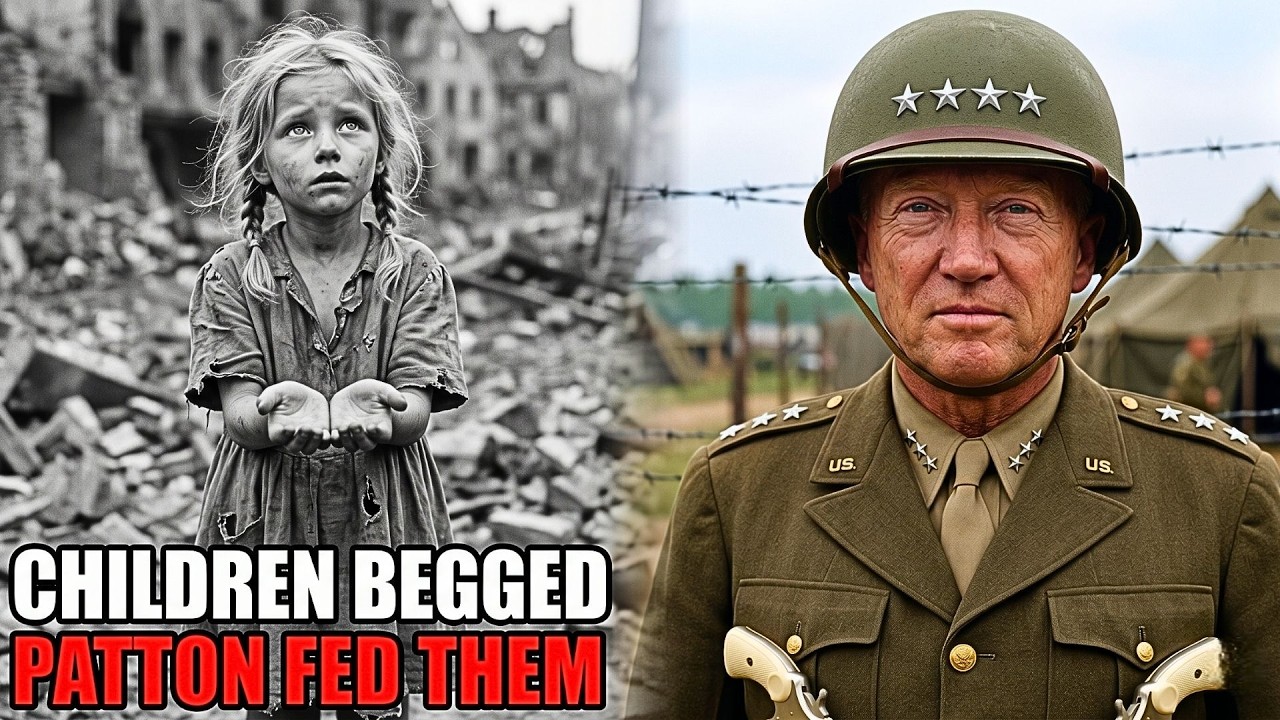
The report went up through division, then to corps. Finally, it landed on General Patton's desk. Patton read it that afternoon, sitting in his command trailer. He read it twice. A corporal had defied orders to feed enemy children. The lieutenant wanted to know how to handle it, whether to proceed with discipline or let it go.
Patton thought about it. This was not a simple question. This was about what kind of army they were, what kind of men they wanted to be. He picked up the phone and called the division commander.
"I'm coming down there. Don't do anything until I arrive."
The next morning, Patton's jeep rolled into Kronberg. He went straight to the checkpoint where Hayes had been stationed. The children were there again, more this time. Maybe 50. Word had spread. The Americans had given out chocolate yesterday. Maybe they would do it again.
Patton got out of his jeep and looked at the children. They stared back. They did not know who he was, just another American officer. He walked over to Lieutenant Parker.
"Show me the corporal."
Hayes was brought forward. He stood at attention, terrified. This was General Patton. Everyone knew his reputation. He did not tolerate insubordination. He did not tolerate weakness. Patton looked at Hayes, up and down, studying him.
"You gave away your ration to enemy civilians."
"Yes, sir."
"Why?"
Hayes thought about his answer, then decided on honesty.
"Because they were hungry, sir, and they were just kids."
"Just kids. You know what just kids grow into?"
"Sir?"
"Adults. German adults, who might fight us in the next war."
Hayes did not know what to say. It was true. History repeated. Wars came back. Patton turned to Parker.
"What's your recommendation, Lieutenant?"
"Sir, I believe discipline is necessary. If we let soldiers make their own decisions about distributing rations, we'll have chaos."
Patton nodded and looked back at the children. They were still watching, hoping. He walked over to them. The children instinctively stepped back. This man felt different, more powerful, dangerous. Patton knelt down, got to their level, and looked at the closest girl, the one with pigtails.
He did not speak German, but he pulled something from his pocket, another candy bar, military issue. He handed it to her. The girl took it, looked at it, then at Patton, then back at the chocolate. Patton stood up and turned to his staff.
"Get me the supply officer."
A major appeared.
"Yes, sir?"
"How much food do we have?"
"Ample supplies, sir. Enough for two months at current strength."
"Good. Set up a distribution point here, twice a day. Feed these civilians. Not a lot, just enough so they don't starve."
The major hesitated.
"Sir, regulations state—"
"I know what regulations state. I'm changing them for this sector. We feed non-combatants, especially children."
"Yes, sir."
Patton turned to Parker and Hayes. Both men were staring.
"Lieutenant, you were right about discipline. Corporal, you were right about humanity. Here's the new order. We don't give out rations randomly. Creates chaos. But we also don't let children starve. Not on my watch. We set up proper distribution, organized, fair. Every child gets something every day until relief organizations take over."
He looked at Hayes specifically.
"Your heart was in the right place, but you can't save the world with one candy bar. You need a system, organization. That's how you actually help people."
Hayes nodded.
"Yes, sir."
Patton turned to walk away, then stopped and looked back.
"Corporal, you're not being court-martialed. You're being reassigned. You're now in charge of civilian relief for this sector. Make sure those kids get fed every day. No excuses."
Hayes stood there, stunned.
"Yes, sir."
Patton got back in his jeep. Before driving off, he said one more thing.
"We didn't fight this war to become them. Remember that."
For the next three weeks, until relief organizations arrived, Hayes ran a feeding station in Kronberg. Every morning and evening, there was soup, bread, and milk for the youngest children. The routine became sacred: 6:00 a.m. and 6:00 p.m., rain or shine. Hayes and a team of volunteers set up tables in the town square. The children would line up, orderly and patient. They learned the system.
The little girl with pigtails came every day. She was always near the front, not pushing, just there early, waiting. Hayes learned her name was Anna. She lived with her grandmother. Her father had died in Russia, her mother in an air raid. She was alone except for the old woman who could barely walk.
After the first week, Anna started to smile. It was a small thing, but Hayes noticed. Her cheeks were filling out slightly. The hollowness in her face was fading. She was coming back to life.
After two weeks, something changed. Anna arrived at the morning feeding carrying something: a piece of paper, folded carefully. She walked up to Hayes, held it out to him, then ran away, shy. Hayes unfolded it.
It was a drawing, done in pencil. A picture of an American soldier giving a child bread. The soldier was wearing a uniform with corporal stripes. The child had pigtails. She could not write his name and did not know English letters, but she had drawn his face carefully, every detail she could remember.
Hayes kept that drawing for the rest of his life. He carried it through the rest of his service, brought it home to Iowa, framed it, and hung it in his house. Years later, his grandson asked him about it.
"Grandpa, why do you have a child's drawing on your wall?"
Hayes looked at it for a long moment, then said, "Because that's the day I learned what we were really fighting for."
Patton never mentioned the incident again. For him, it was just another problem solved, another decision made. But for the soldiers who had been at that checkpoint, it was something more. It was the moment they learned that winning a war meant more than defeating an enemy. It meant deciding what kind of men they would be when the fighting stopped.