In August 1967, a heatwave pressed down on Harlem like a wet wool blanket. The asphalt softened underfoot, and the air carried exhaust fumes, frying grease, and short tempers. On 125th Street, fire hydrants stood open while children danced in the spray, but for adults there was no relief. The city felt like a pressure cooker waiting for a reason to explode.
Ellsworth "Bumpy" Johnson stepped out of his air-conditioned Cadillac and adjusted the cuffs of his Italian silk suit. He did not sweat, or at least he never let anyone see him sweat. While other men wilted in the humidity, Bumpy looked as though he existed in his own personal climate, cool and untouchable.
"I'll be five minutes, June Bug," Bumpy told his driver, leaning into the open window. "Keep the engine running. If the AC dies, I might have to fire you."
June Bug chuckled and wiped his neck with a rag. He reminded Bumpy that Maim wanted the Blue Mountain coffee blend the grocery store had received. If Bumpy came home without it, June Bug joked, he might as well sleep in the car.
Bumpy turned and walked toward the grocery store. It was a mundane errand for the godfather of Harlem, a man who moved mountains of heroin and controlled the numbers racket with an iron fist. But Bumpy liked the mundane. It kept him grounded and reminded him that he was not just a king. He was a resident. This was his neighborhood, and these were his people.
The grocery store was a sanctuary of cool air. When the automatic doors slid open, a blast of refrigeration hit him, smelling of floor wax, ripe produce, and butcher paper. The store was crowded with mothers wrestling shopping carts, old men arguing over the price of peaches, and teenagers loitering by the soda fountain.
When Bumpy walked in, the atmosphere shifted. It was not silence exactly, but a lowering of volume. Heads turned and eyes widened. A cashier straightened her smock, and a stock boy quickly began stacking cans that were already stacked. It was the ripple effect of power.
Bumpy nodded politely to Mrs. Higgins, the deacon's wife, who was inspecting a cantaloupe. She nodded back with a mixture of respect and fear in her eyes. Bumpy grabbed a metal basket and moved toward the coffee aisle, walking with a slow, deliberate rhythm, his cane tapping lightly against the linoleum tiles.
He found the coffee Maim wanted, a gold tin on the top shelf. As he reached for it, his mind drifted to a meeting he had later that evening with the Italians. Gambino was pushing for a larger cut of the uptown distribution, and Bumpy would have to remind him that Harlem was not a pie to be sliced. It was a fortress to be respected.
That was when he heard it. It was not a scream or a shout, but the sound of friction, of rubber soles squeaking violently against the floor and dragging. Bumpy paused with the coffee tin in his hand and listened.
"Come on, sweetie. Stop dragging your feet," a man's voice said. It was tight and strained, the voice of a man trying very hard to sound normal and failing.
"I don't want to," a small, high voice whimpered.
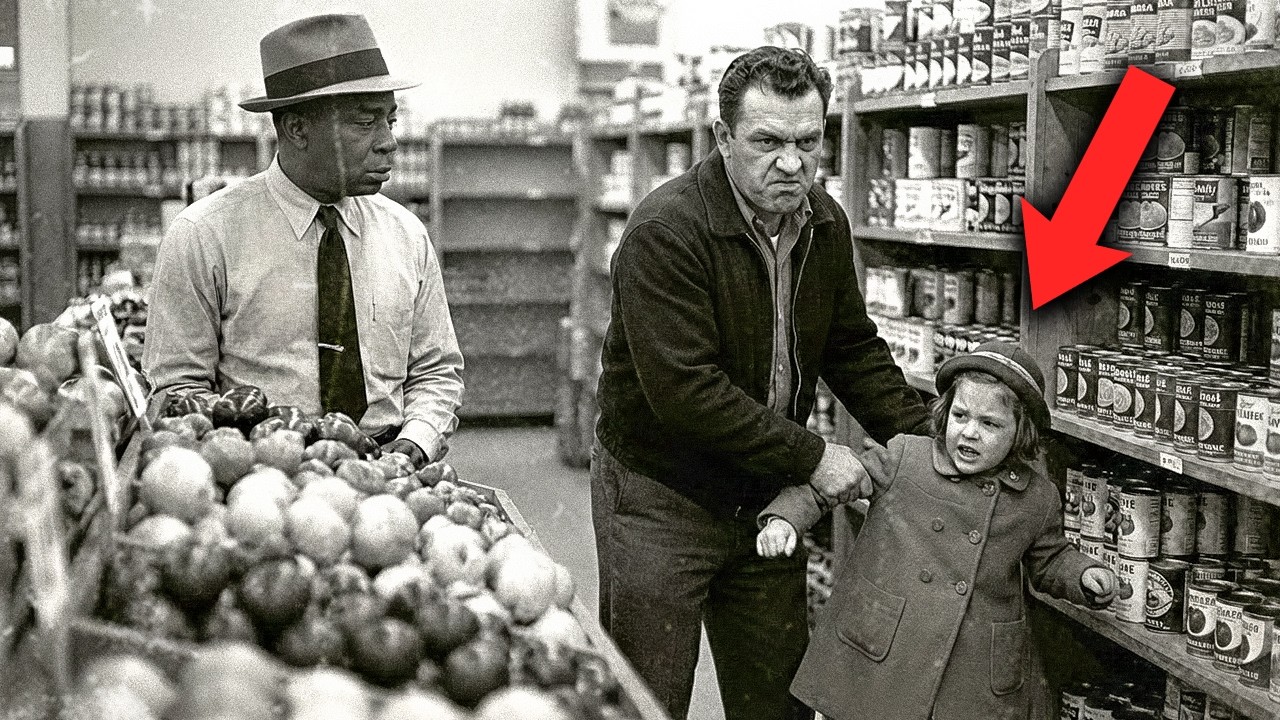
Bumpy turned his head slowly. At the end of the aisle near the cereal display, a man was gripping the wrist of a little girl. The man looked nondescript, white, perhaps in his mid-40s, wearing a tan windbreaker zipped too high for the August heat. His hat was pulled low, and his face was slick with sweat. It was not the heat sweat of the street, but the cold, clammy sweat of panic.
The girl was black and could not have been more than seven years old. She wore a yellow Sunday dress with white daisies and patent leather shoes. Her hair was done up in neat plaits with yellow ribbons. She looked dressed for church, but her eyes were wide, frantic pools of terror.
"We're going to the car, Penny," the man hissed, yanking her arm. He was not holding her hand. He was gripping her wrist, his knuckles white. "Daddy has a surprise for you."
Bumpy stood still. Every instinct he had honed over 40 years of surviving gang wars and prison riots flared to life. The man was white and the girl was black. In Harlem in 1967, mixed families existed, and adoption existed, but Bumpy knew the texture of the neighborhood. He knew how fathers held their daughters, with protection and pride. This man was holding her like a stolen wallet he was trying to hide in his pocket.
Bumpy took a step forward, moving from the coffee aisle to the main thoroughfare of the store. He needed a better look. The man saw him, and for a split second their eyes locked. In the man's eyes, Bumpy saw a flash of recognition. Everyone knew Bumpy Johnson.
The man's grip on the girl tightened. He pulled her closer to his leg, trying to shield her body with his own and make himself small. "Just keep walking," he muttered to the girl, moving faster now toward the exit.
Bumpy did not move to block them yet. He just watched. He needed to be sure. In his world, you did not act on a hunch unless you were ready to bury the mistake. If this was a misunderstanding, stepping in would cause a scene the police would love to use against him.
Then the girl looked at Bumpy. She did not cry out or scream for help. Instead, she did something that froze the blood in his veins. As the man dragged her past the end of the aisle, she looked directly at him. Her face was a mask of paralyzed fear, but her eyes were pleading.
She raised her free hand, the one the man was not crushing, and held her palm out facing Bumpy. She tucked her thumb into her palm, then folded her four fingers down over her thumb, trapping it. She opened her hand and did it again. Thumb in, fingers down.
To anyone else, it might have looked like a child flexing her hand. But Bumpy knew signals. He knew sign language, prison code, and the silent language of the desperate. More importantly, he saw her lips move. She made no sound, but the shape of the words was unmistakable: "That's not my daddy."
The coffee tin in Bumpy's hand dented as his grip tightened, the metal buckling with a sharp clink. The man was moving fast now, almost running, dragging the girl toward the automatic doors. The cashier looked up, confused, and called out that he had to pay.
"Forgot my wallet!" the man shouted over his shoulder, his voice cracking. He shoved past an elderly woman, nearly knocking her into the cigarette stand.
Bumpy dropped the coffee tin. It hit the floor with a loud clang that silenced the front of the store. He did not run. Bumpy Johnson did not run. He moved with the terrifying inevitability of a landslide, walking toward the door, his cane hitting the floor harder now. Click, click, click.
"Lock the back," Bumpy said as he passed the stock boy. He did not shout it. He said it with a command that bypassed the boy's brain and went straight to his motor functions. The boy dropped his box and ran to the loading dock door.
Bumpy pushed through the automatic doors and stepped into the blast of furnace heat. The man was already halfway down the block, moving toward a beat-up blue Chevrolet sedan parked illegally by a hydrant. He was practically carrying the girl now, her feet dragging on the concrete. She was crying openly, silent tears streaming down her face, her ribbons bouncing as she struggled weakly.
"June Bug," Bumpy said. He did not need to shout. June Bug was leaning against the Cadillac 20 feet away. He saw Bumpy come out without the coffee, and he saw the look on Bumpy's face, a look he had not seen since the war with Dutch Schultz. It was the face of the Grim Reaper.
June Bug followed Bumpy's gaze and saw the man and the girl. "Block him," Bumpy said. June Bug did not ask questions. He vaulted over the door of the Cadillac and slammed the car into gear. The engine roared.
The man in the tan windbreaker reached his car and fumbled with his keys, his hands shaking so badly he dropped them in the gutter. "Damn it!" he screamed, yanking the girl violently. "Pick them up! Pick them up now!" The girl sobbed and dropped to her knees on the hot asphalt to grab the keys.
Bumpy was closing the distance. He was 50 feet away, then 40. The man snatched the keys from the girl's hand, unlocked the door, and threw her into the back seat. He slammed the door and scrambled into the driver's seat. The engine of the blue Chevy sputtered, coughed, and then roared to life.
He peeled away from the curb, tires screeching, but he did not get far. June Bug swung the massive black Cadillac across the road, blocking the entire eastbound lane. The Chevy slammed on its brakes, skidding, smoke rising from the tires. The man tried to reverse and spin around, but Bumpy was already standing behind the car.
Bumpy stood in the middle of the street, his legs shoulder-width apart, both hands resting on the head of his cane. He stared through the rear window of the Chevy, straight into the rearview mirror, straight into the man's eyes. The man panicked and revved the engine. For a second, it looked like he was going to reverse right over Bumpy Johnson.
"Do it," Bumpy whispered. "Give me a reason to peel you out of the grill."
The man did not have the nerve. He slammed the car into park and looked around wildly. He was trapped. The Cadillac was in front, the King of Harlem was behind, and now the people of 125th Street were noticing. A crowd was forming. They saw Bumpy, they saw the trapped car, and they sensed blood in the water.
The man reached under his seat. Bumpy saw the movement and walked to the driver's side window. He did not approach cautiously. He walked right up to the glass. The man rolled the window down two inches. He was holding a snub-nosed .38 revolver, his hand shaking so hard the gun rattled against the glass.
"Get back!" the man screamed, spit flying onto the window. "I'm a federal agent. Get away from this car or I will shoot you."
It was a lie. Bumpy knew a federal agent. He knew how they smelled. This man smelled like cheap bourbon and fear. He was a predator, a bottom feeder.
"You're not an agent," Bumpy said, his voice calm, carrying over the noise of traffic. "And that's not your daughter."
"She is. She's my niece. She's sick. I'm taking her to the hospital." The man looked back at the girl. "Tell him, Penny. Tell him I'm your uncle."
The girl was huddled in the corner of the back seat, her knees pulled up to her chest. She looked at Bumpy. She did not speak. She just raised her hand again. Thumb in, fingers down.
Bumpy looked back at the man. "Unlock the door."
"I'll shoot you," the man shrieked, pointing the gun at Bumpy's chest. "I swear to God, I'll put a hole in you."
The crowd on the sidewalk went silent. June Bug, sitting in the Cadillac, clicked the safety off his own weapon. Bumpy did not blink. He did not look at the gun. He looked at the man's soul and found it wanting.
"You have three seconds," Bumpy said. "One. Back off. Two. I'm warning you. Three."
Bumpy moved. He did not lunge for the gun. He swung his cane. The heavy silver-tipped hickory stick crashed through the driver's side window, shattering the safety glass into a million diamonds. The man screamed and covered his face.
Bumpy reached through the broken window, ignoring the shards of glass cutting his suit sleeve. He grabbed the man by the throat. His grip was legendary, the grip of a man who had strangled enemies in the solitary confinement of Alcatraz. He squeezed. The man dropped the gun, and it clattered onto the floorboard. The man clawed at Bumpy's hand, gasping, his eyes bulging.
Bumpy unlocked the door from the inside and ripped it open. He dragged the man out of the car like a sack of garbage and threw him onto the asphalt. The man scrambled backward, crab-walking, coughing, bleeding from cuts on his face.
"You're crazy. You can't do this. I'll call the cops."
Bumpy ignored him and leaned into the back seat. The girl flinched, terrified. "It's okay," Bumpy said, his voice instantly changing. The gravel and the death were gone. He sounded soft, like a grandfather. "You gave the signal. I saw it. You did good." He held out his hand. "Come on, let's get you out of this hot car."
The girl hesitated. She looked at the man on the ground, then at Bumpy. She reached out and took his hand. It engulfed hers. He helped her out of the car.
"June Bug," Bumpy called out without looking back. "Put the girl in the Cadillac. Give her a soda. Turn the radio on." June Bug was there in a second, gently guiding the girl away from the scene.
Now it was just Bumpy and the man. The crowd had formed a circle. They were not intervening. They knew better. This was Harlem court, and the judge was in session.
The man tried to stand up. "Listen, buddy. You're making a big mistake. I got friends, powerful friends. You touch me and they'll burn this whole street down."
Bumpy adjusted his cuffs and kicked the broken glass aside. "You came into my neighborhood," he said, stepping closer. "You snatched a child off my street."
"She's nobody," the man spat, trying to find some bravado. "She's just some project kid. Nobody cares about her. Her mother is a junkie. I was doing her a favor."
Bumpy stopped. The air around him seemed to drop ten degrees. "A favor?" he asked softly.
"Yeah, a favor. I got a buyer. I mean, a family upstate. Nice farm. They pay good money for domestic help. She'd have a roof over her head, better than the rat hole she lives in."
The man realized too late what he had said. He had admitted it. He was not just a kidnapper. He was a trafficker. He was selling children. A low murmur of rage went through the crowd.
"You're selling our children into slavery in 1967," Bumpy said, looking down at the man with absolute disgust.
"It's business," the man yelled, desperate now. "It's just business."
Bumpy sighed. He looked tired. "June Bug, get the trunk open."
The man's eyes widened. "What? No. No. Police! Help! Somebody help me!" He tried to run, scrambling to his feet and lunging toward the sidewalk.
Bumpy did not run. He just extended his cane, hooked the crook around the man's ankle, and yanked. The man faceplanted onto the concrete with a sickening crunch. Bumpy walked over and placed his expensive Italian loafer on the back of the man's neck, pinning him to the scorching pavement.
"You like business?" Bumpy asked. "I'm a businessman, too, and I have a strict policy against defective merchandise."
Bumpy looked at the crowd and saw a young man near the front, a kid named Tyrell who ran numbers for him. "Tyrell," Bumpy said, "go into the store, get the butcher twine, and get some duct tape." Tyrell ran.
"What are you gonna do?" the man sobbed into the asphalt. "Please, I got money. I can pay you. I got $5,000 in the glove box."
"I don't want your money," Bumpy said. "I want to know where you were taking her. You said upstate. You said buyer. You're going to tell me every name, every address, and every stop on your little route."
"I can't. They'll kill me."
Bumpy leaned down, bringing his face close to the man's ear. "Son, look at me. You're worried about them killing you? You should be praying that I let you live long enough to meet them."
Tyrell came back with the tape and twine. Bumpy hog-tied the man right there in the middle of 125th Street. He taped his mouth shut to stop the screaming. Then, effortlessly, he and Tyrell lifted the man and tossed him into the trunk of the Cadillac. Bumpy slammed the trunk shut. The sound was final.
He walked to the passenger window of the Cadillac. The little girl was sipping a grape soda, listening to Motown. She looked at Bumpy. She was not crying anymore. She looked at him with awe.
"What's your name, sweetheart?" Bumpy asked.
"Penny," she whispered.
"Well, Penny, my name is Mr. Johnson. Do you know where your mama lives?"
She nodded. "116, apartment 4B."
"Okay," Bumpy said. "We're going to take you home, but first we have to make a stop. I have to drop off some trash."
Bumpy got into the passenger seat. June Bug looked at him. "Where to, boss? The river?"
"No," Bumpy said, lighting a cigar. The flame illuminated his hard, dark eyes. "Take us to the warehouse on the west side, the soundproof one." He exhaled a cloud of blue smoke. "And then we're going to find out who thinks they can come into Harlem and steal our future. And when we find them, God help them."
As the Cadillac pulled away, the crowd on 125th Street parted. They watched the black car disappear into the heat haze. They knew what was in the trunk. They knew what was going to happen. And for the first time in a long time, the heat did not feel so oppressive, because the king was on the throne, and the streets were watching.
The warehouse was dark, smelling of rust and old oil. It was a place where echoes lived. Bumpy sat on a wooden crate, his jacket folded neatly beside him. He had rolled up his sleeves, revealing the thick forearms of a man who had lifted weights in the yard of Alcatraz for a decade.
The man, whose ID said his name was Miller, was tied to a chair in the center of the room. The tape was off his mouth now. He was weeping, a broken, shivering mess.
"Please," Miller begged. "I told you it's a farm near Peekskill. That's all I know. I just dropped them off."
"How many?" Bumpy asked. His voice was dangerously quiet.
"I don't know."
Bumpy picked up a heavy iron crowbar from the table and dragged it across the concrete floor. Scrape, scrape. "How many?"
"Twelve," Miller screamed. "Twelve girls over the last six months."
Bumpy stopped dragging the bar. He closed his eyes. Twelve children. Twelve daughters of Harlem vanished. The police had not done anything. The papers had not written a word. Because they were black. Because they were poor.
"And what happens at the farm?" Bumpy asked.
Miller hesitated. He looked at the crowbar. He looked at Bumpy's eyes. "I don't ask. I just get paid. But I saw guys there. Foreign guys. They talk about domestic training. But they look—"
"What?"
"They look like animals," Miller whispered. "The way they look at the kids. It ain't right. I knew it wasn't right, but the money."
Bumpy stood up and walked over to Miller. "June Bug," he said.
"Yeah, boss."
"Go to the pay phone. Call the crew. Get Pedigrew. Get Whispers. Get the heavy hitters. Tell them to bring the war bags."
"We going to Peekskill?" June Bug asked, a savage grin spreading across his face.
"We are," Bumpy said. "But not just to get the girls." He leaned in close to Miller's face. "You're going to guide us, Mr. Miller. You're going to drive your blue Chevy right up to the front gate just like you always do. And we'll be right behind you."
"They'll see you. They have guards. Dogs."
"Let them have dogs," Bumpy said. "I'm bringing wolves." He turned away. "Lock him in the closet until nightfall. I have to take Penny home."
The drive to 116th Street was quiet. When they pulled up to the tenement, Penny's mother was sitting on the stoop, sobbing, holding a frantic conversation with a police officer who looked bored. When Penny climbed out of the Cadillac, the scream her mother let out tore the air. She ran to her daughter, falling to her knees, burying her face in the girl's neck.
Bumpy stepped out of the car. The police officer straightened up. He recognized Bumpy. Every cop in New York recognized Bumpy.
"Mr. Johnson," the cop said, his hand resting near his holster. "What's going on here?"
"Found a lost child," Bumpy said simply. "Returned her to her mother. That a crime now, officer?"
The cop looked at the girl, then at Bumpy. He knew better than to ask questions he did not want the answers to. "No, no crime. Just good citizenship."
"Good," Bumpy said. He walked over to Penny and her mother. The mother looked up at him, tears streaming down her face. She knew who he was. She knew what he did. But in that moment, she did not see a gangster. She saw a savior.
"Thank you," she choked out. "Oh, God, thank you."

Bumpy tipped his hat. "Keep a close eye, ma'am. The wolves are out."
He looked at Penny. She was holding her mother's hand tight. She looked at Bumpy and gave him a small, shy wave. She held her hand up, thumb in, fingers down. Then she opened it and smiled. Bumpy did not smile back, but his eyes softened. He turned and got back into the Cadillac.
"We ready, boss?" June Bug asked.
Bumpy looked at the dashboard clock. It was 6:00 p.m. The sun was starting to set, turning the sky the color of a bruise. "Yeah," Bumpy said. "Let's go to Peekskill. I want to see this farm."
As they drove north, leaving the city behind, the landscape changed from concrete to trees. But the darkness inside the car did not lift. Bumpy checked the clip of his Colt .45. He checked the blade in his boot. He thought about the twelve girls. He thought about the man named Miller in the trunk. He thought about the signal Penny had given him.
Bumpy Johnson was not going to be a businessman tonight. He was not going to be a diplomat tonight. He was going to be the monster that the monsters were afraid of.
The convoy of three black Cadillacs moved north along the Taconic State Parkway, cutting through the night like jagged shadows. The city lights had faded miles ago, replaced by the crushing darkness of the Hudson Valley woods. In Harlem, the night was never truly black. It was a bruised purple lit by neon signs, street lamps, and the glow of apartment windows. Here, the darkness was absolute, ancient, and indifferent.
Bumpy Johnson sat in the back of the lead car, staring out at the wall of trees rushing past. He had not spoken since they crossed the George Washington Bridge. His silence was heavy, a physical weight that pressed against the leather seats and filled the lungs of the men riding with him.
Next to him, a Thompson submachine gun rested on the seat, wrapped in oilcloth. June Bug was driving, his knuckles white on the steering wheel. He kept checking the rearview mirror, watching the headlights of the other two cars. They carried the Wolves: Pedigrew, Whispers, and four other hard-eyed men who had served in the Pacific Theater or grown up fighting in the alleyways of 118th Street. They were not coming for money. They were not coming for territory. They were coming for blood.
"How much further?" Bumpy asked, his voice low, barely rising above the hum of the engine.
"Miller says five miles," June Bug replied. "Exit coming up. Route 44."
Bumpy nodded and looked at the dashboard clock. 10:45 p.m. "Pull over," he said. Before the exit, June Bug eased the car onto the shoulder, gravel crunching under the tires. The two cars behind them followed suit, their headlights cutting out as they came to a stop.
Bumpy opened the door and stepped out into the cool country air. It smelled of pine and damp earth. It was a clean smell, innocent, which made the business they were about to do feel even darker. He walked to the trunk of the lead car and tapped it with his cane. June Bug popped the latch.
Miller was curled inside, shivering despite the summer warmth. The duct tape was back over his mouth, and his eyes were wide with terror in the red glow of the taillights. Bumpy reached in and grabbed Miller by the collar, hauling him out. Miller's legs wobbled, and he collapsed onto the grass. Bumpy ripped the tape off his mouth.
"Please," Miller gasped, his voice a dry croak. "I'll do whatever you want. Just don't kill me."
"That depends entirely on your performance," Bumpy said. He pointed to the blue Chevy sedan that one of Bumpy's men, a quiet kid named Stick, had driven up behind the convoy. "You're going to get in your car. June Bug is going to get in the passenger seat. You're going to drive up to the gate just like you always do."
"They'll know," Miller whimpered. "They know I'm late. They'll be suspicious."
"Then you better be a good actor," Bumpy said. He leaned close, his face inches from Miller's. "If you stutter, if you blink wrong, if you try to signal them, June Bug will shoot you in the stomach. You won't die fast. You'll die screaming while we finish the job. Do you understand?"
Miller nodded frantically. "Good."
Bumpy straightened up and addressed his crew. They stood in a semicircle around him, silhouettes against the treeline. "We go in quiet. We don't know where the girls are kept. If we start shooting too early, they might panic and hurt them. We secure the perimeter. We cut the phone lines. And we don't leave anyone standing behind us."
The men nodded. There was no need for a pep talk. They knew the stakes. Twelve girls. Twelve daughters.
Bumpy got back into the Cadillac. The plan was set. The farm was set back two miles from the main road, hidden behind a dense thicket of oak and maple. A dirt road wound its way up a gentle hill, ending at a ten-foot chain-link fence topped with razor wire. There was a guard shack at the gate, lit by a single yellow floodlight.
Miller's blue Chevy rolled up to the gate, gravel popping under the tires. June Bug was slumped low in the passenger seat, his hat pulled down, a .45 pressed into the soft flesh of Miller's side. "Easy," June Bug whispered. "Smile."
Miller rolled down the window. His hands were shaking so badly he had to grip the steering wheel to keep them steady. A guard stepped out of the shack. He was big, wearing a gray uniform with no insignia. He carried a shotgun casually in the crook of his arm. A Doberman strained at a leash held in his other hand, barking viciously at the car.
"You're late, Miller," the guard grunted, shining a flashlight into the driver's face. "The boss is pissed. The guests are waiting."
"Engine trouble," Miller stammered. "Overheated on the parkway."
The guard moved the flashlight beam to the passenger seat. "Who's this?"
Miller froze. He had not prepared an answer. The gun dug harder into his ribs. "New guy," Miller blurted out. "Helper. My back's been acting up. Needed someone to help lift the cargo."
The guard squinted. The dog snarled, snapping its jaws at the door panel. "I didn't hear about no new guy," the guard said suspiciously. "Turn off the engine."
"Look, come on," Miller pleaded, sweat beading on his forehead. "I'm already in deep with Mr. Varcos. Just let me in so I can drop off the package."
The guard hesitated. He stepped closer, the shotgun shifting in his grip. "I said, turn off the engine."
It was going south. Bumpy, watching from the Cadillac parked 50 yards back in the darkness of the treeline, saw the guard's posture tighten. "Now, June Bug," Bumpy whispered to himself.
Inside the Chevy, June Bug moved with the speed of a striking cobra. He did not shoot. The noise would alert the main house. Instead, he shoved the car door open, slamming it into the guard's knees. The guard buckled with a grunt of pain. The shotgun clattered to the ground.
The dog lunged, but June Bug was already out. He kicked the guard in the temple, a brutal, heavy boot that silenced him instantly. The dog turned on June Bug, leaping for his throat. A hiss of air cut through the night. The dog fell mid-leap, an arrow protruding from its chest.
Whispers lowered his compound bow, stepping out from the bushes where he had crept up. He moved silently to the gate, picking the lock in seconds. "Clear," Whispers said into a walkie-talkie.
The blue Chevy drove through. The Cadillacs followed, their headlights off, rolling like sharks through deep water. The compound was larger than Bumpy expected. Beyond the gate, the driveway opened up into a manicured courtyard. In the center stood a sprawling Victorian mansion, its windows glowing with warm, inviting light. To the left, a hundred yards away, was a long, low barn with boarded-up windows. Music drifted from the main house. Classical music. Violins. It was a grotesque contrast to the reality of what was happening.
Bumpy signaled for the cars to stop in the shadows of a carriage house. "Pedigrew, take three men to the barn," Bumpy ordered. "That's where they'll be. Cut the locks. Get them out. Stick, you stay with the cars. Keep the engine running. June Bug, Whispers, you're with me."
"We going to the house?" June Bug asked, checking his ammo.
"We're going to the party," Bumpy said. He adjusted his suit jacket, buttoning it. He picked up his cane. "It would be rude not to introduce ourselves."
Bumpy, June Bug, and Whispers walked across the gravel driveway. They did not sneak. They walked with purpose. The front door of the mansion was heavy oak. Two more guards stood there smoking cigarettes. They saw three men approaching out of the dark, two black men in suits and one holding a bow. They were so confused they did not reach for their weapons until it was too late.
Bumpy did not break stride. He swung his cane, cracking the first guard across the jaw. The man went down like a sack of cement. Whispers put an arrow through the shoulder of the second guard, pinning him to the door frame. The man opened his mouth to scream, but June Bug was there, a hand clamped over his face, a knife flashing once. Silence returned to the porch, save for the muffled sound of Mozart coming from inside.
Bumpy tried the handle. Unlocked. He pushed the door open and stepped into the foyer. It was opulent: crystal chandeliers, Persian rugs, oil paintings of hunting scenes. It looked like the home of a senator or a titan of industry.
Bumpy followed the music. It led to a set of double doors at the end of the hall. He could hear voices now. Laughter, the clinking of glasses. He pushed the doors open.
The room was a library lined with books. In the center, a group of five men sat in leather armchairs drinking brandy. They were older men, white, well-dressed. They looked soft, pampered. In the corner, a man with a thick scar running down his face stood by a fireplace, the muscle of the room. Sitting behind a massive mahogany desk was a man Bumpy assumed was Mr. Varcos. He was thin, elegant, with slicked-back gray hair and a suit that cost more than most people in Harlem made in a year.
The conversation died instantly as Bumpy entered. The men turned, their glasses pausing halfway to their mouths. They stared at the intruder.
"Who the hell are you?" Varcos demanded, standing up. He did not sound scared. He sounded annoyed. "How did you get in here?"
Bumpy walked into the center of the room. June Bug and Whispers flanked him, weapons drawn. The scarred man by the fireplace reached for a holster under his jacket.
"Don't," Bumpy said. He did not raise his voice. He just looked at the man. "You're the only one in here who looks like a soldier. Don't die for these cowards."
The scarred man froze. He looked at the Thompson in June Bug's hands. He slowly raised his hands and stepped away from the fire. "Smart," Bumpy said.
He turned his attention to Varcos. "My name is Ellsworth Johnson," Bumpy said. "But my friends call me Bumpy."
One of the men in the armchairs gasped. Bumpy recognized him from the newspapers. He was a judge. The judge's face went pale.
Varcos sneered. "Johnson, the Harlem thug. You're a long way from 125th Street, boy. Do you have any idea who you're interrupting? Do you know who these men are?"
"I know exactly who they are," Bumpy said, looking around the circle. "A judge, a city councilman, a banker, and you, Varcos, the importer." Bumpy walked to the desk. He saw a ledger open on the blotter and spun it around. It was a list of names, prices, dates.
"You think you can just walk in here?" Varcos laughed, a cold, brittle sound. "I have 20 armed men on this property."
"Had," Bumpy corrected. "You had 20 men. Now you have a very quiet front porch and a barn that is being liberated as we speak."
At that moment, the sound of gunfire erupted from outside. It was distant, coming from the direction of the barn. Short, controlled bursts. Then silence.
Varcos's confidence flickered. "What do you want?" he asked. "Money? We can pay you. Whatever you make running numbers, we can double it, triple it. We're businessmen, Mr. Johnson. Let's make a deal."
Bumpy picked up a crystal decanter of brandy and admired the amber liquid for a moment. "You think this is about money?" he asked. "You think you can buy your way out of selling children?"
"They're nobodies," Varcos shouted, slamming his hand on the desk. "They're street rats. Orphans. We give them a purpose. We supply a demand."
Bumpy smashed the decanter across Varcos's face. The glass shattered. Brandy and blood sprayed across the desk. Varcos screamed, clutching his face, falling back into his chair. The other men in the room jumped up, terrified. The judge tried to run for the door. June Bug racked the slide of his Thompson.
"Sit down!" June Bug barked. "Nobody leaves until the boss says so."
The men collapsed back into their chairs, trembling. Bumpy leaned over the desk, grabbing Varcos by his hair. Varcos was weeping, blood streaming from a gash in his cheek.
"They aren't nobodies," Bumpy whispered. "They are daughters. They are sisters. And they are under my protection."
The front door slammed open. Heavy boots thudded in the hallway. Pedigrew appeared in the doorway. He was breathing hard, his shirt stained with dirt, but he was smiling.
"We got them, boss," Pedigrew said. "All twelve. A few guards at the barn tried to be heroes. They aren't going to be heroes no more."
"The girls?" Bumpy asked.
"Scared, hungry, but alive. We got them in the van."
Bumpy nodded. He released Varcos, wiping his hand on the man's silk suit. "Good work," he said.
He turned to the room of wealthy men. They were cowering, looking at the floor, looking anywhere but at Bumpy. "June Bug," Bumpy said. "Get the camera."
June Bug pulled a small camera from his jacket pocket. "What are you doing?" the banker stammered. "Please, I have a family."
"You should have thought about that before you came here to buy someone else's family," Bumpy said.
June Bug went down the line, snapping photos. Flash, flash, flash. The judge hiding his face. The councilman weeping. The banker begging.
"These pictures go to the press tomorrow," Bumpy said. "They go to your wives. They go to your employers. You won't go to jail, gentlemen. Jail is too safe for you. You're going to lose everything. Your reputations, your money, your lives."
He turned back to Varcos. The man was moaning, holding his face. "And you," Bumpy said. "You don't get off that easy."
Bumpy looked at the fireplace. The fire was roaring, consuming the logs. "Whispers," Bumpy said. "Tie him to the chair."
"No!" Varcos screamed. "No, take the money. Take it all."
Whispers moved efficiently, using a curtain cord to bind Varcos to his high-backed leather chair. Bumpy picked up the ledger from the desk and held it up. "This is your life's work, isn't it, Varcos? The names. The sales."
Bumpy tossed the ledger into the fireplace. The paper curled and blackened, then caught fire. "Burn it down," Bumpy said to his men.
"The room?" June Bug asked.
"The house," Bumpy said. "Burn it all."
Bumpy turned and walked out of the library. Behind him, June Bug and Whispers started knocking over bookshelves, smashing lamps, pouring alcohol onto the rugs. They lit matches. The flames caught instantly, hungry and bright.
Bumpy walked out the front door, down the steps, and onto the gravel driveway. The air was filled with the smell of smoke, now masking the scent of pine. He walked toward the barn where the vans were waiting.
The girls were huddled in the back of a large delivery truck Bumpy's men had commandeered from the farm. They were wrapped in blankets. Some were crying. Some were staring blankly. When Bumpy approached, the group flinched. They expected another monster.
But then Penny pushed her way to the front. She was still wearing her yellow Sunday dress, now dirty and torn. She looked at Bumpy.
"Mr. Johnson," she whispered.
Bumpy stepped into the light of the truck's cargo bay. He took off his hat. "It's me, Penny," he said softly. "I told you I'd come."
Penny ran to him. She wrapped her small arms around his waist and buried her face in his suit. Bumpy hesitated for a second. He was not a hugging man. But then he placed his large hand on her head.
"It's over," he said to the group of girls. "The bad men are gone. We're going home."
Behind him, the mansion roared. The fire had reached the roof. Flames licked into the night sky, painting the clouds orange. The heat was intense, radiating across the courtyard.
Miller, the driver, was standing by the blue Chevy, watched by Stick. Miller was shaking, watching the inferno. "What about him, boss?" Stick asked.
Bumpy looked at Miller, the man who had driven these girls to their nightmares. "Leave him," Bumpy said. "Leave him here for the cops. Let him explain the fire. Let him explain the bodies in the barn."
Bumpy helped Penny into the Cadillac and got in the back seat. "Let's go," he said.
The convoy rolled out of the compound, leaving the burning castle behind them. They drove back down the dirt road, past the broken gate, and back onto the highway.
The drive back to Harlem was different. The silence was not heavy anymore. It was peaceful. The girls in the truck behind them were sleeping, exhausted. Penny had fallen asleep against Bumpy's arm. He did not move. He sat perfectly still, watching the road, feeling the rhythmic breathing of the child he had saved.
They crossed the bridge into Manhattan just as the sun was starting to rise. The sky was turning a soft pink, touching the tops of the skyscrapers. When they reached 116th Street, the neighborhood was waking up. People were coming out of their buildings, heading to work.
When the truck opened and the girls stepped out, a crowd began to gather. Cries of recognition rang out. Mothers ran into the street. Fathers fell to their knees. It was a chaotic, beautiful scene of reunion. Tears, laughter, prayers.
Bumpy stayed by the car. He watched Penny run into her mother's arms again. He saw the way the mother looked at him like he was a saint. He was not a saint. He knew that he was a criminal. He was a killer. He had burned a man's house down tonight and left him in the ashes. But as he watched the families reunited, Bumpy felt something he rarely felt. He felt clean.
Maim was waiting for him when he got back to the apartment. She was standing by the window, wearing her robe, looking worried. When Bumpy walked in, smelling of smoke and the road, she rushed to him.
"I heard," she said. "The radio. They're saying a mansion in Peekskill burned down. They're saying it was a gas leak."
"Gas leak?" Bumpy muttered, taking off his coat. "That's a good story."
"Did you find them?" Maim asked. "The girls?"
"We found them," Bumpy said. "All of them. They're home."
Maim exhaled a long, shuddering breath. She touched Bumpy's face. "You're a good man, Ellsworth."
Bumpy walked to the window and looked down at the street. The sun was fully up now. The heat was returning. The dealers were taking their corners. The numbers runners were starting their rounds. The city was moving again.
"I'm not a good man," Bumpy said quietly. "Good men follow the law. Good men turn the other cheek."
He watched a group of children playing hopscotch on the sidewalk below. "I'm a necessary man," Bumpy said. "And as long as there are wolves at the door, Harlem needs a devil to keep them away."
He closed the curtains.