In the autumn of 1947, a British surveyor named Aldous Pemberton traveled to a monastery east of the Khumbu Glacier in the Himalayas and heard a story that challenged everything his empirical training had taught him. For 11 years, Pemberton had surveyed territory across British India and Nepal, trusting only what he could measure and record. But when his guide, a reliable veteran named Passang, insisted he speak with a 64-year-old monk who had witnessed something important in the high ranges, Pemberton went to listen. The monk, Dorje Wangchuk, had spent over 30 years in those mountains and had known for decades that something inhabited the lower ranges of the massif—areas that were not the dramatic peaks sought by climbing expeditions, but quieter slopes that never drew outside attention.
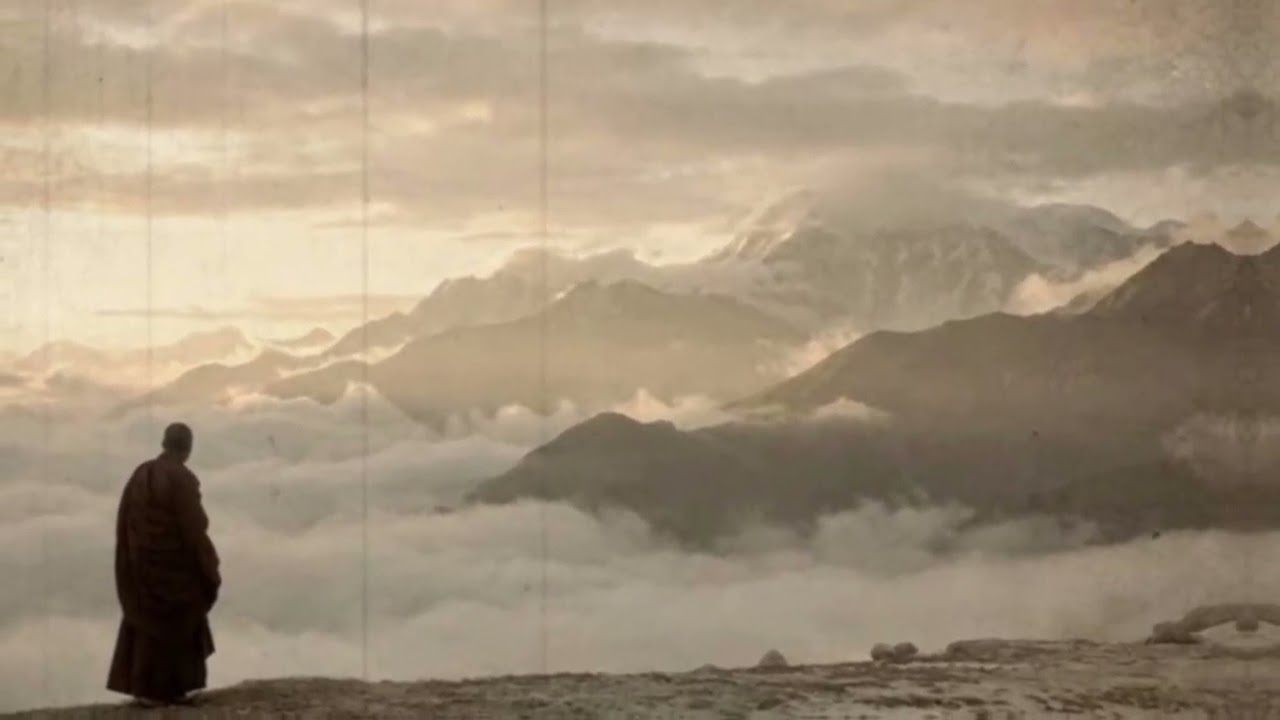
His teacher, an older monk named Gyalwa Rinchen, had been the first to train him in careful observation of those ranges, where herders had long reported strange behavior in their animals and travelers described a peculiar quality of silence that felt intentional rather than empty. Dorje Wangchuk’s first visit to the plateau where the monks watched the upper slopes came when he was 26. He went with Gyalwa Rinchen and two other monks before dawn, arriving at a wind-scoured plateau about two-thirds up the range. In the second hour of watching, something moved along a shelf about 300 meters above them.
It was large, moved laterally at a consistent pace, and its upper portion did not resolve clearly no matter how hard he focused. His teacher instructed the young monks not to immediately decide what they were seeing. “The ones who decide right away are the ones who have trouble afterward,” Gyalwa Rinchen said. The monastery’s records, going back several centuries, agreed on certain points: the things were large, moved strangely, had upper portions that resisted direct observation, and were associated with a sudden drop in wind and a distinctive silence at high altitude.
The accounts did not agree on what they were, and the old monk said that no framework—religious or observational—had ever fit well. What mattered, he stressed, was that the things were not interested in human observers and did not change their behavior based on whether they were being watched. The problem, he said, was never them noticing people; it was people deciding they understood. The account that most affected Dorje Wangchuk came from 1931, when a four-man German team arrived in the region to document the lower ranges.
The monk warned them through their interpreter that the area was unsafe, but gave them the kind of warnings they could accept—unstable terrain and navigation hazards. They went anyway. Three returned on the third day, walking not injured but deliberately, the way people move when they are carefully not thinking about something. The fourth man, Heinrich, had seen something on the slope more directly than the others, and he was walking behind at a slower pace.
The interpreter, a Darjeeling man named Suresh, went back along the trail and found Heinrich walking in a straight line that did not quite follow the actual path. He spoke coherently and answered questions, but he wore the face of someone who had just been reminded that other people exist. In the years that followed, Heinrich returned to Germany, resumed his work, and lived to old age. He was not unhappy or unwell.
But he had stopped being surprised by anything, as if the mechanism for reaction inside him had been quietly removed. Dorje Wangchuk had watched the ranges for 20 years by then, making the trip to the plateau about 30 times with at least one other monk. On roughly a third of those visits, the observers saw movement along a consistent corridor in the upper slopes, east to west and back again. The things never came below a certain line.
The monk shared a thought that Pemberton recorded carefully: perhaps that line was not about where the things could go, but about where humans were allowed to see them clearly. The old records described what happened to those who encountered the things at close range. The accounts differed radically in describing the figures—one with deliberate wrong angles, one with a surface like water under cloud cover, one casting shadow in every direction except the one the light came from. But every close observer shared the same afterward: the quality of receiving information without the mechanism for response.
One traveler from around 1790 lived another 30 years as a perfectly functional man who would only say that he had already seen the largest thing he was ever going to see. Dorje Wangchuk’s most difficult decision came in 1939, when he broke his teacher’s rule and went to the plateau alone. He was 56, carrying a question he had held for two decades: whether the things were aware of being observed. He arrived before dawn and waited four hours.
Nothing moved. As he began to leave, the wind stopped. The silence was the merchant’s silence. He knew he was not alone.
For about three minutes, he stood completely still, facing down slope, with the impulse to turn around arriving three separate times as a pressure from outside rather than his own curiosity. He did not turn around. He began walking down the slope at a deliberate pace, and after about 50 meters, the wind returned. He never determined whether the instruction to turn had come from whatever was behind him or from within himself.
What he did determine, after eight years of reflection, was that the correlation he had found in the records—higher observation frequency correlating with more frequent sightings—was real, but the causation was not what he had suspected. The things were not responding to being watched. Rather, both the observation and the sightings were effects of something else, a third factor neither the monks nor the things controlled. Pemberton wrote that the monk’s teaching was not about understanding the things themselves, but about understanding the position one occupied relative to them.
When Aldous Pemberton left the monastery three days later, Dorje Wangchuk warned him not to look at the upper slopes directly. “Look beside them,” he said, “the way you look beside a fire to see the coals rather than the flame. ” He explained that looking directly and seeing nothing would produce a false assumption of absence, and that assumption was the one that caused the most difficulty. Pemberton’s team moved north four days later.
In his official survey logs from the morning of the third day, he made one annotation: “Anomalous large form, upper slope, east-west traverse, light poor, shape unresolved, not noted in official log. ” In a personal letter to his sister in Bristol two weeks later, he wrote that he followed the monk’s instructions and looked beside the slope rather than at it. He described the form as large in a way that had nothing to do with physical dimension, moving as though the concept of movement itself was a regional convention. He looked away after about 30 seconds, and the looking away, he wrote, came from somewhere older than his reasoning mind.
He was grateful to it. Pemberton returned to England the following year and never went back to the mountains. He never published the account. He died in 1961 at age 76, having continued his career as a careful, thorough surveyor.
His last journal contained a single sentence his sister found while going through his papers: the monk was right about looking beside things, and the method applied to more than mountains. A private archivist cataloged Pemberton’s papers and noted the account of Dorje Wangchuk’s testimony with three phrases: “Veracity unclear, significance unclear, no suitable category. ” No one published the material. The monastery still stands in that valley, and the monks still make the trip to the lower plateau in the early morning.
According to the account, the monks watched the upper slopes for 300 years without ever determining what the things were. The last thing Dorje Wangchuk said to Pemberton, as the surveyor was packing his notes, was that the question was not what the things were—that question had no useful answer. The question that mattered, he said, was this: in all the centuries the monks had been watching them, had the things been watching back, and if they had, what had they been patient enough to wait to see? Aldous Pemberton stood in the courtyard, picked up his notes, and walked out into the mountain morning without looking at the upper slopes.
He looked beside them, and he walked.